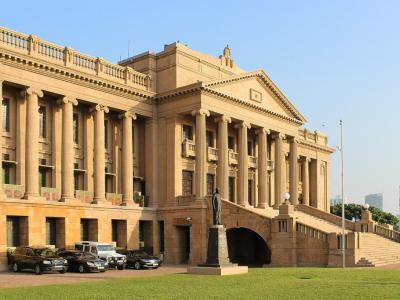


Old Parliament House, Colombo
Old Parliament House is one of Colombo’s key civic landmarks and a clear reminder of Sri Lanka’s colonial and political history. Completed in 1930 under British rule, the building was designed by architect Austin Woodeson to house the State Council of Ceylon, the colonial name for present-day Sri Lanka. Its location near the waterfront emphasized Colombo’s role as the island’s administrative and commercial center, closely linked to the port and colonial government offices.
The building follows a neoclassical design, a style commonly used for government institutions during the British period. Its symmetrical layout, long colonnades, and broad entrance steps give it a formal appearance intended to project stability and authority. The pale stone exterior was chosen to suit the tropical climate, while the interior included large chambers designed for legislative debates and official ceremonies.
The grounds of the Old Parliament House are marked by a small group of statues that reflect Sri Lanka’s layered political and cultural history. These monuments commemorate key figures connected to governance, national identity, and the country’s transition from colonial rule to independence. Set against the neoclassical façade of the building, the statues introduce a quieter, reflective dimension to the site, contrasting with the formality of the architecture.
In the 1980s, Sri Lanka’s Parliament moved to a new complex at Sri Jayawardenepura Kotte, outside Colombo’s historic center. Despite this change, Old Parliament House remains in active use, housing government offices and retaining its official function.
The building follows a neoclassical design, a style commonly used for government institutions during the British period. Its symmetrical layout, long colonnades, and broad entrance steps give it a formal appearance intended to project stability and authority. The pale stone exterior was chosen to suit the tropical climate, while the interior included large chambers designed for legislative debates and official ceremonies.
The grounds of the Old Parliament House are marked by a small group of statues that reflect Sri Lanka’s layered political and cultural history. These monuments commemorate key figures connected to governance, national identity, and the country’s transition from colonial rule to independence. Set against the neoclassical façade of the building, the statues introduce a quieter, reflective dimension to the site, contrasting with the formality of the architecture.
In the 1980s, Sri Lanka’s Parliament moved to a new complex at Sri Jayawardenepura Kotte, outside Colombo’s historic center. Despite this change, Old Parliament House remains in active use, housing government offices and retaining its official function.
Want to visit this sight? Check out these Self-Guided Walking Tours in Colombo. Alternatively, you can download the mobile app "GPSmyCity: Walks in 1K+ Cities" from Apple App Store or Google Play Store. The app turns your mobile device to a personal tour guide and it works offline, so no data plan is needed when traveling abroad.
Download The GPSmyCity App



Old Parliament House on Map
Sight Name: Old Parliament House
Sight Location: Colombo, Sri Lanka (See walking tours in Colombo)
Sight Type: Attraction/Landmark
Guide(s) Containing This Sight:
Sight Location: Colombo, Sri Lanka (See walking tours in Colombo)
Sight Type: Attraction/Landmark
Guide(s) Containing This Sight:
Nearby Sights

Walking Tours in Colombo, Sri Lanka

Create Your Own Walk in Colombo
Creating your own self-guided walk in Colombo is easy and fun. Choose the city attractions that you want to see and a walk route map will be created just for you. You can even set your hotel as the start point of the walk.
Old Colombo Walking Tour
Old Colombo developed as a port settlement long before it became the capital of modern Sri Lanka, shaped by its natural harbor and strategic position along Indian Ocean trade routes. From at least the early centuries BCE, the area attracted merchants trading spices, gemstones, elephants, and textiles. Arab traders were particularly influential, establishing early Muslim communities near the... view more
Tour Duration: 2 Hours
Travel Distance: 2.9 Km or 1.8 Miles
Tour Duration: 2 Hours
Travel Distance: 2.9 Km or 1.8 Miles
Colombo City Center Walking Tour
Colombo, the commercial capital and largest city of Sri Lanka, has a history shaped by centuries of trade, colonization, and cultural exchange. Strategically positioned on the island’s western coast along the Indian Ocean, it has served as an important port city for more than 2,000 years. Early maritime accounts and Sri Lankan chronicles describe Colombo as a hub for spices, gemstones, and other... view more
Tour Duration: 3 Hours
Travel Distance: 5.5 Km or 3.4 Miles
Tour Duration: 3 Hours
Travel Distance: 5.5 Km or 3.4 Miles
City Walks Overview
