

Audio Guide: Old Colombo Walking Tour (Self Guided), Colombo
Old Colombo developed as a port settlement long before it became the capital of modern Sri Lanka, shaped by its natural harbor and strategic position along Indian Ocean trade routes. From at least the early centuries BCE, the area attracted merchants trading spices, gemstones, elephants, and textiles. Arab traders were particularly influential, establishing early Muslim communities near the harbor, followed by contacts with Indian, Chinese, Greek, and Roman merchants. By the medieval period, Colombo was already a recognized maritime hub, connected to both regional and long-distance trade networks.
A decisive shift came in the early 16th century with the arrival of the Portuguese. They fortified the harbor area and established what is now known as the Colombo Fort district, transforming this part of Old Colombo into a colonial stronghold focused on trade control and military defense. Around the fort, local communities and traders settled in adjoining areas, laying the foundations for the broader Old Colombo urban area. When the Dutch took control in 1656, they expanded the fortifications and reorganized the town along more formal lines, introducing canals, warehouses, hospitals, and administrative buildings. The Dutch Hospital and elements of the historic street layout within Old Colombo date from this period.
Under British rule, beginning in 1796, Old Colombo evolved from a fortified town into a colonial administrative city. Much of the defensive wall system was dismantled, and the city expanded outward, yet the historic core retained its commercial importance. Within Old Colombo, Fort became the center of government offices, banks, and trading houses, while Pettah, the neighboring district just inland, developed into a dense mercantile area. Pettah’s grid of streets adopted specialized functions, with individual roads associated with textiles, spices, metals, or household goods, a pattern that remains visible today.
Alongside these commercial districts, religious and ethnic quarters also took shape within Old Colombo. Kochchikade neighborhood, together with parts of Pettah, became known for its churches, mosques, and Hindu temples, reflecting the coexistence of Catholic, Muslim, Hindu, and Buddhist communities. Landmarks such as Saint Anthony’s Shrine, Jami-Ul-Alfar Mosque, and Sri Kailawasanatan Swami Temple illustrate this layered religious landscape within a compact area.
By the late 19th and early 20th centuries, Old Colombo had become the island’s economic heart, linking the port, railways, and markets. Although the city later expanded south and east, Old Colombo—encompassing Fort, Pettah, and Kochchikade—retained its role as a commercial and institutional center. Today, walking through these districts means tracing the same paths once shaped by merchants and empires, a reminder that the city’s story, which began at the water’s edge, still flows through its streets.
A decisive shift came in the early 16th century with the arrival of the Portuguese. They fortified the harbor area and established what is now known as the Colombo Fort district, transforming this part of Old Colombo into a colonial stronghold focused on trade control and military defense. Around the fort, local communities and traders settled in adjoining areas, laying the foundations for the broader Old Colombo urban area. When the Dutch took control in 1656, they expanded the fortifications and reorganized the town along more formal lines, introducing canals, warehouses, hospitals, and administrative buildings. The Dutch Hospital and elements of the historic street layout within Old Colombo date from this period.
Under British rule, beginning in 1796, Old Colombo evolved from a fortified town into a colonial administrative city. Much of the defensive wall system was dismantled, and the city expanded outward, yet the historic core retained its commercial importance. Within Old Colombo, Fort became the center of government offices, banks, and trading houses, while Pettah, the neighboring district just inland, developed into a dense mercantile area. Pettah’s grid of streets adopted specialized functions, with individual roads associated with textiles, spices, metals, or household goods, a pattern that remains visible today.
Alongside these commercial districts, religious and ethnic quarters also took shape within Old Colombo. Kochchikade neighborhood, together with parts of Pettah, became known for its churches, mosques, and Hindu temples, reflecting the coexistence of Catholic, Muslim, Hindu, and Buddhist communities. Landmarks such as Saint Anthony’s Shrine, Jami-Ul-Alfar Mosque, and Sri Kailawasanatan Swami Temple illustrate this layered religious landscape within a compact area.
By the late 19th and early 20th centuries, Old Colombo had become the island’s economic heart, linking the port, railways, and markets. Although the city later expanded south and east, Old Colombo—encompassing Fort, Pettah, and Kochchikade—retained its role as a commercial and institutional center. Today, walking through these districts means tracing the same paths once shaped by merchants and empires, a reminder that the city’s story, which began at the water’s edge, still flows through its streets.
How it works: Download the app "GPSmyCity: Walks in 1K+ Cities" from Apple App Store or Google Play Store to your mobile phone or tablet. The app turns your mobile device into a personal tour guide and its built-in GPS navigation functions guide you from one tour stop to next. The app works offline, so no data plan is needed when traveling abroad.
Old Colombo Walking Tour Map
Guide Name: Old Colombo Walking Tour
Guide Location: Sri Lanka » Colombo (See other walking tours in Colombo)
Guide Type: Self-guided Walking Tour (Sightseeing)
# of Attractions: 8
Tour Duration: 2 Hour(s)
Travel Distance: 2.9 Km or 1.8 Miles
Author: Linda
Sight(s) Featured in This Guide:
Guide Location: Sri Lanka » Colombo (See other walking tours in Colombo)
Guide Type: Self-guided Walking Tour (Sightseeing)
# of Attractions: 8
Tour Duration: 2 Hour(s)
Travel Distance: 2.9 Km or 1.8 Miles
Author: Linda
Sight(s) Featured in This Guide:
- Old Parliament House
- Old Colombo Lighthouse
- Old Colombo Dutch Hospital
- Cargills
- Khan Clock Tower
- Jami-Ul-Alfar Mosque
- Sri Kailawasanatan Swami Temple
- Saint Anthony’s Shrine
1) Old Parliament House
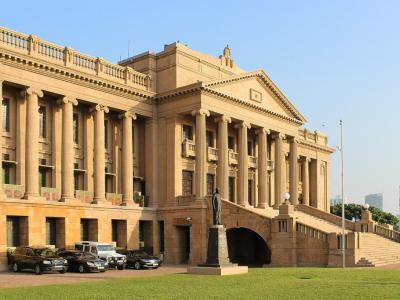
Old Parliament House is one of Colombo’s key civic landmarks and a clear reminder of Sri Lanka’s colonial and political history. Completed in 1930 under British rule, the building was designed by architect Austin Woodeson to house the State Council of Ceylon, the colonial name for present-day Sri Lanka. Its location near the waterfront emphasized Colombo’s role as the island’s administrative and commercial center, closely linked to the port and colonial government offices.
The building follows a neoclassical design, a style commonly used for government institutions during the British period. Its symmetrical layout, long colonnades, and broad entrance steps give it a formal appearance intended to project stability and authority. The pale stone exterior was chosen to suit the tropical climate, while the interior included large chambers designed for legislative debates and official ceremonies.
The grounds of the Old Parliament House are marked by a small group of statues that reflect Sri Lanka’s layered political and cultural history. These monuments commemorate key figures connected to governance, national identity, and the country’s transition from colonial rule to independence. Set against the neoclassical façade of the building, the statues introduce a quieter, reflective dimension to the site, contrasting with the formality of the architecture.
In the 1980s, Sri Lanka’s Parliament moved to a new complex at Sri Jayawardenepura Kotte, outside Colombo’s historic center. Despite this change, Old Parliament House remains in active use, housing government offices and retaining its official function.
The building follows a neoclassical design, a style commonly used for government institutions during the British period. Its symmetrical layout, long colonnades, and broad entrance steps give it a formal appearance intended to project stability and authority. The pale stone exterior was chosen to suit the tropical climate, while the interior included large chambers designed for legislative debates and official ceremonies.
The grounds of the Old Parliament House are marked by a small group of statues that reflect Sri Lanka’s layered political and cultural history. These monuments commemorate key figures connected to governance, national identity, and the country’s transition from colonial rule to independence. Set against the neoclassical façade of the building, the statues introduce a quieter, reflective dimension to the site, contrasting with the formality of the architecture.
In the 1980s, Sri Lanka’s Parliament moved to a new complex at Sri Jayawardenepura Kotte, outside Colombo’s historic center. Despite this change, Old Parliament House remains in active use, housing government offices and retaining its official function.
2) Old Colombo Lighthouse
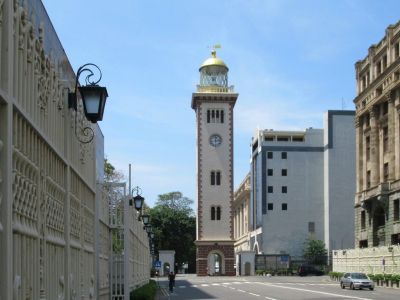
The Old Colombo Lighthouse, also known as the Colombo Fort Clock Tower, is a historic landmark that reflects both the city’s colonial heritage and maritime history. Originally serving as a lighthouse, it is no longer operational and now functions solely as a clock tower.
The clock tower was constructed between 1856 and 1857 and was formally commissioned on 25 March 1857. It was designed by Emily Elizabeth Ward, wife of Governor Sir Henry George Ward, and built under the supervision of Mr. John Flemming Churchill, Director General of Public Works. At 29 metres high, it was the tallest structure in Colombo at the time, symbolizing both the city’s growth and the prominence of colonial architecture. The clock mechanism was crafted by the renowned English clockmakers Dent, who had also produced the famous Big Ben in London, and featured a main bell of approximately 150 kg along with two auxiliary bells.
Before the construction of the clock tower, the original Colombo lighthouse had been erected in 1829 on a bastion at the ocean edge of the fort. This neo-classical structure featured a 23-metre wooden light tower rising from a two-storey circular brick building, surrounded by an elaborate colonnade. However, the lighthouse was eventually decommissioned on 12 July 1952, after its light was obscured by surrounding buildings, and replaced by the modern Galle Buck Lighthouse on Marine Drive. The removal of the fort ramparts between 1869 and 1871 led to the demolition of the original lighthouse structure.
Today, while it no longer serves maritime functions, the clock tower remains a functional timepiece and a reminder of Colombo’s colonial-era urban planning, engineering, and nautical significance.
The clock tower was constructed between 1856 and 1857 and was formally commissioned on 25 March 1857. It was designed by Emily Elizabeth Ward, wife of Governor Sir Henry George Ward, and built under the supervision of Mr. John Flemming Churchill, Director General of Public Works. At 29 metres high, it was the tallest structure in Colombo at the time, symbolizing both the city’s growth and the prominence of colonial architecture. The clock mechanism was crafted by the renowned English clockmakers Dent, who had also produced the famous Big Ben in London, and featured a main bell of approximately 150 kg along with two auxiliary bells.
Before the construction of the clock tower, the original Colombo lighthouse had been erected in 1829 on a bastion at the ocean edge of the fort. This neo-classical structure featured a 23-metre wooden light tower rising from a two-storey circular brick building, surrounded by an elaborate colonnade. However, the lighthouse was eventually decommissioned on 12 July 1952, after its light was obscured by surrounding buildings, and replaced by the modern Galle Buck Lighthouse on Marine Drive. The removal of the fort ramparts between 1869 and 1871 led to the demolition of the original lighthouse structure.
Today, while it no longer serves maritime functions, the clock tower remains a functional timepiece and a reminder of Colombo’s colonial-era urban planning, engineering, and nautical significance.
3) Old Colombo Dutch Hospital (must see)
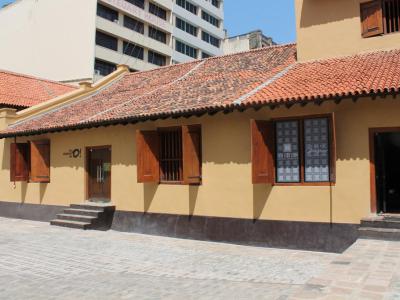
The Old Colombo Dutch Hospital, commonly referred to as The Dutch Hospital, stands as a testament to Sri Lanka's colonial history, dating back to the Dutch era in the late 17th century. Originally established as a hospital to cater to the health needs of Dutch East India Company personnel, its strategic location near the harbor facilitated care for Dutch seafarers. Over the years, the building has undergone several transformations, serving various functions such as a hospital, police station, and apothecary.
Today, the Old Colombo Dutch Hospital has been revitalized into a vibrant shopping and dining precinct while retaining its seventeenth-century Dutch colonial charm. Characterized by thick walls, teak beams, and spacious courtyards designed to mitigate the tropical climate, the building offers visitors a glimpse into the island's colonial past.
One of the most recognized venues within the Dutch Hospital Shopping Precinct is the Ministry of Crab, an internationally known restaurant founded by Sri Lankan cricket legends together with a chef-restaurateur. After entering the precinct through the main access facing the waterfront and Colombo Fort area, walk straight into the central courtyard. From here, follow the main inner corridor running along the courtyard’s edge; the restaurant is located along this primary passageway, set behind a preserved colonial façade with understated signage. Inside, the focus is on local lagoon crab prepared with Sri Lankan spices, and since opening, it has played a major role in establishing the Dutch Hospital as a culinary destination.
Dilmah t-Lounges, dedicated to Sri Lanka’s tea heritage, is found along the shaded arcades that border the same central courtyard. From the courtyard, walk beneath the original verandas rather than through the enclosed corridors, keeping to the perimeter walkway. The tea lounge occupies one of the former hospital rooms opening directly onto the arcade, with clear branding visible from the courtyard side. Its location makes it a convenient stop while circulating around the complex, linking Ceylon tea culture to a building once connected to maritime trade and colonial administration.
Elsewhere in the precinct, long-running cafés, bars, and boutiques are distributed along the outer walkways and smaller side courtyards branching off from the central space. These occupy former hospital wards and offices that now open directly onto pedestrian paths. Many specialize in Sri Lankan crafts, jewelry, spices, and textiles, with displays extending into the arcaded walkways.
Today, the Old Colombo Dutch Hospital has been revitalized into a vibrant shopping and dining precinct while retaining its seventeenth-century Dutch colonial charm. Characterized by thick walls, teak beams, and spacious courtyards designed to mitigate the tropical climate, the building offers visitors a glimpse into the island's colonial past.
One of the most recognized venues within the Dutch Hospital Shopping Precinct is the Ministry of Crab, an internationally known restaurant founded by Sri Lankan cricket legends together with a chef-restaurateur. After entering the precinct through the main access facing the waterfront and Colombo Fort area, walk straight into the central courtyard. From here, follow the main inner corridor running along the courtyard’s edge; the restaurant is located along this primary passageway, set behind a preserved colonial façade with understated signage. Inside, the focus is on local lagoon crab prepared with Sri Lankan spices, and since opening, it has played a major role in establishing the Dutch Hospital as a culinary destination.
Dilmah t-Lounges, dedicated to Sri Lanka’s tea heritage, is found along the shaded arcades that border the same central courtyard. From the courtyard, walk beneath the original verandas rather than through the enclosed corridors, keeping to the perimeter walkway. The tea lounge occupies one of the former hospital rooms opening directly onto the arcade, with clear branding visible from the courtyard side. Its location makes it a convenient stop while circulating around the complex, linking Ceylon tea culture to a building once connected to maritime trade and colonial administration.
Elsewhere in the precinct, long-running cafés, bars, and boutiques are distributed along the outer walkways and smaller side courtyards branching off from the central space. These occupy former hospital wards and offices that now open directly onto pedestrian paths. Many specialize in Sri Lankan crafts, jewelry, spices, and textiles, with displays extending into the arcaded walkways.
4) Cargills
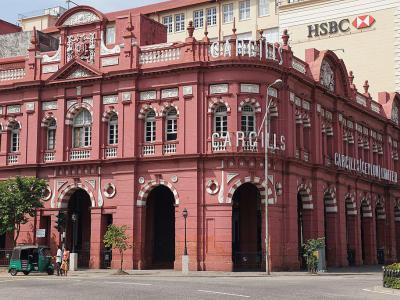
Cargills was founded in 1844 by William Miller and David Sime Cargill as a general warehouse for wholesale trade during the colonial period. Over time, it grew into a major department store and became part of the development of modern retail in Sri Lanka. In 1983, the company opened the country’s first supermarket chain, changing how everyday shopping was done. Its long history links the building closely with the country’s commercial life.
The present building was constructed between 1902 and 1906. Its exterior is known for red-brick walls with white horizontal bands, often called the “red palace.” Arched windows, towers, and other details reflect early 20th-century British colonial architecture, and the exterior has changed little over the past century.
Inside, the atmosphere is more mixed. The ground floor is active, with a modern supermarket, food outlets, and basic services like a pharmacy or bank. The upper floors are mostly quiet and partly unused, with some office space. Old wooden fittings, brass signs, and original lifts remain, so the interior feels partly preserved rather than fully modern.
The present building was constructed between 1902 and 1906. Its exterior is known for red-brick walls with white horizontal bands, often called the “red palace.” Arched windows, towers, and other details reflect early 20th-century British colonial architecture, and the exterior has changed little over the past century.
Inside, the atmosphere is more mixed. The ground floor is active, with a modern supermarket, food outlets, and basic services like a pharmacy or bank. The upper floors are mostly quiet and partly unused, with some office space. Old wooden fittings, brass signs, and original lifts remain, so the interior feels partly preserved rather than fully modern.
5) Khan Clock Tower
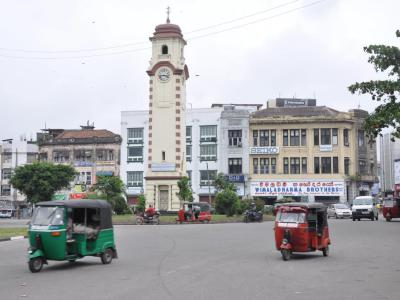
Khan Clock Tower stands at a busy roundabout at the entrance to Pettah Market, where trade, traffic, and daily routines meet. It was built in the early 20th century by the Khan family, a wealthy Parsi merchant family from Bombay with strong business links to Sri Lanka. The tower was officially dedicated on January 4, 1923, and from the beginning it served as a public clock, helping people keep track of time in one of the most active commercial areas.
The tower was commissioned by Khan brothers in memory of their father, marking 45 years since his death. It was given to the public as a gift, with an inscription describing it as a “token of affectionate gratitude,” showing the family’s aim to create something useful for the wider community rather than a private memorial.
The structure is four stories high, with a straightforward design that stands out above the surrounding activity. The clock faces are placed high so they can be seen from several directions. A public water fountain once operated at the base but is no longer in use. Today, the tower is still used as a meeting point and reflects the area’s long links to trade, public giving, and family history.
The tower was commissioned by Khan brothers in memory of their father, marking 45 years since his death. It was given to the public as a gift, with an inscription describing it as a “token of affectionate gratitude,” showing the family’s aim to create something useful for the wider community rather than a private memorial.
The structure is four stories high, with a straightforward design that stands out above the surrounding activity. The clock faces are placed high so they can be seen from several directions. A public water fountain once operated at the base but is no longer in use. Today, the tower is still used as a meeting point and reflects the area’s long links to trade, public giving, and family history.
6) Jami-Ul-Alfar Mosque (must see)
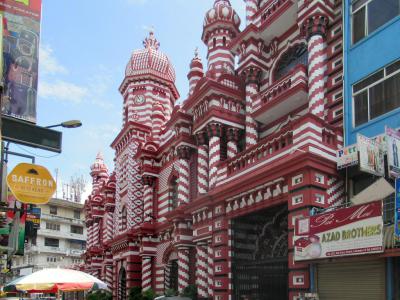
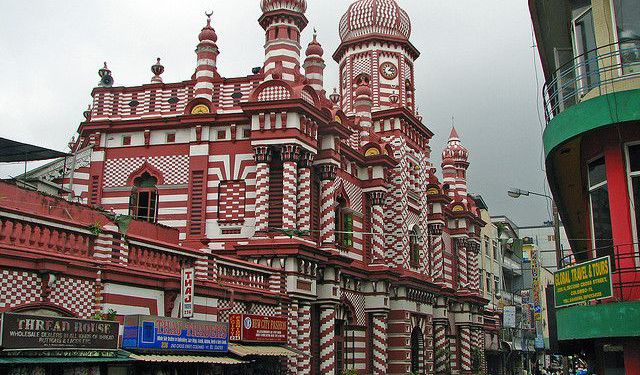
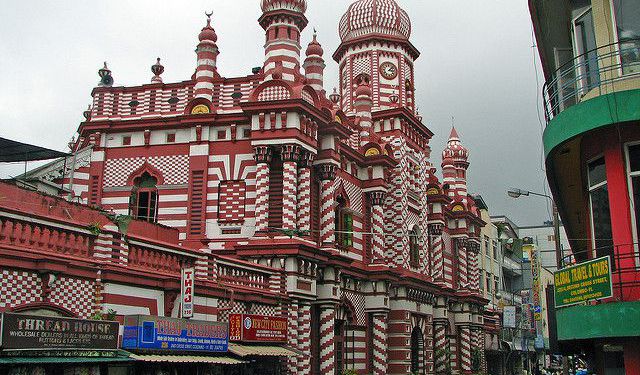
Jami-Ul-Alfar Mosque is easy to recognize because of its red and white striped walls. It was completed in 1909, with construction beginning in 1908, during a time when the local Muslim trading community was growing. The mosque was funded by merchants who worked nearby and needed a large place for daily prayers and Friday gatherings. Its tall structure and strong color contrast made it visible from a distance, and it once served as a visual guide for sailors approaching the port.
The building shows clear Indo-Islamic design influences. Red brick and white plaster are arranged in bold horizontal bands across the exterior. Rounded arches, small towers, and onion-shaped domes give the structure a layered and patterned look rather than flat walls. These design features also help with airflow and shade, which is useful in a hot climate and adds to the mosque’s strong visual presence.
Inside, the mood is much quieter and simpler. Large prayer halls are open and supported by rows of columns. Light enters through arched windows and openings, creating a calm atmosphere during the day. The mosque can hold several thousand worshippers, especially during Friday prayers and major religious events. Visitors may enter outside prayer times and are expected to dress modestly and remove their shoes.
The building shows clear Indo-Islamic design influences. Red brick and white plaster are arranged in bold horizontal bands across the exterior. Rounded arches, small towers, and onion-shaped domes give the structure a layered and patterned look rather than flat walls. These design features also help with airflow and shade, which is useful in a hot climate and adds to the mosque’s strong visual presence.
Inside, the mood is much quieter and simpler. Large prayer halls are open and supported by rows of columns. Light enters through arched windows and openings, creating a calm atmosphere during the day. The mosque can hold several thousand worshippers, especially during Friday prayers and major religious events. Visitors may enter outside prayer times and are expected to dress modestly and remove their shoes.
7) Sri Kailawasanatan Swami Temple (must see)
Sri Kailawasanatan Swami Temple is a historic Hindu temple built by a group of Indian Chetti traders known as the Thiruvilanga Nakarathar, who migrated to Sri Lanka for business around two hundred years ago. At the time, King Kirthi Sri Rajasingha ruled Kandy, while the Dutch controlled the coastal regions and managed trade. The Chetti traders, devoted Hindus, initially worshipped a small Sivalingam kept under a tree, but felt the need for a formal temple built according to Vedic Scriptures. With the support of fellow traders, they laid the foundation for the temple in 1783 on land owned by Sri Veerapathran, a prominent trader who also financed and supervised the construction.
Originally known as the Captain Gardens Temple—named after a Dutch officer overseeing local trade—the temple was designed and sculpted by skilled architects from India.
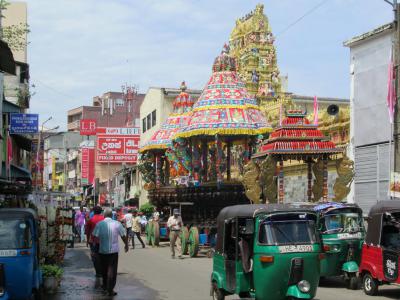
When visiting Sri Kailawasanatan Swami Temple, begin by pausing just outside the main entrance to take in the gopuram, the tall, ornate gateway tower. This is the best vantage point to observe its layered structure and painted sculptures, which are arranged in horizontal tiers. Looking upward from ground level allows you to see how the figures increase in number and density toward the top, a common feature of Dravidian temple design meant to draw the eye from the earthly to the divine.
After entering the temple grounds, move slowly through the central passageway, where the main shrines are aligned. These are usually marked by smaller sanctum structures and framed by lamps, flower offerings, and ritual objects. The principal shrine dedicated to Lord Shiva is typically the focal point, while surrounding shrines honor other deities such as Ganesha, Murugan, and Parvati. Visitors should observe from the side or rear of worshippers, as these areas are actively used for prayer.
Along the walkways, take time to examine the sculpted columns, which often support covered orridors or halls. These columns feature carved figures, floral motifs, and symbolic forms that are easy to miss when moving quickly. Standing slightly back allows the relief work to become more visible, especially where light falls across the stone.
The ritual spaces are usually identifiable by the presence of oil lamps, incense holders, and offering platforms. These areas are best observed quietly, watching how devotees interact with the space through movement, gesture, and offerings.
The temple is heavily surrounded by railway tracks and urban traffic, making the transition from the busy street to the serene sanctuary inside particularly striking.
Originally known as the Captain Gardens Temple—named after a Dutch officer overseeing local trade—the temple was designed and sculpted by skilled architects from India.
When visiting Sri Kailawasanatan Swami Temple, begin by pausing just outside the main entrance to take in the gopuram, the tall, ornate gateway tower. This is the best vantage point to observe its layered structure and painted sculptures, which are arranged in horizontal tiers. Looking upward from ground level allows you to see how the figures increase in number and density toward the top, a common feature of Dravidian temple design meant to draw the eye from the earthly to the divine.
After entering the temple grounds, move slowly through the central passageway, where the main shrines are aligned. These are usually marked by smaller sanctum structures and framed by lamps, flower offerings, and ritual objects. The principal shrine dedicated to Lord Shiva is typically the focal point, while surrounding shrines honor other deities such as Ganesha, Murugan, and Parvati. Visitors should observe from the side or rear of worshippers, as these areas are actively used for prayer.
Along the walkways, take time to examine the sculpted columns, which often support covered orridors or halls. These columns feature carved figures, floral motifs, and symbolic forms that are easy to miss when moving quickly. Standing slightly back allows the relief work to become more visible, especially where light falls across the stone.
The ritual spaces are usually identifiable by the presence of oil lamps, incense holders, and offering platforms. These areas are best observed quietly, watching how devotees interact with the space through movement, gesture, and offerings.
The temple is heavily surrounded by railway tracks and urban traffic, making the transition from the busy street to the serene sanctuary inside particularly striking.
8) Saint Anthony’s Shrine
Saint Anthony’s Shrine is one of Colombo’s most significant Christian landmarks and an important place of pilgrimage for Catholics across Sri Lanka. Dedicated to Saint Anthony of Padua, the shrine has long been associated with prayers for protection, healing, and personal intentions. Its history dates back to the early 19th century, when Catholic worship in Colombo began to recover after earlier periods of restriction during colonial rule, establishing the site as a lasting center of devotion.
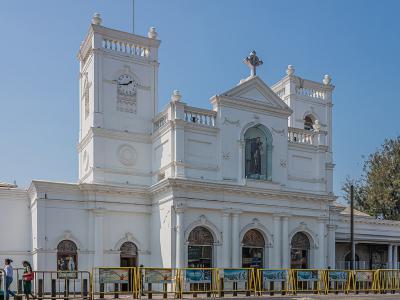
The present shrine building was completed in the early 20th century, replacing earlier chapels that served the growing Catholic community. Architecturally, Saint Anthony’s Shrine reflects European church design adapted to local conditions. The exterior is defined by twin towers, arched entrances, and a symmetrical façade, while the interior includes stained-glass windows, religious statues, and a broad nave designed to hold large congregations during services and feast days.
Saint Anthony’s Shrine is particularly well known for its devotional practices. Tuesdays are traditionally dedicated to Saint Anthony, drawing large numbers of worshippers, including many from non-Christian backgrounds. Annual feast celebrations also attract crowds from across the country, highlighting the shrine’s role as a shared spiritual space within Colombo’s diverse religious landscape.
The present shrine building was completed in the early 20th century, replacing earlier chapels that served the growing Catholic community. Architecturally, Saint Anthony’s Shrine reflects European church design adapted to local conditions. The exterior is defined by twin towers, arched entrances, and a symmetrical façade, while the interior includes stained-glass windows, religious statues, and a broad nave designed to hold large congregations during services and feast days.
Saint Anthony’s Shrine is particularly well known for its devotional practices. Tuesdays are traditionally dedicated to Saint Anthony, drawing large numbers of worshippers, including many from non-Christian backgrounds. Annual feast celebrations also attract crowds from across the country, highlighting the shrine’s role as a shared spiritual space within Colombo’s diverse religious landscape.
Walking Tours in Colombo, Sri Lanka

Create Your Own Walk in Colombo
Creating your own self-guided walk in Colombo is easy and fun. Choose the city attractions that you want to see and a walk route map will be created just for you. You can even set your hotel as the start point of the walk.
Colombo Introduction Walking Tour
Colombo, the commercial capital and largest city of Sri Lanka, has a history shaped by centuries of trade, colonization, and cultural exchange. Strategically positioned on the island’s western coast along the Indian Ocean, it has served as an important port city for more than 2,000 years. Early maritime accounts and Sri Lankan chronicles describe Colombo as a hub for spices, gemstones, and other... view more
Tour Duration: 3 Hour(s)
Travel Distance: 5.5 Km or 3.4 Miles
Tour Duration: 3 Hour(s)
Travel Distance: 5.5 Km or 3.4 Miles
The Most Popular Cities
/ view all