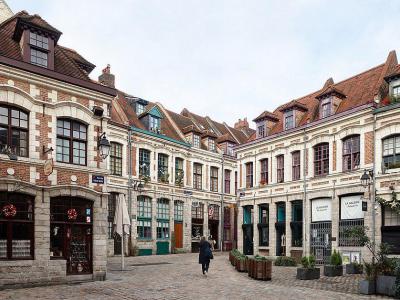


Place aux Oignons (Onions Square), Lille
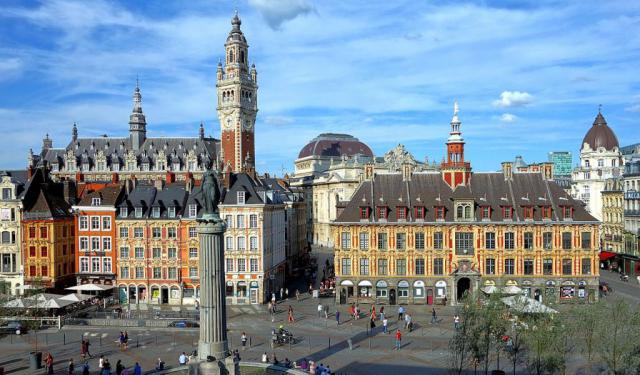
The Onion Square lies at the foot of Lille’s former castle mound, where the fortress of the counts of Flanders once stood. According to a traditional explanation, its name developed from the Latin word dominium, associated with the nearby stronghold, through dominion and eventually oignons, the French word for onions. No trace of the original wooden fortress survives.
The square is lined with houses dating mainly from the late 17th and early 18th centuries. They were originally occupied by artisan weavers, who installed their looms in attics or in cellars where the humidity could help with the preparation of textile fibers. As traditional weaving declined and mechanized textile production expanded during the 19th century, the houses became crowded accommodation for workers employed in nearby factories.
By the 1970s, many of the buildings were severely dilapidated, and some were occupied by squatters. Structural reinforcement began in 1976 in preparation for a larger restoration project. Between 1985 and 1990, the houses were renovated or partially reconstructed in their original style. Today, this small pedestrian square is surrounded by restaurants and traditional Flemish-style cafés.
Au Petit Vieux, at number 5, is a traditional Flemish tavern serving regional cuisine and beers from northern France in an informal setting. Nearby, Au Vieux de la Vieille, at the corner of Rue des Vieux-Murs on the southwestern side of the square, is known for Flemish dishes such as beer-braised beef stew or Welsh rarebit, a rich dish of bread covered with melted cheese. Those seeking something different can try In Bocca al Lupo, an Italian restaurant opposite Au Vieux de la Vieille. The terraces are particularly lively at lunchtime and in the evening, when Onion Square becomes one of the most inviting gathering places in Old Lille.
The square is lined with houses dating mainly from the late 17th and early 18th centuries. They were originally occupied by artisan weavers, who installed their looms in attics or in cellars where the humidity could help with the preparation of textile fibers. As traditional weaving declined and mechanized textile production expanded during the 19th century, the houses became crowded accommodation for workers employed in nearby factories.
By the 1970s, many of the buildings were severely dilapidated, and some were occupied by squatters. Structural reinforcement began in 1976 in preparation for a larger restoration project. Between 1985 and 1990, the houses were renovated or partially reconstructed in their original style. Today, this small pedestrian square is surrounded by restaurants and traditional Flemish-style cafés.
Au Petit Vieux, at number 5, is a traditional Flemish tavern serving regional cuisine and beers from northern France in an informal setting. Nearby, Au Vieux de la Vieille, at the corner of Rue des Vieux-Murs on the southwestern side of the square, is known for Flemish dishes such as beer-braised beef stew or Welsh rarebit, a rich dish of bread covered with melted cheese. Those seeking something different can try In Bocca al Lupo, an Italian restaurant opposite Au Vieux de la Vieille. The terraces are particularly lively at lunchtime and in the evening, when Onion Square becomes one of the most inviting gathering places in Old Lille.
Want to visit this sight? Check out these Self-Guided Walking Tours in Lille. Alternatively, you can download the mobile app "GPSmyCity: Walks in 1K+ Cities" from Apple App Store or Google Play Store. The app turns your mobile device to a personal tour guide and it works offline, so no data plan is needed when traveling abroad.
Download The GPSmyCity App



Place aux Oignons (Onions Square) on Map
Sight Name: Place aux Oignons (Onions Square)
Sight Location: Lille, France (See walking tours in Lille)
Sight Type: Attraction/Landmark
Guide(s) Containing This Sight:
Sight Location: Lille, France (See walking tours in Lille)
Sight Type: Attraction/Landmark
Guide(s) Containing This Sight:
Nearby Sights

Walking Tours in Lille, France

Create Your Own Walk in Lille
Creating your own self-guided walk in Lille is easy and fun. Choose the city attractions that you want to see and a walk route map will be created just for you. You can even set your hotel as the start point of the walk.
Walking Through Lille's Old Town
Often called France’s “Capital of Flanders,” Lille and its surroundings belong to the historic region of Romance Flanders. Legend has it that, in AD 620, Salvaert, Prince of Dijon, was passing through the region with his pregnant wife when he was attacked and killed by Phinaert, a local lord known as the Giant. Years later, his son, Lydéric, avenged his father by killing Phinaert and is... view more
Tour Duration: 2 Hours
Travel Distance: 4 Km or 2.5 Miles
Tour Duration: 2 Hours
Travel Distance: 4 Km or 2.5 Miles
Lille's Historical Buildings Tour
Historically, Lille's architecture differs from that of other French cities. Prior to being invaded by Louis XIV in 1667, Lille was Flemish, which is evident in its red-brick and other structures, quite uncommon for the rest of France.
Among many things, Lille is reputed for its fabulous historic center, abounding in time-honored buildings, palaces, and churches, offering a great deal of... view more
Tour Duration: 2 Hours
Travel Distance: 3.7 Km or 2.3 Miles
Among many things, Lille is reputed for its fabulous historic center, abounding in time-honored buildings, palaces, and churches, offering a great deal of... view more
Tour Duration: 2 Hours
Travel Distance: 3.7 Km or 2.3 Miles