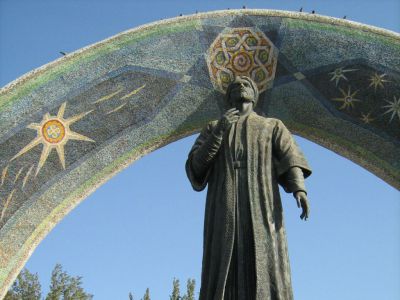


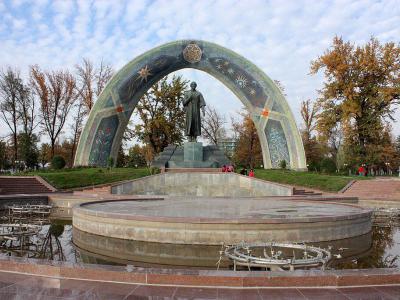
Statue of Tajik poet Rudaky, Dushanbe (must see)
The statue of Rudaki honours a poet regarded as the founder of classical Persian–Tajik poetry. Living in the 9th–10th centuries (c. 858–941), he served as a court poet to the Samanid rulers, most notably under Amir Nasr II. Rudaki was among the earliest writers to use New Persian, shaping a tradition that later spread across Central Asia and Iran. Although tradition credits him with a vast body of work, fewer than 1,000 lines survive today through later sources.
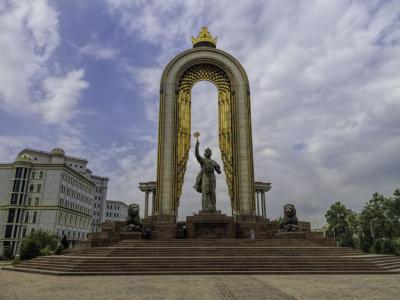
The monument shows Rudaki standing on a tall pedestal, leaning lightly on a cane, a detail often linked to traditions about his blindness in later life. The figure faces forward in a calm, balanced pose, with clothing that reflects early medieval styles connected to the Samanid period.
One of the most striking features of the monument is the large decorative arch behind the statue. This arch is covered in colourful mosaics arranged in a rainbow-like form, with sun and star motifs that echo themes of light, knowledge, and creativity. Inscriptions on the base record Rudaki’s name and life dates (858–941) in Tajik and Persian script, along with selected lines from his poetry, allowing visitors to connect the figure with his words.
The statue stands within a broad public park setting, surrounded by paths, trees, fountains, and benches. It is easily accessible and closely tied to daily life, with people passing through, resting nearby, or stopping briefly to read the inscriptions. For visitors, the monument offers a clear introduction to the region’s literary heritage and highlights the lasting role of poetry in shaping cultural identity.
The monument shows Rudaki standing on a tall pedestal, leaning lightly on a cane, a detail often linked to traditions about his blindness in later life. The figure faces forward in a calm, balanced pose, with clothing that reflects early medieval styles connected to the Samanid period.
One of the most striking features of the monument is the large decorative arch behind the statue. This arch is covered in colourful mosaics arranged in a rainbow-like form, with sun and star motifs that echo themes of light, knowledge, and creativity. Inscriptions on the base record Rudaki’s name and life dates (858–941) in Tajik and Persian script, along with selected lines from his poetry, allowing visitors to connect the figure with his words.
The statue stands within a broad public park setting, surrounded by paths, trees, fountains, and benches. It is easily accessible and closely tied to daily life, with people passing through, resting nearby, or stopping briefly to read the inscriptions. For visitors, the monument offers a clear introduction to the region’s literary heritage and highlights the lasting role of poetry in shaping cultural identity.
Want to visit this sight? Check out these Self-Guided Walking Tours in Dushanbe. Alternatively, you can download the mobile app "GPSmyCity: Walks in 1K+ Cities" from Apple App Store or Google Play Store. The app turns your mobile device to a personal tour guide and it works offline, so no data plan is needed when traveling abroad.
Download The GPSmyCity App



Statue of Tajik poet Rudaky on Map
Sight Name: Statue of Tajik poet Rudaky
Sight Location: Dushanbe, Tajikistan (See walking tours in Dushanbe)
Sight Type: Attraction/Landmark
Guide(s) Containing This Sight:
Sight Location: Dushanbe, Tajikistan (See walking tours in Dushanbe)
Sight Type: Attraction/Landmark
Guide(s) Containing This Sight:
Nearby Sights
Walking Tours in Dushanbe, Tajikistan

Create Your Own Walk in Dushanbe
Creating your own self-guided walk in Dushanbe is easy and fun. Choose the city attractions that you want to see and a walk route map will be created just for you. You can even set your hotel as the start point of the walk.
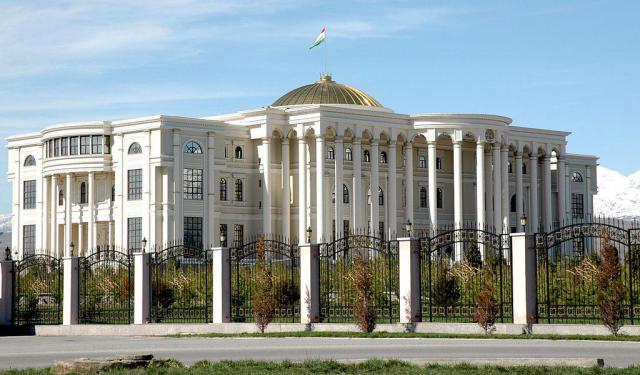
Dushanbe Introduction Walking Tour II
Relatively small in size, the city of Dushanbe, capital of Tajikistan, sits on the banks of the Varzob River and contains a number of notable sights, significant in terms of national history and culture. Among the local landmarks featured here are the Presidential Palace, Haji Yakoub Mosque, Komsomolskoe Lake, and more. To explore these and other attractions of Dushanbe in more detail, follow this... view more
Tour Duration: 2 Hour(s)
Travel Distance: 4.4 Km or 2.7 Miles
Tour Duration: 2 Hour(s)
Travel Distance: 4.4 Km or 2.7 Miles
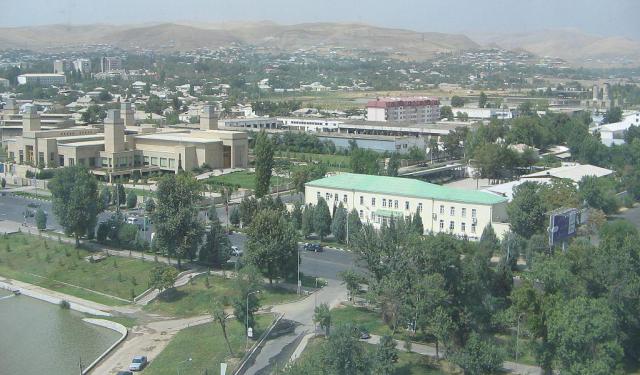
Dushanbe Introduction Walking Tour I
Relatively small in size, the city of Dushanbe, capital of Tajikistan, sits on the banks of the Varzob River and contains a number of notable sights, significant in terms of national history and culture. The most prominent local landmarks include Rudaki Park, bearing the name of the Tajik poetry classic; the Ismoili Somoni statue and gilded arch; the National Museum of Tajikistan; and more. To... view more
Tour Duration: 2 Hour(s)
Travel Distance: 5.1 Km or 3.2 Miles
Tour Duration: 2 Hour(s)
Travel Distance: 5.1 Km or 3.2 Miles