

Dushanbe Introduction Walking Tour II (Self Guided), Dushanbe
Relatively small in size, the city of Dushanbe, capital of Tajikistan, sits on the banks of the Varzob River and contains a number of notable sights, significant in terms of national history and culture. Among the local landmarks featured here are the Presidential Palace, Haji Yakoub Mosque, Komsomolskoe Lake, and more. To explore these and other attractions of Dushanbe in more detail, follow this orientation walk.
How it works: Download the app "GPSmyCity: Walks in 1K+ Cities" from Apple App Store or Google Play Store to your mobile phone or tablet. The app turns your mobile device into a personal tour guide and its built-in GPS navigation functions guide you from one tour stop to next. The app works offline, so no data plan is needed when traveling abroad.
Dushanbe Introduction Walking Tour II Map
Guide Name: Dushanbe Introduction Walking Tour II
Guide Location: Tajikistan » Dushanbe (See other walking tours in Dushanbe)
Guide Type: Self-guided Walking Tour (Sightseeing)
# of Attractions: 9
Tour Duration: 2 Hour(s)
Travel Distance: 4.4 Km or 2.7 Miles
Author: Maia
Sight(s) Featured in This Guide:
Guide Location: Tajikistan » Dushanbe (See other walking tours in Dushanbe)
Guide Type: Self-guided Walking Tour (Sightseeing)
# of Attractions: 9
Tour Duration: 2 Hour(s)
Travel Distance: 4.4 Km or 2.7 Miles
Author: Maia
Sight(s) Featured in This Guide:
- Puppet Theatre
- Mayakovsky Russian Drama Theater
- Presidential Palace
- Tajik Academic Theatre of A. Lahuti
- Palace of Unity
- Haji Yakoub Mosque
- Writers' Union Building
- Amphitheatre
- Komsomolskoe Lake (Youth Lake)
1) Puppet Theatre
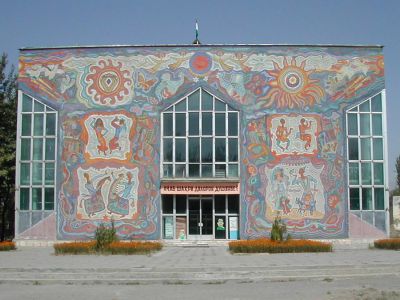
The State Puppet Theatre of Tajikistan, often known as the “Lukhtak” Puppet Theatre, focuses on performances for children and families. While puppet shows existed earlier in the region, the theatre officially opened on September 7, 1985. It was created to support children’s theatre and preserve storytelling traditions through puppetry.
The building is easy to recognise by its colourful brick exterior and decorative designs showing people dancing. Inside, the theatre is small and practical, with seating close to the stage so children can clearly follow the action. Sets are usually handmade, using painted panels, fabric, and simple lighting, keeping the focus on the puppets and the story.
The theatre has staged around 40 to 60 productions based on folk tales, fairy stories, and modern children’s plays. Shows are performed in Tajik and Russian, using hand puppets, rod puppets, and marionettes linked to traditional zochabozi and chodirkhayol. It also hosts the Chodari Khayol International Puppet Festival, with music and sound effects helping visitors follow the stories easily.
The building is easy to recognise by its colourful brick exterior and decorative designs showing people dancing. Inside, the theatre is small and practical, with seating close to the stage so children can clearly follow the action. Sets are usually handmade, using painted panels, fabric, and simple lighting, keeping the focus on the puppets and the story.
The theatre has staged around 40 to 60 productions based on folk tales, fairy stories, and modern children’s plays. Shows are performed in Tajik and Russian, using hand puppets, rod puppets, and marionettes linked to traditional zochabozi and chodirkhayol. It also hosts the Chodari Khayol International Puppet Festival, with music and sound effects helping visitors follow the stories easily.
2) Mayakovsky Russian Drama Theater
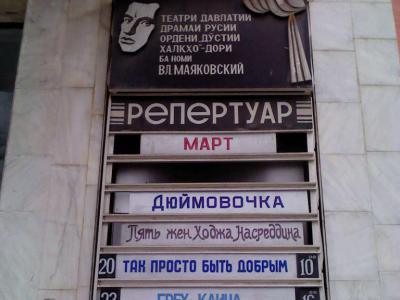
The Mayakovsky Russian Drama Theater was founded in 1937 and named after the poet Vladimir Mayakovsky. It has long been the main venue for Russian-language drama in the country. During the Soviet period, it helped shape professional theatre life, and today it continues to draw a steady and loyal audience.
The theatre’s repertoire follows a traditional, academic style. Most performances are based on Russian and European classics, with Chekhov, Ostrovsky, and Shakespeare appearing often, alongside occasional modern Russian plays. All shows are in Russian, but clear acting and strong stage movement help make the stories understandable. The emphasis is on character and dialogue rather than large sets or visual effects.
The theatre’s original building was demolished in 2016 during a redevelopment project. For several years, the troupe performed at the Lohuti Tajik Drama Theatre before moving into a renovated former cinema building. The current space is smaller, with seating close to the stage, creating a direct and intimate atmosphere that fits the theatre’s style well.
The theatre’s repertoire follows a traditional, academic style. Most performances are based on Russian and European classics, with Chekhov, Ostrovsky, and Shakespeare appearing often, alongside occasional modern Russian plays. All shows are in Russian, but clear acting and strong stage movement help make the stories understandable. The emphasis is on character and dialogue rather than large sets or visual effects.
The theatre’s original building was demolished in 2016 during a redevelopment project. For several years, the troupe performed at the Lohuti Tajik Drama Theatre before moving into a renovated former cinema building. The current space is smaller, with seating close to the stage, creating a direct and intimate atmosphere that fits the theatre’s style well.
3) Presidential Palace (must see)
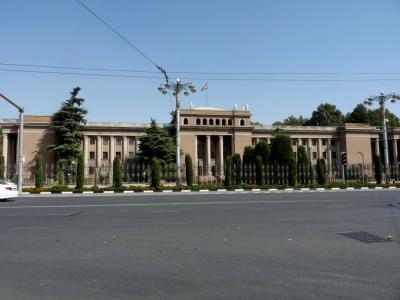
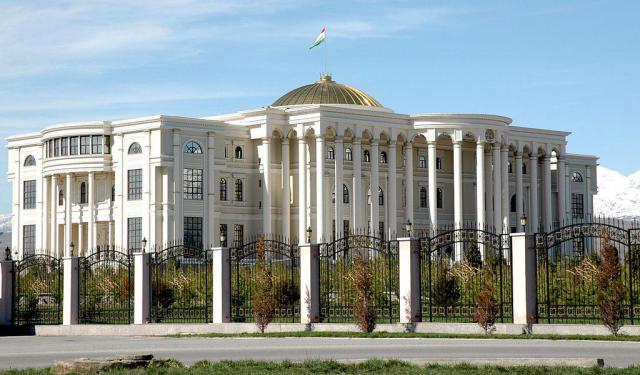
The former Presidential Palace was built as the headquarters of the Central Committee of the Communist Party of Tajikistan. Designed in the Stalinist style, with a symmetrical façade and tall entrance columns, it was likely completed in 1957 to mark the 40th anniversary of the October Revolution. After independence in 1991, it became the Presidential Palace and remained a centre of political power for many years.
In February 2020, authorities decided to demolish the building as part of a larger plan to replace several Soviet-era structures and modernise the government district. The decision led to public discussion about its historical value, but demolition went ahead, and the area was cleared for a new and much larger complex.
The new building, officially called the “Government of the Republic of Tajikistan” (Ҳукумати Ҷумҳурии Тоҷикистон), was opened on July 5, 2024, during a state visit by Chinese President Xi Jinping. China provided about $350 million in assistance for the construction of both the new government and parliament complexes. The design combines Tajik decorative details with modern Chinese construction methods. More than 10,000 tons of stone were brought from China. The complex includes one 15-storey building and two 13-storey buildings, covering around 10.27 hectares.
This site should not be confused with the Palace of the Nation (Qasri Millat), which remains the President’s official residence and is used for major diplomatic meetings. The new Government complex serves as the country’s main administrative centre, housing the Executive Office of the President, government offices, a 1,000-seat hall, and other state departments.
In February 2020, authorities decided to demolish the building as part of a larger plan to replace several Soviet-era structures and modernise the government district. The decision led to public discussion about its historical value, but demolition went ahead, and the area was cleared for a new and much larger complex.
The new building, officially called the “Government of the Republic of Tajikistan” (Ҳукумати Ҷумҳурии Тоҷикистон), was opened on July 5, 2024, during a state visit by Chinese President Xi Jinping. China provided about $350 million in assistance for the construction of both the new government and parliament complexes. The design combines Tajik decorative details with modern Chinese construction methods. More than 10,000 tons of stone were brought from China. The complex includes one 15-storey building and two 13-storey buildings, covering around 10.27 hectares.
This site should not be confused with the Palace of the Nation (Qasri Millat), which remains the President’s official residence and is used for major diplomatic meetings. The new Government complex serves as the country’s main administrative centre, housing the Executive Office of the President, government offices, a 1,000-seat hall, and other state departments.
4) Tajik Academic Theatre of A. Lahuti
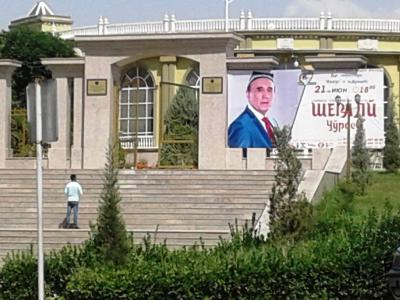
The Tajik State Academic Drama Theatre named after Abulqasim Lahuti was founded in 1929 as the country’s first professional drama theatre. In 1933, it was named after Abulqasim Lahuti, a Persian-born poet who helped shape modern Tajik literature by linking classical Persian traditions with new social ideas.
The theatre stages classic Tajik plays, Russian and European works, and modern dramas by local writers. It gained wide recognition for its Shakespeare productions, including King Lear and Othello, which highlighted the expressive power of the Tajik language. Today, the theatre is known for clear, formal literary Tajik and a strong acting style shaped by the Stanislavski system.
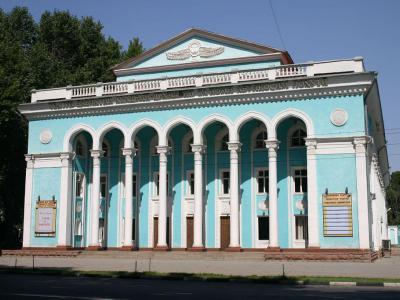
The mid-20th-century building follows a Stalinist Neoclassical style, with a formal exterior and a simple, practical interior. The hall has tiered seating, good acoustics, and a stage suited to spoken drama. Performances are usually held in the evening, tickets are affordable, and a visit offers insight into Tajik literary and theatre traditions.
The theatre stages classic Tajik plays, Russian and European works, and modern dramas by local writers. It gained wide recognition for its Shakespeare productions, including King Lear and Othello, which highlighted the expressive power of the Tajik language. Today, the theatre is known for clear, formal literary Tajik and a strong acting style shaped by the Stanislavski system.
The mid-20th-century building follows a Stalinist Neoclassical style, with a formal exterior and a simple, practical interior. The hall has tiered seating, good acoustics, and a stage suited to spoken drama. Performances are usually held in the evening, tickets are affordable, and a visit offers insight into Tajik literary and theatre traditions.
5) Palace of Unity
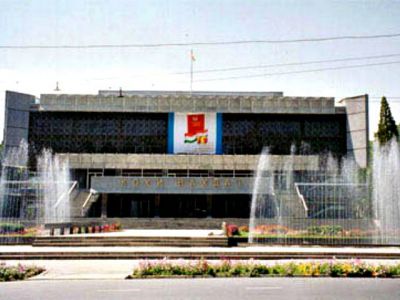
The Palace of Unity, also called Kohi Vahdat, was for many years a major concert and conference hall. Built in the late Soviet period, it hosted music events, government meetings, and international conferences. Its name, “Vahdat,” means “unity” in Tajik and reflects its role in public celebrations and official ceremonies.
The building had a symmetrical design with tall entrance columns and wide steps leading to the main doors. Inside was a large hall with fixed seating and a deep stage for concerts and official events. As part of a redevelopment plan that replaced several Soviet-era buildings, the aging palace was scheduled for demolition, and by 2024 the site was being prepared for a new, larger complex in a modern style.
The palace was also the scene of serious security incidents. On 14 November 2007, a homemade explosive device detonated in the rear yard. A 77-year-old man was killed after picking up a plastic bag that contained the device. The blast shattered windows and occurred shortly before an international conference was due to begin. In September 2010, a smaller bomb exploded outside during Fashion Week, causing minor damage but no deaths.
The building had a symmetrical design with tall entrance columns and wide steps leading to the main doors. Inside was a large hall with fixed seating and a deep stage for concerts and official events. As part of a redevelopment plan that replaced several Soviet-era buildings, the aging palace was scheduled for demolition, and by 2024 the site was being prepared for a new, larger complex in a modern style.
The palace was also the scene of serious security incidents. On 14 November 2007, a homemade explosive device detonated in the rear yard. A 77-year-old man was killed after picking up a plastic bag that contained the device. The blast shattered windows and occurred shortly before an international conference was due to begin. In September 2010, a smaller bomb exploded outside during Fashion Week, causing minor damage but no deaths.
6) Haji Yakoub Mosque
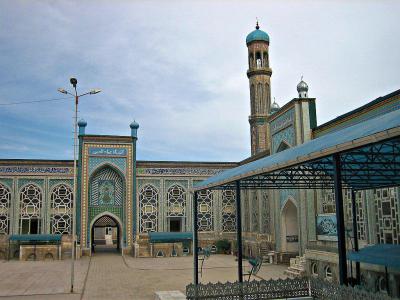
Haji Yakoub Mosque is a major place of worship with roots going back to 1856, when the site was founded with support from Haji Yakoub and his mother. Named after a respected Tajik religious figure, the mosque reflects a long tradition of Islamic learning and worship. The main building seen today was constructed between 1905 and 1910, shaping its lasting architectural form.
The mosque is known for its fine craftsmanship, including arched windows, patterned mosaic (mo‘araq) tiles, and carved wooden columns along the porches. A tall crescent-topped minaret and a dome with a golden finish define the outline of the complex. Earlier blue, lapis-style colors were altered during later renovations, with major restoration work carried out after 1991, especially in the late 1990s.
The mosque complex houses the Islamic Centre of the Republic of Tajikistan and remains an important religious centre. The Islamic Institute of Tajikistan was formerly based here but has since moved elsewhere. Visitors should arrive outside prayer times and dress modestly; women are expected to wear a headscarf. The mosque is often compared with the much larger Dushanbe Central Mosque, but it serves a more historical role.
The mosque is known for its fine craftsmanship, including arched windows, patterned mosaic (mo‘araq) tiles, and carved wooden columns along the porches. A tall crescent-topped minaret and a dome with a golden finish define the outline of the complex. Earlier blue, lapis-style colors were altered during later renovations, with major restoration work carried out after 1991, especially in the late 1990s.
The mosque complex houses the Islamic Centre of the Republic of Tajikistan and remains an important religious centre. The Islamic Institute of Tajikistan was formerly based here but has since moved elsewhere. Visitors should arrive outside prayer times and dress modestly; women are expected to wear a headscarf. The mosque is often compared with the much larger Dushanbe Central Mosque, but it serves a more historical role.
7) Writers' Union Building
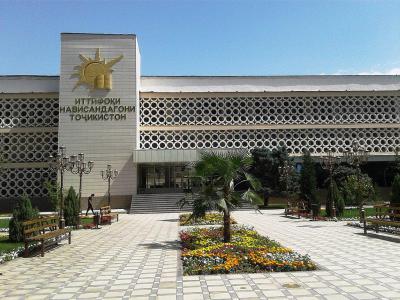
The Writers' Union of Tajikistan Building holds an important place in the country’s literary life. The Writers’ Union was founded in 1934, when Soviet literature was being reorganised under Socialist Realism. It became the main centre for Tajik-language writers. Early figures such as Sadriddin Ayni and Abulqosim Lohuti helped shape modern literature and support Tajik literary traditions during a time of major change.
The building itself was completed in 1981 and designed by Eduard Salikhov. Its most recognisable feature is the front façade, the “Wall of Greats,” with nine niches holding statues of eleven Persian-Tajik poets and thinkers, including Rudaki, Ferdowsi, Saadi, and Omar Khayyam. The sculptures, created by Ion Munteanu, highlight a literary tradition that long predates the Soviet era.
Inside, the building remains a working space. Editorial offices such as Sadoi Sharq are based here, and the halls host readings, meetings, and State Rudaki Prize events. The main hall includes a large mural on the theme The Chariot of Apollo, while a traditional teahouse-style courtyard provides a quiet contrast to the concrete exterior.
The building itself was completed in 1981 and designed by Eduard Salikhov. Its most recognisable feature is the front façade, the “Wall of Greats,” with nine niches holding statues of eleven Persian-Tajik poets and thinkers, including Rudaki, Ferdowsi, Saadi, and Omar Khayyam. The sculptures, created by Ion Munteanu, highlight a literary tradition that long predates the Soviet era.
Inside, the building remains a working space. Editorial offices such as Sadoi Sharq are based here, and the halls host readings, meetings, and State Rudaki Prize events. The main hall includes a large mural on the theme The Chariot of Apollo, while a traditional teahouse-style courtyard provides a quiet contrast to the concrete exterior.
8) Amphitheatre
The Amphitheatre is the main open-air venue most visitors mean when they refer to the city’s performance space. It was built in 2004 to celebrate the 80th anniversary of Dushanbe as a capital city. The venue has around 1,500 fixed seats, with room for up to about 2,000 people during busy events. It is mainly used for concerts, dance performances, and public celebrations, especially those aimed at medium-sized audiences.
The amphitheatre has a round layout with tiered seating facing a wide stage. A row of arched openings lets daylight into the space and softens the solid structure. Its design combines large-scale Soviet-era building forms with Persian and Islamic decorative details, a style common in public projects from the early 2000s.
A second open-air amphitheatre sits inside Boghi Poytakht, opened in 2011, and is closely linked to the park’s musical fountains with evening light-and-water shows. Both venues are mainly used from late April to October. Although larger sites now host major state events, these amphitheatres still play an active role in everyday cultural life.
The amphitheatre has a round layout with tiered seating facing a wide stage. A row of arched openings lets daylight into the space and softens the solid structure. Its design combines large-scale Soviet-era building forms with Persian and Islamic decorative details, a style common in public projects from the early 2000s.
A second open-air amphitheatre sits inside Boghi Poytakht, opened in 2011, and is closely linked to the park’s musical fountains with evening light-and-water shows. Both venues are mainly used from late April to October. Although larger sites now host major state events, these amphitheatres still play an active role in everyday cultural life.
9) Komsomolskoe Lake (Youth Lake)
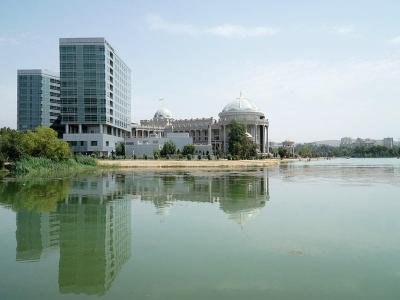
Kuli Javonon (Youth Lake) is a man-made lake built during the Soviet period to create public green space. It was long known as Komsomolskoe Lake, a name still used by many older residents and some guidebooks. The official name was later changed to Kuli Javonon, or Youth Lake, as part of a wider shift away from Soviet-era names. From the beginning, the lake was designed mainly for relaxation, a role it continues to serve today.
In recent years, the area around the lake has been renovated, with repaved walking paths, improved lighting, and refreshed green spaces. It is now part of a central leisure zone near major public landmarks, which has increased daily use and made the area livelier, especially in the evenings.
Benches and wide paths make the shoreline easy to walk along. In warmer months, pedal boats and small leisure boats operate on the lake, but swimming is not allowed. Evenings are the busiest time, with people coming to walk, relax, and enjoy drinks or snacks from nearby cafés and kiosks.
In recent years, the area around the lake has been renovated, with repaved walking paths, improved lighting, and refreshed green spaces. It is now part of a central leisure zone near major public landmarks, which has increased daily use and made the area livelier, especially in the evenings.
Benches and wide paths make the shoreline easy to walk along. In warmer months, pedal boats and small leisure boats operate on the lake, but swimming is not allowed. Evenings are the busiest time, with people coming to walk, relax, and enjoy drinks or snacks from nearby cafés and kiosks.
Walking Tours in Dushanbe, Tajikistan

Create Your Own Walk in Dushanbe
Creating your own self-guided walk in Dushanbe is easy and fun. Choose the city attractions that you want to see and a walk route map will be created just for you. You can even set your hotel as the start point of the walk.
Dushanbe Introduction Walking Tour I
Relatively small in size, the city of Dushanbe, capital of Tajikistan, sits on the banks of the Varzob River and contains a number of notable sights, significant in terms of national history and culture. The most prominent local landmarks include Rudaki Park, bearing the name of the Tajik poetry classic; the Ismoili Somoni statue and gilded arch; the National Museum of Tajikistan; and more. To... view more
Tour Duration: 2 Hour(s)
Travel Distance: 5.1 Km or 3.2 Miles
Tour Duration: 2 Hour(s)
Travel Distance: 5.1 Km or 3.2 Miles
The Most Popular Cities
/ view all