Custom Walk in Aachen, Germany by jvvanzon_f6b63 created on 2023-09-25
Guide Location: Germany » Aachen
Guide Type: Custom Walk
# of Sights: 9
Tour Duration: 1 Hour(s)
Travel Distance: 1.3 Km or 0.8 Miles
Share Key: LYSS7
Guide Type: Custom Walk
# of Sights: 9
Tour Duration: 1 Hour(s)
Travel Distance: 1.3 Km or 0.8 Miles
Share Key: LYSS7
How It Works
Please retrieve this walk in the GPSmyCity app. Once done, the app will guide you from one tour stop to the next as if you had a personal tour guide. If you created the walk on this website or come to the page via a link, please follow the instructions below to retrieve the walk in the app.
Retrieve This Walk in App
Step 1. Download the app "GPSmyCity: Walks in 1K+ Cities" on Apple App Store or Google Play Store.



Step 2. In the GPSmyCity app, download(or launch) the guide "Aachen Map and Walking Tours".
Step 3. Tap the menu button located at upper right corner of the "Walks" screen and select "Retrieve custom walk". Enter the share key: LYSS7
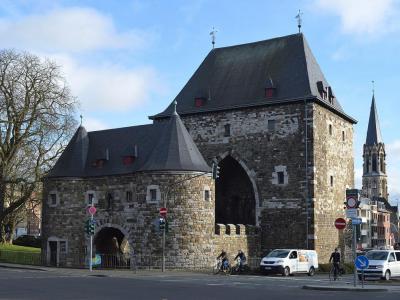
1) Ponttor Gate
The Ponttor (known in the 17th and 18th centuries as the Brückenpforte or Brückenthor) is one of the two remaining gates of the original medieval wall of Aachen (the other being the Marschiertor), and as such is a prominent landmark in the city. The westernmost of the north-facing gates, it was built in 1320, designed for defense purposes, and was originally manned by soldiers and militia throughout Aachen's Free Imperial City era.
The name Ponttor is assumed to be derived from the Latin word "pons", which means bridge. Although indeed, Aachen has several rivers and streams passing through, none of them is found nearby. Still, before the gate appeared, the area itself had already carried this appellation, so the gate must have been named after the neighborhood itself. The latter was named after a bridge that existed in Roman times on what is now known as the Annuntiaten stream. Beyond this area lay extensive swamps, and to exit the settlement, one would have to cross the bridge.
The Ponttor is a right-angled, three-storey gateway with two small towers and the main portal in between. In the main entrance, there is a Portcullis as well as a machicolation, through which things could be dropped onto the invading enemy. A bridge passage with crenelations spanned a moat and was strengthened in the foregate with two reinforced towers (barbicans). The building material was Devonian sandstone, with the framing made of light bluestone.
At the top of the main gate’s arch is the statue of the Virgin, protector of the city.
Today, the Ponttor is used by German Youth and Scout groups belonging to the German Scout Club (1945) and the German Scout Association of Saint George.
The name Ponttor is assumed to be derived from the Latin word "pons", which means bridge. Although indeed, Aachen has several rivers and streams passing through, none of them is found nearby. Still, before the gate appeared, the area itself had already carried this appellation, so the gate must have been named after the neighborhood itself. The latter was named after a bridge that existed in Roman times on what is now known as the Annuntiaten stream. Beyond this area lay extensive swamps, and to exit the settlement, one would have to cross the bridge.
The Ponttor is a right-angled, three-storey gateway with two small towers and the main portal in between. In the main entrance, there is a Portcullis as well as a machicolation, through which things could be dropped onto the invading enemy. A bridge passage with crenelations spanned a moat and was strengthened in the foregate with two reinforced towers (barbicans). The building material was Devonian sandstone, with the framing made of light bluestone.
At the top of the main gate’s arch is the statue of the Virgin, protector of the city.
Today, the Ponttor is used by German Youth and Scout groups belonging to the German Scout Club (1945) and the German Scout Association of Saint George.
Sight description based on Wikipedia.
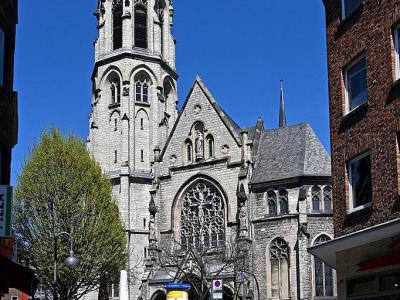
2) Heilig-Kreuz-Kirche (Holy Cross Church)
The Pfarrkirche Heilig Kreuz (Holy Cross Church) on Aachen's Pontstraße, near the Ponttor gate, is the third church on this site, and was consecrated in 1902. Laying its foundation stone in 1898 was preceded by a lengthy dispute, as to where it should stand; so long in fact that the pastor had resigned and only the radical actions of his successor made it possible to “set the ball rolling”.
The very first chapel on the spot, rather modest in size, also took quite a long time to build, from 1363 to 1372. Later, the original structure was rebuilt several times. During the fire in 1656, it was destroyed down to the outer walls and was fully restored only in 1770, hampered by the wars and periods of unrest.
The architect Joseph Buchkremer planned the current church in the spirit of historicism, combining German and French High Gothic elements. The public accused him of arbitrariness in the choice of stylistic elements, yet today the Heilig-Kreuz-Kirche remains one of the few churches in Aachen with an almost authentic historic church interior.
The building is a cross-shaped, three-aisled basilica with a short nave, which creates the impression of a temple surrounded by chapels. Resorting to this construction form was dictated by the limited space available.
The single tower in the northern part of the church, a component of German High Gothic, is particularly striking. Another point of interest is the Sacrament Chapel, located on the site of the former Julian Chapel. The capitals of the round columns of the church, supporting the ribbed vault, are decorated with vine leaves and foliage.
The façade consists of a vestibule with three portals, surmounted by a large window with a stone crucifix and the statues of the Virgin Mary and John the Baptist. The text on the façade reads "Stat crux, dum volvitur orbis " (The cross stands firm while the world turns) which is originally the motto of the Carthusians. In the upper part of the façade is a statue of Saint Helena.
Inside, the church contains numerous art treasures spanning the 15th through 20th centuries. Among them the most noteworthy is a silver chalice with Gothic ornamentation (dating from the late 15th century), gilded and with small enamel decorations, including a Latin text engraved with the names of the donors.
The very first chapel on the spot, rather modest in size, also took quite a long time to build, from 1363 to 1372. Later, the original structure was rebuilt several times. During the fire in 1656, it was destroyed down to the outer walls and was fully restored only in 1770, hampered by the wars and periods of unrest.
The architect Joseph Buchkremer planned the current church in the spirit of historicism, combining German and French High Gothic elements. The public accused him of arbitrariness in the choice of stylistic elements, yet today the Heilig-Kreuz-Kirche remains one of the few churches in Aachen with an almost authentic historic church interior.
The building is a cross-shaped, three-aisled basilica with a short nave, which creates the impression of a temple surrounded by chapels. Resorting to this construction form was dictated by the limited space available.
The single tower in the northern part of the church, a component of German High Gothic, is particularly striking. Another point of interest is the Sacrament Chapel, located on the site of the former Julian Chapel. The capitals of the round columns of the church, supporting the ribbed vault, are decorated with vine leaves and foliage.
The façade consists of a vestibule with three portals, surmounted by a large window with a stone crucifix and the statues of the Virgin Mary and John the Baptist. The text on the façade reads "Stat crux, dum volvitur orbis " (The cross stands firm while the world turns) which is originally the motto of the Carthusians. In the upper part of the façade is a statue of Saint Helena.
Inside, the church contains numerous art treasures spanning the 15th through 20th centuries. Among them the most noteworthy is a silver chalice with Gothic ornamentation (dating from the late 15th century), gilded and with small enamel decorations, including a Latin text engraved with the names of the donors.
Sight description based on Wikipedia.
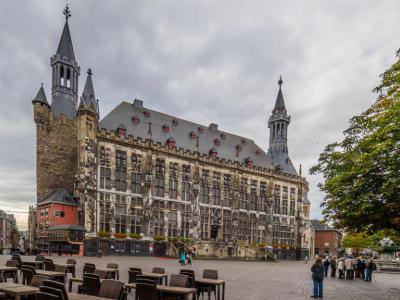
3) Rathaus (Town Hall) (must see)
Nestled between Aachen’s two main squares-Market Square and Katschhof Square-the Town Hall is a magnificent reminder of the city’s imperial past. Dating back to the early 14th century, this storied building still serves as the headquarters for the mayor and city council. In its prime, it hosted the lavish coronation banquets for Holy Roman Emperors, who were crowned in Aachen Cathedral. From 936 to 1531, 31 emperors took their vows here, and the monumental Coronation Hall still echoes with that regal history. Step inside, and you’ll find faithful replicas of the imperial regalia-the crown, sword, and gospel book of medieval rulers.
But the Town Hall’s history goes even deeper. It’s built atop the remains of Charlemagne’s original palace, and elements of the Carolingian dynasty are woven into its very walls. Look closely at the south wall to spot the ancient masonry that survived centuries of change.
And change it did. Fires repeatedly damaged the building, prompting reconstructions that gave it a constantly evolving appearance. After the Great Fire of Aachen in 1656, the roof and towers were rebuilt in a baroque style. By the 18th century, gothic adornments were stripped away, and the baroque trend took hold. However, in the 19th century, a neo-gothic restoration project sought to revive the Town Hall’s medieval charm, adding frescoes that told Charlemagne’s legendary tales and statues of kings and symbolic figures along its facade.
Even World War II could not topple this resilient landmark. Bombing raids left the towers twisted and charred, but emergency beams prevented a total collapse. It wasn’t until the late 1960s that the towers were finally rebuilt, restoring the structure’s iconic skyline presence.
Today, the Town Hall not only stands as a monument to Aachen’s imperial past, but it also hosts the prestigious Charlemagne Prize ceremony, honoring those who have advanced the cause of European unity. Past recipients include Pope John Paul II, US President Bill Clinton, and German Chancellor Angela Merkel-proof that this historic hall remains at the heart of Europe’s ongoing story.
But the Town Hall’s history goes even deeper. It’s built atop the remains of Charlemagne’s original palace, and elements of the Carolingian dynasty are woven into its very walls. Look closely at the south wall to spot the ancient masonry that survived centuries of change.
And change it did. Fires repeatedly damaged the building, prompting reconstructions that gave it a constantly evolving appearance. After the Great Fire of Aachen in 1656, the roof and towers were rebuilt in a baroque style. By the 18th century, gothic adornments were stripped away, and the baroque trend took hold. However, in the 19th century, a neo-gothic restoration project sought to revive the Town Hall’s medieval charm, adding frescoes that told Charlemagne’s legendary tales and statues of kings and symbolic figures along its facade.
Even World War II could not topple this resilient landmark. Bombing raids left the towers twisted and charred, but emergency beams prevented a total collapse. It wasn’t until the late 1960s that the towers were finally rebuilt, restoring the structure’s iconic skyline presence.
Today, the Town Hall not only stands as a monument to Aachen’s imperial past, but it also hosts the prestigious Charlemagne Prize ceremony, honoring those who have advanced the cause of European unity. Past recipients include Pope John Paul II, US President Bill Clinton, and German Chancellor Angela Merkel-proof that this historic hall remains at the heart of Europe’s ongoing story.
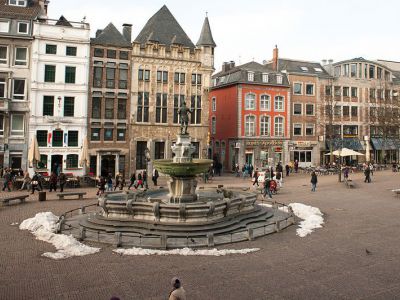
4) Marktplatz (Market Square) (must see)
Aachen’s Market Square has long been a focal point of city life. Located in the heart of the historic center, it has been a gathering spot since medieval times. Here, traders once peddled their wares, locals swapped gossip, and grand celebrations lit up the town. Over the centuries, this place has been the stage for coronations, civic announcements, and daily commerce. Its central location, surrounded by landmark buildings, ensures it remains a vibrant gathering spot.
At the heart of the square is Aachen’s Gothic Town Hall, built in the 14th century on the remnants of Charlemagne’s former palace. Not far from this stately structure, the Market Fountain draws the eye. With its elegant Renaissance flair and bronze statue of Charlemagne, this iconic monument has become one of Aachen’s most recognizable symbols, celebrating the city’s ties to the legendary emperor.
Just to the north, in the courtyard of the Karlshof building, the Karlshof Fountain steals the show. A modern masterpiece from 1969, its seven sides each depict one of the Seven Free Arts of Roman antiquity-grammar, rhetoric, logic, arithmetic, geometry, music, and astronomy.
As you stroll across the square, it’s hard to resist the charm of cozy cafes and shops. You might catch yourself nibbling sweet Aachener Printen gingerbread, or perhaps sipping a perfectly rich coffee-either way, you'll be immersed in history, elegance, and an lively atmosphere. Throughout the year, the square transforms for festivals, open-air markets, and the beloved Christmas Market, which draws visitors from near and far.
At the heart of the square is Aachen’s Gothic Town Hall, built in the 14th century on the remnants of Charlemagne’s former palace. Not far from this stately structure, the Market Fountain draws the eye. With its elegant Renaissance flair and bronze statue of Charlemagne, this iconic monument has become one of Aachen’s most recognizable symbols, celebrating the city’s ties to the legendary emperor.
Just to the north, in the courtyard of the Karlshof building, the Karlshof Fountain steals the show. A modern masterpiece from 1969, its seven sides each depict one of the Seven Free Arts of Roman antiquity-grammar, rhetoric, logic, arithmetic, geometry, music, and astronomy.
As you stroll across the square, it’s hard to resist the charm of cozy cafes and shops. You might catch yourself nibbling sweet Aachener Printen gingerbread, or perhaps sipping a perfectly rich coffee-either way, you'll be immersed in history, elegance, and an lively atmosphere. Throughout the year, the square transforms for festivals, open-air markets, and the beloved Christmas Market, which draws visitors from near and far.
5) Krämerstraße (Kramer Street)
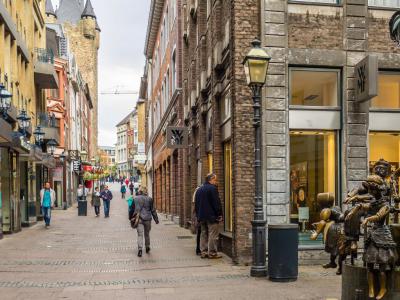
One of Aachen’s most enchanting pedestrian streets, Krämer is the quintessential blend of medieval charm and modern-day flair. Just a short stroll from the Cathedral, this quaint lane has its roots in the medieval trade that once defined the city’s marketplace. Even its name-Krämer-nods to the merchants who made this street their home, trading in everything from fine cloth to aromatic spices.
Strolling down the street today, you’ll find an array of boutiques, specialty shops, and cozy cafes. The narrow pathway is lined with beautifully preserved historic facades that provide the perfect backdrop for a few snapshots. Many of the buildings retain their medieval and Renaissance elements, giving you a sense of the street’s centuries-old heritage.
Notable historic structures include the Postwagen, Ratskeller, and Eulenspiegel houses, all dating back to the mid-17th century. Once crucial fixtures near the Town Hall, they now host upscale restaurants where history and fine dining meet. Another standout is Number 29, a three-story brick beauty from 1656 with a curved façade and a quirky round staircase tucked into the right half of the building.
As you wander along, keep an eye out for whimsical art installations and fountains. The Dolls’ Fountain delights visitors with its playful figures, while the Chicken Thief Fountain near the street’s northern end has a storied past. Originally unveiled at the 1913 Christmas Market, the fountain portrays a hapless chicken thief betrayed by a crowing rooster. Though the original was lost in World War II, the fountain was lovingly recreated in 1950.
Strolling down the street today, you’ll find an array of boutiques, specialty shops, and cozy cafes. The narrow pathway is lined with beautifully preserved historic facades that provide the perfect backdrop for a few snapshots. Many of the buildings retain their medieval and Renaissance elements, giving you a sense of the street’s centuries-old heritage.
Notable historic structures include the Postwagen, Ratskeller, and Eulenspiegel houses, all dating back to the mid-17th century. Once crucial fixtures near the Town Hall, they now host upscale restaurants where history and fine dining meet. Another standout is Number 29, a three-story brick beauty from 1656 with a curved façade and a quirky round staircase tucked into the right half of the building.
As you wander along, keep an eye out for whimsical art installations and fountains. The Dolls’ Fountain delights visitors with its playful figures, while the Chicken Thief Fountain near the street’s northern end has a storied past. Originally unveiled at the 1913 Christmas Market, the fountain portrays a hapless chicken thief betrayed by a crowing rooster. Though the original was lost in World War II, the fountain was lovingly recreated in 1950.
6) Puppenbrunnen (Dolls' Fountain) (must see)
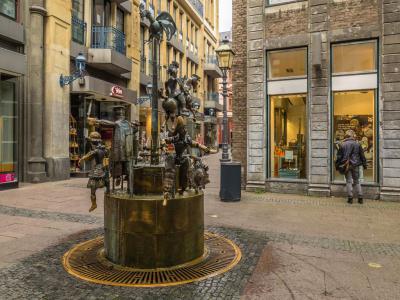
The Dolls’ Fountain is pure whimsy in bronze form, tucked near the Cathedral in Aachen’s picturesque old town. Dreamed up by local sculptor Bonifatius Stirnberg and installed in 1975, this playful fountain isn’t just for show-it’s for play. Its bronze figurines, from a market woman and a professor to a rooster and a clown, all have swiveling joints. That’s right-these aren’t your typical static statues. You can twist, turn, and pose them, turning a quick stop at the fountain into a hands-on history lesson for all ages.
The figures themselves each tell a story, nodding to Aachen’s rich past and present. The market woman reflects the city’s trading roots, the horse and rider represent riding tournaments, and the professor with his monocle tips his hat to Aachen’s universities and intellectual history. Even the rooster at the top hints at the city’s musical talents, although some claim it points to the times of the French occupation. Meanwhile, the doll pays tribute to Aachen’s long textile history, and the clown and masks channel the city’s cheerful, celebratory spirit.
It’s more than a fountain; it’s a conversation starter, a photo opportunity, and moment of interactive joy for kids, parents, and curious passersby. So as you stroll past this delightful landmark, don’t just look-step right up, turn a figure or two, and let Aachen’s colorful past come alive, one moveable joint at a time.
The figures themselves each tell a story, nodding to Aachen’s rich past and present. The market woman reflects the city’s trading roots, the horse and rider represent riding tournaments, and the professor with his monocle tips his hat to Aachen’s universities and intellectual history. Even the rooster at the top hints at the city’s musical talents, although some claim it points to the times of the French occupation. Meanwhile, the doll pays tribute to Aachen’s long textile history, and the clown and masks channel the city’s cheerful, celebratory spirit.
It’s more than a fountain; it’s a conversation starter, a photo opportunity, and moment of interactive joy for kids, parents, and curious passersby. So as you stroll past this delightful landmark, don’t just look-step right up, turn a figure or two, and let Aachen’s colorful past come alive, one moveable joint at a time.
7) Aachener Dom (Aachen Cathedral) (must see)
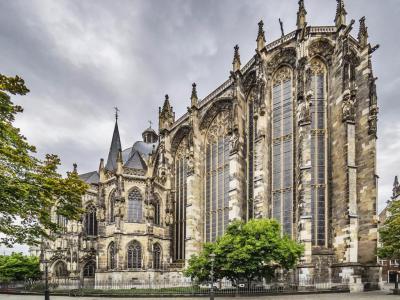
Aachen Cathedral, also known as the Imperial Cathedral, is a true heavyweight in Germany’s lineup of iconic landmarks. Built in the late 8th century at the behest of Charlemagne, this architectural gem earned the honor of becoming the first German site inscribed on UNESCO’s World Heritage list in 1978.
At its core is the magnificent Palatine Chapel, a crowning achievement of Carolingian design that proudly reflects Charlemagne’s lofty dream of crafting a “new Rome” right in the heart of Europe. Inspired by Byzantine influences, the chapel’s octagonal shape is rich with symbolic meaning: eight sides evoke the eighth day and the resurrection of Christ, while recurring multiples of ten embody medieval notions of architectural perfection. Case in point: the dome’s height and the building’s diameter each measure a perfect 100 Carolingian feet. Multiples of ten were considered perfect and complete, so the precise use of 100 feet emphasized divine order and the chapel’s role as a sacred space.
After Charlemagne’s passing, the chapel became his final resting place and soon cemented its status as a centerpiece of medieval power. Between 936 and 1531, no fewer than 31 German kings and 12 queens were crowned in the cathedral, leaving an indelible mark on its legacy as a cornerstone of royal tradition.
The cathedral’s Treasury ranks among Europe’s most revered church treasuries. Inside, you’ll find the Throne of Charlemagne, the four great Aachen relics-including a cloak attributed to the Virgin Mary-and the Pala d’Oro, a dazzling golden altar screen.
As the centuries rolled by, the structure expanded and evolved, blending the strength of Carolingian architecture with the soaring elegance of Gothic design and later additions. The awe-inspiring 13th-century choir hall, with its intricate stained-glass windows, serves as a spectacular counterpoint to the original 8th-century structure.
Today, Aachen Cathedral stands tall as a breathtaking reminder of Charlemagne’s visionary legacy, the unmatched craftsmanship of the Middle Ages, and the enduring beauty of a masterpiece shaped by history.
At its core is the magnificent Palatine Chapel, a crowning achievement of Carolingian design that proudly reflects Charlemagne’s lofty dream of crafting a “new Rome” right in the heart of Europe. Inspired by Byzantine influences, the chapel’s octagonal shape is rich with symbolic meaning: eight sides evoke the eighth day and the resurrection of Christ, while recurring multiples of ten embody medieval notions of architectural perfection. Case in point: the dome’s height and the building’s diameter each measure a perfect 100 Carolingian feet. Multiples of ten were considered perfect and complete, so the precise use of 100 feet emphasized divine order and the chapel’s role as a sacred space.
After Charlemagne’s passing, the chapel became his final resting place and soon cemented its status as a centerpiece of medieval power. Between 936 and 1531, no fewer than 31 German kings and 12 queens were crowned in the cathedral, leaving an indelible mark on its legacy as a cornerstone of royal tradition.
The cathedral’s Treasury ranks among Europe’s most revered church treasuries. Inside, you’ll find the Throne of Charlemagne, the four great Aachen relics-including a cloak attributed to the Virgin Mary-and the Pala d’Oro, a dazzling golden altar screen.
As the centuries rolled by, the structure expanded and evolved, blending the strength of Carolingian architecture with the soaring elegance of Gothic design and later additions. The awe-inspiring 13th-century choir hall, with its intricate stained-glass windows, serves as a spectacular counterpoint to the original 8th-century structure.
Today, Aachen Cathedral stands tall as a breathtaking reminder of Charlemagne’s visionary legacy, the unmatched craftsmanship of the Middle Ages, and the enduring beauty of a masterpiece shaped by history.

8) Kreislauf des Geldes ("Money Cycle" Fountain)
Fountain “Circulation of Money” or Kreislauf des Geldes is an original fountain and interesting landmark in Aachen. Situated in the historic centre near Elisengarten, it was created by Karl-Henning Seemann in 1976. Depicting the circulation of money, the fountain presents six bronze figures: a woman that symbolizes the thrift, while the leaning man shows the avarice. You can also see a father with his child explaining how to deal with money. The centrifugal movement of water exemplifies the steady flow of money.
9) Elisenbrunnen (Elise Fountain) (must see)
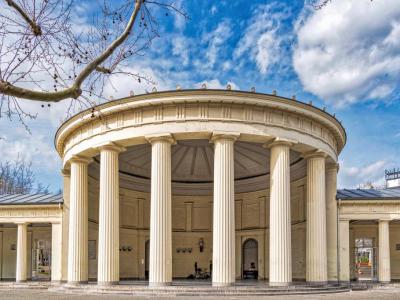
The Elise Fountain is one of Aachen’s most famous landmarks, a neoclassical masterpiece that has been drawing visitors since 1827. With its grand colonnade and two charming pavilions, it exudes an air of old-world elegance.
Named after Princess Elisabeth Ludovika of Bavaria-later the Queen of Prussia-who visited Aachen in her younger years, the fountain sits atop the city’s legendary hot springs. These springs have been bubbling away since Roman times, celebrated for their therapeutic properties. Inside, two fountains still flow with that famous mineral-rich water. A quick warning, though: the distinct sulfur aroma might not be to your taste, and officially, the water is considered a medicinal product, so no casual sipping unless you’ve got a prescription!
Back in the 19th century, this was the go-to hangout for Europe’s upper crust-royalty, politicians, and artists flocked here to “take the waters” and rub elbows. Over the years, the fountain has become a proud symbol of Aachen’s spa tradition and its reputation as a cultural meeting point.
Although it suffered damage during World War II, the structure rose from the ashes and was carefully restored. Today, it remains a popular gathering place in the city center. Snap a photo against its stately colonnade, or peek inside to see those famous thermal waters.
Named after Princess Elisabeth Ludovika of Bavaria-later the Queen of Prussia-who visited Aachen in her younger years, the fountain sits atop the city’s legendary hot springs. These springs have been bubbling away since Roman times, celebrated for their therapeutic properties. Inside, two fountains still flow with that famous mineral-rich water. A quick warning, though: the distinct sulfur aroma might not be to your taste, and officially, the water is considered a medicinal product, so no casual sipping unless you’ve got a prescription!
Back in the 19th century, this was the go-to hangout for Europe’s upper crust-royalty, politicians, and artists flocked here to “take the waters” and rub elbows. Over the years, the fountain has become a proud symbol of Aachen’s spa tradition and its reputation as a cultural meeting point.
Although it suffered damage during World War II, the structure rose from the ashes and was carefully restored. Today, it remains a popular gathering place in the city center. Snap a photo against its stately colonnade, or peek inside to see those famous thermal waters.
