Custom Walk in Siena, Italy by vatunas_7f542 created on 2025-05-10
Guide Location: Italy » Siena
Guide Type: Custom Walk
# of Sights: 5
Tour Duration: 1 Hour(s)
Travel Distance: 2.7 Km or 1.7 Miles
Share Key: KFBXG
Guide Type: Custom Walk
# of Sights: 5
Tour Duration: 1 Hour(s)
Travel Distance: 2.7 Km or 1.7 Miles
Share Key: KFBXG
How It Works
Please retrieve this walk in the GPSmyCity app. Once done, the app will guide you from one tour stop to the next as if you had a personal tour guide. If you created the walk on this website or come to the page via a link, please follow the instructions below to retrieve the walk in the app.
Retrieve This Walk in App
Step 1. Download the app "GPSmyCity: Walks in 1K+ Cities" on Apple App Store or Google Play Store.



Step 2. In the GPSmyCity app, download(or launch) the guide "Siena Map and Walking Tours".
Step 3. Tap the menu button located at upper right corner of the "Walks" screen and select "Retrieve custom walk". Enter the share key: KFBXG
1) Piazza del Campo (Campo Square) (must see)
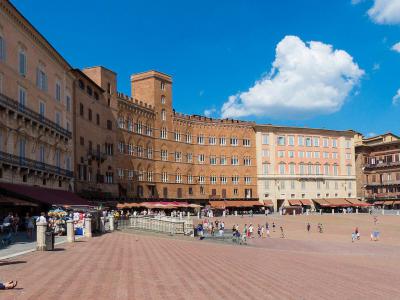
The Campo Square on the site where three ancient towns met and where three main roads intersect. The square was designed to be a gathering site where the entire town could meet and celebrate holidays, enjoy games, or attend political events.
The Campo Square features a red brick fishtail design that was laid in 1349. Eight lines of white travertine cut through the red brick, creating nine sections. The nine sections represent the nine ruling governors who maintained peace and prosperity in Siena from 1291-1355.
The sections also represent the folds of the Virgin Mary's cloak. The Virgin Mary was Siena's patron saint and considered Siena's ultimate ruler. The nine sections radiate out from the central water drain in front of the Public Palace.
In 1297, the government created guidelines to ensure buildings had a congruent appearance. Therefore, many gorgeous, harmonious buildings face Campo Square. The most notable building in the square is the medieval Gothic Public Palace which was home to the Government of Nine and now houses the Civic Museum.
The Joyous Fountain was built in 1346, and the intricate marble carvings were added in 1409. Underground tunnels feed the Joyous Fountain.
The Palio di Siena, a popular horse race, is held twice a year. The course runs around the edge of the Campo Square and fans pack the square. The yearly road cycling race Strade Bianche finishes at the square. In addition, the Campo Square hosts various Carnival festivities every February.
Why You Should Visit:
The Campo Square is known as one of the most beautiful medieval squares in Italy. This gorgeously preserved square is the heart and soul of Siena and the perfect place to immerse yourself in Siena's culture and history.
Tips:
Enjoy a glass of wine, gelato, or coffee in one of the many cafes and restaurants. Watch the activity in the square and listen for the tower bells ringing.
The Campo Square features a red brick fishtail design that was laid in 1349. Eight lines of white travertine cut through the red brick, creating nine sections. The nine sections represent the nine ruling governors who maintained peace and prosperity in Siena from 1291-1355.
The sections also represent the folds of the Virgin Mary's cloak. The Virgin Mary was Siena's patron saint and considered Siena's ultimate ruler. The nine sections radiate out from the central water drain in front of the Public Palace.
In 1297, the government created guidelines to ensure buildings had a congruent appearance. Therefore, many gorgeous, harmonious buildings face Campo Square. The most notable building in the square is the medieval Gothic Public Palace which was home to the Government of Nine and now houses the Civic Museum.
The Joyous Fountain was built in 1346, and the intricate marble carvings were added in 1409. Underground tunnels feed the Joyous Fountain.
The Palio di Siena, a popular horse race, is held twice a year. The course runs around the edge of the Campo Square and fans pack the square. The yearly road cycling race Strade Bianche finishes at the square. In addition, the Campo Square hosts various Carnival festivities every February.
Why You Should Visit:
The Campo Square is known as one of the most beautiful medieval squares in Italy. This gorgeously preserved square is the heart and soul of Siena and the perfect place to immerse yourself in Siena's culture and history.
Tips:
Enjoy a glass of wine, gelato, or coffee in one of the many cafes and restaurants. Watch the activity in the square and listen for the tower bells ringing.
2) Duomo di Siena (Siena Cathedral) (must see)
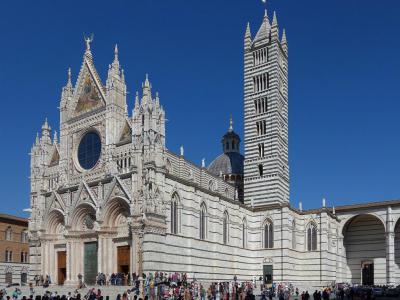
Siena Cathedral is one of Italy's most exquisite Cathedrals. The Cathedral was completed in 1263 on the site of a church dating to the 9th century. This stunning Cathedral has a transept, a dome, and a bell tower and features artwork from Italy's most prominent artists.
The dome has a hexagonal base and supporting columns. Famous sculptor Gian Lorenzo Bernini designed the lantern on top of the dome. The bell tower features six bells; the oldest bell was cast in 1149. The Cathedral was built with white and dark-colored marble in alternating stripes. White and black are the colors of Siena and represent the white and black horses of the city's founders, Senius and Aschius.
Giovanni Pisano, Nicola Pisano's son, created the west facade with carved sculptures of the prophets and philosophers. The original sculptures are now housed in the Cathedral Treasures Museum, while copies are displayed in the facade.
The mosaic inlay floor is the Cathedral's prized possession and has been called the most beautiful floor ever made. Fifty-six inlay panels were drawn by various Sienese artists and transposed into the marble mosaic inlay.
The most celebrated Italian artists created artwork on display in the Cathedral. Donatello created a statue of Saint John the Baptist in the Saint John the Baptist chape. Michelangelo carved four statues, Saint Peter, Saint Paul, Saint Pius, and Saint Augustine, for the Piccolomini altar. Gian Lorenzo Bernini carved the statues of Saint Mary Magdalen and Saint Jerome in the Chapel of the Vow. Nicola Pisano carved the pulpit that can be seen in the north transept.
A copy of Duccio di Boninsegna's stained glass window is on display. The original is in the Cathedral Treasures Museum. Several other notable stained glass works beautify the Cathedral.
The Cathedral Choir features eight wood-carved inlays by Fra Giovanni da Verona. Underneath the choir, a narthex, long filled with rubble, was excavated between 1999 and 2003. The excavation uncovered 13th-century frescoes depicting scenes from the life of Christ.
Why You Should Visit:
The Siena Cathedral is regarded as one of the most beautiful Cathedrals in Italy and shows the pinnacle of Siena's beauty and commitment to artistry. Statues by Donatello, Michelangelo, and Bernini are just some of the artworks on display.
Tips:
Inside the main entrance, there's a sign with a map of the Cathedral's floorplan. Take a photo of this map with your phone, so you don't get lost as you explore the massive Cathedral and take in all the sights.
The Cathedral is open until 7 pm and is less crowded in the early evening. The floor is only uncovered during specific dates; check online to see if the floor is uncovered during your visit.
The dome has a hexagonal base and supporting columns. Famous sculptor Gian Lorenzo Bernini designed the lantern on top of the dome. The bell tower features six bells; the oldest bell was cast in 1149. The Cathedral was built with white and dark-colored marble in alternating stripes. White and black are the colors of Siena and represent the white and black horses of the city's founders, Senius and Aschius.
Giovanni Pisano, Nicola Pisano's son, created the west facade with carved sculptures of the prophets and philosophers. The original sculptures are now housed in the Cathedral Treasures Museum, while copies are displayed in the facade.
The mosaic inlay floor is the Cathedral's prized possession and has been called the most beautiful floor ever made. Fifty-six inlay panels were drawn by various Sienese artists and transposed into the marble mosaic inlay.
The most celebrated Italian artists created artwork on display in the Cathedral. Donatello created a statue of Saint John the Baptist in the Saint John the Baptist chape. Michelangelo carved four statues, Saint Peter, Saint Paul, Saint Pius, and Saint Augustine, for the Piccolomini altar. Gian Lorenzo Bernini carved the statues of Saint Mary Magdalen and Saint Jerome in the Chapel of the Vow. Nicola Pisano carved the pulpit that can be seen in the north transept.
A copy of Duccio di Boninsegna's stained glass window is on display. The original is in the Cathedral Treasures Museum. Several other notable stained glass works beautify the Cathedral.
The Cathedral Choir features eight wood-carved inlays by Fra Giovanni da Verona. Underneath the choir, a narthex, long filled with rubble, was excavated between 1999 and 2003. The excavation uncovered 13th-century frescoes depicting scenes from the life of Christ.
Why You Should Visit:
The Siena Cathedral is regarded as one of the most beautiful Cathedrals in Italy and shows the pinnacle of Siena's beauty and commitment to artistry. Statues by Donatello, Michelangelo, and Bernini are just some of the artworks on display.
Tips:
Inside the main entrance, there's a sign with a map of the Cathedral's floorplan. Take a photo of this map with your phone, so you don't get lost as you explore the massive Cathedral and take in all the sights.
The Cathedral is open until 7 pm and is less crowded in the early evening. The floor is only uncovered during specific dates; check online to see if the floor is uncovered during your visit.
3) Fortezza Medicea (Medici Fortress)
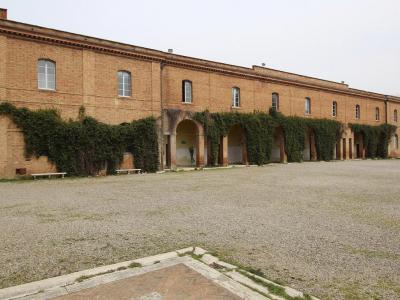
The Medici Fortress (Fortezza Medicea), also known as the Fort of Santa Barbara, stands as a historical monument in Siena, located near the San Prospero District adjacent to the Stadio Artemio Franchi. This fortress has a rich history tied to the power struggles and political dynamics of Renaissance Italy.
The construction of the Medici Fortress was commissioned by Cosimo I de' Medici following the Florentine conquest of Siena. The site was previously occupied by a fort built by Charles V, King of Spain, after the Spanish conquest of Siena in 1548. This earlier fort was destroyed in 1552 when the Sienese rebelled against the Spanish occupation. In its place, Cosimo I established the Medici Fortress in 1560 to consolidate Florentine control and prevent further uprisings by the Sienese.
Originally constructed with an L-shaped layout, the fortress was later redesigned into a square shape by the Medici's military engineer, Baldassarre Lanci, signifying the complete establishment of Medici power in the region. The fortress features robust brick-built ramparts at each of its four corners. Notably, three corners bear the Medici coat of arms above the head of a lion, symbolizing the family's authority, while the south-facing corner displays only the head of a lion.
The fortress was demilitarized towards the end of the 18th century and subsequently integrated into the public and cultural life of Siena. A significant restoration in 1937 transformed the fortress into a public park, which now includes an Enoteca that promotes the local wine industry. Today, the fortress serves as a vibrant cultural hub, hosting art exhibitions, festivals, and concerts. It is also the home of the Siena Jazz Foundation.
The structure itself is impressive, with internal dimensions measuring approximately 180 by 125 meters and external dimensions around 270 by 200 meters. Including the outer walls, the fortress has an external perimeter of about 1,500 meters. This grand size and its historical significance make the Medici Fortress a landmark of both architectural and cultural importance in Siena.
The construction of the Medici Fortress was commissioned by Cosimo I de' Medici following the Florentine conquest of Siena. The site was previously occupied by a fort built by Charles V, King of Spain, after the Spanish conquest of Siena in 1548. This earlier fort was destroyed in 1552 when the Sienese rebelled against the Spanish occupation. In its place, Cosimo I established the Medici Fortress in 1560 to consolidate Florentine control and prevent further uprisings by the Sienese.
Originally constructed with an L-shaped layout, the fortress was later redesigned into a square shape by the Medici's military engineer, Baldassarre Lanci, signifying the complete establishment of Medici power in the region. The fortress features robust brick-built ramparts at each of its four corners. Notably, three corners bear the Medici coat of arms above the head of a lion, symbolizing the family's authority, while the south-facing corner displays only the head of a lion.
The fortress was demilitarized towards the end of the 18th century and subsequently integrated into the public and cultural life of Siena. A significant restoration in 1937 transformed the fortress into a public park, which now includes an Enoteca that promotes the local wine industry. Today, the fortress serves as a vibrant cultural hub, hosting art exhibitions, festivals, and concerts. It is also the home of the Siena Jazz Foundation.
The structure itself is impressive, with internal dimensions measuring approximately 180 by 125 meters and external dimensions around 270 by 200 meters. Including the outer walls, the fortress has an external perimeter of about 1,500 meters. This grand size and its historical significance make the Medici Fortress a landmark of both architectural and cultural importance in Siena.
4) Fonte Gaia (Gaia Fountain) (must see)
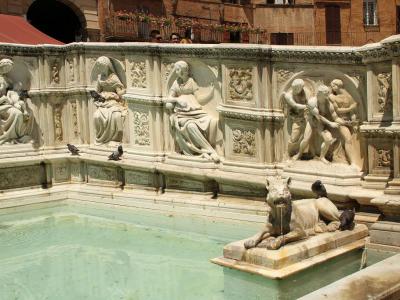
The Gaia Fountain is a monumental fountain located opposite the Public Palace on the high side of Campo Square in Siena. Surrounded by fences, the fountain is a protected monument in the city. The Gaia Fountain was designed by local sculptor, Jacopo della Quercia, in 1419, in keeping with the style traditional for Sienese fountains. It consisted of a rectangular basin surrounded by a high parapet on three sides. The parapet was covered with bas reliefs. The bas reliefs depicted the creation of Adam and the flight from the Garden of Eden. The long section has a statue of the Madonna and the Child surrounded by allegories of the virtues.
The fountain was placed on the site of a previous one, created in 1346. It got its name from the celebrations that took place when water flowed from the fountain for the first time. Legend holds that the fountain was met with much joy, and thus the name Gaia or joyous. Others suggest the term Gaia refers to the Latin term for "bride", and that the fountain was dedicated to the bride of God and patron of Siena, the Virgin Mary. The original panels, created by Jacopo della Quercia, fell into disrepair in the 19th century. Tito Sarrochi reproduced the originals, while the old panels were removed and displayed in the loggia of the Public Palace.
The fountain was placed on the site of a previous one, created in 1346. It got its name from the celebrations that took place when water flowed from the fountain for the first time. Legend holds that the fountain was met with much joy, and thus the name Gaia or joyous. Others suggest the term Gaia refers to the Latin term for "bride", and that the fountain was dedicated to the bride of God and patron of Siena, the Virgin Mary. The original panels, created by Jacopo della Quercia, fell into disrepair in the 19th century. Tito Sarrochi reproduced the originals, while the old panels were removed and displayed in the loggia of the Public Palace.
5) Palazzo Pubblico (Public Palace) (must see)
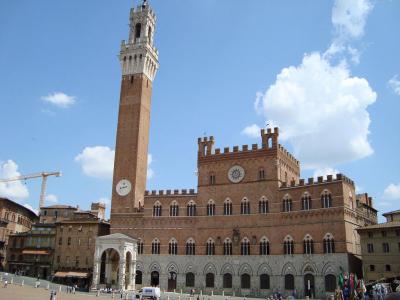
The Public Palace was completed in 1308 after being commissioned by the Council of Nine. It is a fine example of traditional Italian medieval architecture. The first floor is light-colored stone, and the upper floors are made of red brick. The facade is slightly curved inwards to reflect the curve of the Campo Square.
In the center of the facade, you will notice a round bronze plate. The Christogram plate was placed in 1425 to honor Saint Bernardino, whose sermons eased social unrest.
The triforate windows are an architectural specialty unique to Siena. The windows are divided with three arches resting on columns. Visitors will also notice the balzana, or coat of arms of the Town Council of Siena.
The attached bell tower, Mangia Tower, was completed in 1348. It stands at 102 meters, the same height as the Siena Cathedral. The height is also equal to the radius of the square. This was deliberate to show that the church and the state had equal power. The Mangia Tower has a gray upper loggia and a red brick base.
The Piazza Chapel was added in 1352 and features marble statues. The lower loggia was added to fulfill a promise that Black Death survivors made to the Holy Virgin. Visitors can climb the Mangia Tower for panaramic views of Siena.
The Public Palace housed the Council of Nine, who were chosen from the general public by lot. The Council of Nine lived in the palace to avoid outside influence and served for just two months before being replaced by the next set of members. The Public Palace also housed the 500 parliamentary members known as the Grand Council.
The internal courtyard is decorated with the coat of arms of families who served on the Council of Nine. Here, you can enter the Civic Museum and see all the world-class frescoes.
Why You Should Visit:
The Public Palace is the crown of Campo Square and a great example of Siena's impressive architecture.
Tips:
You can purchase a combined ticket to climb the Mangia Tower and visit the Civic Museum. Arrive early as the tower tickets sell out fast.
In the center of the facade, you will notice a round bronze plate. The Christogram plate was placed in 1425 to honor Saint Bernardino, whose sermons eased social unrest.
The triforate windows are an architectural specialty unique to Siena. The windows are divided with three arches resting on columns. Visitors will also notice the balzana, or coat of arms of the Town Council of Siena.
The attached bell tower, Mangia Tower, was completed in 1348. It stands at 102 meters, the same height as the Siena Cathedral. The height is also equal to the radius of the square. This was deliberate to show that the church and the state had equal power. The Mangia Tower has a gray upper loggia and a red brick base.
The Piazza Chapel was added in 1352 and features marble statues. The lower loggia was added to fulfill a promise that Black Death survivors made to the Holy Virgin. Visitors can climb the Mangia Tower for panaramic views of Siena.
The Public Palace housed the Council of Nine, who were chosen from the general public by lot. The Council of Nine lived in the palace to avoid outside influence and served for just two months before being replaced by the next set of members. The Public Palace also housed the 500 parliamentary members known as the Grand Council.
The internal courtyard is decorated with the coat of arms of families who served on the Council of Nine. Here, you can enter the Civic Museum and see all the world-class frescoes.
Why You Should Visit:
The Public Palace is the crown of Campo Square and a great example of Siena's impressive architecture.
Tips:
You can purchase a combined ticket to climb the Mangia Tower and visit the Civic Museum. Arrive early as the tower tickets sell out fast.
