Custom Walk in Palma de Mallorca, Spain by 1paulajohnson_2bb3a created on 2025-05-13
Guide Location: Spain » Palma de Mallorca
Guide Type: Custom Walk
# of Sights: 8
Tour Duration: 3 Hour(s)
Travel Distance: 8.1 Km or 5 Miles
Share Key: MKRUP
Guide Type: Custom Walk
# of Sights: 8
Tour Duration: 3 Hour(s)
Travel Distance: 8.1 Km or 5 Miles
Share Key: MKRUP
How It Works
Please retrieve this walk in the GPSmyCity app. Once done, the app will guide you from one tour stop to the next as if you had a personal tour guide. If you created the walk on this website or come to the page via a link, please follow the instructions below to retrieve the walk in the app.
Retrieve This Walk in App
Step 1. Download the app "GPSmyCity: Walks in 1K+ Cities" on Apple App Store or Google Play Store.



Step 2. In the GPSmyCity app, download(or launch) the guide "Palma de Mallorca Map and Walking Tours".
Step 3. Tap the menu button located at upper right corner of the "Walks" screen and select "Retrieve custom walk". Enter the share key: MKRUP
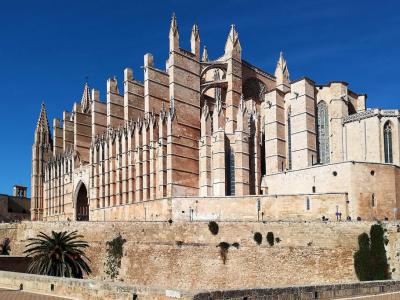
1) Palma Cathedral (must see)
James I of Aragon was in grave danger. On his way to conquer the Balearic Islands in December, 1229, his fleet of ships was overtaken by a violent storm. In peril of foundering, young James swore to God that if he survived and conquered Mallorca, he would build there a great cathedral.
God held him to it. Construction began in 1230 on the Palma Cathedral or La Seu, as it is popularly known. Building went on for 350 years. Finally the nave and the main portal, the last elements, were finished. James had really kept his promise. The dimensions of the church are vast: width, 108 feet; height, 145 feet; length, 361 feet.
The nave, last to be finished, is among the largest in Europe. A Gothic rose window dominates the eastern wall. It has a diameter of 41 feet and it is composed of around 1200 pieces of stained glass. Every sunrise the cathedral interior is flooded with sparkling reflections of colors in the morning light. But there is more to this light.
There is a game, called "Light Game of the Eight." The game occurs just twice a year, on February 2nd and November 11th. At 8am the rays of the sun shine through the rosette window on the eastern wall and project the image of the window exactly on the opposite wall below the rosette of the main facade.
But there is yet more to this light. Twenty days on each side of the winter solstice the sunrise is viewable through both enormous rosettes.
The cathedral shows a range of architectural styles. There are clearly Gothic influences in the seaward facing portal that date from the 13th century. The portal on the opposite side is late Gothic from the 16th century. The Gothic is replaced by the Renaissance. The chapels are Baroque. There is Classicism in the Baptistry.
Two kings, James II and James III, are laid to rest in the Trinity Chapel. The chapel is not open to the public. Visitors are charged a small entrance fee. The cathedral is open after 10 am.
Why You Should Visit:
Here is all uplifting spirit of Mallorca spelled out in stone and light. The great cathedral reaches for the sky as the soul might reach for heaven.
God held him to it. Construction began in 1230 on the Palma Cathedral or La Seu, as it is popularly known. Building went on for 350 years. Finally the nave and the main portal, the last elements, were finished. James had really kept his promise. The dimensions of the church are vast: width, 108 feet; height, 145 feet; length, 361 feet.
The nave, last to be finished, is among the largest in Europe. A Gothic rose window dominates the eastern wall. It has a diameter of 41 feet and it is composed of around 1200 pieces of stained glass. Every sunrise the cathedral interior is flooded with sparkling reflections of colors in the morning light. But there is more to this light.
There is a game, called "Light Game of the Eight." The game occurs just twice a year, on February 2nd and November 11th. At 8am the rays of the sun shine through the rosette window on the eastern wall and project the image of the window exactly on the opposite wall below the rosette of the main facade.
But there is yet more to this light. Twenty days on each side of the winter solstice the sunrise is viewable through both enormous rosettes.
The cathedral shows a range of architectural styles. There are clearly Gothic influences in the seaward facing portal that date from the 13th century. The portal on the opposite side is late Gothic from the 16th century. The Gothic is replaced by the Renaissance. The chapels are Baroque. There is Classicism in the Baptistry.
Two kings, James II and James III, are laid to rest in the Trinity Chapel. The chapel is not open to the public. Visitors are charged a small entrance fee. The cathedral is open after 10 am.
Why You Should Visit:
Here is all uplifting spirit of Mallorca spelled out in stone and light. The great cathedral reaches for the sky as the soul might reach for heaven.
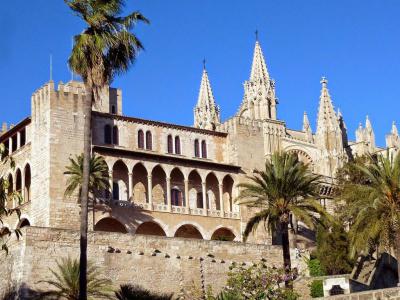
2) Royal Palace of La Almudaina (must see)
The Royal Palace of La Almudaina is an "alcazar", a fortified palace. In 1309 it was rebuilt by King James II of Majorca. The rebuilt was based on the Royal Palace of Perpignan. La Almudaina today follows a layout established in the 14th century. There are spaces for the ruling family, a chapel dedicated to Saint Anne, and the baths.
The spaces are differentiated into ways. On the ground floor a medieval ambience is maintained with art and furnishings dating from the 15th century. The upper floor is reserved for official Royal acts and it is decorated with objects and art from the 17th, 18th and 20th centuries.
The palace is the official summer residence of the Spanish Royal Family. The family also resides at the Palace of Marivent and the Zarzuela Palace in Madrid when not in Mallorca. The Palace and Palma Cathedral are next door neighbors. Both rise over palma de Mallorca harbor, providing great views of the sea.
The Palace is open Thursdays to Sundays from 10am to 6pm. Hours may be longer in the summer. There is a small admission fee.
The spaces are differentiated into ways. On the ground floor a medieval ambience is maintained with art and furnishings dating from the 15th century. The upper floor is reserved for official Royal acts and it is decorated with objects and art from the 17th, 18th and 20th centuries.
The palace is the official summer residence of the Spanish Royal Family. The family also resides at the Palace of Marivent and the Zarzuela Palace in Madrid when not in Mallorca. The Palace and Palma Cathedral are next door neighbors. Both rise over palma de Mallorca harbor, providing great views of the sea.
The Palace is open Thursdays to Sundays from 10am to 6pm. Hours may be longer in the summer. There is a small admission fee.
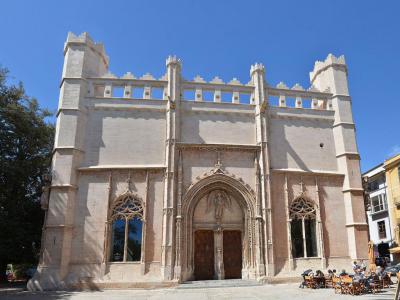
3) La Llotja (The Market) (must see)
La Llotja, the old Maritime Trade Exchange, is a masterpiece of bourgeois Gothic architecture. It may be found next to La Seu, or Palma Cathedral, on the Avenue Gabriel Roca. The Trade Exchange was founded in Barcelona by a privilege granted by King Marti I in 1403. The exchange moved to Mallorca in 1452 to be housed in La Llotja.
The Exchange regulated trade and maintained the port of Palma. Business transactions could be conducted in the la Llotja building. As maritime trade fell off, la Llotja became merely a goods depot. It was an arms factory and arsenal in the Napoleonic wars and after the factory, it was a courthouse. From 1886 to 1962 it was a museum.
Architect Guillem Sanear began construction in 1426. It was completed in 1447 by Guillermo Vilasolar. In 1452 the Maritime Trade Exchange moved in. During this time the building formed a part of the city's defense walls. Four towers were set up on the four corners of the cube-shaped building. The building was almost touched by the sea.
Inside is a single space. Two rows of twisted columns support a vaulted ceiling. Above the main entrance is a sculpture of The Angel of Merchants in the tympanum.
In the last thirty years the Llotja has been a center for art shows, events and political meetings. It has been recently restored and the roof is now a terraced flat roof. Groups may ascend to the roof with permission. It is open daily except Monday.
The Exchange regulated trade and maintained the port of Palma. Business transactions could be conducted in the la Llotja building. As maritime trade fell off, la Llotja became merely a goods depot. It was an arms factory and arsenal in the Napoleonic wars and after the factory, it was a courthouse. From 1886 to 1962 it was a museum.
Architect Guillem Sanear began construction in 1426. It was completed in 1447 by Guillermo Vilasolar. In 1452 the Maritime Trade Exchange moved in. During this time the building formed a part of the city's defense walls. Four towers were set up on the four corners of the cube-shaped building. The building was almost touched by the sea.
Inside is a single space. Two rows of twisted columns support a vaulted ceiling. Above the main entrance is a sculpture of The Angel of Merchants in the tympanum.
In the last thirty years the Llotja has been a center for art shows, events and political meetings. It has been recently restored and the roof is now a terraced flat roof. Groups may ascend to the roof with permission. It is open daily except Monday.

4) Castell de Bellver (Bellver Castle) (must see)
Bellver Castle (Castell de Bellver), perched atop the lush Puig de Sa Mesquida just 3 kilometers west of Palma’s historic core, offers visitors both architectural intrigue and breathtaking vistas. Built between 1300 and 1310 by order of King Jaume II of Mallorca and designed by Pere Salvà (who also worked on the Royal Palace of La Almudaina), this castle is one of the few truly circular fortresses in Europe-its round outer curtain wall, central courtyard, and three surrounding towers seamlessly define its rare form.
Originally conceived as a royal residence, Bellver Castle served the kings of Mallorca only briefly-Jaume II, Sanç I, and Jaume III all stayed for short periods. As political tides shifted, the fortress was repurposed: by the 18th century, it had become a military prison, holding notable figures such as Gaspar Melchor de Jovellanos, and continued in this function through Spain’s wars and civil conflicts until the early 20th century.
Today, the castle is a welcoming cultural icon under the care of Palma’s city government. Inside lies the City History Museum (Museu d’Història de la Ciutat), tracing Palma’s evolution from Roman and Moorish times through to the modern era, with displays of ceramics, maps, sculpture, and city artefacts. Visitors can stroll among the Gothic arches of the two‑level courtyard, climb to the rooftop terrace, and explore the structure’s hidden recesses-from former dungeons to a cistern within the courtyard well.
For tourists, Bellver Castle rewards both curiosity and wonder: artfully blending medieval Gothic elegance with formidable military design, it also offers panoramic views across the Bay of Palma, the Sierra de Tramuntana, and the city rooftops. Surrounded by pine‑clad forest and linked to the city via a scenic uphill walk or local bus route, it’s a must-see landmark whose name, meaning “beautiful view,” lives up to every bit of expectation.
Originally conceived as a royal residence, Bellver Castle served the kings of Mallorca only briefly-Jaume II, Sanç I, and Jaume III all stayed for short periods. As political tides shifted, the fortress was repurposed: by the 18th century, it had become a military prison, holding notable figures such as Gaspar Melchor de Jovellanos, and continued in this function through Spain’s wars and civil conflicts until the early 20th century.
Today, the castle is a welcoming cultural icon under the care of Palma’s city government. Inside lies the City History Museum (Museu d’Història de la Ciutat), tracing Palma’s evolution from Roman and Moorish times through to the modern era, with displays of ceramics, maps, sculpture, and city artefacts. Visitors can stroll among the Gothic arches of the two‑level courtyard, climb to the rooftop terrace, and explore the structure’s hidden recesses-from former dungeons to a cistern within the courtyard well.
For tourists, Bellver Castle rewards both curiosity and wonder: artfully blending medieval Gothic elegance with formidable military design, it also offers panoramic views across the Bay of Palma, the Sierra de Tramuntana, and the city rooftops. Surrounded by pine‑clad forest and linked to the city via a scenic uphill walk or local bus route, it’s a must-see landmark whose name, meaning “beautiful view,” lives up to every bit of expectation.
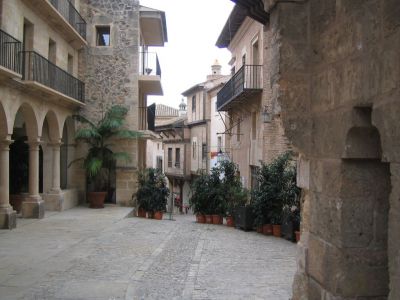
5) Poble Espanyol (Spanish Village)
Spanish Village (Poble Espanyol) is a cultural and architectural showcase located in Palma de Mallorca. Built in 1965, it was designed as an open-air museum to represent the rich diversity of Spanish architecture, crafts, and traditions. The complex spans over 6,000 square meters and features replicas of iconic buildings, streets, and squares from different regions of Spain, offering visitors a condensed tour of the country’s cultural heritage without leaving the island.
The village is divided into distinct sections, each reflecting a particular style or region, from Andalusian courtyards with whitewashed walls to Gothic arches reminiscent of Catalonia. Walking through its cobbled streets feels like stepping into a miniature version of Spain’s most recognizable landmarks. The attention to detail in the replicas provides both an educational experience and a picturesque setting for leisurely exploration.
Beyond its architectural charm, Spanish Village is also a hub for local craftsmanship and cultural events. Visitors can browse artisan workshops, where traditional ceramics, leather goods, and jewelry are made and sold. Seasonal events, including live music performances, wine tastings, and art exhibitions, add to its vibrant atmosphere, making it a lively destination throughout the year.
For tourists seeking a deeper understanding of Spain’s regional variety, Spanish Village offers an accessible and visually striking introduction. Its combination of historical references, cultural activities, and shopping opportunities makes it a popular stop for families, culture enthusiasts, and those looking to enjoy an immersive experience in a unique setting.
The village is divided into distinct sections, each reflecting a particular style or region, from Andalusian courtyards with whitewashed walls to Gothic arches reminiscent of Catalonia. Walking through its cobbled streets feels like stepping into a miniature version of Spain’s most recognizable landmarks. The attention to detail in the replicas provides both an educational experience and a picturesque setting for leisurely exploration.
Beyond its architectural charm, Spanish Village is also a hub for local craftsmanship and cultural events. Visitors can browse artisan workshops, where traditional ceramics, leather goods, and jewelry are made and sold. Seasonal events, including live music performances, wine tastings, and art exhibitions, add to its vibrant atmosphere, making it a lively destination throughout the year.
For tourists seeking a deeper understanding of Spain’s regional variety, Spanish Village offers an accessible and visually striking introduction. Its combination of historical references, cultural activities, and shopping opportunities makes it a popular stop for families, culture enthusiasts, and those looking to enjoy an immersive experience in a unique setting.
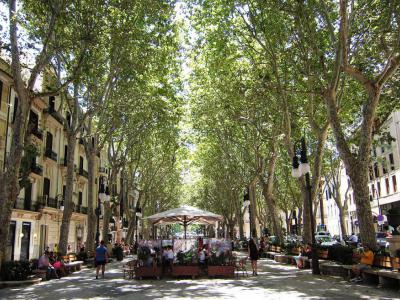
6) Passeig des Born (Born Passage) (must see)
For more than one hundred years, the tree-lined Born Passage has held feasts, demos, events and peaceful strollers. There is a wide promenade and two traffic lanes on either side of the promenade. The promenade was built over the riverbed of the Riera torrent which once divided the city.
The two traffic lanes were laid out for traffic in each direction but now one is mostly pedestrian. The old Born cinema is now a Zara store. The cinema shares space on the promenade with Casal Solleric, an exhibition space formerly a palace. The grand old houses have galleries at street level.
The promenade extends to the Queen's Square and joins the Paseo Maritimo. Jaime III Aenue leads to Juan Carlos I Square, a main commercial spot of Palma. Union Street joins the promenade with Las Ramblas.
Pretend to be stranded and spend an evening walk on the Born Passage. See the Royal Palace of La Almudaina and the Palma Cathedral at night. Then sample some vegan ice cream at a place called Dolce.
In his obsession to possess everything, Francisco Franco called the Born Passage "Paseo Franco" but everyone else preferred "Born".
The two traffic lanes were laid out for traffic in each direction but now one is mostly pedestrian. The old Born cinema is now a Zara store. The cinema shares space on the promenade with Casal Solleric, an exhibition space formerly a palace. The grand old houses have galleries at street level.
The promenade extends to the Queen's Square and joins the Paseo Maritimo. Jaime III Aenue leads to Juan Carlos I Square, a main commercial spot of Palma. Union Street joins the promenade with Las Ramblas.
Pretend to be stranded and spend an evening walk on the Born Passage. See the Royal Palace of La Almudaina and the Palma Cathedral at night. Then sample some vegan ice cream at a place called Dolce.
In his obsession to possess everything, Francisco Franco called the Born Passage "Paseo Franco" but everyone else preferred "Born".
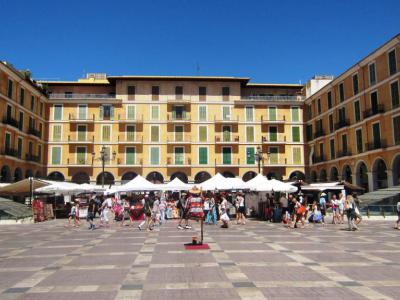
7) Plaza Mayor (Main Square)
The old convent of San Felipe Neri in Palma de Mallorca was torn down in 1823. That was a good thing. Few people, if any, were nostalgic for the Inquisition and the old convent in the city had been essentially Inquisition Central. Ten years after the convent and associated buildings were pulled down, work on the Main Square began.
Work continued, off and on, until the 20th century. When completed, the square featured an underground car park, businesses and commercial galleries.
The square is a big rectangle. Porticoed three and four-storied houses line the edges. The square is close to the Churches of San Miguel and Santa Eulalia. Other important buildings nearby include the Town Hall and the Main Theater. The streets of San Miguel, Jaime II, Colon and Sindicato stretch from the Main Square to the city limits.
Restaurants, cafes, art galleries and street performers abound in the square. An artisan market is held every week. Streets leading out of the square are also jammed with cafes and shops. The square tiled and closed to motor traffic. Main Square is a social and cultural watering hole for visitors and locals alike.
Work continued, off and on, until the 20th century. When completed, the square featured an underground car park, businesses and commercial galleries.
The square is a big rectangle. Porticoed three and four-storied houses line the edges. The square is close to the Churches of San Miguel and Santa Eulalia. Other important buildings nearby include the Town Hall and the Main Theater. The streets of San Miguel, Jaime II, Colon and Sindicato stretch from the Main Square to the city limits.
Restaurants, cafes, art galleries and street performers abound in the square. An artisan market is held every week. Streets leading out of the square are also jammed with cafes and shops. The square tiled and closed to motor traffic. Main Square is a social and cultural watering hole for visitors and locals alike.
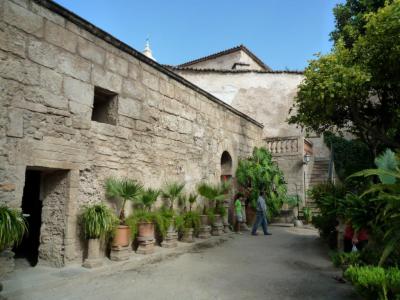
8) Arab Baths (must see)
Romans, Byzantines and Arabs had settled one after the other in Mallorca before the Catalans arrived. In the Arab days it was called Medina Mayurqa and they really liked to bath. They built their baths, called hammams, using materials left behind by the Romans and Byzantines. They used old bits of columns and capitals and voila! A bath!
The Arabs built well. The baths in Mallorca are over a thousand years old. One may not vouch for the plumbing, but the building materials are still good. Maybe shabby, but ok. The hot room and warm room of the Arab Baths are still extant but the cold room is no more.
The hot room is a square room. It has 12 columns and a domed ceiling. It is a gallery with a barrel vault. The room has 24 holes for ventilation. The dome has five holes to let in light and fresh air. There is a small well-tended garden attached to the baths. The garden has a jasmine archway, subtropical trees and plants. An afternoon enjoyment.
The baths are only a walk of a minute or so from the Palma Cathedral. They open at 9am to 6pm in the evening in winter and until 7:30pm from April to November.
The Arabs built well. The baths in Mallorca are over a thousand years old. One may not vouch for the plumbing, but the building materials are still good. Maybe shabby, but ok. The hot room and warm room of the Arab Baths are still extant but the cold room is no more.
The hot room is a square room. It has 12 columns and a domed ceiling. It is a gallery with a barrel vault. The room has 24 holes for ventilation. The dome has five holes to let in light and fresh air. There is a small well-tended garden attached to the baths. The garden has a jasmine archway, subtropical trees and plants. An afternoon enjoyment.
The baths are only a walk of a minute or so from the Palma Cathedral. They open at 9am to 6pm in the evening in winter and until 7:30pm from April to November.
