Custom Walk in Cartagena, Colombia by gretchen_fisher7423 created on 2025-05-28
Guide Location: Colombia » Cartagena
Guide Type: Custom Walk
# of Sights: 15
Tour Duration: 4 Hour(s)
Travel Distance: 7 Km or 4.3 Miles
Share Key: FXA8Z
Guide Type: Custom Walk
# of Sights: 15
Tour Duration: 4 Hour(s)
Travel Distance: 7 Km or 4.3 Miles
Share Key: FXA8Z
How It Works
Please retrieve this walk in the GPSmyCity app. Once done, the app will guide you from one tour stop to the next as if you had a personal tour guide. If you created the walk on this website or come to the page via a link, please follow the instructions below to retrieve the walk in the app.
Retrieve This Walk in App
Step 1. Download the app "GPSmyCity: Walks in 1K+ Cities" on Apple App Store or Google Play Store.



Step 2. In the GPSmyCity app, download(or launch) the guide "Cartagena Map and Walking Tours".
Step 3. Tap the menu button located at upper right corner of the "Walks" screen and select "Retrieve custom walk". Enter the share key: FXA8Z
1) Plaza de La Trinidad (Trinity Square)
Plaza de la Trinidad in Cartagena's Getsemaní takes its name from the eponymous church, La Iglesia de la Santísima Trinidad, located right in front of it, completed in 1643.
The square is historically significant as the place of the country's first independence movement, the rebellion of Gethsemane lancers, in 1811, headed by blacksmith Pedro Romero. It ultimately led to the declaration of independence of what was then known as the city of Cartagena de Indias from the Spanish crown, some 11 years before the rest of the country became independent. Following the event, the square was renamed Plaza de la Libertad (Freedom Square).
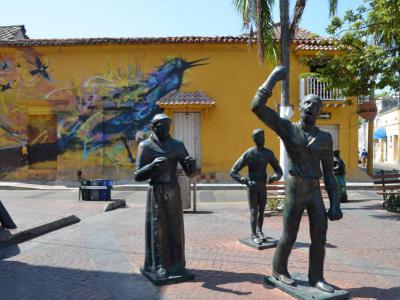
Today, there is a sculpture in the plaza paying tribute to Pedro Romero. Created by artist Nora Quintana, the sculptural group (made of fiberglass, resin and bronze patina) features Romero with his fist raised high in the air, accompanied by the Franciscan priest Father Umaña, and a Drummer.
Lately, the bohemian air of Getsemaní neighborhood found its way to this area in the form of graffiti. Alluding to the life and customs of the city, the graffiti create the image of a colonial-era plaza “disguised as a modern spot”, all the more beautiful in its own rustic way.
A piece of wall art to be noted in particular here is the picture-perfect mural of a black bird called Maria Mulata, which is the official bird of Cartagena. Painted by Colombian artist and graphic designer, Yurika MDC, at a glance, it seems just like an ordinary bird painted on yellow background, with some flashing lights of different colors added for decoration. However, locals know that, when the sun hits the bird from certain angles, these bright colors come to a full, meaningful display. Reportedly, the artist borrowed the idea for the mural from an old story told by a longtime Getsemaní resident.
Attractive by day, the square is also one of the coolest hangouts at night thanks to the street performers, food stands, and dine-in restaurants located nearby, largely stimulating the attendance by tourists and locals alike.
The square is historically significant as the place of the country's first independence movement, the rebellion of Gethsemane lancers, in 1811, headed by blacksmith Pedro Romero. It ultimately led to the declaration of independence of what was then known as the city of Cartagena de Indias from the Spanish crown, some 11 years before the rest of the country became independent. Following the event, the square was renamed Plaza de la Libertad (Freedom Square).
Today, there is a sculpture in the plaza paying tribute to Pedro Romero. Created by artist Nora Quintana, the sculptural group (made of fiberglass, resin and bronze patina) features Romero with his fist raised high in the air, accompanied by the Franciscan priest Father Umaña, and a Drummer.
Lately, the bohemian air of Getsemaní neighborhood found its way to this area in the form of graffiti. Alluding to the life and customs of the city, the graffiti create the image of a colonial-era plaza “disguised as a modern spot”, all the more beautiful in its own rustic way.
A piece of wall art to be noted in particular here is the picture-perfect mural of a black bird called Maria Mulata, which is the official bird of Cartagena. Painted by Colombian artist and graphic designer, Yurika MDC, at a glance, it seems just like an ordinary bird painted on yellow background, with some flashing lights of different colors added for decoration. However, locals know that, when the sun hits the bird from certain angles, these bright colors come to a full, meaningful display. Reportedly, the artist borrowed the idea for the mural from an old story told by a longtime Getsemaní resident.
Attractive by day, the square is also one of the coolest hangouts at night thanks to the street performers, food stands, and dine-in restaurants located nearby, largely stimulating the attendance by tourists and locals alike.
2) Parque del Centenario (Centennial Park)
Centennial Park is a popular public park located in the historic center of Cartagena. Established in 1911 to commemorate the 100th anniversary of Catargena's independence from Spanish colonialism, the park is a beloved destination for locals and tourists, offering a tranquil oasis amid the bustling city.
The park's centerpiece is a large monument dedicated to the heroes of Colombia's independence. With pathways shaded by trees and dotted with statues and monuments, the park is a pleasant spot to hang out. Visitors will enjoy fountains, well-manicured gardens, palm trees, and shaded areas to relax.
In addition to its natural beauty, Centennial Park is a cultural hub, with regular events and activities throughout the year, such as concerts, art exhibitions, and traditional dance performances, providing visitors with a glimpse into the vibrant cultural heritage of Cartagena and Colombia.
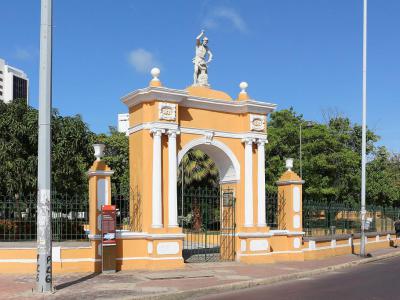
Centennial Park was designed by Pedro Malabet and built under the direction of Luis Felipe Jaspe Franco. Park's design was influenced by the neoclassical style of French gardens and incorporated elements such as symmetrical designs, axial perspectives, and fountains. Pedro Malabet designed several of the park's notable features, including the octagonal kiosk, the gatehouse, and the Clock Gate (Puerta del Reloj), one of the park's most recognizable landmarks.
The park's centerpiece is a large monument dedicated to the heroes of Colombia's independence. With pathways shaded by trees and dotted with statues and monuments, the park is a pleasant spot to hang out. Visitors will enjoy fountains, well-manicured gardens, palm trees, and shaded areas to relax.
In addition to its natural beauty, Centennial Park is a cultural hub, with regular events and activities throughout the year, such as concerts, art exhibitions, and traditional dance performances, providing visitors with a glimpse into the vibrant cultural heritage of Cartagena and Colombia.
Centennial Park was designed by Pedro Malabet and built under the direction of Luis Felipe Jaspe Franco. Park's design was influenced by the neoclassical style of French gardens and incorporated elements such as symmetrical designs, axial perspectives, and fountains. Pedro Malabet designed several of the park's notable features, including the octagonal kiosk, the gatehouse, and the Clock Gate (Puerta del Reloj), one of the park's most recognizable landmarks.
3) Torre del Reloj (Clock Tower) (must see)
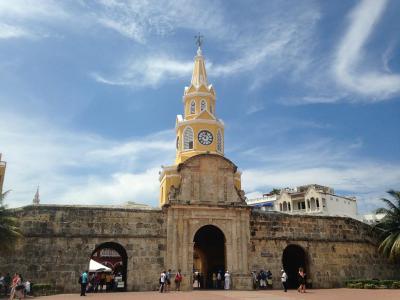
The main entrance to the historic walled city of Cartagena is famously known as the Clock Tower (Torre del Reloj). This significant landmark, built into the city wall, features a trio of open archways that offer a gateway into the Old City. A stunning clock tower crowns the central arch. With Baroque architecture, this beautiful eight-sided tower is painted golden-yellow with white trim.
Construction of this gateway took place between 1601 and 1631. Initially, only the central archway existed as a portal to the city. It was known as the Mouth of the Bridge (Boca del Puente). The other two housed an armory and a chapel. The clock tower was added later, during the early 18th century.
The Clock Tower is located next to Cars Square (Plaza de Los Coches) just inside the city walls. This triangular-shaped city square has a dark past as the place that once held Cartagena's slave market. This past also included public gallows in the center of the town square. On the plaza, directly across from the clock tower, you'll find the well-liked Cartagena sweets market known as Sweets Portal (Portal de Los Dulces).
The clock tower gate also serves as a connection from the city to the nearby Getsemani neighborhood just outside the walls. Getsemani is now a hip neighborhood filled with graffiti art and brightly painted buildings. Don't miss the two statues of Pegasus located on a nearby road that leads to the outside of the clock tower.
Construction of this gateway took place between 1601 and 1631. Initially, only the central archway existed as a portal to the city. It was known as the Mouth of the Bridge (Boca del Puente). The other two housed an armory and a chapel. The clock tower was added later, during the early 18th century.
The Clock Tower is located next to Cars Square (Plaza de Los Coches) just inside the city walls. This triangular-shaped city square has a dark past as the place that once held Cartagena's slave market. This past also included public gallows in the center of the town square. On the plaza, directly across from the clock tower, you'll find the well-liked Cartagena sweets market known as Sweets Portal (Portal de Los Dulces).
The clock tower gate also serves as a connection from the city to the nearby Getsemani neighborhood just outside the walls. Getsemani is now a hip neighborhood filled with graffiti art and brightly painted buildings. Don't miss the two statues of Pegasus located on a nearby road that leads to the outside of the clock tower.
4) Plaza de los Coches (Square of the Carriages)
Square of the Carriages (Plaza de los Coches) is a historic square located in the heart of the walled city of Cartagena. This vibrant place is one of the city's most popular tourist destinations, known for its lively atmosphere, charming colonial architecture, and rich cultural history.
The square, originally known as Slave Square (Plaza del Esclavo), was where African slaves were bought and sold during the colonial period. In the early 19th century, the square was renamed Square of the Carriages as it became a popular spot for carriages to pick up and drop off passengers.
The square is bordered by several impressive colonial-era buildings, including the 18th-century Clock Tower and the Governor's Palace, which now houses the Museum of History of Cartagena. The architecture of these buildings reflects the city's rich cultural heritage and adds to the charm of the square.
Today, Square of the Carriages is a bustling hub of activity where visitors can find street vendors selling souvenirs, local food and drinks, and musicians playing traditional Colombian music. The area is also surrounded by shops, restaurants, and cafes.
The square was a hub of social and cultural activity during the colonial era. It hosted bullfights, theatrical performances, and religious processions, which attracted people from all over the city.
The statue located in the Square of the Carriages depicts Pedro de Heredia, the Spanish conquistador who founded the city of Cartagena in 1533. The statue was erected in 1937 to commemorate the 400th anniversary of the city's founding. It stands at the center of the square and is a popular spot for tourists to take photos.
The square, originally known as Slave Square (Plaza del Esclavo), was where African slaves were bought and sold during the colonial period. In the early 19th century, the square was renamed Square of the Carriages as it became a popular spot for carriages to pick up and drop off passengers.
The square is bordered by several impressive colonial-era buildings, including the 18th-century Clock Tower and the Governor's Palace, which now houses the Museum of History of Cartagena. The architecture of these buildings reflects the city's rich cultural heritage and adds to the charm of the square.
Today, Square of the Carriages is a bustling hub of activity where visitors can find street vendors selling souvenirs, local food and drinks, and musicians playing traditional Colombian music. The area is also surrounded by shops, restaurants, and cafes.
The square was a hub of social and cultural activity during the colonial era. It hosted bullfights, theatrical performances, and religious processions, which attracted people from all over the city.
The statue located in the Square of the Carriages depicts Pedro de Heredia, the Spanish conquistador who founded the city of Cartagena in 1533. The statue was erected in 1937 to commemorate the 400th anniversary of the city's founding. It stands at the center of the square and is a popular spot for tourists to take photos.
5) Portal de Los Dulces (Sweets Portal)
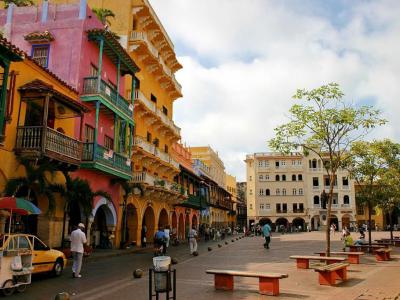
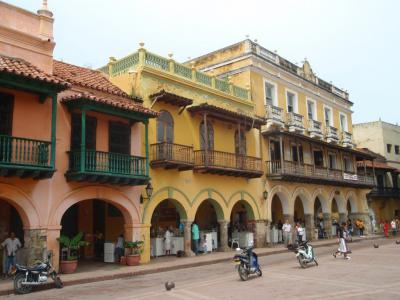
In the triangular-shaped Cars Square (Plaza de Los Coches), you'll find a candy market called Sweets Portal (Portal de Los Dulces). This site was named years ago for the sweet pastries sold there by street hagglers. You will find this lively market in the arcaded walkways of a row of old houses. The lovely Spanish colonial architecture of these brightly painted structures, with their charming balconies and tile roofs, is worth checking out.
At this outdoor market, you will find dozens of confectionary stands with vendors selling homemade candies and pastries. Jars filled with a variety of sweet treats are on display. You'll have fun shopping for delicious Caribbean delicacies with an emphasis on coconut sweets. Try the popular Cubanitos, rolled candy wrapped in colored paper.
Enjoy the colorful display of treats and the wonderful aroma of sweets in the air as you stroll through this inviting marketplace. There are also some interesting shops and restaurants around this colonial square. Don't miss Cartagena's landmark clock tower, directly across from the Sweets Portal.
At this outdoor market, you will find dozens of confectionary stands with vendors selling homemade candies and pastries. Jars filled with a variety of sweet treats are on display. You'll have fun shopping for delicious Caribbean delicacies with an emphasis on coconut sweets. Try the popular Cubanitos, rolled candy wrapped in colored paper.
Enjoy the colorful display of treats and the wonderful aroma of sweets in the air as you stroll through this inviting marketplace. There are also some interesting shops and restaurants around this colonial square. Don't miss Cartagena's landmark clock tower, directly across from the Sweets Portal.
6) Iglesia de San Pedro Claver (St. Peter Claver Church) (must see)
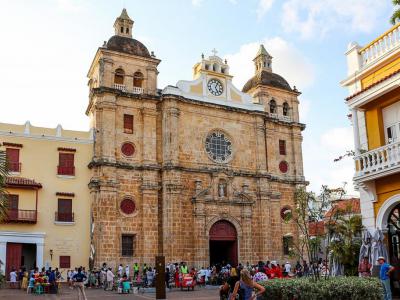
The Church of Saint Peter Claver (Iglesia de San Pedro Claver) in the homonymous square (Plaza de San Pedro Claver) forms part of the complex of buildings made up of the Convent of San Pedro Claver and the archaeological museum. The church was built between 1580 and 1654 and was originally known as San Juan de Dios. In 1622, it was re-dedicated to San Ignacio de Loyola, before finally being assigned to San Pedro Claver.
The latter was a Jesuit priest and missionary who dedicated practically all his life to evangelizing the African slaves of New Granada. Born in Spain in 1580, Claver ministered at this church for many years and died at the adjacent convent in 1654. He was declared a saint in 1888.
The church building is of Spanish Colonial design, all except the dome, which was replaced in 1921. The architecture generally corresponds to the style commonly regarded as "Jesuit", widespread throughout Latin America. Much of its monumental façade is made of stone delivered from the island of Tierrabomba. The large and ornate wooden doors at the front, however, deviate from the Baroque style.
In contrast to the Baroque profusion on the outside, the interior of the church is distinguished by its severity. There are some beautiful stained glass windows and a winding staircase, climbing which you can get a bird's eye view of the inside. Underneath the main altar (made of marble imported from Italy), is a glass coffin holding the remains of Saint Peter Claver.
The three-story building of the convent, surrounding a lovely courtyard, is now a museum dedicated to the saint, Colombia's indigenous people, and the history of this location. In addition to the numerous artifacts on display, you can also see the humble dormitory in which San Pedro Claver lived and died.
Don't miss the whimsical metal sculptures in the square outside the church either. These delightfully avant-garde depictions of people at work and play were crafted by Colombian artist Eduardo Carmona. There is also a bronze statue of San Pedro Claver blessing a slave, created by sculptor Enrique Grau.
The latter was a Jesuit priest and missionary who dedicated practically all his life to evangelizing the African slaves of New Granada. Born in Spain in 1580, Claver ministered at this church for many years and died at the adjacent convent in 1654. He was declared a saint in 1888.
The church building is of Spanish Colonial design, all except the dome, which was replaced in 1921. The architecture generally corresponds to the style commonly regarded as "Jesuit", widespread throughout Latin America. Much of its monumental façade is made of stone delivered from the island of Tierrabomba. The large and ornate wooden doors at the front, however, deviate from the Baroque style.
In contrast to the Baroque profusion on the outside, the interior of the church is distinguished by its severity. There are some beautiful stained glass windows and a winding staircase, climbing which you can get a bird's eye view of the inside. Underneath the main altar (made of marble imported from Italy), is a glass coffin holding the remains of Saint Peter Claver.
The three-story building of the convent, surrounding a lovely courtyard, is now a museum dedicated to the saint, Colombia's indigenous people, and the history of this location. In addition to the numerous artifacts on display, you can also see the humble dormitory in which San Pedro Claver lived and died.
Don't miss the whimsical metal sculptures in the square outside the church either. These delightfully avant-garde depictions of people at work and play were crafted by Colombian artist Eduardo Carmona. There is also a bronze statue of San Pedro Claver blessing a slave, created by sculptor Enrique Grau.
7) Plaza de Bolivar (Bolivar Square)
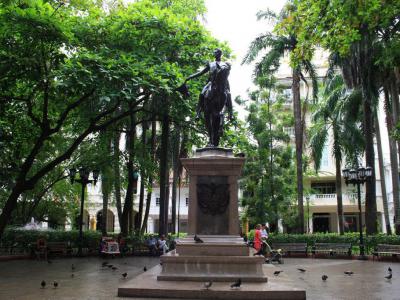
In the heart of the old walled city of Cartagena, you'll find Bolivar Square (Plaza de Bolivar). Inside this lovely square is a park full of lush greenery, shady trees, fountains, and plenty of benches that are perfect for relaxing on a sunny day. With its central location, it is considered the main square of the city.
In the center of the square is an equestrian statue of Simon Bolivar, the first president of Colombia, who was famously known as "The Liberator." The bronze statue rests on a granite pedestal and has had a prominent place in the square since 1896. It was created by Venezuelan artist and sculptor Eloy Palacios.
Around Bolivar Square are some lovely historic buildings stylized with features that include arcaded walkways, balconies, and tiled roofs. At one corner, you'll find the impressive Cartagena Cathedral. You will also find several intriguing museums around this square and nearby. Museums include the Palace of the Inquisition, the Zenu Gold Museum, and the Emerald Museum inside Caribe Jewelry.
Bolivar Square offers a shady tropical oasis in the center of Cartagena. You won't want to miss an exploration of this charming historical place.
In the center of the square is an equestrian statue of Simon Bolivar, the first president of Colombia, who was famously known as "The Liberator." The bronze statue rests on a granite pedestal and has had a prominent place in the square since 1896. It was created by Venezuelan artist and sculptor Eloy Palacios.
Around Bolivar Square are some lovely historic buildings stylized with features that include arcaded walkways, balconies, and tiled roofs. At one corner, you'll find the impressive Cartagena Cathedral. You will also find several intriguing museums around this square and nearby. Museums include the Palace of the Inquisition, the Zenu Gold Museum, and the Emerald Museum inside Caribe Jewelry.
Bolivar Square offers a shady tropical oasis in the center of Cartagena. You won't want to miss an exploration of this charming historical place.
8) Plaza de Santo Domingo (Santo Domingo Square) (must see)
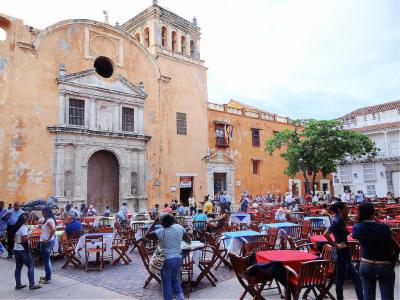
Plaza de Santo Domingo (Santo Domingo Square) is a vibrant square in the Old City of Cartagena. It was named after the beautiful church and convent Santo Domingo Church (also known as Santo Domingo Convent), which stands on one of its corners. The orange-yellow facade of the church and its massive arched entryway is striking. Check out the twisted bell tower on top.
With a gruesome past, this square was used during the Spanish Inquisition as a place for executions. The buildings surrounding Santo Domino Square boast Spanish Colonial architecture featuring balconies and red tile roofs. Around the square are shops, street vendors, lively restaurants, and plenty of outdoor tables for dining and relaxing.
Don't miss the famous "La Gorda Gertrudis" (Fat Gertrudis), a statue of a naked Rubenesque woman done in bronze. The sculpture was created by renowned artist Fernando Botero and stands in front of the church. It is a popular spot for taking photographs. The narrow nearby alleyways that branch off Santo Domingo Square are just ripe for exploration!
With a gruesome past, this square was used during the Spanish Inquisition as a place for executions. The buildings surrounding Santo Domino Square boast Spanish Colonial architecture featuring balconies and red tile roofs. Around the square are shops, street vendors, lively restaurants, and plenty of outdoor tables for dining and relaxing.
Don't miss the famous "La Gorda Gertrudis" (Fat Gertrudis), a statue of a naked Rubenesque woman done in bronze. The sculpture was created by renowned artist Fernando Botero and stands in front of the church. It is a popular spot for taking photographs. The narrow nearby alleyways that branch off Santo Domingo Square are just ripe for exploration!
9) Teatro Adolfo Mejia (Adolfo Mejia Theater)
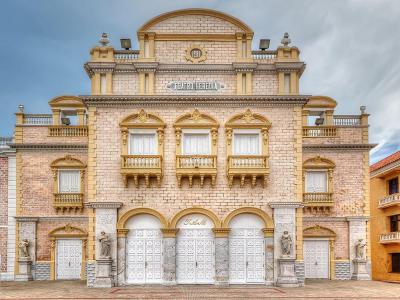
Adolfo Mejia Theater (Teatro Adolfo Mejia) is a historic theater located in the heart of Cartagena. Built in 1911 and named after a local composer, the theater is considered one of the most important cultural landmarks in the city. Its neoclassical facade and ornate interior design have made it a popular venue for performances of all kinds, from ballet and opera to theater and live music.
The building's facade features a series of tall, narrow columns with Corinthian capitals, giving it a grand and imposing appearance. The columns are topped with a triangular pediment, which is decorated with intricate carvings and sculptures. The entrance to the theater is marked by a large, arched doorway, flanked by smaller arched windows. The doorway is topped with a balcony, supported by decorative brackets, and is accessed by a grand staircase. The facade is painted in a soft pink color, which is typical of many historic buildings in Cartagena.
The interior of Adolfo Mejia Theater is equally impressive, with a large auditorium that can seat up to 800 people. The auditorium is decorated with ornate plasterwork, frescoes, and crystal chandeliers, creating an opulent and luxurious atmosphere. The stage is framed by a large proscenium arch, which is decorated with elaborate carvings and gold leaf.
Throughout its history, Teatro Adolfo Mejia has played host to a wide variety of famous performers, including renowned Colombian musicians like Rafael Escalona and Totó la Momposina, as well as international acts like the Bolshoi Ballet and the Vienna Philharmonic Orchestra. Its stage has also been the site of many important cultural events, such as the coronation of the Queen of the Independence Festival in 1923 and the signing of the Cartagena Manifesto in 1948.
Today, Adolfo Mejia Theater remains an important cultural institution in Cartagena, hosting regular performances and events that showcase the city's rich artistic heritage.
The building's facade features a series of tall, narrow columns with Corinthian capitals, giving it a grand and imposing appearance. The columns are topped with a triangular pediment, which is decorated with intricate carvings and sculptures. The entrance to the theater is marked by a large, arched doorway, flanked by smaller arched windows. The doorway is topped with a balcony, supported by decorative brackets, and is accessed by a grand staircase. The facade is painted in a soft pink color, which is typical of many historic buildings in Cartagena.
The interior of Adolfo Mejia Theater is equally impressive, with a large auditorium that can seat up to 800 people. The auditorium is decorated with ornate plasterwork, frescoes, and crystal chandeliers, creating an opulent and luxurious atmosphere. The stage is framed by a large proscenium arch, which is decorated with elaborate carvings and gold leaf.
Throughout its history, Teatro Adolfo Mejia has played host to a wide variety of famous performers, including renowned Colombian musicians like Rafael Escalona and Totó la Momposina, as well as international acts like the Bolshoi Ballet and the Vienna Philharmonic Orchestra. Its stage has also been the site of many important cultural events, such as the coronation of the Queen of the Independence Festival in 1923 and the signing of the Cartagena Manifesto in 1948.
Today, Adolfo Mejia Theater remains an important cultural institution in Cartagena, hosting regular performances and events that showcase the city's rich artistic heritage.
10) Plaza San Diego (San Diego Square)
San Diego Square is a charming and picturesque square surrounded by colonial-era buildings and is considered one of the most beautiful and peaceful squares in Cartagena.
The square is named after the San Diego Convent, a historic landmark on one side of the San Diego Square. The convent was built in the 16th century and served as a place of worship and refuge for the Spanish colonizers during attacks from pirates and other invaders. The architecture of the San Diego Convent is a beautiful blend of colonial and Baroque styles, with elegant arches, frescoes, and ornate carvings adorning the walls and ceilings. The convent also features a stunning courtyard, surrounded by galleries with arches and columns. It is now home to the University of Fine Arts and Sciences of Bolívar.
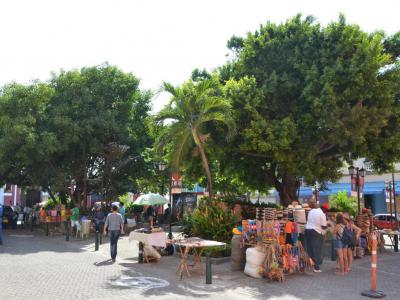
The square is a popular destination for locals and tourists alike, who come to enjoy its peaceful atmosphere and beautiful surroundings. Visitors can sit on the benches in the shade of the palm trees, sip on a refreshing drink from one of the nearby cafes, or admire the historic architecture and colonial charm of the square.
The surrounding buildings, many of which have been restored and converted into boutique hotels, restaurants, and shops, add to the charm of the square. Visitors can enjoy a meal or a drink at one of the outdoor cafes, browse local handicrafts at the street vendors' stalls, or take in the sights and sounds of the lively surroundings.
The square is named after the San Diego Convent, a historic landmark on one side of the San Diego Square. The convent was built in the 16th century and served as a place of worship and refuge for the Spanish colonizers during attacks from pirates and other invaders. The architecture of the San Diego Convent is a beautiful blend of colonial and Baroque styles, with elegant arches, frescoes, and ornate carvings adorning the walls and ceilings. The convent also features a stunning courtyard, surrounded by galleries with arches and columns. It is now home to the University of Fine Arts and Sciences of Bolívar.
The square is a popular destination for locals and tourists alike, who come to enjoy its peaceful atmosphere and beautiful surroundings. Visitors can sit on the benches in the shade of the palm trees, sip on a refreshing drink from one of the nearby cafes, or admire the historic architecture and colonial charm of the square.
The surrounding buildings, many of which have been restored and converted into boutique hotels, restaurants, and shops, add to the charm of the square. Visitors can enjoy a meal or a drink at one of the outdoor cafes, browse local handicrafts at the street vendors' stalls, or take in the sights and sounds of the lively surroundings.
11) Las Bovedas (The Vaults)
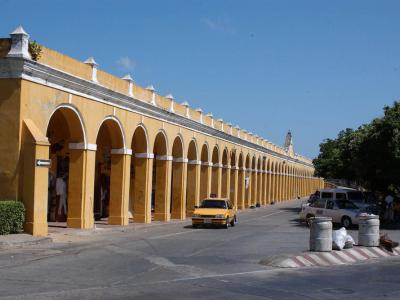
Exploring the Old City of Cartagena one cannot miss the immense arcade of columns and arches of bright golden color, located between the forts of Santa Clara and Santa Catalina. Known as Las Bóvedas (The Vaults), this building is indeed massive. Its walls – 15 meters thick(!) – were originally intended to protect a military storehouse.
The 23 bombproof arcades were built between 1789 and 1795 to a design by Antonio de Arebalo, a military engineer who worked on all fortifications in Cartagena. The 47 porticos were added in 1798. For a while, the vaults were used by the Spanish Crown as a garrison, the same purpose later used by republican forces. During the civil wars in the 19th century, the vaults were utilized as prison cells; at high tide, the unfortunate inmates had to stand up to their knees in seawater.
Nowadays, the building has become a lively marketplace, with the dungeon cells accommodating boutiques and other businesses. Inside the numbered vaults shops are selling a vast array of souvenirs: handcrafted items, paintings, colorful clothing, jewelry, and more. Together with the breathtaking view of the Caribbean Sea, this makes Las Bóvedas a popular tourist destination, appealing to those who love to stroll along the arcaded walkway whilst exploring traditional Colombian merchandise in this historic landmark.
The 23 bombproof arcades were built between 1789 and 1795 to a design by Antonio de Arebalo, a military engineer who worked on all fortifications in Cartagena. The 47 porticos were added in 1798. For a while, the vaults were used by the Spanish Crown as a garrison, the same purpose later used by republican forces. During the civil wars in the 19th century, the vaults were utilized as prison cells; at high tide, the unfortunate inmates had to stand up to their knees in seawater.
Nowadays, the building has become a lively marketplace, with the dungeon cells accommodating boutiques and other businesses. Inside the numbered vaults shops are selling a vast array of souvenirs: handcrafted items, paintings, colorful clothing, jewelry, and more. Together with the breathtaking view of the Caribbean Sea, this makes Las Bóvedas a popular tourist destination, appealing to those who love to stroll along the arcaded walkway whilst exploring traditional Colombian merchandise in this historic landmark.
12) Murallas de Cartagena (Cartagena City Walls) (must see)
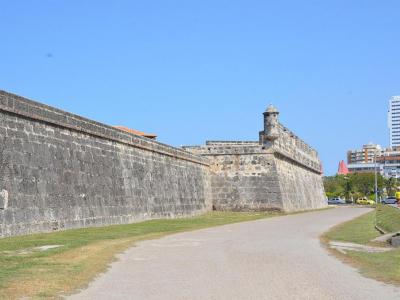
The walls around the Old City of Cartagena were built as protection against enemy attacks and pirate raids. The city walls reached completion in 1796 after nearly two centuries of construction. The wall is thick and well-constructed. Today, the walls represent one of the best-preserved fortifications in South America.
Walking along the Murallas de Cartagena (Cartagena City Walls) is a fun way to explore the walled site and offers fabulous views of the city and the glistening Caribbean Sea. The walls surround the historic Old Cartagena and stretch for 11 kilometers (just under seven miles). In spots along the wall, you'll find watch towers, old iron cannons, and lookout points.
A popular place to watch the sunset is from the Bastion of Santo Domingo, a fortification that marks the origin of the efforts to secure the city. Cafe del Mar is a restaurant with a central spot at the top of the bastion along the city walls. Relaxing on the walls and enjoying a drink is a great way to end a day exploring Cartagena.
Walking along the Murallas de Cartagena (Cartagena City Walls) is a fun way to explore the walled site and offers fabulous views of the city and the glistening Caribbean Sea. The walls surround the historic Old Cartagena and stretch for 11 kilometers (just under seven miles). In spots along the wall, you'll find watch towers, old iron cannons, and lookout points.
A popular place to watch the sunset is from the Bastion of Santo Domingo, a fortification that marks the origin of the efforts to secure the city. Cafe del Mar is a restaurant with a central spot at the top of the bastion along the city walls. Relaxing on the walls and enjoying a drink is a great way to end a day exploring Cartagena.
13) La Serrezuela
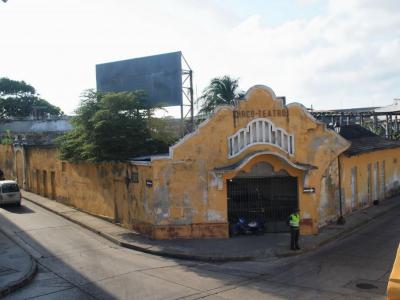
La Serrezuela is a unique shopping mall built around an old theater and bullring. The bullring opened in 1930 and could host 4,000 spectators for bullfights. In 1935, it became the Circus Theater (Circo Teatro) after a redesign that allowed cinema and theater productions in addition to bullfighting. A restoration of this historical icon gave it new life as a modern shopping and entertainment complex.
Inside La Serrezuela, you'll find a choice of upscale specialty shops featuring a variety of merchandise. The Malva department store sells products from emerging and luxury brands. La Serrezuela Square offers a spacious area to hold events and entertainment inside what was once the old arena. The complex also offers a convention center with room to host 750 people.
The Tempter (El Tentadero) is the culinary center of La Serrezuela, featuring a selection of restaurants and bars brought together in a gorgeous space on the top floor. Huge picture windows give you fabulous views of the city while you dine! You'll find this shopping center in the historic San Diego neighborhood in the Old City of Cartagena.
Inside La Serrezuela, you'll find a choice of upscale specialty shops featuring a variety of merchandise. The Malva department store sells products from emerging and luxury brands. La Serrezuela Square offers a spacious area to hold events and entertainment inside what was once the old arena. The complex also offers a convention center with room to host 750 people.
The Tempter (El Tentadero) is the culinary center of La Serrezuela, featuring a selection of restaurants and bars brought together in a gorgeous space on the top floor. Huge picture windows give you fabulous views of the city while you dine! You'll find this shopping center in the historic San Diego neighborhood in the Old City of Cartagena.
14) Castillo San Felipe de Barajas (San Felipe de Barajas Castle) (must see)
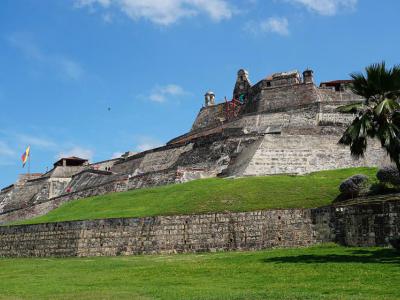
San Felipe de Barajas Castle (Castillo San Felipe de Barajas) is an old fortress located in Cartagena. It was built by the Spanish during the colonial period, to protect the city from attack by enemies and pirates.
The construction of the fortress began in 1536 under the direction of the Spanish engineer Antonio de Arévalo. However, the original structure was small and inadequate, so it was expanded and improved by subsequent Spanish engineers.
The most significant expansion of the fortress took place in the 17th century when the Spanish engineer Bautista Antonelli designed and built the present-day structure. Antonelli's design included a series of walls and bastions that made the fortress nearly impregnable.
The fortress played a crucial role in Cartagena's defense against various attacks by enemies and pirates, including the English, in 1741, during the War of Jenkins' Ear. The fortress held off the English for two months, and the battle ended with the Spanish victory.
During the 19th and 20th centuries, the fortress lost its military significance and was used for various purposes, including as a prison and a hospital. In 1984, UNESCO declared the historic center of Cartagena, including the fortress, a World Heritage Site.
Today, San Felipe de Barajas Castle is a popular tourist attraction in Cartagena. Visitors can explore the castle and learn about its history through exhibits and guided tours. The fortress also offers panoramic views of the city and the Caribbean Sea.
The construction of the fortress began in 1536 under the direction of the Spanish engineer Antonio de Arévalo. However, the original structure was small and inadequate, so it was expanded and improved by subsequent Spanish engineers.
The most significant expansion of the fortress took place in the 17th century when the Spanish engineer Bautista Antonelli designed and built the present-day structure. Antonelli's design included a series of walls and bastions that made the fortress nearly impregnable.
The fortress played a crucial role in Cartagena's defense against various attacks by enemies and pirates, including the English, in 1741, during the War of Jenkins' Ear. The fortress held off the English for two months, and the battle ended with the Spanish victory.
During the 19th and 20th centuries, the fortress lost its military significance and was used for various purposes, including as a prison and a hospital. In 1984, UNESCO declared the historic center of Cartagena, including the fortress, a World Heritage Site.
Today, San Felipe de Barajas Castle is a popular tourist attraction in Cartagena. Visitors can explore the castle and learn about its history through exhibits and guided tours. The fortress also offers panoramic views of the city and the Caribbean Sea.
15) Convento de la Popa (La Popa Convent) (must see)
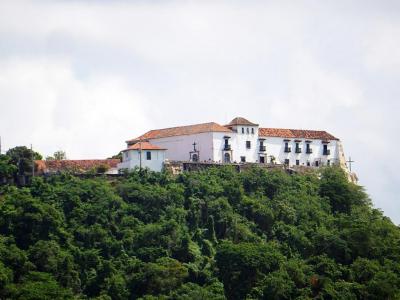
La Popa Convent (Convento de la Popa) stands in a stunning location atop Mount la Popa, the highest point in Cartagena. The origins of this marvelous convent date back to the early 17th century when, around 1607, the first wooden chapel was built. Soon after, the construction of a monastery began and was completed several years later.
La Popa Convent translates to "Convent of the Stern." It gets its name from the high hill where it stands, called this for its resemblance to the stern of a boat. The convent features classic Spanish Colonial architecture, with white stucco walls, arched entryways, small balconies, and a red tiled roof.
There is a lovely little chapel with a superb altarpiece, very ornately done in gold. In a central spot on the altar is an elaborately costumed statue of Our Lady of the Candles (La Virgen de la Candelaria). A feast is held in Cartagena each year in early February to celebrate her. Around the monastery are displays and artifacts that help visitors learn about the history of the convent.
A visit to the convent would not be complete without a stroll through the charming inner courtyard (also known as the cloister). This beautiful courtyard sits surrounded by a two-story stone arcade and a mezzanine that overlooks the brick patio below. It is gorgeous, filled with potted palm trees, hanging plants, and Bougainvillea vines.
This convent is open to the public. Access to the convent is via a curved road up the hill. Its location, high above the city, offers spectacular panoramic views of Cartagena and the Caribbean sea.
La Popa Convent translates to "Convent of the Stern." It gets its name from the high hill where it stands, called this for its resemblance to the stern of a boat. The convent features classic Spanish Colonial architecture, with white stucco walls, arched entryways, small balconies, and a red tiled roof.
There is a lovely little chapel with a superb altarpiece, very ornately done in gold. In a central spot on the altar is an elaborately costumed statue of Our Lady of the Candles (La Virgen de la Candelaria). A feast is held in Cartagena each year in early February to celebrate her. Around the monastery are displays and artifacts that help visitors learn about the history of the convent.
A visit to the convent would not be complete without a stroll through the charming inner courtyard (also known as the cloister). This beautiful courtyard sits surrounded by a two-story stone arcade and a mezzanine that overlooks the brick patio below. It is gorgeous, filled with potted palm trees, hanging plants, and Bougainvillea vines.
This convent is open to the public. Access to the convent is via a curved road up the hill. Its location, high above the city, offers spectacular panoramic views of Cartagena and the Caribbean sea.
