Custom Walk in Valencia, Spain by anisha_magecha_afcd9 created on 2025-05-31
Guide Location: Spain » Valencia
Guide Type: Custom Walk
# of Sights: 9
Tour Duration: 3 Hour(s)
Travel Distance: 6.2 Km or 3.9 Miles
Share Key: 9XP92
Guide Type: Custom Walk
# of Sights: 9
Tour Duration: 3 Hour(s)
Travel Distance: 6.2 Km or 3.9 Miles
Share Key: 9XP92
How It Works
Please retrieve this walk in the GPSmyCity app. Once done, the app will guide you from one tour stop to the next as if you had a personal tour guide. If you created the walk on this website or come to the page via a link, please follow the instructions below to retrieve the walk in the app.
Retrieve This Walk in App
Step 1. Download the app "GPSmyCity: Walks in 1K+ Cities" on Apple App Store or Google Play Store.



Step 2. In the GPSmyCity app, download(or launch) the guide "Valencia Map and Walking Tours".
Step 3. Tap the menu button located at upper right corner of the "Walks" screen and select "Retrieve custom walk". Enter the share key: 9XP92
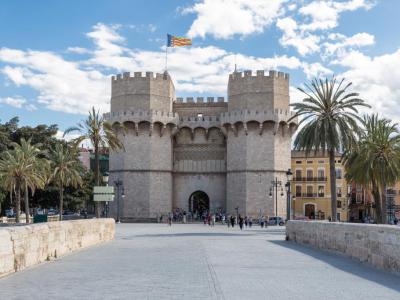
1) Torres de Serranos (Serranos Towers) (must see)
One of the last standing pieces of Valencia’s medieval walls, the gateway known today as the Serranos Towers dates back to the 14th century. Its design was inspired by a monastery in Catalonia, blending solid defensive features with an unmistakable decorative flair. The twin towers, crowned with battlements, seem poised for battle, yet the ornate Gothic stonework above the arch suggests something far more ceremonial. And in fact, it wasn’t just a fortification, but served as a grand entrance for royalty and visiting dignitaries.
Interestingly, the rear of the structure was intentionally left open. The idea was simple: to prevent the towers from being turned against the city’s own people in case of revolt. From the square behind, you can spot the chambers that once held noble prisoners between the 16th and 19th centuries. Four stone gargoyles jut from the rear wall, watching over the scene with silent, stony faces.
During the Spanish Civil War, the towers were repurposed as a secure vault, protecting priceless artworks from the Prado Museum in Madrid. Despite the turmoil, they emerged relatively unscathed and remain one of Valencia’s iconic monuments.
You can climb the winding staircases up to the terraces, where wide views stretch across the old town, the Turia Garden, and beyond. Occasionally, there are exhibitions or small historical displays inside, but the real pleasure is simply moving through the spaces, taking in the craftsmanship and the cityscape beyond the walls.
Well preserved and open to the public, the Serranos Towers have a quiet, welcoming presence, like an old guardian who still takes pride in watching over the city.
Interestingly, the rear of the structure was intentionally left open. The idea was simple: to prevent the towers from being turned against the city’s own people in case of revolt. From the square behind, you can spot the chambers that once held noble prisoners between the 16th and 19th centuries. Four stone gargoyles jut from the rear wall, watching over the scene with silent, stony faces.
During the Spanish Civil War, the towers were repurposed as a secure vault, protecting priceless artworks from the Prado Museum in Madrid. Despite the turmoil, they emerged relatively unscathed and remain one of Valencia’s iconic monuments.
You can climb the winding staircases up to the terraces, where wide views stretch across the old town, the Turia Garden, and beyond. Occasionally, there are exhibitions or small historical displays inside, but the real pleasure is simply moving through the spaces, taking in the craftsmanship and the cityscape beyond the walls.
Well preserved and open to the public, the Serranos Towers have a quiet, welcoming presence, like an old guardian who still takes pride in watching over the city.
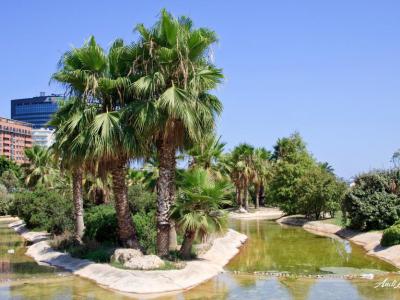
2) Jardin del Turia (Turia Garden) (must see)
Valencianos take pride in the Turia Garden-a remarkable green ribbon that winds through the city where the Turia River once flowed. After a devastating flood in 1957, the river was redirected south, and the old riverbed was transformed into a 9-kilometre park. Urban planners and landscape designers were brought in to shape each section, creating a diverse mix of lawns, shady walking trails, fountains, orange groves, and palm-lined paths. The park officially opened in 1986 and has since become one of the city's most beloved public spaces.
Among the standout spots in the vicinity are the beautifully landscaped Royal Gardens, a peaceful retreat just steps from the busy Historic Center. Here, you'll find rosebeds, elegant paths lined with trees, and sculptures like the “Four Seasons,” crafted by Genoese artist Ponzanelli. The gardens take their name from a royal palace once located on the site-originally built in the 11th century as a Muslim ruler’s refuge.
Nearby, there’s plenty more to explore-such as the Botanic Garden, home to 4,500 plant species arranged across 20 themed collections. A bit further along the riverbank, you’ll come across the Valencian Institute of Modern Art-widely regarded as one of Spain’s leading modern art institutions. And for those curious about Valencia’s deep past, the Prehistory Museum showcases everything from tools to undeciphered stone engravings created by early human communities in the region’s surrounding hills.
To take it all in at your own pace, consider renting a bicycle-it’s one of the best ways to discover Turia’s many treasures.
Among the standout spots in the vicinity are the beautifully landscaped Royal Gardens, a peaceful retreat just steps from the busy Historic Center. Here, you'll find rosebeds, elegant paths lined with trees, and sculptures like the “Four Seasons,” crafted by Genoese artist Ponzanelli. The gardens take their name from a royal palace once located on the site-originally built in the 11th century as a Muslim ruler’s refuge.
Nearby, there’s plenty more to explore-such as the Botanic Garden, home to 4,500 plant species arranged across 20 themed collections. A bit further along the riverbank, you’ll come across the Valencian Institute of Modern Art-widely regarded as one of Spain’s leading modern art institutions. And for those curious about Valencia’s deep past, the Prehistory Museum showcases everything from tools to undeciphered stone engravings created by early human communities in the region’s surrounding hills.
To take it all in at your own pace, consider renting a bicycle-it’s one of the best ways to discover Turia’s many treasures.
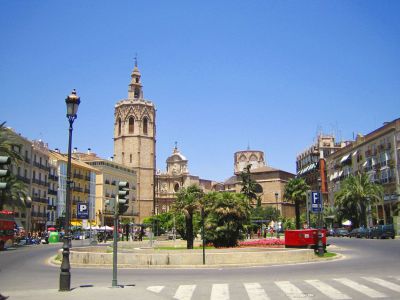
3) Plaza de la Reina (Queen's Plaza)
Valencia’s second most prominent public space, Queen’s Plaza lies right at the heart of the city’s historic center, framed by centuries of history. Initially created in 1878 to mark the royal marriage of King Alfonso XII and Queen María de las Mercedes, the area has evolved well beyond its ceremonial origins. Nowadays, it’s a popular gathering spot, where both residents and travelers pause for coffee, a sweet treat, or simply to soak in the atmosphere.
A visit wouldn’t be complete without stopping at the Horchatería Santa Catalina, where you can sample traditional horchata paired with airy, sugar-dusted fartons. For something savory, nearby tapas bars offer a taste of the region’s flavors, often with outdoor seating.
Dominating one side of the plaza is the grand Valencia Cathedral, which you can enter through the Baroque-style Door of the Irons. Next to it rises the Miguelete Tower, a 14th-century bell tower that rewards those who climb its 207 steps with sweeping views over the rooftops of the old town. On the opposite side, the Church of Santa Catalina stands tall with its Gothic base and unmistakable Baroque bell tower.
Queen’s Plaza also marks kilometer zero for Valencia’s road network, a detail that links it to the ancient Roman infrastructure. When Emperor Augustus unified Roman control over the Iberian Peninsula, he ordered the construction of the Via Augusta-a 1,500-kilometer artery running from the Pyrenees to Cádiz. One stretch of that great road once passed right through what is now the heart of this plaza, making it a literal crossroads of empire, commerce, and time.
In recent years, the area has seen a major redesign. Completed in 2022, the transformation focused on pedestrianizing the space and giving it new life. Vehicles were redirected, the pavement was expanded, and over a hundred trees were planted to brind more shade and colour. Adjustable awnings were also installed, offering welcome relief from the summer sun and making the space even more inviting year-round.
A visit wouldn’t be complete without stopping at the Horchatería Santa Catalina, where you can sample traditional horchata paired with airy, sugar-dusted fartons. For something savory, nearby tapas bars offer a taste of the region’s flavors, often with outdoor seating.
Dominating one side of the plaza is the grand Valencia Cathedral, which you can enter through the Baroque-style Door of the Irons. Next to it rises the Miguelete Tower, a 14th-century bell tower that rewards those who climb its 207 steps with sweeping views over the rooftops of the old town. On the opposite side, the Church of Santa Catalina stands tall with its Gothic base and unmistakable Baroque bell tower.
Queen’s Plaza also marks kilometer zero for Valencia’s road network, a detail that links it to the ancient Roman infrastructure. When Emperor Augustus unified Roman control over the Iberian Peninsula, he ordered the construction of the Via Augusta-a 1,500-kilometer artery running from the Pyrenees to Cádiz. One stretch of that great road once passed right through what is now the heart of this plaza, making it a literal crossroads of empire, commerce, and time.
In recent years, the area has seen a major redesign. Completed in 2022, the transformation focused on pedestrianizing the space and giving it new life. Vehicles were redirected, the pavement was expanded, and over a hundred trees were planted to brind more shade and colour. Adjustable awnings were also installed, offering welcome relief from the summer sun and making the space even more inviting year-round.
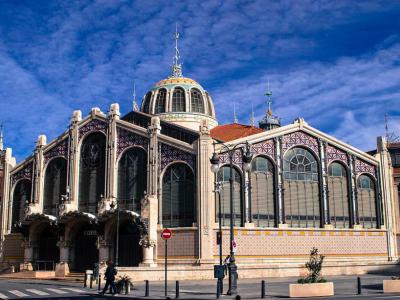
4) Mercado Central (Central Market) (must see)
Europe’s largest covered market-and arguably one of its most striking-Valencia’s Central Market is housed in a remarkable Modernista structure right in the heart of the Historic Center. While it may sit in a highly visited area, this market remains firmly rooted in everyday life, buzzing with locals who come here to stock up on hams, cheeses, vegetables, and fresh Mediterranean seafood. You’ll not only get a taste of authentic local life, but also the chance to discover regional specialties, and maybe even pick up a few souvenirs.
Though built for practical commerce, the building is anything but ordinary. Decorative flourishes in ceramic, brick, and stained glass come together in celebration of early 20th-century design. Look up, and you’ll even spot the red and yellow stripes of the Valencian flag worked into the architecture.
When it opened in 1928, the market hosted over 1,000 stalls. That number has since consolidated to around 700, still offering more than enough variety for a curious shopper or hungry traveler. For the full atmosphere, aim to visit around mid-morning, when the place comes alive with the rhythm of daily trade: voices calling out orders in Valencian, and baskets brimming with fresh produce. If you’re not heading out to the countryside to buy oranges, this is the place to grab some.
Many stalls sell herbs, spices, dried fruit, and nuts, while others surprise with items like ostrich meat or giant eggs. A separate section is devoted entirely to fish and seafood, and more adventurous food lovers might seek out snails, sweetbreads, or tripe.
Though built for practical commerce, the building is anything but ordinary. Decorative flourishes in ceramic, brick, and stained glass come together in celebration of early 20th-century design. Look up, and you’ll even spot the red and yellow stripes of the Valencian flag worked into the architecture.
When it opened in 1928, the market hosted over 1,000 stalls. That number has since consolidated to around 700, still offering more than enough variety for a curious shopper or hungry traveler. For the full atmosphere, aim to visit around mid-morning, when the place comes alive with the rhythm of daily trade: voices calling out orders in Valencian, and baskets brimming with fresh produce. If you’re not heading out to the countryside to buy oranges, this is the place to grab some.
Many stalls sell herbs, spices, dried fruit, and nuts, while others surprise with items like ostrich meat or giant eggs. A separate section is devoted entirely to fish and seafood, and more adventurous food lovers might seek out snails, sweetbreads, or tripe.
5) Lonja de la Seda (The Silk Exchange) (must see)
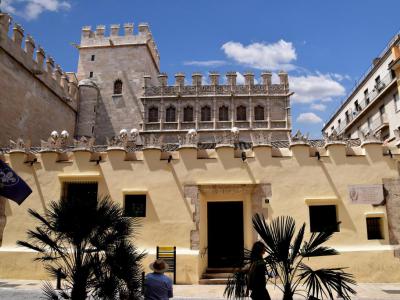
Just across from the Central Market is one of the city’s most beloved landmarks-a true cathedral of commerce. Known as the Silk Exchange, this grand structure was originally built for the silk trade and later used for broader commercial exchanges. A symbol of Valencia’s golden age in the late 15th century, it’s also one Europe’s finest examples of secular Gothic architecture.
The facade alone is a marvel of craftsmanship-elaborate stone carvings, delicate tracery, and distinctive windows line the walls. You’ll also notice a parade of gargoyles on the balustrades-28 in total, in the shape of winged creatures, beasts, and bats.
A central tower divides the structure into three main sections. Inside the tower, there’s a small chapel and a former debtor’s prison-used to hold merchants who failed to pay what they owed. To the left of the tower were two key institutions: one overseeing maritime trade, the other an early banking body that helped fund the construction. It’s well worth venturing inside to admire the ceilings-especially the Golden Hall upstairs, where a richly painted and gilded wooden ceiling dazzles with scenes of music, prophets, and mythological creatures.
But the soul of the building lies in the Transactions Hall, just to the right of the tower. Here, eight soaring spiral columns support a vaulted ceiling in a room divided into three aisles. Along the walls, a carved inscription proclaims: “I am a famous house which took fifteen years to build. See how fine a thing commerce can be when its words are not deceitful, when it keeps its oaths and does not practise usury. The merchant who lives in such a way will have riches and enjoy eternal life.”
When you’re done exploring, take a moment to relax under the orange trees in the peaceful courtyard-an ideal spot to catch your breath before moving on with your walking tour.
The facade alone is a marvel of craftsmanship-elaborate stone carvings, delicate tracery, and distinctive windows line the walls. You’ll also notice a parade of gargoyles on the balustrades-28 in total, in the shape of winged creatures, beasts, and bats.
A central tower divides the structure into three main sections. Inside the tower, there’s a small chapel and a former debtor’s prison-used to hold merchants who failed to pay what they owed. To the left of the tower were two key institutions: one overseeing maritime trade, the other an early banking body that helped fund the construction. It’s well worth venturing inside to admire the ceilings-especially the Golden Hall upstairs, where a richly painted and gilded wooden ceiling dazzles with scenes of music, prophets, and mythological creatures.
But the soul of the building lies in the Transactions Hall, just to the right of the tower. Here, eight soaring spiral columns support a vaulted ceiling in a room divided into three aisles. Along the walls, a carved inscription proclaims: “I am a famous house which took fifteen years to build. See how fine a thing commerce can be when its words are not deceitful, when it keeps its oaths and does not practise usury. The merchant who lives in such a way will have riches and enjoy eternal life.”
When you’re done exploring, take a moment to relax under the orange trees in the peaceful courtyard-an ideal spot to catch your breath before moving on with your walking tour.
6) City of the Arts and Sciences (must see)
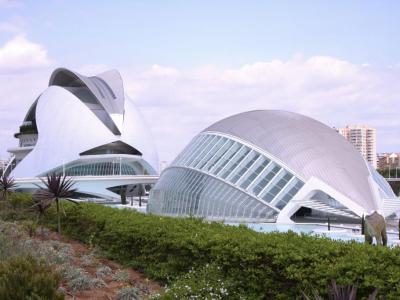
Situated at the southeast end of the former riverbed of the Turia River, which underwent redirection following a devastating flood in 1957, lies the remarkable City of Arts and Sciences (Ciutat de les Arts i les Ciències). This extraordinary complex stands as the paramount modern tourist attraction in Valencia, earning its place among the esteemed 12 Treasures of Spain.
Incepted by the visionary minds of Santiago Calatrava and Félix Candela, the project commenced its initial construction phases in July 1996 and was ceremoniously inaugurated on April 16, 1998, with the unveiling of the mesmerizing L'Hemisfèric. The culmination of the City of Arts and Sciences arrived with the grand opening of the Queen Sofía Palace of the Arts (Palau de les Arts Reina Sofía) on October 9, 2005, coinciding with Valencian Community Day. The most recent addition to this architectural marvel, L'Àgora, welcomed visitors in 2009.
Within the expansive complex, a blend of complimentary attractions awaits, with both free and paid options available. A planetarium, a science museum, an aquarium, and an arts and science exhibition area collectively form the tapestry of this captivating destination. Spanning over seven kilometers, be prepared for a leisurely stroll to fully immerse yourself in the splendor it offers.
The science museum captivates visitors with its interactive exhibits designed to engage audiences of all ages. The tactile nature of the displays encourages hands-on exploration, leaving a lasting impression. Notably, many observers have drawn comparisons between this architectural marvel and the skeletal structure of a fish-an awe-inspiring sight indeed.
Among the cherished highlights of the complex, the awe-inspiring aquarium stands out. Holding the distinction of being Europe's largest of its kind, it houses a staggering array of over 500 species sourced from oceans around the world. A captivating journey into the depths of aquatic life awaits those who venture within its walls.
The City of Arts and Sciences, with its blend of cultural significance and architectural brilliance, stands as a testament to human creativity and ingenuity. A visit to this extraordinary complex is sure to leave an indelible impression on all who step foot within its extraordinary confines.
Why You Should Visit:
Fabulous architecture and gardens that you can spend hours exploring without even getting inside any of the buildings.
The sprawling complex consists of 7 structures, seamlessly interwoven with lush greenery, interesting artwork and beautiful shallow pools that you can dip your feet in to cool off.
Tip:
Budget at least 2 days to fully explore and appreciate everything the area has to offer, including the night views and amazing Valencian horchata from the stalls located throughout the complex.
Activities can cost anywhere from 5€ to €30.
Incepted by the visionary minds of Santiago Calatrava and Félix Candela, the project commenced its initial construction phases in July 1996 and was ceremoniously inaugurated on April 16, 1998, with the unveiling of the mesmerizing L'Hemisfèric. The culmination of the City of Arts and Sciences arrived with the grand opening of the Queen Sofía Palace of the Arts (Palau de les Arts Reina Sofía) on October 9, 2005, coinciding with Valencian Community Day. The most recent addition to this architectural marvel, L'Àgora, welcomed visitors in 2009.
Within the expansive complex, a blend of complimentary attractions awaits, with both free and paid options available. A planetarium, a science museum, an aquarium, and an arts and science exhibition area collectively form the tapestry of this captivating destination. Spanning over seven kilometers, be prepared for a leisurely stroll to fully immerse yourself in the splendor it offers.
The science museum captivates visitors with its interactive exhibits designed to engage audiences of all ages. The tactile nature of the displays encourages hands-on exploration, leaving a lasting impression. Notably, many observers have drawn comparisons between this architectural marvel and the skeletal structure of a fish-an awe-inspiring sight indeed.
Among the cherished highlights of the complex, the awe-inspiring aquarium stands out. Holding the distinction of being Europe's largest of its kind, it houses a staggering array of over 500 species sourced from oceans around the world. A captivating journey into the depths of aquatic life awaits those who venture within its walls.
The City of Arts and Sciences, with its blend of cultural significance and architectural brilliance, stands as a testament to human creativity and ingenuity. A visit to this extraordinary complex is sure to leave an indelible impression on all who step foot within its extraordinary confines.
Why You Should Visit:
Fabulous architecture and gardens that you can spend hours exploring without even getting inside any of the buildings.
The sprawling complex consists of 7 structures, seamlessly interwoven with lush greenery, interesting artwork and beautiful shallow pools that you can dip your feet in to cool off.
Tip:
Budget at least 2 days to fully explore and appreciate everything the area has to offer, including the night views and amazing Valencian horchata from the stalls located throughout the complex.
Activities can cost anywhere from 5€ to €30.
7) L'Hemisfèric Building
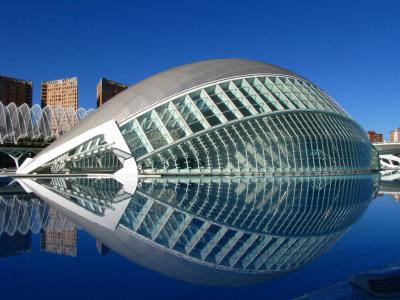
L'Hemisfèric, situated at the heart of the City of Arts and Sciences, is a multifunctional venue encompassing an IMAX Cinema, Planetarium, and Laserium. Its distinctive architectural design emulates that of a colossal eye, covering an expansive area of approximately 13,000 square meters.
This renowned structure, also referred to as the planetarium or the "eye of knowledge," designed by architect Santiago Calatrava, was completed in 1998. Its captivating composition resembles an eyelid, which gracefully unfurls to grant access to the surrounding water pool. The pool's bottom is crafted from glass, ingeniously creating the illusion of an integrated ocular entity. Within the concrete framework, the planetarium takes the form of a semi-spherical dome, measuring 110 meters in length and 55.5 meters in width. The shutter comprises elongated aluminum awnings that collectively ascend, forming a brise soleil roof. This unique roof smoothly opens along the curved axis of the eye, unveiling the dome, metaphorically known as the "iris," which houses the planetarium or Ominax theater. A set of stairs bisects the structure, leading down into the vaulted concrete lobby.
Translucent glass panels adorn the underground areas, allowing gentle illumination to permeate the pathways. The transparent roof, supported by concrete arches, interconnects with the sunken gallery. Notably, an extraordinary echo reverberates throughout the building, allowing individuals positioned at the opposing pillars within the eye to engage in conversation with each other.
This renowned structure, also referred to as the planetarium or the "eye of knowledge," designed by architect Santiago Calatrava, was completed in 1998. Its captivating composition resembles an eyelid, which gracefully unfurls to grant access to the surrounding water pool. The pool's bottom is crafted from glass, ingeniously creating the illusion of an integrated ocular entity. Within the concrete framework, the planetarium takes the form of a semi-spherical dome, measuring 110 meters in length and 55.5 meters in width. The shutter comprises elongated aluminum awnings that collectively ascend, forming a brise soleil roof. This unique roof smoothly opens along the curved axis of the eye, unveiling the dome, metaphorically known as the "iris," which houses the planetarium or Ominax theater. A set of stairs bisects the structure, leading down into the vaulted concrete lobby.
Translucent glass panels adorn the underground areas, allowing gentle illumination to permeate the pathways. The transparent roof, supported by concrete arches, interconnects with the sunken gallery. Notably, an extraordinary echo reverberates throughout the building, allowing individuals positioned at the opposing pillars within the eye to engage in conversation with each other.
8) L'Umbracle Sculpture Garden
The Umbracle is a mesmerizing sculpture garden and landscaped pathway adorned with native plant species found in Valencia. Among these botanical treasures are rockrose, lentiscus, romero, honeysuckle, bougainvillea, and palm trees. Nestled within its confines lies The Walk of the Sculptures, an open-air art gallery showcasing masterpieces by contemporary artists like Miquel from Navarre, Francesc Abbot, Yoko Ono, and others.
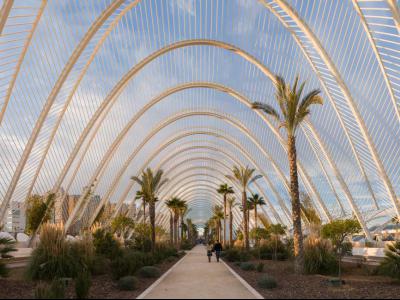
The Umbracle serves as a sanctuary for numerous sculptures, embraced by the beauty of nature. Designed by Santiago Calatrava, it serves as an entrance on the southwestern periphery of the City of Arts and Sciences, while also providing a roof over the adjacent car park. L'Umbracle was successfully completed in 2001.
Spanning an impressive length of 320 meters and width of 60 meters, this remarkable structure occupies the southern side of the complex. Its elegant form comprises 55 fixed arches and 54 floating arches, reaching a soaring height of 18 meters. These arches exhibit captivating parabolic shapes.
Delicately chosen for their seasonal transformations, the plants within the garden enchantingly change their hues throughout the year. The garden showcases a collection of 99 palm trees, 78 smaller palm trees, and 62 bitter orange trees. Moreover, it boasts an array of 42 shrub varieties originating from the Region of Valencia, including cistuses, mastics, buddleia, pampas grass, and plumbagos. Honeysuckle and cascading bougainvillea are among the 450 climbing plants that adorn the Umbracle.
Additionally, the garden houses 5,500 ground cover plants, such as lotus, Spanish Flags, and fig marigolds. Adding to its allure, more than a hundred aromatic plants, including rosemary and lavender, perfume the air with their delightful scents.
The Umbracle serves as a sanctuary for numerous sculptures, embraced by the beauty of nature. Designed by Santiago Calatrava, it serves as an entrance on the southwestern periphery of the City of Arts and Sciences, while also providing a roof over the adjacent car park. L'Umbracle was successfully completed in 2001.
Spanning an impressive length of 320 meters and width of 60 meters, this remarkable structure occupies the southern side of the complex. Its elegant form comprises 55 fixed arches and 54 floating arches, reaching a soaring height of 18 meters. These arches exhibit captivating parabolic shapes.
Delicately chosen for their seasonal transformations, the plants within the garden enchantingly change their hues throughout the year. The garden showcases a collection of 99 palm trees, 78 smaller palm trees, and 62 bitter orange trees. Moreover, it boasts an array of 42 shrub varieties originating from the Region of Valencia, including cistuses, mastics, buddleia, pampas grass, and plumbagos. Honeysuckle and cascading bougainvillea are among the 450 climbing plants that adorn the Umbracle.
Additionally, the garden houses 5,500 ground cover plants, such as lotus, Spanish Flags, and fig marigolds. Adding to its allure, more than a hundred aromatic plants, including rosemary and lavender, perfume the air with their delightful scents.
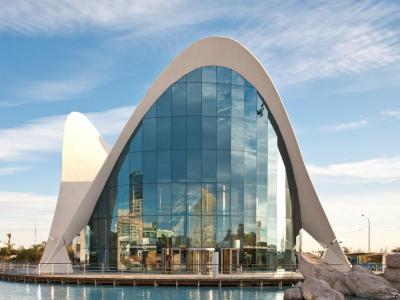
9) L'Oceanogràfic (must see)
Situated on the dry Turia River bed southeast of Valencia's city center, L'Oceanogràfic is a captivating oceanarium that showcases diverse marine habitats. This architectural marvel was collaboratively designed by Félix Candela, an esteemed architect, and structural engineers Alberto Domingo and Carlos Lázaro. It is an integral part of the renowned cultural complex known as the City of Arts and Sciences, and it officially opened its doors on 14 February 2003.
Spanning an impressive 110,000 square meters (1,200,000 square feet), the Oceanographic stands as the largest complex of its kind in Europe. Its massive water capacity, reaching 42,000,000 liters (11,000,000 US gallons), includes a dolphinarium with a volume of 26,000,000 liters (6,900,000 US gallons) and an ocean tank housing sharks, rays, and other fish with a capacity of 7,000,000 liters (1,800,000 US gallons).
Within this vast space, 45,000 animals from 500 different species find their home, encompassing sharks, penguins, dolphins, sea lions, walruses, beluga whales, birds, reptiles, and invertebrates. These creatures inhabit nine two-tiered underwater towers, each representing a significant ecosystem on Earth. Remarkably, the aquariums utilize seawater pumped from La Malva-Rosa beach.
The park is divided into ten distinct areas, offering visitors a diverse range of experiences. These areas include Mediterranean habitats, the Arctic oceans, islands, the tropics, the temperate seas, the Red Sea, a dolphinarium, an area dedicated to mangrove swamps and marshland, and a splendid garden boasting over 80 different plant species.
The Oceanographic's unique architectural structure features a steel-fiber reinforced concrete thin-shell design. Candela drew inspiration from the iconic hyperbolic parabola (hypars) shape of his earlier creation, the Los Manantiales Restaurant in Mexico City, which he designed back in 1958.
At present, the Oceanographic operates in partnership with the Vancouver Aquarium Marine Science Centre in Vancouver, British Columbia, Canada, further enhancing its global connection and commitment to marine science and conservation.
Spanning an impressive 110,000 square meters (1,200,000 square feet), the Oceanographic stands as the largest complex of its kind in Europe. Its massive water capacity, reaching 42,000,000 liters (11,000,000 US gallons), includes a dolphinarium with a volume of 26,000,000 liters (6,900,000 US gallons) and an ocean tank housing sharks, rays, and other fish with a capacity of 7,000,000 liters (1,800,000 US gallons).
Within this vast space, 45,000 animals from 500 different species find their home, encompassing sharks, penguins, dolphins, sea lions, walruses, beluga whales, birds, reptiles, and invertebrates. These creatures inhabit nine two-tiered underwater towers, each representing a significant ecosystem on Earth. Remarkably, the aquariums utilize seawater pumped from La Malva-Rosa beach.
The park is divided into ten distinct areas, offering visitors a diverse range of experiences. These areas include Mediterranean habitats, the Arctic oceans, islands, the tropics, the temperate seas, the Red Sea, a dolphinarium, an area dedicated to mangrove swamps and marshland, and a splendid garden boasting over 80 different plant species.
The Oceanographic's unique architectural structure features a steel-fiber reinforced concrete thin-shell design. Candela drew inspiration from the iconic hyperbolic parabola (hypars) shape of his earlier creation, the Los Manantiales Restaurant in Mexico City, which he designed back in 1958.
At present, the Oceanographic operates in partnership with the Vancouver Aquarium Marine Science Centre in Vancouver, British Columbia, Canada, further enhancing its global connection and commitment to marine science and conservation.
