Custom Walk in Prague, Czech Republic by kmtaping22_f5ef6 created on 2025-06-03
Guide Location: Czech Republic » Prague
Guide Type: Custom Walk
# of Sights: 8
Tour Duration: 2 Hour(s)
Travel Distance: 2.9 Km or 1.8 Miles
Share Key: YFUPP
Guide Type: Custom Walk
# of Sights: 8
Tour Duration: 2 Hour(s)
Travel Distance: 2.9 Km or 1.8 Miles
Share Key: YFUPP
How It Works
Please retrieve this walk in the GPSmyCity app. Once done, the app will guide you from one tour stop to the next as if you had a personal tour guide. If you created the walk on this website or come to the page via a link, please follow the instructions below to retrieve the walk in the app.
Retrieve This Walk in App
Step 1. Download the app "GPSmyCity: Walks in 1K+ Cities" on Apple App Store or Google Play Store.



Step 2. In the GPSmyCity app, download(or launch) the guide "Prague Map and Walking Tours".
Step 3. Tap the menu button located at upper right corner of the "Walks" screen and select "Retrieve custom walk". Enter the share key: YFUPP
1) Astronomical Clock (must see)
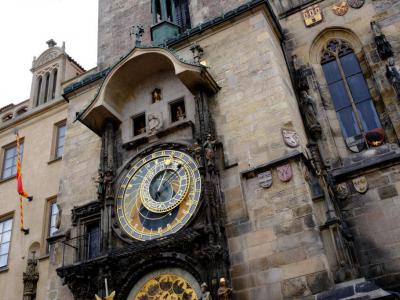
The Astronomical Clock on Prague’s Old Town Square has been drawing curious eyes since the 15th century. Every hour from 9 a.m. to 9 p.m., a theatrical blend of medieval engineering and storytelling never fails to draw a crowd. The clock’s beauty is matched by its complexity, with layers of astronomical and calendar dials showcasing the scientific prowess of its creators.
The main dial presents a symbolic view of Earth and Sky, split between day and night. Surrounding that is a ring showing old Bohemian time, while the astronomical display charts the sun and planets as they orbit the Earth-back when the universe revolved around us, of course. Another circle traces the paths of the sun and moon through the zodiac. A final ring on the edge shows the day, date, and the name of the saint commemorated-a matter of significance in medieval times.
But it’s the show on the hour that captures the most attention. From tiny trapdoors above the clock face, a parade of carved apostles appears, led by Christ, moving steadily past two small windows. Overhead, four figures symbolize medieval threats-Death with an hourglass, Greed clutching gold, Vanity admiring his reflection, and a Turk shaking his head. Below, statues representing Philosophy, Religion, Astronomy, and History observe the scene. As the show concludes, a golden rooster flaps and crows, and the clock strikes the hour to polite applause before the spectators disperse.
Local legend adds an eerie layer: the master clockmaker, Hanus, was blinded to ensure he’d never replicate his work elsewhere. In revenge, he damaged the clock, and no one could repair it for a hundred years. Another tale suggests that if the clock ever stops for too long, the fate of Prague may hang in the balance.
Tip: For a bird’s-eye view, take the elevator-or brave the stairs-to the top of the tower. The view is worth every step.
The main dial presents a symbolic view of Earth and Sky, split between day and night. Surrounding that is a ring showing old Bohemian time, while the astronomical display charts the sun and planets as they orbit the Earth-back when the universe revolved around us, of course. Another circle traces the paths of the sun and moon through the zodiac. A final ring on the edge shows the day, date, and the name of the saint commemorated-a matter of significance in medieval times.
But it’s the show on the hour that captures the most attention. From tiny trapdoors above the clock face, a parade of carved apostles appears, led by Christ, moving steadily past two small windows. Overhead, four figures symbolize medieval threats-Death with an hourglass, Greed clutching gold, Vanity admiring his reflection, and a Turk shaking his head. Below, statues representing Philosophy, Religion, Astronomy, and History observe the scene. As the show concludes, a golden rooster flaps and crows, and the clock strikes the hour to polite applause before the spectators disperse.
Local legend adds an eerie layer: the master clockmaker, Hanus, was blinded to ensure he’d never replicate his work elsewhere. In revenge, he damaged the clock, and no one could repair it for a hundred years. Another tale suggests that if the clock ever stops for too long, the fate of Prague may hang in the balance.
Tip: For a bird’s-eye view, take the elevator-or brave the stairs-to the top of the tower. The view is worth every step.
2) Old Town Hall (must see)
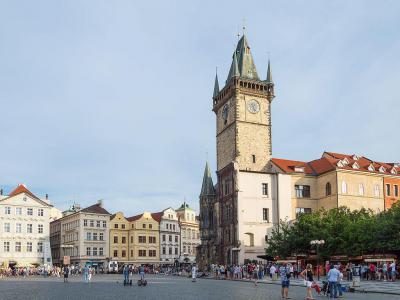
Rising on the eastern edge of Prague’s Old Town Square, the Old Town Hall has watched over the city since 1338, when it became the seat of the Old Town’s self-rule. Over the centuries, as surrounding buildings were added into the mix, the complex evolved into a unique blend of styles-Gothic at its core, but with Renaissance and Baroque elements layered in.
The centerpiece is the tall Gothic tower, built in the 14th century and stretching nearly 70 meters into the sky. From the top, you’re treated to sweeping views across Prague’s rooftops and the square below. Just beneath the tower ticks one of the city's most beloved attractions: the Astronomical Clock. Installed in 1410, it’s one of the oldest working examples in the world, famous for its hourly show of the Twelve Apostles-a mechanical spectacle that still draws a crowd.
Visitors can explore the historic interiors, each telling a different chapter of Prague’s past. The Gothic Council Chamber, the intimate Chapel of the Virgin Mary, and the Romanesque underground rooms all invite exploration.
The building has also stood witness to some of Czech history’s darker chapters. In 1621, it was here that 27 Czech Protestant leaders were executed following the Battle of White Mountain. Their memory lives on in the 27 white crosses set into the pavement just outside the entrance. And during the Prague Uprising in May 1945, the eastern wing was destroyed and never rebuilt-leaving behind a striking gap that still marks the cost of conflict.
The centerpiece is the tall Gothic tower, built in the 14th century and stretching nearly 70 meters into the sky. From the top, you’re treated to sweeping views across Prague’s rooftops and the square below. Just beneath the tower ticks one of the city's most beloved attractions: the Astronomical Clock. Installed in 1410, it’s one of the oldest working examples in the world, famous for its hourly show of the Twelve Apostles-a mechanical spectacle that still draws a crowd.
Visitors can explore the historic interiors, each telling a different chapter of Prague’s past. The Gothic Council Chamber, the intimate Chapel of the Virgin Mary, and the Romanesque underground rooms all invite exploration.
The building has also stood witness to some of Czech history’s darker chapters. In 1621, it was here that 27 Czech Protestant leaders were executed following the Battle of White Mountain. Their memory lives on in the 27 white crosses set into the pavement just outside the entrance. And during the Prague Uprising in May 1945, the eastern wing was destroyed and never rebuilt-leaving behind a striking gap that still marks the cost of conflict.
3) Church of Our Lady before Tyn (must see)
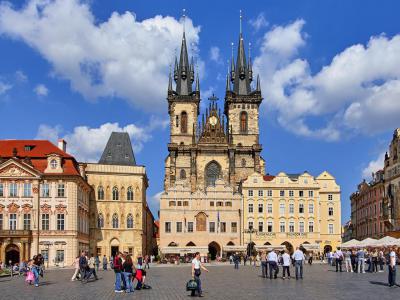
Standing tall over Prague’s Old Town, this mighty 14th-century Gothic marvel commands attention like few others. Marked by its uneven twin spires topped with smaller turrets, it is visible from nearly every angle in the city-a reliable landmark for orientation. Alongside the nearby Jan Hus monument, Týn Church stirs deep national pride and adds to that dreamlike quality often dubbed “Magic Prague”"-no wonder Disney used it as an inspiration for his fairytale castle. After dark, bathed in a warm orange glow, the church looks straight out of a storybook.
For a postcard-worthy view of the exterior, grab a ticket to the Clock Tower across the square and ride the lift to the top. Entry to the church itself is free, though a bit hidden: look for the narrow passage-specifically, the last arch on the left among the row of restaurants when you’re facing the spires from the square.
Inside, the Baroque-era makeover is on full display-ornate gilded woodwork, vivid stained glass, and a forest of soaring altarpieces surround you from every angle. They rise beside columns, frame the sanctuary, and line the walls in dazzling abundance.
Fans of astronomy will want to pay their respects at the marble tomb of Tycho Brahe, royal astronomer to Emperor Rudolf II. His likeness is carved into a wooden relief, surrounded by celestial symbols. And if you’re lucky, you might catch a concert on the grand 17th-century organ-check with Via Musica for tickets. The acoustics alone are worth it.
For a postcard-worthy view of the exterior, grab a ticket to the Clock Tower across the square and ride the lift to the top. Entry to the church itself is free, though a bit hidden: look for the narrow passage-specifically, the last arch on the left among the row of restaurants when you’re facing the spires from the square.
Inside, the Baroque-era makeover is on full display-ornate gilded woodwork, vivid stained glass, and a forest of soaring altarpieces surround you from every angle. They rise beside columns, frame the sanctuary, and line the walls in dazzling abundance.
Fans of astronomy will want to pay their respects at the marble tomb of Tycho Brahe, royal astronomer to Emperor Rudolf II. His likeness is carved into a wooden relief, surrounded by celestial symbols. And if you’re lucky, you might catch a concert on the grand 17th-century organ-check with Via Musica for tickets. The acoustics alone are worth it.
4) Spanish Synagogue (must see)
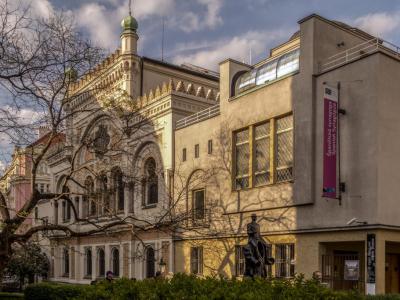
Prague is known the world over for its architecture, and even in a city filled with Gothic spires, Baroque palaces, and Art Nouveau gems, the Spanish Synagogue manages to stand out. Situated in the Jewish Quarter, this stunning Moorish Revival landmark was completed in 1868 on the site of the city's oldest synagogue. If you're starting your exploration of the area, there’s hardly a more fitting place to begin.
From the outside, the building’s design immediately draws the eye. Its façade, divided into three sections, features a taller central portion flanked by twin domed turrets. If you’ve been to Vienna, you might notice the architectural echo of the Leopoldstadt Temple, a key inspiration. But while the exterior is impressive, the real magic begins inside.
Every inch, except the floor, is covered in elicate arabesques that twist and curl across walls and ceilings-either carved, painted, or molded with astonishing precision. The effect is mesmerizing, like being inside a jewel box. Look up and you’ll spot a richly decorated dome at the center, illuminated by a striking Magen David chandelier. The ark and bimah command attention with their elegance, and tucked at the back is a beautifully restored organ-something rarely found in synagogues.
Over the course of the 20th century, the synagogue suffered neglect under both Nazi and Communist regimes. But in the late 1990s, it was restored and reopened to the public under the care of the Jewish Museum. Today, it serves as a concert venue, while the Robert Guttmann Gallery next door hosts rotating art exhibitions of Jewish art and culture.
Interestingly, the Spanish Synagogue has never served a Sephardic or Spanish-speaking community. The origin of the name remains unclear-but one thing is certain: its beauty speaks a universal language.
From the outside, the building’s design immediately draws the eye. Its façade, divided into three sections, features a taller central portion flanked by twin domed turrets. If you’ve been to Vienna, you might notice the architectural echo of the Leopoldstadt Temple, a key inspiration. But while the exterior is impressive, the real magic begins inside.
Every inch, except the floor, is covered in elicate arabesques that twist and curl across walls and ceilings-either carved, painted, or molded with astonishing precision. The effect is mesmerizing, like being inside a jewel box. Look up and you’ll spot a richly decorated dome at the center, illuminated by a striking Magen David chandelier. The ark and bimah command attention with their elegance, and tucked at the back is a beautifully restored organ-something rarely found in synagogues.
Over the course of the 20th century, the synagogue suffered neglect under both Nazi and Communist regimes. But in the late 1990s, it was restored and reopened to the public under the care of the Jewish Museum. Today, it serves as a concert venue, while the Robert Guttmann Gallery next door hosts rotating art exhibitions of Jewish art and culture.
Interestingly, the Spanish Synagogue has never served a Sephardic or Spanish-speaking community. The origin of the name remains unclear-but one thing is certain: its beauty speaks a universal language.
5) Charles Bridge (must see)
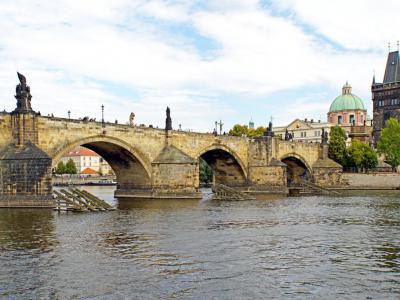
One of Prague’s most iconic landmarks, the Charles Bridge wasn’t just built; it was timed. Construction began on July 9, 1357, at exactly 5:31 in the morning. The oddly precise timing wasn’t random. Holy Roman Emperor Charles IV was a firm believer in numerology and astrology. That moment created a palindrome-135797531-which, in his mind, would grant the bridge strength and longevity. Whether that worked, or whether the secret ingredient was the rumored mix of eggs, wine, or milk stirred into the foundations, we’ll never know. But over six centuries later, the bridge still stands.
Stretching over the Vltava River, it runs 516 meters long and nearly 10 meters wide, supported by 16 sturdy arches with ice guards to fend off the river’s freeze. Until 1841, this was the only way to cross from Prague’s Old Town to the Castle and the Lesser Town. With the boom in traffic in the 20th century, the bridge eventually closed to vehicles and became pedestrian-only in 1978.
Lining both sides are 30 striking Baroque statues, added from the late 1600s through the early 20th century. They complement the Gothic structure underneath and turn any stroll into a kind of open-air museum. As you head toward Lesser Town, keep an eye out for the bronze crucifix-the oldest statue on the bridge-as well as the dramatic tableau of Saint Francis Xavier converting four royal figures from faraway lands: an Indian, Moor, Chinese, and Tartar. Perhaps the most famous is the eighth statue on the right: Saint John of Nepomuk, thrown into the river for refusing to betray the Queen’s confession. Locals say touching his plaque brings luck-or guarantees you’ll return to Prague one day.
Tip: For a quieter, more magical walk, go at dawn or after sunset-when the statues seem to whisper, and the city hushes just long enough to hear them.
Stretching over the Vltava River, it runs 516 meters long and nearly 10 meters wide, supported by 16 sturdy arches with ice guards to fend off the river’s freeze. Until 1841, this was the only way to cross from Prague’s Old Town to the Castle and the Lesser Town. With the boom in traffic in the 20th century, the bridge eventually closed to vehicles and became pedestrian-only in 1978.
Lining both sides are 30 striking Baroque statues, added from the late 1600s through the early 20th century. They complement the Gothic structure underneath and turn any stroll into a kind of open-air museum. As you head toward Lesser Town, keep an eye out for the bronze crucifix-the oldest statue on the bridge-as well as the dramatic tableau of Saint Francis Xavier converting four royal figures from faraway lands: an Indian, Moor, Chinese, and Tartar. Perhaps the most famous is the eighth statue on the right: Saint John of Nepomuk, thrown into the river for refusing to betray the Queen’s confession. Locals say touching his plaque brings luck-or guarantees you’ll return to Prague one day.
Tip: For a quieter, more magical walk, go at dawn or after sunset-when the statues seem to whisper, and the city hushes just long enough to hear them.
6) Church of St. Nicholas (Lesser Town) (must see)
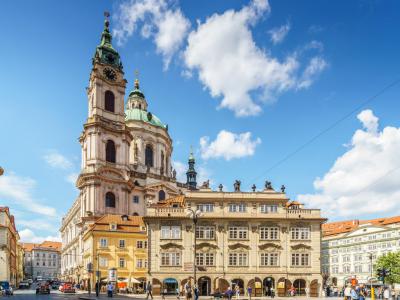
Towering over Lesser Town is a Baroque masterpiece-one of the most recognizable landmarks along Prague’s left bank. With its colossal green dome and soaring tower, this church was the grandest project of the Jesuits in Bohemia, a bold statement of their significant influence over the region in the 18th century. The contrast between the dome’s solid breadth and the tower’s slender elegance adds a distinctive flair to the city’s silhouette.
Step inside, and you’re met with a riot of pinks and greens that almost overwhelm the senses. The space is alive with movement-from the dynamic statues and vibrant frescoes to the polished, faux-marble columns. At the center, a sweeping ceiling painting brings to life the miracles of Saint Nicholas in true Baroque drama. But it’s the towering dome that steals the spotlight. Look up, and you’ll find four stern-faced Church Fathers circling the space-one of them even clutching a golden thunderbolt as if daring you to question the weight of their message.
The organ alone is worth the visit. Installed in the 1740s and fitted with more than 4,000 pipes, it once echoed with the music of Mozart himself, who played here during his time in Prague. After his death, this is where his Requiem was performed. With such acoustics, it's no wonder the church still hosts classical concerts to this day.
During the communist era, the bell tower wasn’t just a place of worship-it also served as a surveillance outpost for State Security, keeping a close eye on the embassies below. Now, you can climb the 299 steps to the gallery, perched 65 meters above the square, and enjoy a fine perspective over Lesser Town and the Charles Bridge beyond.
Step inside, and you’re met with a riot of pinks and greens that almost overwhelm the senses. The space is alive with movement-from the dynamic statues and vibrant frescoes to the polished, faux-marble columns. At the center, a sweeping ceiling painting brings to life the miracles of Saint Nicholas in true Baroque drama. But it’s the towering dome that steals the spotlight. Look up, and you’ll find four stern-faced Church Fathers circling the space-one of them even clutching a golden thunderbolt as if daring you to question the weight of their message.
The organ alone is worth the visit. Installed in the 1740s and fitted with more than 4,000 pipes, it once echoed with the music of Mozart himself, who played here during his time in Prague. After his death, this is where his Requiem was performed. With such acoustics, it's no wonder the church still hosts classical concerts to this day.
During the communist era, the bell tower wasn’t just a place of worship-it also served as a surveillance outpost for State Security, keeping a close eye on the embassies below. Now, you can climb the 299 steps to the gallery, perched 65 meters above the square, and enjoy a fine perspective over Lesser Town and the Charles Bridge beyond.
7) Prague Castle (must see)
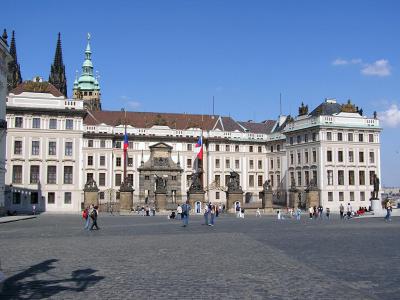
When you hear “Prague Castle,” you might picture one grandiose palace with spires and regal chambers-but in reality, it’s even more than that. What you're looking at is a vast, fortified complex filled with government buildings, centuries-old churches, art-filled museums, stunning gardens, and the famously charming Golden Lane-where Franz Kafka once lived in a tiny cottage. Covering over 17 acres, or 70,000 square meters, it holds the Guinness World Record as the largest castle complex in existence, and its roots stretch all the way back to the 9th century.
This place has seen centuries of rulers come and go-from medieval kings and Habsburg monarchs to Tomáš Masaryk, the first president of Czechoslovakia. Today, it’s still the official residence of the Czech president, and you can tell when they’re in town by the national flag flying above the entrance. Just outside the main gates, the stoic castle guards carry out the ceremonial changing of the guard every day at noon, with smaller routines each hour starting at 7 a.m.
The architecture here is a timeline in stone-Saint Vitus Cathedral blends Gothic drama with Renaissance and Baroque flourishes, while nearby Saint George’s Basilica keeps things somewhat simpler with a Romanesque interior hidden behind a Baroque facade. You’ll even notice touches from the 20th century scattered across the grounds, making the Castle feel like a living archive of Czech history.
If you’re planning to explore the whole complex, set aside at least 3 to 5 hours-it’s worth taking your time. The castle gardens are open to the public for free, perfect for wandering or simply sitting and soaking up the atmosphere. If the ticket line at the main entrance seems long, try one of the booths deeper in the courtyard-they’re often quicker and easier to access.
This place has seen centuries of rulers come and go-from medieval kings and Habsburg monarchs to Tomáš Masaryk, the first president of Czechoslovakia. Today, it’s still the official residence of the Czech president, and you can tell when they’re in town by the national flag flying above the entrance. Just outside the main gates, the stoic castle guards carry out the ceremonial changing of the guard every day at noon, with smaller routines each hour starting at 7 a.m.
The architecture here is a timeline in stone-Saint Vitus Cathedral blends Gothic drama with Renaissance and Baroque flourishes, while nearby Saint George’s Basilica keeps things somewhat simpler with a Romanesque interior hidden behind a Baroque facade. You’ll even notice touches from the 20th century scattered across the grounds, making the Castle feel like a living archive of Czech history.
If you’re planning to explore the whole complex, set aside at least 3 to 5 hours-it’s worth taking your time. The castle gardens are open to the public for free, perfect for wandering or simply sitting and soaking up the atmosphere. If the ticket line at the main entrance seems long, try one of the booths deeper in the courtyard-they’re often quicker and easier to access.
8) St. Vitus Cathedral (must see)
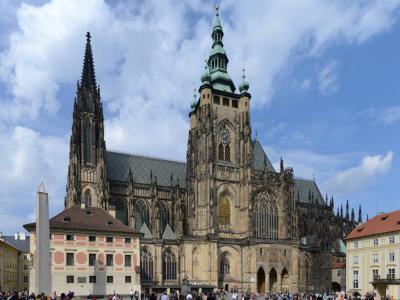
Rising above the Vltava River from within the grounds of Prague Castle, Saint Vitus Cathedral is hailed as a pinnacle of Gothic architectire and a powerful emblem of Bohemian identity. For generations, it has been the final resting place of kings and emperors, and its very presence resonates with centuries of history. But even if you're not drawn in by royal lineages or historic timelines, the striking façade, sweeping nave, and exquisite stained glass stir something deeper-a quiet sense of awe and reverence that transcends time.
The first thing you'll likely notice is the imposing Great Tower, topped with a Baroque dome and housing Sigismund-the largest bell in Bohemia, cast in the 1500s and weighing in at over 33,000 pounds. Just beside it is the cathedral’s southern entrance-the Golden Gate-famed for its gleaming mosaic of the Last Judgment, crafted from Venetian glass.
Inside, you’re instantly struck by the vertical grandeur of the nave. On the left, the stained-glass windows impart a transcendent aura; particularly the third one-a vivid Art Nouveau piece by Alfons Mucha, which tells the story of Christianity in the Czech lands through a kaleidoscope of color and symbolism. Other highlights include a wooden panorama of old Prague, the extravagant silver tomb of Saint John of Nepomuk, and a fascinating mix of sculptural details that range from sacred to surreal.
A few tips before your visit: entry to the main area and some interior sections is free, but a full tour requires a ticket bundled with Prague Castle access. There’s also an option to climb the tower-for a separate fee-rewarding the ambitious with sweeping views, assuming you're up for the tight staircase.
The first thing you'll likely notice is the imposing Great Tower, topped with a Baroque dome and housing Sigismund-the largest bell in Bohemia, cast in the 1500s and weighing in at over 33,000 pounds. Just beside it is the cathedral’s southern entrance-the Golden Gate-famed for its gleaming mosaic of the Last Judgment, crafted from Venetian glass.
Inside, you’re instantly struck by the vertical grandeur of the nave. On the left, the stained-glass windows impart a transcendent aura; particularly the third one-a vivid Art Nouveau piece by Alfons Mucha, which tells the story of Christianity in the Czech lands through a kaleidoscope of color and symbolism. Other highlights include a wooden panorama of old Prague, the extravagant silver tomb of Saint John of Nepomuk, and a fascinating mix of sculptural details that range from sacred to surreal.
A few tips before your visit: entry to the main area and some interior sections is free, but a full tour requires a ticket bundled with Prague Castle access. There’s also an option to climb the tower-for a separate fee-rewarding the ambitious with sweeping views, assuming you're up for the tight staircase.
