Custom Walk in Marseille, France by jean_marier_94edc created on 2025-06-07
Guide Location: France » Marseille
Guide Type: Custom Walk
# of Sights: 7
Tour Duration: 2 Hour(s)
Travel Distance: 5.6 Km or 3.5 Miles
Share Key: GC358
Guide Type: Custom Walk
# of Sights: 7
Tour Duration: 2 Hour(s)
Travel Distance: 5.6 Km or 3.5 Miles
Share Key: GC358
How It Works
Please retrieve this walk in the GPSmyCity app. Once done, the app will guide you from one tour stop to the next as if you had a personal tour guide. If you created the walk on this website or come to the page via a link, please follow the instructions below to retrieve the walk in the app.
Retrieve This Walk in App
Step 1. Download the app "GPSmyCity: Walks in 1K+ Cities" on Apple App Store or Google Play Store.



Step 2. In the GPSmyCity app, download(or launch) the guide "Marseille Map and Walking Tours".
Step 3. Tap the menu button located at upper right corner of the "Walks" screen and select "Retrieve custom walk". Enter the share key: GC358
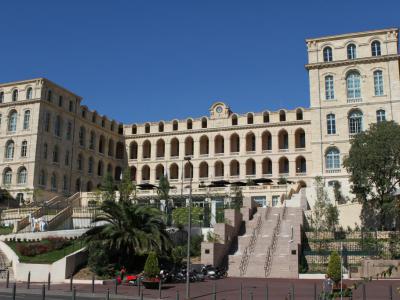
1) InterContinental Marseille Hotel Dieu
The InterContinental Marseille – Hotel Dieu is a five-star luxury hotel that opened in 2013, yet its history extends over eight centuries. The site was originally home to the Saint-Esprit Hospital, founded around 1188, which cared for Marseille’s poor and sick for hundreds of years. After several expansions, the current Neoclassical building was inaugurated by Napoleon III on November 15, 1866, marking a new era in the city’s public health.
In 1963, the complex was officially listed as a Historic Monument, recognized for its architectural and cultural importance. The hospital continued to operate as a teaching facility until 1993, when the last patients were relocated. A decade later, the city of Marseille, working with private partners, launched a major restoration and redevelopment project. The transformed building reopened under the InterContinental brand in 2013.
Today, the InterContinental Marseille – Hotel Dieu features over 170 rooms and suites—some with panoramic views of the Old Port—along with restaurants, a spa, and conference facilities. During its conversion, archaeological excavations revealed the remains of a 12th-century chapel buried beneath the gardens and Roman mosaics that are now displayed in the hotel’s cultural area. Guests can stroll through historic vaulted corridors, admire 18th- and 19th-century staircases, and encounter traces of the city’s ancient past woven into this restored architectural landmark.
In 1963, the complex was officially listed as a Historic Monument, recognized for its architectural and cultural importance. The hospital continued to operate as a teaching facility until 1993, when the last patients were relocated. A decade later, the city of Marseille, working with private partners, launched a major restoration and redevelopment project. The transformed building reopened under the InterContinental brand in 2013.
Today, the InterContinental Marseille – Hotel Dieu features over 170 rooms and suites—some with panoramic views of the Old Port—along with restaurants, a spa, and conference facilities. During its conversion, archaeological excavations revealed the remains of a 12th-century chapel buried beneath the gardens and Roman mosaics that are now displayed in the hotel’s cultural area. Guests can stroll through historic vaulted corridors, admire 18th- and 19th-century staircases, and encounter traces of the city’s ancient past woven into this restored architectural landmark.
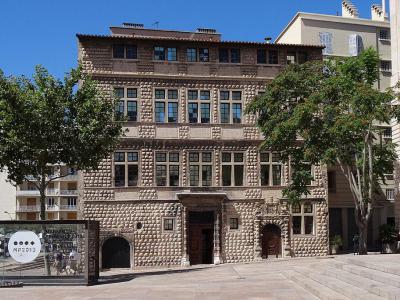
2) Maison Diamantée (Diamond House)
The Diamond House owes its name to the diamond-shaped stones that decorate its façade, an elegant example of diamond-point masonry typical of late Renaissance architecture. It is among Marseille’s best-preserved historic residences. Built on the grounds of the former Palace of Provence gardens by wealthy Spanish and Italian merchants, the house dates from the late 16th or early 17th century, reflecting the prosperity of the city’s international trading elite.
Over time, it was home to several notable Marseille families, including Peter Sebolin de Bollena, the city’s second sheriff in 1685, and his nephew, first sheriff in 1702. In 1943, the house narrowly escaped destruction when German occupation forces razed much of the north side of the Old Port. From 1967 to 2009, it housed the Museum of Old Marseille, whose collections were later incorporated into the Marseille History Museum.
Today, the Diamond House is primarily used for municipal offices. The building itself is not generally open to the public, but visitors can still admire its façade and monumental staircase. Its finely carved portal, mullioned windows, and sculpted stonework mark the transition between Gothic and Renaissance styles, preserving a link to Marseille’s mercantile past.
Over time, it was home to several notable Marseille families, including Peter Sebolin de Bollena, the city’s second sheriff in 1685, and his nephew, first sheriff in 1702. In 1943, the house narrowly escaped destruction when German occupation forces razed much of the north side of the Old Port. From 1967 to 2009, it housed the Museum of Old Marseille, whose collections were later incorporated into the Marseille History Museum.
Today, the Diamond House is primarily used for municipal offices. The building itself is not generally open to the public, but visitors can still admire its façade and monumental staircase. Its finely carved portal, mullioned windows, and sculpted stonework mark the transition between Gothic and Renaissance styles, preserving a link to Marseille’s mercantile past.
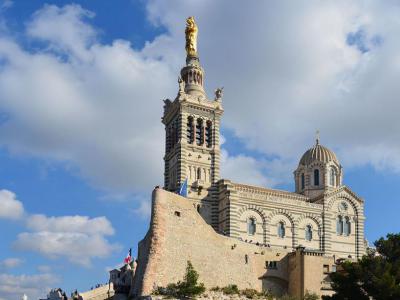
3) Notre-Dame de la Garde (must see)
Notre-Dame de la Garde stands proudly as an opulent Neo-Byzantine church situated atop the highest natural point in Marseille, perched upon a 532 feet limestone outcrop on the south side of the Old Port. This majestic site has become a cherished destination for an annual pilgrimage on Assumption Day.
Conceived by the talented architect Henri-Jacques Espérandieu, the basilica received its consecration on the 5th of June in 1864. Its origins trace back to a church with the same name, first erected in 1214 and later reconstructed during the 15th century. Remarkably, the basilica's foundations rest upon a 16th-century fortress built by Francis I of France to fend off Emperor Charles V's siege of the city in 1536.
The basilica comprises two distinct sections: a lower church or crypt, artistically carved into the rock in the Romanesque style, and an upper church boasting Neo-Byzantine elegance adorned with breathtaking mosaics. Towering above is a square bell-tower, reaching a height of 135 feet, crowned with a belfry standing at 42 feet. At its peak, a monumental statue of the Madonna and Child, crafted from copper gilded with gold leaf, soars to an impressive 27 feet.
During its history, the basilica encountered challenges, particularly regarding the stone used in its construction, which proved susceptible to atmospheric corrosion. In response, extensive restoration work took place from 2001 to 2008. This effort encompassed the meticulous repair of the mosaics, damaged by candle smoke over the years, as well as by bullets during the Liberation of France at the end of World War II.
Conceived by the talented architect Henri-Jacques Espérandieu, the basilica received its consecration on the 5th of June in 1864. Its origins trace back to a church with the same name, first erected in 1214 and later reconstructed during the 15th century. Remarkably, the basilica's foundations rest upon a 16th-century fortress built by Francis I of France to fend off Emperor Charles V's siege of the city in 1536.
The basilica comprises two distinct sections: a lower church or crypt, artistically carved into the rock in the Romanesque style, and an upper church boasting Neo-Byzantine elegance adorned with breathtaking mosaics. Towering above is a square bell-tower, reaching a height of 135 feet, crowned with a belfry standing at 42 feet. At its peak, a monumental statue of the Madonna and Child, crafted from copper gilded with gold leaf, soars to an impressive 27 feet.
During its history, the basilica encountered challenges, particularly regarding the stone used in its construction, which proved susceptible to atmospheric corrosion. In response, extensive restoration work took place from 2001 to 2008. This effort encompassed the meticulous repair of the mosaics, damaged by candle smoke over the years, as well as by bullets during the Liberation of France at the end of World War II.
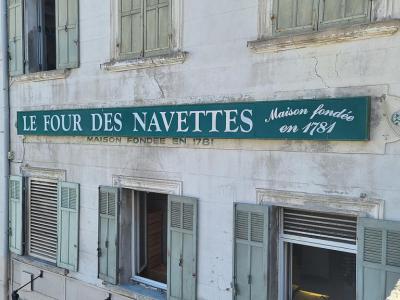
4) Le Four des Navettes
Le Four des Navettes stands proudly as Marseille's oldest bakery, nestled along the sacred path leading to the revered Saint Victor Abbey. Owned by Master Artisan Baker Jean-Claude Imbert and his son Nicolas, this bakery has preserved the cherished Navette recipe for over two centuries. Throughout its history since its establishment in 1781, the exclusive know-how has been passed down by its three owners.
The legacy of the vaulted oven, constructed in the late 18th century, endures to this day, ensuring the unmatched quality of these shuttle-shaped delights. Solely dedicated to their creation, this oven is an essential part of the local cultural heritage, boasting both historical and gastronomical significance.
Yet, behind its unassuming appearance, the Four des Navettes conceals a remarkable and unparalleled recipe. The scent of orange blossom delicately infuses the shuttles, making them a delightful treat in various forms: naturally crisp, gently warmed, or straight out of the oven. The remarkable expertise of the bakers allows these shuttles to maintain their exceptional qualities for an entire year without any deterioration.
For some, the origins of this delectable biscuit are intertwined with the Candlemas celebrations held at the Abbey of Saint-Victor, adding a touch of tradition and mystique to these beloved pastries.
The legacy of the vaulted oven, constructed in the late 18th century, endures to this day, ensuring the unmatched quality of these shuttle-shaped delights. Solely dedicated to their creation, this oven is an essential part of the local cultural heritage, boasting both historical and gastronomical significance.
Yet, behind its unassuming appearance, the Four des Navettes conceals a remarkable and unparalleled recipe. The scent of orange blossom delicately infuses the shuttles, making them a delightful treat in various forms: naturally crisp, gently warmed, or straight out of the oven. The remarkable expertise of the bakers allows these shuttles to maintain their exceptional qualities for an entire year without any deterioration.
For some, the origins of this delectable biscuit are intertwined with the Candlemas celebrations held at the Abbey of Saint-Victor, adding a touch of tradition and mystique to these beloved pastries.
5) Vieux-Port (Old Port) (must see)
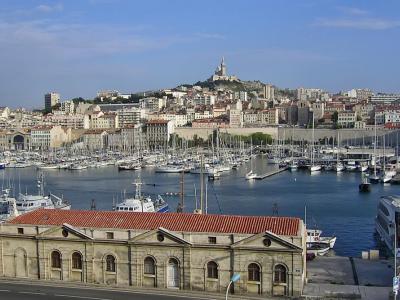
The Old Port is the city’s historic heart and one of the most evocative harbours in Europe, being a centre of maritime life for over 2,600 years. The site was first used as a trading post by the Phoenicians, long before the Greek settlers from Phocaea officially established it in 600 BCE as the port of Massalia, making it the birthplace of the city itself.
Through the centuries, the Old Port became a hub of Mediterranean commerce and naval activity. Kings Louis XII and Louis XIII expanded the shipyards in the 15th and 16th centuries, while King Louis XIV added the imposing Fort Saint John and Fort Saint Nicholas to defend the entrance of the harbour. The port reached its commercial peak in the 19th century, when up to 18,000 merchant vessels docked here annually, rivaling the activity of major ports such as Liverpool and Le Havre. However, with the arrival of large steamships that required deeper waters, Marseille shifted much of its industrial trade to the Port of La Joliette, located farther north.
The Old Port suffered immense damage during World War II, when German forces, assisted by French police, demolished much of the area to block access to Allied troops. Postwar reconstruction reshaped the district, and by the late 20th century, major urban renewal projects restored the port’s vitality. Architect Norman Foster’s redesign, featuring the The Shade Pavilion, a mirrored canopy that reflects the harbour below, marked a new era of pedestrian-friendly space and modern elegance.
Today, the Port serves as a marina for yachts, ferries, and fishing boats, as well as the site of a daily fish market that preserves centuries-old local tradition. Lined with cafés, restaurants, and open-air terraces, it remains a favourite gathering place for both locals and visitors.
Through the centuries, the Old Port became a hub of Mediterranean commerce and naval activity. Kings Louis XII and Louis XIII expanded the shipyards in the 15th and 16th centuries, while King Louis XIV added the imposing Fort Saint John and Fort Saint Nicholas to defend the entrance of the harbour. The port reached its commercial peak in the 19th century, when up to 18,000 merchant vessels docked here annually, rivaling the activity of major ports such as Liverpool and Le Havre. However, with the arrival of large steamships that required deeper waters, Marseille shifted much of its industrial trade to the Port of La Joliette, located farther north.
The Old Port suffered immense damage during World War II, when German forces, assisted by French police, demolished much of the area to block access to Allied troops. Postwar reconstruction reshaped the district, and by the late 20th century, major urban renewal projects restored the port’s vitality. Architect Norman Foster’s redesign, featuring the The Shade Pavilion, a mirrored canopy that reflects the harbour below, marked a new era of pedestrian-friendly space and modern elegance.
Today, the Port serves as a marina for yachts, ferries, and fishing boats, as well as the site of a daily fish market that preserves centuries-old local tradition. Lined with cafés, restaurants, and open-air terraces, it remains a favourite gathering place for both locals and visitors.
6) Hotel de Ville (City Hall)
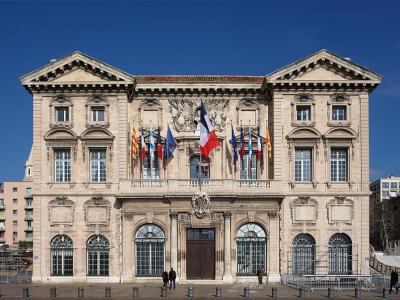
Built in 1656, the City Hall has served as Marseille’s civic centre ever since, replacing the earlier Town Hall that had fulfilled the same role since the 13th century. Often referred to as “The Lodge”, derived from the Italian loggia for its Baroque style, it was designed by Gaspard Puget.
The pink stone building, is richly decorated with sculptures and flags, reflecting the prosperity of 17th-century Marseille, then a thriving maritime republic under French influence. Above the main entrance is the city’s seal, created by Gaspard’s brother, Pierre Puget, a favourite artist of King Louis XIV. Appropriately, a bust of the Sun King crowns the façade, gazing over the bustling harbour and boulevard below.
Though monarchs fell from power in the 18th century, the City Hall endured. It survived multiple regimes, revolutions, and even the devastation of World War II—standing as a rare witness to the city’s turbulent history. Remarkably, despite wartime bombings that destroyed much of the surrounding district in 1943, the building itself escaped major damage. Inside, several ceremonial rooms still preserve period furnishings, portraits of former mayors, and historical archives that document centuries of municipal life.
The building’s rear features a covered bridge connecting its two main levels, symbolically reuniting the upper floor—once reserved for the nobility—with the ground floor, which was occupied by merchants and tradesmen in the 18th century. The City Hall continues to house the mayor’s office and serves as a venue for civic ceremonies, making it both a working institution and a living monument to the city’s storied past.
The pink stone building, is richly decorated with sculptures and flags, reflecting the prosperity of 17th-century Marseille, then a thriving maritime republic under French influence. Above the main entrance is the city’s seal, created by Gaspard’s brother, Pierre Puget, a favourite artist of King Louis XIV. Appropriately, a bust of the Sun King crowns the façade, gazing over the bustling harbour and boulevard below.
Though monarchs fell from power in the 18th century, the City Hall endured. It survived multiple regimes, revolutions, and even the devastation of World War II—standing as a rare witness to the city’s turbulent history. Remarkably, despite wartime bombings that destroyed much of the surrounding district in 1943, the building itself escaped major damage. Inside, several ceremonial rooms still preserve period furnishings, portraits of former mayors, and historical archives that document centuries of municipal life.
The building’s rear features a covered bridge connecting its two main levels, symbolically reuniting the upper floor—once reserved for the nobility—with the ground floor, which was occupied by merchants and tradesmen in the 18th century. The City Hall continues to house the mayor’s office and serves as a venue for civic ceremonies, making it both a working institution and a living monument to the city’s storied past.
7) Museum of European and Mediterranean Civilisations (MuCEM) (must see)
The Museum of European and Mediterranean Civilisations (Musée des Civilisations de l'Europe et de la Méditerranée) is a national institution situated in Marseille. Its inauguration took place on 7th June 2013, coinciding with Marseille's designation as the European Capital of Culture during the Marseille-Provence 2013 celebration. This museum was recognized for its excellence and awarded the prestigious Council of Europe Museum Prize in 2015.
Dedicated to the exploration of European and Mediterranean civilizations, the museum showcases a permanent collection that delves into the historical and cultural interactions within the Mediterranean basin. Adopting an interdisciplinary approach, it covers various aspects of society throughout different eras, right up to modern times.
The museum's strategic location lies on reclaimed land at the harbor's entrance, adjacent to the 17th-century Fort Saint-Jean and the former port terminal, J4. A channel separates the contemporary building from the Fort Saint-Jean, which has been renovated as part of the overall project. These two areas are connected via a 130-meter-long high footbridge. Additionally, another footbridge links Fort Saint-Jean to the Esplanade de la Tourette, close to the church of Saint Laurent in the Panier quarter.
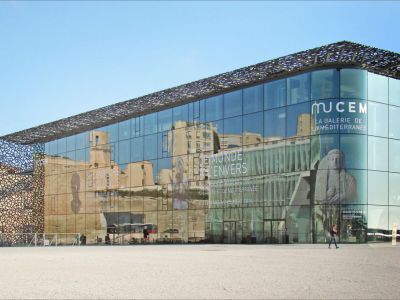
Designed by architects Rudy Ricciotti and Roland Carta, the museum embodies the concept of "stone, water, and wind." It features a striking cube-shaped structure spanning 15,000 square meters, enclosed by a latticework shell made of fiber-reinforced concrete. Inside, visitors can explore exhibits on two levels, while an underground auditorium with a seating capacity of 400 enriches the experience. The ground floor houses the permanent collection and a bookshop, while the top terrace hosts a restaurant that offers breathtaking panoramic views of Marseille's bay, the Corniche, and the Prado area.
In addition to its regular exhibitions, the museum presented a special exhibition in 2022 dedicated to Emir Abdelkader. This unique showcase provided an opportunity to delve into significant historical and memorial aspects related to this eminent figure within the Mediterranean context.
Dedicated to the exploration of European and Mediterranean civilizations, the museum showcases a permanent collection that delves into the historical and cultural interactions within the Mediterranean basin. Adopting an interdisciplinary approach, it covers various aspects of society throughout different eras, right up to modern times.
The museum's strategic location lies on reclaimed land at the harbor's entrance, adjacent to the 17th-century Fort Saint-Jean and the former port terminal, J4. A channel separates the contemporary building from the Fort Saint-Jean, which has been renovated as part of the overall project. These two areas are connected via a 130-meter-long high footbridge. Additionally, another footbridge links Fort Saint-Jean to the Esplanade de la Tourette, close to the church of Saint Laurent in the Panier quarter.
Designed by architects Rudy Ricciotti and Roland Carta, the museum embodies the concept of "stone, water, and wind." It features a striking cube-shaped structure spanning 15,000 square meters, enclosed by a latticework shell made of fiber-reinforced concrete. Inside, visitors can explore exhibits on two levels, while an underground auditorium with a seating capacity of 400 enriches the experience. The ground floor houses the permanent collection and a bookshop, while the top terrace hosts a restaurant that offers breathtaking panoramic views of Marseille's bay, the Corniche, and the Prado area.
In addition to its regular exhibitions, the museum presented a special exhibition in 2022 dedicated to Emir Abdelkader. This unique showcase provided an opportunity to delve into significant historical and memorial aspects related to this eminent figure within the Mediterranean context.
