Custom Walk in Shanghai, China by dominique_6722b created on 2025-06-08
Guide Location: China » Shanghai
Guide Type: Custom Walk
# of Sights: 7
Tour Duration: 3 Hour(s)
Travel Distance: 7.5 Km or 4.7 Miles
Share Key: HZELG
Guide Type: Custom Walk
# of Sights: 7
Tour Duration: 3 Hour(s)
Travel Distance: 7.5 Km or 4.7 Miles
Share Key: HZELG
How It Works
Please retrieve this walk in the GPSmyCity app. Once done, the app will guide you from one tour stop to the next as if you had a personal tour guide. If you created the walk on this website or come to the page via a link, please follow the instructions below to retrieve the walk in the app.
Retrieve This Walk in App
Step 1. Download the app "GPSmyCity: Walks in 1K+ Cities" on Apple App Store or Google Play Store.



Step 2. In the GPSmyCity app, download(or launch) the guide "Shanghai Map and Walking Tours".
Step 3. Tap the menu button located at upper right corner of the "Walks" screen and select "Retrieve custom walk". Enter the share key: HZELG
1) The Bund (Waitan) (must see)
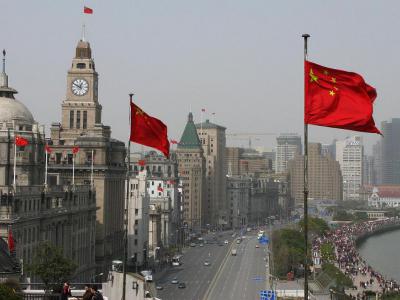
If you want to explore the history of Shanghai as the leading financial hub of modern China, The Bund is the ideal place to start. Initially serving as a path for towing rice-loaded barges, it eventually became the site of Shanghai's first foreign settlement, evolving into a bustling business district where major banks and trading companies established their presence to take advantage of the emerging trading opportunities.
In its heyday, The Bund also hosted the Russian and British consulates, as well as the English club and the Masonic lodge. Prior to the communist victory in the Chinese Civil War, the area featured numerous statues of notable colonial and European figures. These have since been replaced by a bronze statue of Chen Yi (Shanghai's first mayor after the communist takeover) and a Monument to the People’s Heroes at the northern end.
During the 1990s, The Bund underwent restoration, showcasing a waterfront adorned with a variety of buildings representing the architectural styles of nations that once sought to be involved in Shanghai's development.
The western section of The Bund boasts older colonial-style architecture, prominently featuring the neo-classical Hong-Kong and Shanghai Banking Corporation building and the Signal Tower, formerly maintained by the Jesuits to aid local shipping. For many locals, this area serves as a reminder of a century of foreign dominance. In the present golden age, however, it has transformed into a vibrant hub for top-notch dining, entertainment, and shopping.
Set against the backdrop of the now-famous Shanghai skyline, adorned with iconic skyscrapers of various shapes, heights, and colors, The Bund is particularly breathtaking after sunset when all the lights illuminate the area. Be sure to visit before 10pm, as some of the lights are turned off after that time.
Tip:
If you're out taking a stroll along The Bund, make way to the high-ground part beside the river for a better look at the two sides of the promenade. Otherwise, climb to the observation deck of one of the high towers to the east of the Huangpu River and see the whole stretch of the riverfront from up there. A sight not to be missed!
In its heyday, The Bund also hosted the Russian and British consulates, as well as the English club and the Masonic lodge. Prior to the communist victory in the Chinese Civil War, the area featured numerous statues of notable colonial and European figures. These have since been replaced by a bronze statue of Chen Yi (Shanghai's first mayor after the communist takeover) and a Monument to the People’s Heroes at the northern end.
During the 1990s, The Bund underwent restoration, showcasing a waterfront adorned with a variety of buildings representing the architectural styles of nations that once sought to be involved in Shanghai's development.
The western section of The Bund boasts older colonial-style architecture, prominently featuring the neo-classical Hong-Kong and Shanghai Banking Corporation building and the Signal Tower, formerly maintained by the Jesuits to aid local shipping. For many locals, this area serves as a reminder of a century of foreign dominance. In the present golden age, however, it has transformed into a vibrant hub for top-notch dining, entertainment, and shopping.
Set against the backdrop of the now-famous Shanghai skyline, adorned with iconic skyscrapers of various shapes, heights, and colors, The Bund is particularly breathtaking after sunset when all the lights illuminate the area. Be sure to visit before 10pm, as some of the lights are turned off after that time.
Tip:
If you're out taking a stroll along The Bund, make way to the high-ground part beside the river for a better look at the two sides of the promenade. Otherwise, climb to the observation deck of one of the high towers to the east of the Huangpu River and see the whole stretch of the riverfront from up there. A sight not to be missed!
2) Nanjing Lu (Nanjing Road) (must see)
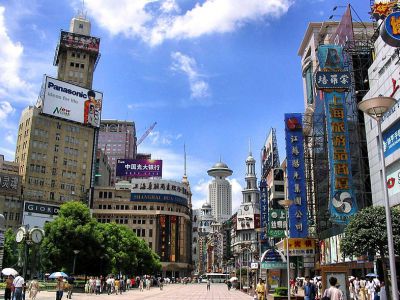
Nanjing Road in Shanghai has long been the city's top shopping destination, attracting more than a million visitors daily. This famous street is divided into two sections: Nanjing East Road and Nanjing West Road. In total, they stretch for nearly 10 kilometers (about 6 miles), making it the world's longest and busiest pedestrian thoroughfare.
Nanjing East Road has held the reputation of being a shopper's paradise since the 1950s or even earlier. Its main attraction is the Shanghai No. 1 Department Store, famous for its eye-catching window displays. Some say it's a great place to browse, but not necessarily the best for finding bargains.
Once the sun sets, Nanjing East Road becomes especially lively, with various malls competing for shoppers' attention through elaborate lighting and countless advertising screens. It seems like they spare no expense when it comes to electricity bills.
Many of the buildings along this road have been standing for over a century, showcasing a unique fusion of Eastern and Western architectural styles that first gained prominence in the 1930s, establishing Shanghai as a significant intermediary between the two civilizations. The newer malls cater to the modern tastes of China's millennials, who are keen on luxury brands.
Unlike other parts of Shanghai, you won't find street vendors or markets on Nanjing Road. Everything here is on a grand scale, including Starbucks. The Starbucks Reserve Roastery, which happens to be the world's largest outlet, spans three floors and serves up to 7,000 customers a day, with seating for up to 1,000 people at once.
Tip:
For ease of travel, mini-trains run up and down half the length of Nanjing Road during day hours – convenient for those wanting to see the area, especially if tired of walking or with kids in tow.
On a foodie note, try the food court in the New World City Plaza. Huge, pretty, and clean, with numerous stores, and good prices. And the LEGO shop on its ground floor is a haven for LEGO lovers.
Nanjing East Road has held the reputation of being a shopper's paradise since the 1950s or even earlier. Its main attraction is the Shanghai No. 1 Department Store, famous for its eye-catching window displays. Some say it's a great place to browse, but not necessarily the best for finding bargains.
Once the sun sets, Nanjing East Road becomes especially lively, with various malls competing for shoppers' attention through elaborate lighting and countless advertising screens. It seems like they spare no expense when it comes to electricity bills.
Many of the buildings along this road have been standing for over a century, showcasing a unique fusion of Eastern and Western architectural styles that first gained prominence in the 1930s, establishing Shanghai as a significant intermediary between the two civilizations. The newer malls cater to the modern tastes of China's millennials, who are keen on luxury brands.
Unlike other parts of Shanghai, you won't find street vendors or markets on Nanjing Road. Everything here is on a grand scale, including Starbucks. The Starbucks Reserve Roastery, which happens to be the world's largest outlet, spans three floors and serves up to 7,000 customers a day, with seating for up to 1,000 people at once.
Tip:
For ease of travel, mini-trains run up and down half the length of Nanjing Road during day hours – convenient for those wanting to see the area, especially if tired of walking or with kids in tow.
On a foodie note, try the food court in the New World City Plaza. Huge, pretty, and clean, with numerous stores, and good prices. And the LEGO shop on its ground floor is a haven for LEGO lovers.
3) People's Square and Park (must see)
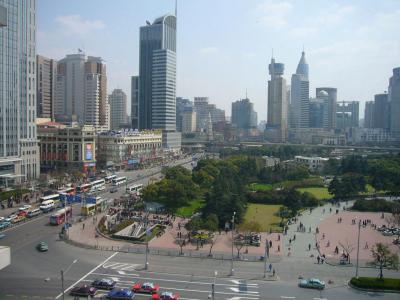
People's Square, situated at the very center of Shanghai, serves as a prominent location in the city. It features world-class museums, the Grand Theater, luxurious five-star hotels, a large water fountain, and the imposing Shanghai City Hall. These structures were constructed in the late 1990s and each of them serves as a significant architectural representation of Shanghai's economic and cultural advancement.
This area stands out in China due to its exceptional collection of remarkable attractions and stunning skyline, making it a highly popular meeting place and a venue for various celebrations. Today, there are few visual reminders of People's Square's history as Asia's finest racecourse, where wealthy individuals once watched horse races. During the wartime Japanese administration, the racetrack was utilized as a detention facility, and after World War II, the Chinese nationalist government transformed it into a sports arena.
By 1952, the new Communist regime had abolished horse racing and gambling, and a section of the racetrack was converted into a recreational space, now referred to as People's Park. Both the square and the park are meticulously maintained and offer numerous benches for relaxation. The park boasts pleasant landscaping, with tree-lined pathways and ponds that are beloved by locals who often visit for leisurely walks, exercise, kite flying, and where children can enjoy various activities at the playground.
Tip:
Underneath the park, there's a fantastic underground labyrinth of galleries with colorful stores, a subway station, and a food court. A definite must-visit!
This area stands out in China due to its exceptional collection of remarkable attractions and stunning skyline, making it a highly popular meeting place and a venue for various celebrations. Today, there are few visual reminders of People's Square's history as Asia's finest racecourse, where wealthy individuals once watched horse races. During the wartime Japanese administration, the racetrack was utilized as a detention facility, and after World War II, the Chinese nationalist government transformed it into a sports arena.
By 1952, the new Communist regime had abolished horse racing and gambling, and a section of the racetrack was converted into a recreational space, now referred to as People's Park. Both the square and the park are meticulously maintained and offer numerous benches for relaxation. The park boasts pleasant landscaping, with tree-lined pathways and ponds that are beloved by locals who often visit for leisurely walks, exercise, kite flying, and where children can enjoy various activities at the playground.
Tip:
Underneath the park, there's a fantastic underground labyrinth of galleries with colorful stores, a subway station, and a food court. A definite must-visit!
4) Shanghai Museum (must see)
To get a thorough look at some of the world's best-preserved and exquisite Chinese artifacts, you should visit the Shanghai Museum. It has been open since 1952 and boasts an impressive collection of ancient Chinese art, consisting of nearly one million exhibits spanning over 5,000 years, from China's Neolithic period to the Qing dynasty.
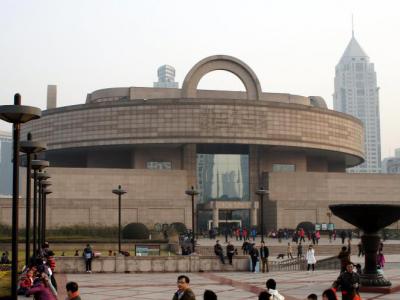
The museum's architecture resembles an ancient Chinese "ding" pot, and its layout draws inspiration from traditional Chinese cosmology, where a square base symbolizes earth and a rounded roof represents heaven. Inside, you'll find ten permanent exhibitions and three rotating international exhibitions. The items are well-displayed, allowing visitors to take photos without needing a flashlight.
After a roughly 15-minute wait for security clearance, you are free to explore the museum at your own pace, although your actual visit time might be limited due to a tight schedule. The museum offers guided tours and audio guides for those who prefer independent exploration.
According to the museum brochure, there are nearly 130,000 pieces of national treasures across 21 categories, including bronze, ceramics, calligraphy, paintings, jade and ivory works, bamboo and lacquer wares, oracle bones, seals, coins, and artifacts from various ethnic minorities.
One of the museum's highlights is the ground-floor bronze gallery, featuring artifacts dating back to 2200 BC. This early period of Chinese art may not be familiar to many visitors, making these exhibits seem less visually appealing. However, the diversity of shapes and craftsmanship demonstrates the advanced technology of ancient China.
On the first floor, the ceramics gallery proudly displays pieces from nearly every era of Chinese history, while the second-floor painting gallery showcases incredibly realistic depictions of animals, especially birds.
The top floor houses a colorful and striking gallery dedicated to various Chinese ethnic minorities, challenging the perception of China as a homogeneous culture. Next door on the same floor is an exhibition of Ming- and Qing-period furniture, which proves more interesting than one might expect.
Tip:
Clean bathrooms on each floor, a tea house on the 2nd floor, and before leaving the museum, don't forget to check out the on-site bookstore for a wide choice of beautiful books on China, in case you're interested in any!
The museum's architecture resembles an ancient Chinese "ding" pot, and its layout draws inspiration from traditional Chinese cosmology, where a square base symbolizes earth and a rounded roof represents heaven. Inside, you'll find ten permanent exhibitions and three rotating international exhibitions. The items are well-displayed, allowing visitors to take photos without needing a flashlight.
After a roughly 15-minute wait for security clearance, you are free to explore the museum at your own pace, although your actual visit time might be limited due to a tight schedule. The museum offers guided tours and audio guides for those who prefer independent exploration.
According to the museum brochure, there are nearly 130,000 pieces of national treasures across 21 categories, including bronze, ceramics, calligraphy, paintings, jade and ivory works, bamboo and lacquer wares, oracle bones, seals, coins, and artifacts from various ethnic minorities.
One of the museum's highlights is the ground-floor bronze gallery, featuring artifacts dating back to 2200 BC. This early period of Chinese art may not be familiar to many visitors, making these exhibits seem less visually appealing. However, the diversity of shapes and craftsmanship demonstrates the advanced technology of ancient China.
On the first floor, the ceramics gallery proudly displays pieces from nearly every era of Chinese history, while the second-floor painting gallery showcases incredibly realistic depictions of animals, especially birds.
The top floor houses a colorful and striking gallery dedicated to various Chinese ethnic minorities, challenging the perception of China as a homogeneous culture. Next door on the same floor is an exhibition of Ming- and Qing-period furniture, which proves more interesting than one might expect.
Tip:
Clean bathrooms on each floor, a tea house on the 2nd floor, and before leaving the museum, don't forget to check out the on-site bookstore for a wide choice of beautiful books on China, in case you're interested in any!
5) Shanghai Town God's Temple (must see)
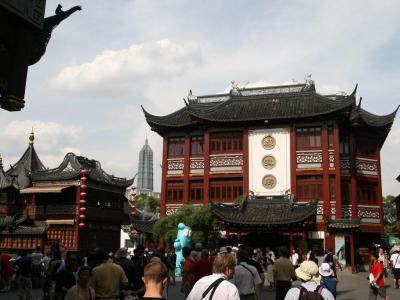
Traditionally, any notable city in China with a sense of history has a temple to its patron deity placed in the old quarter. The Ming-era Taoist temple in the Yuyuan Gardens serves this purpose for Shanghai and deserves a visit if you are in the vicinity, especially given the scarcity of old-style buildings in this part of the city.
Until 1950, this was the center of what is sometimes referred to as "popular Taoism", which is quite removed from the philosophical Taoism of the Tao Te Ching teaching by Lao Tzu. However, the new communist government was equally unsympathetic to any form of Taoism, and promptly removed from the temple all the statues allegedly supporting religious superstition.
Apparently, that reformation still wasn't enough and during the Cultural Revolution the temple was fully converted to a secular use with the main hall housing a jewelry shop for many years afterwards. The return of the traditional Chinese culture to political respectability saw the temple back in the hands of Taoist priests and reconsecrated in 2006.
Inside the temple, passing through its medium-size main courtyard, in front of the main gate, opens way to a number of halls, including the Huo Guang Hall, on the north side, with a large statue of Huo Guang, the prime of Shanghai's three City Gods. Going round the back of the hall one can see a short corridor leading to the hall of Qin Yu-Bo, Shanghai's second major deity. Around that are additional small halls featuring, among others, the Gods of Wealth, Literature, and Knowledge. Few more gods can be seen in the other halls around the main courtyard.
The area outside the temple is packed with souvenir shops selling everything, from postcards to key-chains to handicrafts to clothing, plus many other stores to choose from, mixed up with the beautiful modern but traditionally-styled buildings housing food courts and restaurants offering a wealth of regional cuisine.
At night, when they are lit up, or even during daytime, these old-style buildings are great for taking memorable photos contrasting the Bund's high-rises in the background.
Until 1950, this was the center of what is sometimes referred to as "popular Taoism", which is quite removed from the philosophical Taoism of the Tao Te Ching teaching by Lao Tzu. However, the new communist government was equally unsympathetic to any form of Taoism, and promptly removed from the temple all the statues allegedly supporting religious superstition.
Apparently, that reformation still wasn't enough and during the Cultural Revolution the temple was fully converted to a secular use with the main hall housing a jewelry shop for many years afterwards. The return of the traditional Chinese culture to political respectability saw the temple back in the hands of Taoist priests and reconsecrated in 2006.
Inside the temple, passing through its medium-size main courtyard, in front of the main gate, opens way to a number of halls, including the Huo Guang Hall, on the north side, with a large statue of Huo Guang, the prime of Shanghai's three City Gods. Going round the back of the hall one can see a short corridor leading to the hall of Qin Yu-Bo, Shanghai's second major deity. Around that are additional small halls featuring, among others, the Gods of Wealth, Literature, and Knowledge. Few more gods can be seen in the other halls around the main courtyard.
The area outside the temple is packed with souvenir shops selling everything, from postcards to key-chains to handicrafts to clothing, plus many other stores to choose from, mixed up with the beautiful modern but traditionally-styled buildings housing food courts and restaurants offering a wealth of regional cuisine.
At night, when they are lit up, or even during daytime, these old-style buildings are great for taking memorable photos contrasting the Bund's high-rises in the background.
6) Yuyuan Bazaar (must see)
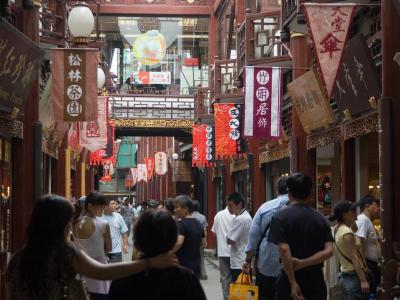
Regularly packed with locals and tourists, this busy shopping area – located just outside the famous Yuyuan Gardens – is a good chance to get a glimpse of Shanghai's everyday life. Amid the plethora of goods on sale – including fresh produce, second-hand stuff, antiques and handicrafts – the most intriguing, perhaps, are the countless food offerings whose vendors seemingly compete with each other. The vast majority of them specialize in dumplings of every imaginable filling; they even have dumplings filled with soup and served with a straw. The Nanxiang Shanghai steamed buns are pretty good on a chilly day either, and there's a long but well-organized queue for them in the central courtyard.
On the whole, this new-looking Ming-style bazaar is a cacophony of shops, street performers, sedan-chair rides and swarms of people everywhere. It covers an area of over 50 hectares and houses almost 3,000 shops and nearly 10,000 vendors. Among them are souvenir shops with tonnes of fine gift ideas, from painted snuff bottles and delightful Chinese kites to embroidered and clever palm-and-finger paintings.
As with any shopping in Asia, haggling skills are quite handy here, especially if you've done your homework on products and prices previously. Another good thing is to buy as the locals buy, particularly women, who certainly know where the best deals are.
Why You Should Visit:
No matter how commercialized, this is still a pretty sight to behold. Only in China!
Tip:
Other than the bazaar itself, there are a few spots just behind the Yuyan Gardens on Fuyou Street where you can find things at wholesale prices. In particular, if you're after household items, check out the Fuyou Street Merchandise Mart – similar to WalMart in the U.S., but in a fraction of the space it usually occupies there. Bargaining here is recommended, but the prices aren’t too high to begin with – just perfect for those on a budget.
On the whole, this new-looking Ming-style bazaar is a cacophony of shops, street performers, sedan-chair rides and swarms of people everywhere. It covers an area of over 50 hectares and houses almost 3,000 shops and nearly 10,000 vendors. Among them are souvenir shops with tonnes of fine gift ideas, from painted snuff bottles and delightful Chinese kites to embroidered and clever palm-and-finger paintings.
As with any shopping in Asia, haggling skills are quite handy here, especially if you've done your homework on products and prices previously. Another good thing is to buy as the locals buy, particularly women, who certainly know where the best deals are.
Why You Should Visit:
No matter how commercialized, this is still a pretty sight to behold. Only in China!
Tip:
Other than the bazaar itself, there are a few spots just behind the Yuyan Gardens on Fuyou Street where you can find things at wholesale prices. In particular, if you're after household items, check out the Fuyou Street Merchandise Mart – similar to WalMart in the U.S., but in a fraction of the space it usually occupies there. Bargaining here is recommended, but the prices aren’t too high to begin with – just perfect for those on a budget.
7) Yuyuan Garden (must see)
This lovely classical Chinese garden was built in 1577, under the Ming Dynasty, by a high-ranking imperial court official who dedicated it to his elderly father, and quite fittingly so, as ‘yu’ means peace and comfort in Chinese. Probably because of this name or good luck, despite changing fortunes, the garden had miraculously survived the passage of centuries and was reopened to the public in 1961.
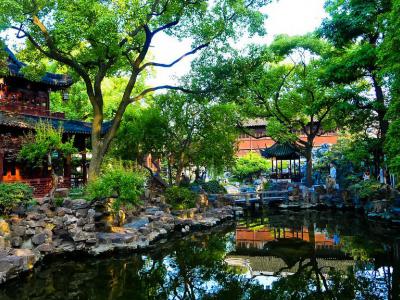
For those unfamiliar with Chinese gardening, this would be a great introduction to its elegance manifested, among other things, in the hidden bat and dragon features and, in this particular case, a huge authentic rockery dating back to the Ming period. Overall, the garden has less emphasis on flora and more on water and the harmonious position of elements.
It may well look small, but you will be amazed at how much actually fits in here. The corridors, archways and zigzag bridges all are carefully placed with a great deal of meaning. Of special interest is the Ming-style rosewood furniture in three halls within the garden, one of which is historically famous as the headquarters of the anti-imperialist “Little Sword” society during the Taiping uprising in the 1850s-60s. The roofs and tops of the walls here are decorated with incredible carvings of dragons, horses, and warriors.
Among other highlights is the famous Jade Rock, a 5-ton boulder said to have been one of the private collection items of the Song Dynasty Emperor Huizong. Interestingly enough, this rock's 72 holes are reportedly positioned so as to make the water or smoke sent into one of the holes, come out from all the other holes simultaneously. Sometimes, the guides show another trick with a coin dropped into a hole at the top and exiting from a certain hole down below (each time different) in accordance, they say, with the person's astrological sign.
Tip:
Depending on the time of your visit, the garden may be quite crowded – but that's China! Try coming early, as closer to the opening hours as possible; otherwise, later in the day, the queues are usually long! Don't forget a bottle of water or check out a two-storey teahouse on the island in the middle of the garden. The Queen of England herself once dropped in for a cup of tea there, so these days it’s a bit pricey, but you’re welcome to poke about anyway.
For those unfamiliar with Chinese gardening, this would be a great introduction to its elegance manifested, among other things, in the hidden bat and dragon features and, in this particular case, a huge authentic rockery dating back to the Ming period. Overall, the garden has less emphasis on flora and more on water and the harmonious position of elements.
It may well look small, but you will be amazed at how much actually fits in here. The corridors, archways and zigzag bridges all are carefully placed with a great deal of meaning. Of special interest is the Ming-style rosewood furniture in three halls within the garden, one of which is historically famous as the headquarters of the anti-imperialist “Little Sword” society during the Taiping uprising in the 1850s-60s. The roofs and tops of the walls here are decorated with incredible carvings of dragons, horses, and warriors.
Among other highlights is the famous Jade Rock, a 5-ton boulder said to have been one of the private collection items of the Song Dynasty Emperor Huizong. Interestingly enough, this rock's 72 holes are reportedly positioned so as to make the water or smoke sent into one of the holes, come out from all the other holes simultaneously. Sometimes, the guides show another trick with a coin dropped into a hole at the top and exiting from a certain hole down below (each time different) in accordance, they say, with the person's astrological sign.
Tip:
Depending on the time of your visit, the garden may be quite crowded – but that's China! Try coming early, as closer to the opening hours as possible; otherwise, later in the day, the queues are usually long! Don't forget a bottle of water or check out a two-storey teahouse on the island in the middle of the garden. The Queen of England herself once dropped in for a cup of tea there, so these days it’s a bit pricey, but you’re welcome to poke about anyway.
