Custom Walk in Lucerne, Switzerland by ohyani96_55b58 created on 2025-06-12
Guide Location: Switzerland » Lucerne
Guide Type: Custom Walk
# of Sights: 6
Tour Duration: 2 Hour(s)
Travel Distance: 3.2 Km or 2 Miles
Share Key: ZZQEL
Guide Type: Custom Walk
# of Sights: 6
Tour Duration: 2 Hour(s)
Travel Distance: 3.2 Km or 2 Miles
Share Key: ZZQEL
How It Works
Please retrieve this walk in the GPSmyCity app. Once done, the app will guide you from one tour stop to the next as if you had a personal tour guide. If you created the walk on this website or come to the page via a link, please follow the instructions below to retrieve the walk in the app.
Retrieve This Walk in App
Step 1. Download the app "GPSmyCity: Walks in 1K+ Cities" on Apple App Store or Google Play Store.



Step 2. In the GPSmyCity app, download(or launch) the guide "Lucerne Map and Walking Tours".
Step 3. Tap the menu button located at upper right corner of the "Walks" screen and select "Retrieve custom walk". Enter the share key: ZZQEL
1) Lake Lucerne Promenade
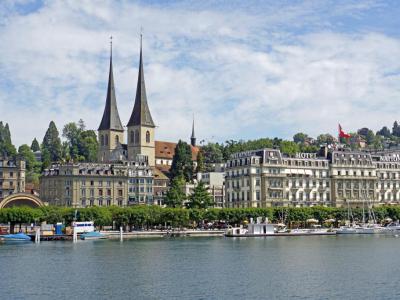
The Lake Lucerne Promenade is arguably the best place in the city to take an easy walk. Visitors can join the locals as they stroll along the shore of Lake Lucerne. They can stop to watch the boats, gaze at the Alps, play games or sample one of the local restaurants. Many tourists simply enjoy having a place to sit and relax.
Some of the most popular draws of the Lake Lucerne Promenade are the summer concerts. Free, public concerts are available in the pavilion to anyone who wishes to enjoy listening to music in the open air. This tradition has been going strong since 1908. The evening concerts take place from May to September on Tuesdays and Fridays at 8:15 PM. Morning concerts are available at 10:15 AM.
The promenade is in a central location that has easy to access to other tourist sites. Visitors to Lucerne can easily add a side trip to the promenade as they explore the Church of Saint Leodegar, which is only a three minute walk. Just a bit further is the Bourbaki Panorama. Neither should be missed on a trip to Lucerne.
Some of the most popular draws of the Lake Lucerne Promenade are the summer concerts. Free, public concerts are available in the pavilion to anyone who wishes to enjoy listening to music in the open air. This tradition has been going strong since 1908. The evening concerts take place from May to September on Tuesdays and Fridays at 8:15 PM. Morning concerts are available at 10:15 AM.
The promenade is in a central location that has easy to access to other tourist sites. Visitors to Lucerne can easily add a side trip to the promenade as they explore the Church of Saint Leodegar, which is only a three minute walk. Just a bit further is the Bourbaki Panorama. Neither should be missed on a trip to Lucerne.
2) Lion Monument (must see)
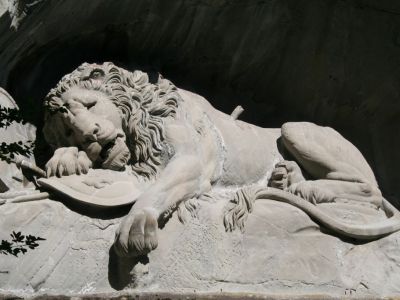
The Lion Monument, also known as the Lion of Lucerne, is a carved rock sculpture located in Lucerne, Switzerland. It was crafted in 1820 to honor the memory of the Swiss Guards who tragically lost their lives in 1792 during the French Revolution. This somber event occurred when revolutionaries attacked the Tuileries Palace in Paris. The Lion Monument stands as one of Switzerland's most renowned landmarks and draws approximately 1.4 million tourists annually.
Starting in the early 17th century, a Swiss Guards regiment had been a part of the Royal Army of France. On August 10th, 1792, as revolutionaries overran the palace, conflict erupted spontaneously after the royal family had been evacuated from the Tuileries to seek shelter with the Legislative Assembly. The Swiss Guards found themselves running out of ammunition and were ultimately overwhelmed by the numerically superior revolutionary forces.
In the course of the fighting or in the aftermath of their surrender, approximately 760 Swiss Guards who had defended the Tuileries lost their lives. An additional two hundred succumbed to their injuries while in prison or fell victim to the September Massacres that ensued.
The Lion Monument, an impressive piece of rock art carved into a cliff face, measures an imposing ten meters in length and six meters in height. It is dedicated to honoring the loyalty and courage of the Swiss. The sculpture depicts a dying lion impaled by a spear, with a shield bearing the emblem of the French monarchy covering its body. Adjacent to the lion, there is another shield bearing the coat of arms of Switzerland.
Mark Twain famously referred to this sculpture of a mortally wounded lion as "the most mournful and moving piece of stone in the world."
Starting in the early 17th century, a Swiss Guards regiment had been a part of the Royal Army of France. On August 10th, 1792, as revolutionaries overran the palace, conflict erupted spontaneously after the royal family had been evacuated from the Tuileries to seek shelter with the Legislative Assembly. The Swiss Guards found themselves running out of ammunition and were ultimately overwhelmed by the numerically superior revolutionary forces.
In the course of the fighting or in the aftermath of their surrender, approximately 760 Swiss Guards who had defended the Tuileries lost their lives. An additional two hundred succumbed to their injuries while in prison or fell victim to the September Massacres that ensued.
The Lion Monument, an impressive piece of rock art carved into a cliff face, measures an imposing ten meters in length and six meters in height. It is dedicated to honoring the loyalty and courage of the Swiss. The sculpture depicts a dying lion impaled by a spear, with a shield bearing the emblem of the French monarchy covering its body. Adjacent to the lion, there is another shield bearing the coat of arms of Switzerland.
Mark Twain famously referred to this sculpture of a mortally wounded lion as "the most mournful and moving piece of stone in the world."
3) Spreuer Bridge (must see)
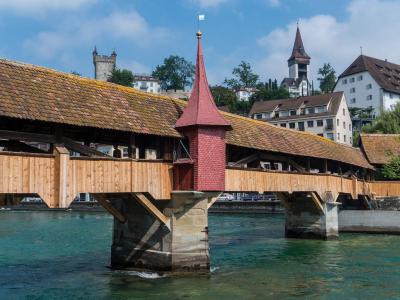
Spreuer Bridge is a covered, wooden footbridge that begins in the Mills Square in old town and ends in Pfister Alley. Also called the Mills Bridge, it is a popular spot for tourists who wish to see both the stunning architecture and the interior paintings.
The original bridge was constructed in the 13th century but was destroyed by a flood in 1566. It was rebuilt shortly thereafter, which was when the paintings were added. The paintings are the largest known paintings of the Dance of Death during the late Middle Ages.
Kaspar Meglinger directed the 67 paintings from 1616 to 1637. Most paintings contain information about the donors, including their names and family coat-of-arms. Some also have portraits of the donors. Forty-five of those paintings have survived. The paintings at Spreuer Bridge have also created the nickname "The Dance of Death Bridge."
Visitors are welcome to walk across the pedestrian bridge at any time, though the paintings are best viewed with natural daylight.
The original bridge was constructed in the 13th century but was destroyed by a flood in 1566. It was rebuilt shortly thereafter, which was when the paintings were added. The paintings are the largest known paintings of the Dance of Death during the late Middle Ages.
Kaspar Meglinger directed the 67 paintings from 1616 to 1637. Most paintings contain information about the donors, including their names and family coat-of-arms. Some also have portraits of the donors. Forty-five of those paintings have survived. The paintings at Spreuer Bridge have also created the nickname "The Dance of Death Bridge."
Visitors are welcome to walk across the pedestrian bridge at any time, though the paintings are best viewed with natural daylight.
4) Jesuit Church (Jesuitenkirche) (must see)
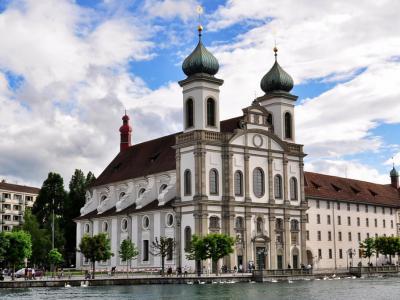
The Lucerne Jesuit Church, located in Lucerne, is a prominent Catholic place of worship. It holds the distinction of being the first grand Baroque-style church constructed in northern Switzerland, situated above the Alps.
The Jesuit order, initiated by Ignatius of Loyola in 1534, played an active role in the Counter-Reformation, which was the Catholic response to the emergence of Protestantism. Protestant reformers like Zwingli in Zurich and Calvin in Geneva had caused a religious divide in predominantly Catholic Switzerland. In response to this situation, the Lucerne city council invited the Jesuits to establish a college in the year 1573.
Ludwig Pfyffer, who held the position of mayor in Lucerne, provided annual financial support to the Jesuits from his personal resources. The Jesuit College of Lucerne was officially founded in 1577, and it was housed in the Ritter Palace, a building originally constructed in 1557 to serve as the residence of Mayor Lux Ritter.
The construction of the associated church commenced in 1667, and by 1673, the basic structure of the church, including its main façade, had been completed. The church was consecrated in 1677, although the interior was not fully finished at that time. Numerous side altars were still missing, and even the high altar wasn't erected until four years later due to financial difficulties. The iconic onion-domed towers were not finished until 1893. In the mid-18th century, the vault underwent a redecoration. The original vestments of Brother Klaus, a renowned Swiss patron, are housed in the inner chapel.
Today, while the church presents an aesthetically pleasing exterior along the river promenade, its remarkable and unaltered pink and white interior truly captivates visitors. Entry to the church is free, and upon stepping inside, you will encounter one of the most magnificent churches in all of Switzerland.
The Jesuit order, initiated by Ignatius of Loyola in 1534, played an active role in the Counter-Reformation, which was the Catholic response to the emergence of Protestantism. Protestant reformers like Zwingli in Zurich and Calvin in Geneva had caused a religious divide in predominantly Catholic Switzerland. In response to this situation, the Lucerne city council invited the Jesuits to establish a college in the year 1573.
Ludwig Pfyffer, who held the position of mayor in Lucerne, provided annual financial support to the Jesuits from his personal resources. The Jesuit College of Lucerne was officially founded in 1577, and it was housed in the Ritter Palace, a building originally constructed in 1557 to serve as the residence of Mayor Lux Ritter.
The construction of the associated church commenced in 1667, and by 1673, the basic structure of the church, including its main façade, had been completed. The church was consecrated in 1677, although the interior was not fully finished at that time. Numerous side altars were still missing, and even the high altar wasn't erected until four years later due to financial difficulties. The iconic onion-domed towers were not finished until 1893. In the mid-18th century, the vault underwent a redecoration. The original vestments of Brother Klaus, a renowned Swiss patron, are housed in the inner chapel.
Today, while the church presents an aesthetically pleasing exterior along the river promenade, its remarkable and unaltered pink and white interior truly captivates visitors. Entry to the church is free, and upon stepping inside, you will encounter one of the most magnificent churches in all of Switzerland.
5) Chapel Bridge (must see)
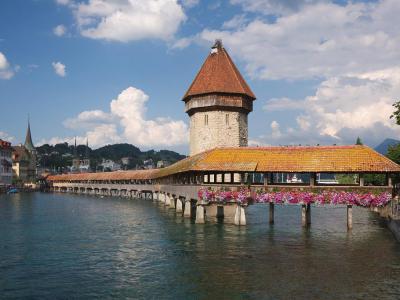
The Chapel Bridge is a wooden foot bridge that stretches diagonally across the Reuss River in Lucerne. It got its name from Saint Peter's Chapel nearby. What makes this bridge special is that it has some old paintings inside from the 17th century. Unfortunately, many of these paintings were destroyed in a fire that happened in 1993, which also damaged most of the bridge. Thankfully, they fixed it up afterward. This bridge is not just any bridge; it's actually the oldest covered wooden bridge in Europe and the world's oldest surviving truss bridge. People in Lucerne really like it, and it's a famous tourist spot in Switzerland.
Originally, they built this bridge in 1333 as part of Lucerne's defenses. It connected the old town on one side of the river to the new town on the other side, which helped protect the city from attacks coming from the south of Lake Lucerne. At first, it was more than 200 meters long, but over time, they made it shorter and did some work on the riverbanks, so now it's 170 meters long.
Lucerne is special because it has three wooden pedestrian bridges: the Hof Bridge from the 14th century (but that one's gone now), the Chapel Bridge, and the Spreuer Bridge from the 16th century. All of them have paintings on the inside in triangle-shaped frames. No other wooden footbridges in Europe have this. The paintings on the Chapel Bridge were made in the 17th century by a local Catholic painter named Hans Heinrich Wagmann. They show things from Lucerne's history. There used to be 147 paintings on the bridge before the fire in 1993, but they could only fully restore 30 of them.
Tip:
Experience it at night with the city lights, swans, flowers and romantic atmosphere. Both banks are full of great shopping and fantastic restaurants.
Originally, they built this bridge in 1333 as part of Lucerne's defenses. It connected the old town on one side of the river to the new town on the other side, which helped protect the city from attacks coming from the south of Lake Lucerne. At first, it was more than 200 meters long, but over time, they made it shorter and did some work on the riverbanks, so now it's 170 meters long.
Lucerne is special because it has three wooden pedestrian bridges: the Hof Bridge from the 14th century (but that one's gone now), the Chapel Bridge, and the Spreuer Bridge from the 16th century. All of them have paintings on the inside in triangle-shaped frames. No other wooden footbridges in Europe have this. The paintings on the Chapel Bridge were made in the 17th century by a local Catholic painter named Hans Heinrich Wagmann. They show things from Lucerne's history. There used to be 147 paintings on the bridge before the fire in 1993, but they could only fully restore 30 of them.
Tip:
Experience it at night with the city lights, swans, flowers and romantic atmosphere. Both banks are full of great shopping and fantastic restaurants.
6) Lucerne Railway Station (must see)
The Lucerne Railway Station is the main hub of Switzerland's rail network. It serves domestic and international traffic on several rail lines. The station is located in a waterfront location on the south side of Lake Lucerne just above the outflow of the Reuss river. A square occupies the area between the front of the station and the lakefront, and is heavily used by the local buses. The landing stages used by the passenger ships are located at the lakeside of the square, providing interchange between rail and water transport. An underground shopping mall lies below both the concourse of the railway station and the square.
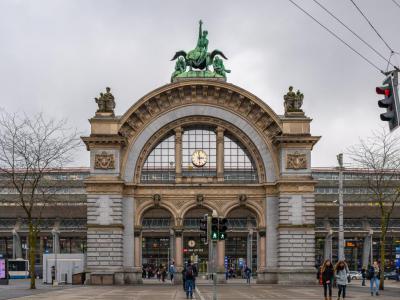
The station building was built in 1896. It featured an amazing entrance hall with a distinctive cupola and an elegant curved roof. A fire broke out in 1971 and destroyed much of the building including the cupola, the station frontage and concourse.
A new station was eventually built, and opened on 5 February 1991, exactly 20 years after its predecessor was destroyed. The historic entrance portal facing the lake was re-erected to honor the legacy 1896 building. The portal is crowned by a sculpture named "Zeitgeist" by the well known Swiss sculptor, Richard Kissling.
The station building was built in 1896. It featured an amazing entrance hall with a distinctive cupola and an elegant curved roof. A fire broke out in 1971 and destroyed much of the building including the cupola, the station frontage and concourse.
A new station was eventually built, and opened on 5 February 1991, exactly 20 years after its predecessor was destroyed. The historic entrance portal facing the lake was re-erected to honor the legacy 1896 building. The portal is crowned by a sculpture named "Zeitgeist" by the well known Swiss sculptor, Richard Kissling.
