Custom Walk in Dresden, Germany by secant055_cbcd5 created on 2025-06-15
Guide Location: Germany » Dresden
Guide Type: Custom Walk
# of Sights: 5
Tour Duration: 1 Hour(s)
Travel Distance: 1.3 Km or 0.8 Miles
Share Key: UCTUF
Guide Type: Custom Walk
# of Sights: 5
Tour Duration: 1 Hour(s)
Travel Distance: 1.3 Km or 0.8 Miles
Share Key: UCTUF
How It Works
Please retrieve this walk in the GPSmyCity app. Once done, the app will guide you from one tour stop to the next as if you had a personal tour guide. If you created the walk on this website or come to the page via a link, please follow the instructions below to retrieve the walk in the app.
Retrieve This Walk in App
Step 1. Download the app "GPSmyCity: Walks in 1K+ Cities" on Apple App Store or Google Play Store.



Step 2. In the GPSmyCity app, download(or launch) the guide "Dresden Map and Walking Tours".
Step 3. Tap the menu button located at upper right corner of the "Walks" screen and select "Retrieve custom walk". Enter the share key: UCTUF
1) Dresden Castle (must see)
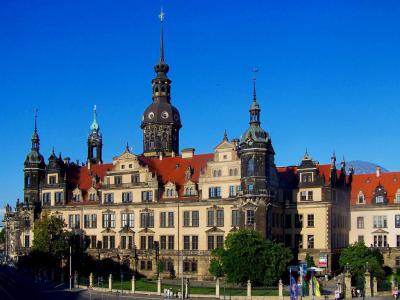
Dresden Castle is one of Dresden's oldest buildings. It served as a royal residence for almost 400 years and housed Saxony electors and Saxony and Polish kings. The castle features different architectural styles, such as Baroque and Neo-renaissance.
The castle was originally built in the 13th century as a Romanesque keep. The keep was extended in the 15th century and again in the 16th century. A fire damaged the castle in 1701, and Augustus the Strong rebuilt the castle and added the western wing collection rooms. The castle was rebuilt in the ornate Baroque style.
The House of Wettin celebrated its 800th anniversary with further renovations and additions between 1889 and 1901. The Stall Courtyard was painted with the famous "Procession of Princes ." In 1914, additional renovations modernized the castle with heating and electric lights.
World War II bombs heavily damaged Dresden Castle. Restoration work started in the 1960s and continues today.
The castle is now home to a collection of museums that are housed in Augustus the Strong's collection rooms. The museums include the Historic Green Vault, the New Green Vault, the Numismatic Cabinet, the Collection of Prints, Drawings, and Photographs, and the Dresden Armory. Guests can also visit an art library with 260,000 titles related to art history.
The Hausmann Tower offers a beautiful view of Dresden's Old Town. In addition, the English Stairway was reconstructed using the original Baroque design.
The castle was originally built in the 13th century as a Romanesque keep. The keep was extended in the 15th century and again in the 16th century. A fire damaged the castle in 1701, and Augustus the Strong rebuilt the castle and added the western wing collection rooms. The castle was rebuilt in the ornate Baroque style.
The House of Wettin celebrated its 800th anniversary with further renovations and additions between 1889 and 1901. The Stall Courtyard was painted with the famous "Procession of Princes ." In 1914, additional renovations modernized the castle with heating and electric lights.
World War II bombs heavily damaged Dresden Castle. Restoration work started in the 1960s and continues today.
The castle is now home to a collection of museums that are housed in Augustus the Strong's collection rooms. The museums include the Historic Green Vault, the New Green Vault, the Numismatic Cabinet, the Collection of Prints, Drawings, and Photographs, and the Dresden Armory. Guests can also visit an art library with 260,000 titles related to art history.
The Hausmann Tower offers a beautiful view of Dresden's Old Town. In addition, the English Stairway was reconstructed using the original Baroque design.
2) Old Masters Picture Gallery (must see)
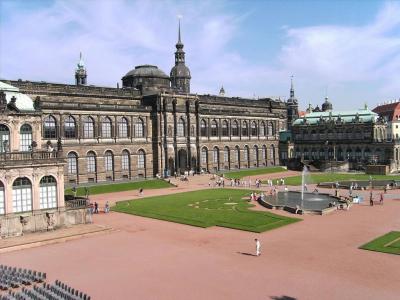
Augustus, Elector of Saxony, first founded an Art Chamber in 1560. During the 18th century, Augustus the Strong and his heir Frederick Augustus II made significant additions. In 1754, Electors added Raphael’s Sistine Madonna to the collection. The growing collection moved to the Semper Gallery in 1855.
The paintings were stored during World War II and then confiscated by the Red Army. The surviving paintings were returned to Dresden in 1955, and the Old Masters Gallery re-opened in 1960.
The Old Masters Picture Gallery underwent a 50 million dollar renovation completed in 2020. Classic paintings are now displayed amongst the museum's impressive sculpture collection.
Seven hundred paintings were rehung among 420 sculptures. Visitors can see priceless paintings by Rembrandt, Titian, and Raphael. Popular artworks include Vermeer’s Girl Reading a Letter at an Open Window, Rembrandt’s Ganymede, and Titian’s Zinsgroschen.
Artworks are now hung on vibrant walls and grouped by region and time period. For example, Italian works are hung on crimson walls, while French and Spanish works are featured on blue walls.
The paintings were stored during World War II and then confiscated by the Red Army. The surviving paintings were returned to Dresden in 1955, and the Old Masters Gallery re-opened in 1960.
The Old Masters Picture Gallery underwent a 50 million dollar renovation completed in 2020. Classic paintings are now displayed amongst the museum's impressive sculpture collection.
Seven hundred paintings were rehung among 420 sculptures. Visitors can see priceless paintings by Rembrandt, Titian, and Raphael. Popular artworks include Vermeer’s Girl Reading a Letter at an Open Window, Rembrandt’s Ganymede, and Titian’s Zinsgroschen.
Artworks are now hung on vibrant walls and grouped by region and time period. For example, Italian works are hung on crimson walls, while French and Spanish works are featured on blue walls.
3) Zwinger (Palatial Complex) (must see)
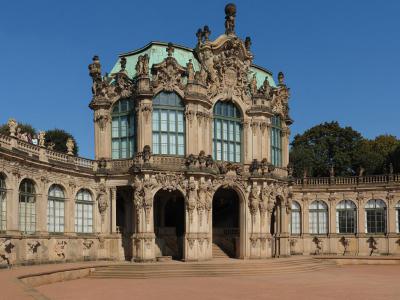
The Zwinger is one of Germany's most impressive Baroque buildings. August the Strong commissioned the complex after visiting Louis XIV's Versailles Palace. The palace was designed as an orangery, garden, and festival area. Architect Matthäus Daniel Pöppelmann designed the palace, which was built between 1710 and 1728.
The Zwinger name refers to an area between defensive walls. In the 15th century, Dresden had a Zwinger garden in between the city walls that supplied the royal court with fresh produce. The present-day Zwinger is in a different location, but the new palace kept the old garden's name.
The Zwinger was primarily a royal entertainment venue and features ornate portals and extravagant fountains. Sculptor Balthasar Permoser’s Nymph's Bath is one fine example of the Zwinger's fabulous Baroque fountains.
Other attractions include an Atlas sculpture on top of the western pavilion. In addition, a carillon with 40 porcelain bells plays every 15 minutes. The chimes change every season and feature melodies by Vivaldi, Mozart, Bach, Wagner, and Weber.
The Zwinger hosted a royal wedding in 1719 when Augustus the Strong’s son Frederick August married Maria Josepha, the daughter of Habsburg emperor Joseph I.
The courtyard garden and pond were added in the 1820s. The gallery wing that now houses the Old Masters Gallery was built in 1855.
The Zwinger was heavily damaged during World War II bombs. It was reconstructed during the 1950s. The Zwinger houses three museums, including the Old Masters Gallery, the Porcelain Collection, and the Mathematical and Physical Instruments collection. The Zwinger and its gardens are open to the public.
The Zwinger name refers to an area between defensive walls. In the 15th century, Dresden had a Zwinger garden in between the city walls that supplied the royal court with fresh produce. The present-day Zwinger is in a different location, but the new palace kept the old garden's name.
The Zwinger was primarily a royal entertainment venue and features ornate portals and extravagant fountains. Sculptor Balthasar Permoser’s Nymph's Bath is one fine example of the Zwinger's fabulous Baroque fountains.
Other attractions include an Atlas sculpture on top of the western pavilion. In addition, a carillon with 40 porcelain bells plays every 15 minutes. The chimes change every season and feature melodies by Vivaldi, Mozart, Bach, Wagner, and Weber.
The Zwinger hosted a royal wedding in 1719 when Augustus the Strong’s son Frederick August married Maria Josepha, the daughter of Habsburg emperor Joseph I.
The courtyard garden and pond were added in the 1820s. The gallery wing that now houses the Old Masters Gallery was built in 1855.
The Zwinger was heavily damaged during World War II bombs. It was reconstructed during the 1950s. The Zwinger houses three museums, including the Old Masters Gallery, the Porcelain Collection, and the Mathematical and Physical Instruments collection. The Zwinger and its gardens are open to the public.
4) Fürstenzug (Procession of Princes) (must see)
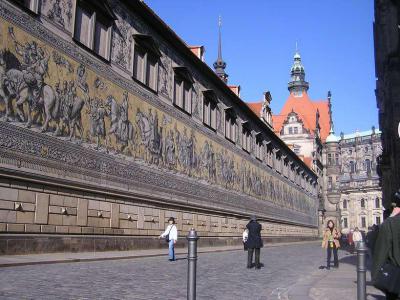
The Procession of Princes is an impressive mural that shows Saxony's rulers. The painting was commissioned to celebrate the Wettin Dynasty's 800th anniversary in 1889.
Wilhelm Walther painted the original painting. It took Walther five years to complete the painting, which was finished in 1876. When the artwork began to fade, a preservation plan was implemented. Between 1904 and 1907, the painting was replaced by 23,000 porcelain tiles to make the artwork weatherproof.
The artwork is 102 meters (335 feet) long and is the world's largest porcelain artwork. The mural shows the portraits of the House of Wettin's 35 margraves, electors, dukes, and kings from 1127 to 1904. The rulers are shown on horses with their names written underneath them.
The first ruler in the procession mural is 12th-century ruler Conrad, Margrave of Meissen. The last king of Saxony, Frederick Augustus III, who ruled from 1904 to 1918, is not shown.
The mural also shows 59 farmers, craftsmen, scientists, artists, and children. A girl in the children's group is the only female shown in the procession. The last person shown in the procession is the mural's original creator, Wilhelm Walther.
The Procession of Princes was designed to look like a giant tapestry. The top edge features depictions of 38 individual hanging knobs to make the mural look like a tapestry hung on a wall. The mural also features ornamental frames with plants, butterflies, and birds.
Wilhelm Walther painted the original painting. It took Walther five years to complete the painting, which was finished in 1876. When the artwork began to fade, a preservation plan was implemented. Between 1904 and 1907, the painting was replaced by 23,000 porcelain tiles to make the artwork weatherproof.
The artwork is 102 meters (335 feet) long and is the world's largest porcelain artwork. The mural shows the portraits of the House of Wettin's 35 margraves, electors, dukes, and kings from 1127 to 1904. The rulers are shown on horses with their names written underneath them.
The first ruler in the procession mural is 12th-century ruler Conrad, Margrave of Meissen. The last king of Saxony, Frederick Augustus III, who ruled from 1904 to 1918, is not shown.
The mural also shows 59 farmers, craftsmen, scientists, artists, and children. A girl in the children's group is the only female shown in the procession. The last person shown in the procession is the mural's original creator, Wilhelm Walther.
The Procession of Princes was designed to look like a giant tapestry. The top edge features depictions of 38 individual hanging knobs to make the mural look like a tapestry hung on a wall. The mural also features ornamental frames with plants, butterflies, and birds.
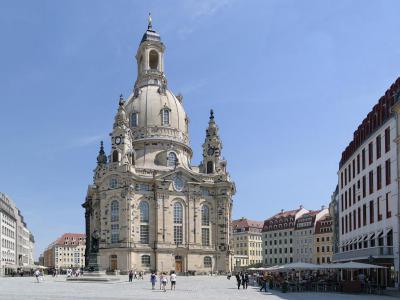
5) Frauenkirche (Church of Our Lady) (must see)
The current Church of Our Lady is a Lutheran church built between 1726 and 1743. It features Baroque architecture and has one of Europe's largest domes.
The first Church of Our Lady was a Catholic church built in the 11th century. It became a Protestant church during the Reformation. The original church was torn down and replaced by the new Luthern church.
In 1736, Gottfried Silbermann built an exceptional 43-stop organ for the church. Johann Sebastian Bach played a recital on the organ on December 1, 1736.
The church's iconic dome is 96 meters (315 feet) tall. The dome is known as Stone Bell ("die Steinerne Glocke" in German). The dome is often compared to Michelangelo's Saint Peter's Basilica dome. Stone Bell weighed 12,000 tons and was originally held up by eight supports.
In 1945, Allied forces bombed Dresden. The church survived two days of attacks before collapsing. While most of the church was destroyed, the original altar and chancel were salvaged.
Residents salvaged and numbered stone fragments, hoping to use them in a future reconstruction. In 1994, Gunter Blobel won the Nobel Prize for medicine and donated his prize money to restore the Church of Our Lady. In addition, England's Prince Edward supported the Dresden Trust which contributed funds for the reconstruction project.
Rebuilding the Church of Our Lady cost 180 million Euros. The rebuilding effort began in 1992 and was completed in 2005. The church was rebuilt using the original plans from the 1720s and salvaged materials. About 3,800 original stones were used in the reconstruction. One can see the original stones in the building as they appear darker due to age and fire damage.
Rebuilding the church was a community-wide effort. Builders relied on photographs and memories to reconstruct the details. For example, old wedding albums helped builders reconstruct the church's carved oak doors.
A new orb and cross were forged and placed on top of the dome. The original damaged cross stands inside by the church's altar. The original organ was replaced with a 68-stop organ.
The rebuilt Church of Our Lady is a popular attraction. US President Barack Obama visited the church in 2009.
The first Church of Our Lady was a Catholic church built in the 11th century. It became a Protestant church during the Reformation. The original church was torn down and replaced by the new Luthern church.
In 1736, Gottfried Silbermann built an exceptional 43-stop organ for the church. Johann Sebastian Bach played a recital on the organ on December 1, 1736.
The church's iconic dome is 96 meters (315 feet) tall. The dome is known as Stone Bell ("die Steinerne Glocke" in German). The dome is often compared to Michelangelo's Saint Peter's Basilica dome. Stone Bell weighed 12,000 tons and was originally held up by eight supports.
In 1945, Allied forces bombed Dresden. The church survived two days of attacks before collapsing. While most of the church was destroyed, the original altar and chancel were salvaged.
Residents salvaged and numbered stone fragments, hoping to use them in a future reconstruction. In 1994, Gunter Blobel won the Nobel Prize for medicine and donated his prize money to restore the Church of Our Lady. In addition, England's Prince Edward supported the Dresden Trust which contributed funds for the reconstruction project.
Rebuilding the Church of Our Lady cost 180 million Euros. The rebuilding effort began in 1992 and was completed in 2005. The church was rebuilt using the original plans from the 1720s and salvaged materials. About 3,800 original stones were used in the reconstruction. One can see the original stones in the building as they appear darker due to age and fire damage.
Rebuilding the church was a community-wide effort. Builders relied on photographs and memories to reconstruct the details. For example, old wedding albums helped builders reconstruct the church's carved oak doors.
A new orb and cross were forged and placed on top of the dome. The original damaged cross stands inside by the church's altar. The original organ was replaced with a 68-stop organ.
The rebuilt Church of Our Lady is a popular attraction. US President Barack Obama visited the church in 2009.
