Custom Walk in Santorini, Greece by leon_orlowsky2697 created on 2025-06-15
Guide Location: Greece » Santorini
Guide Type: Custom Walk
# of Sights: 13
Tour Duration: 23 Hour(s)
Travel Distance: 65 Km or 40.4 Miles
Share Key: J7AHD
Guide Type: Custom Walk
# of Sights: 13
Tour Duration: 23 Hour(s)
Travel Distance: 65 Km or 40.4 Miles
Share Key: J7AHD
How It Works
Please retrieve this walk in the GPSmyCity app. Once done, the app will guide you from one tour stop to the next as if you had a personal tour guide. If you created the walk on this website or come to the page via a link, please follow the instructions below to retrieve the walk in the app.
Retrieve This Walk in App
Step 1. Download the app "GPSmyCity: Walks in 1K+ Cities" on Apple App Store or Google Play Store.



Step 2. In the GPSmyCity app, download(or launch) the guide "Santorini Map and Walking Tours".
Step 3. Tap the menu button located at upper right corner of the "Walks" screen and select "Retrieve custom walk". Enter the share key: J7AHD
1) 25 Martiou Street
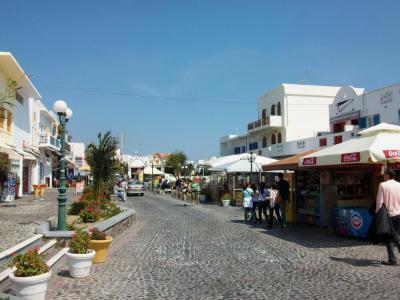
25 Martiou Street, in Santorini, is a picturesque destination that embodies the distinctive charm of this renowned island. Situated in the bustling neighborhood of Thira, the street is acclaimed for its vibrant shopping scene that ranges from quaint boutiques and artisan workshops to a plethora of souvenir shops offering everything from unique handcrafted items to budget-friendly mementos.
As the main shopping hub of Santorini, 25 Martiou Street is framed by the island's iconic architecture - white-washed buildings with blue-domed roofs that reflect the classic Cycladic style. This aesthetic is complemented by vivid splashes of color from blooming bougainvillea vines, enhancing the street’s visual appeal. The cobblestone pathways invite visitors to leisurely explore the area, which offers not only retail therapy but also a taste of local life through its cozy cafes and traditional Greek tavernas.
The street’s proximity to stunning views of the Aegean Sea and the famous Santorini sunsets add to its allure, making it a perfect backdrop for both relaxation and exploration. Whether you're interested in shopping for unique souvenirs, enjoying the local cuisine, or simply taking in the scenic vistas, 25 Martiou Street provides a captivating experience that highlights the beauty and cultural richness of Santorini.
As the main shopping hub of Santorini, 25 Martiou Street is framed by the island's iconic architecture - white-washed buildings with blue-domed roofs that reflect the classic Cycladic style. This aesthetic is complemented by vivid splashes of color from blooming bougainvillea vines, enhancing the street’s visual appeal. The cobblestone pathways invite visitors to leisurely explore the area, which offers not only retail therapy but also a taste of local life through its cozy cafes and traditional Greek tavernas.
The street’s proximity to stunning views of the Aegean Sea and the famous Santorini sunsets add to its allure, making it a perfect backdrop for both relaxation and exploration. Whether you're interested in shopping for unique souvenirs, enjoying the local cuisine, or simply taking in the scenic vistas, 25 Martiou Street provides a captivating experience that highlights the beauty and cultural richness of Santorini.
2) Agios Nikolaos Monastery
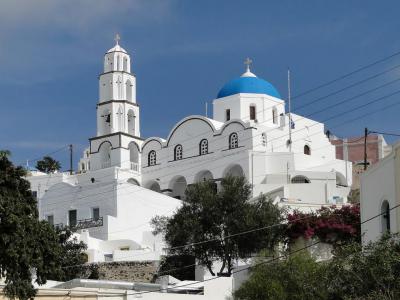
Located in the stunning and blue waters of the Aegean Sea is the Agios Nikolaos Monastery. This female convent is located between the villages of Firostefani and Imerovogli in Santorini. It is dedicated to saints Agios Panteleimon, Agios Nikolaos, and Zoodochos Pigi, and was established by the Gizi family in 1651. Prior to its current use, it was a private family chapel.
The design of the nunnery reflects the clean and simple lines of Cycladic style, while the interior of the edifice features beautiful 17th century artwork and spectacular golden icons. Two museums, folklore and ecclesiastical, are also located on the property.
Each year on August 15th, locals come here to celebrate the religious festival the Feast of the Assumption of the Virgin Mary. After church services, locals and visitors celebrate the holiday with food, song, and dance. Visitors will enjoy viewing the handmade textiles that the nuns make, using hand looms.
The design of the nunnery reflects the clean and simple lines of Cycladic style, while the interior of the edifice features beautiful 17th century artwork and spectacular golden icons. Two museums, folklore and ecclesiastical, are also located on the property.
Each year on August 15th, locals come here to celebrate the religious festival the Feast of the Assumption of the Virgin Mary. After church services, locals and visitors celebrate the holiday with food, song, and dance. Visitors will enjoy viewing the handmade textiles that the nuns make, using hand looms.
3) Panagia Theoskepasti Chapel
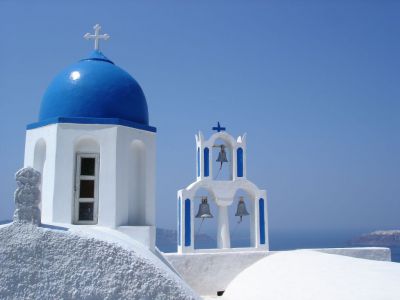
One of Santorini's symbols, the Chapel of Panagia Theoskepasti, is located near the port of Andres, on Skaros Rock, a rocky peninsula that projects into the sea. It was fashioned by multiple volcanoes that changed the shape of the island from circular to crescent. In addition, many other islands were also formed from these volcanoes. The rock was also the site of a castle until an earthquake destroyed the building in the 19th century.
The white building with a blue dome housing the church is open during the day until 4pm, free for anyone to visit. Moreover, the village of Imerovigli has some of the best views of Santorini because of its high vantage point. Visitors can reach the church via the nearby walking trail that begins at Imerovigli and runs through the cape that connects Skaros to the village. The trail ends at the Chapel of Theoskepasti. There is also a stunning underwater caldera that is worth the wait. Once you have visited the church, make sure to see the Hidden Room. The cave sits to the right of the trail and is one of the few elements that remain from the original castle structure.
Tip:
Weekend morning chanting begins at 7am and is broadcasted via loudspeakers to the entire district for hours.
The white building with a blue dome housing the church is open during the day until 4pm, free for anyone to visit. Moreover, the village of Imerovigli has some of the best views of Santorini because of its high vantage point. Visitors can reach the church via the nearby walking trail that begins at Imerovigli and runs through the cape that connects Skaros to the village. The trail ends at the Chapel of Theoskepasti. There is also a stunning underwater caldera that is worth the wait. Once you have visited the church, make sure to see the Hidden Room. The cave sits to the right of the trail and is one of the few elements that remain from the original castle structure.
Tip:
Weekend morning chanting begins at 7am and is broadcasted via loudspeakers to the entire district for hours.
4) Church of Panagia Platsani
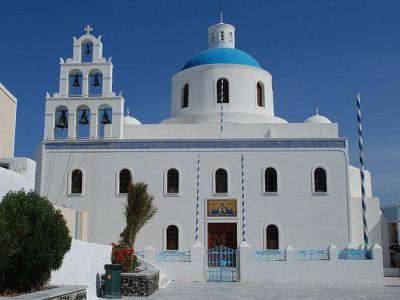
The Church of Panagia Platsani was originally constructed inside the walls of the Castle of Oia. The church was moved to its current location, the village center, and was rebuilt on higher and more stable ground following the earthquake of 1956. The place of worship is dedicated to the Akathist Hymn of the Most Holy Theotokos. The building is white-washed and features a blue-dome and arched windows.
The place of worship came into existence when the townspeople decided to build the cathedral at its previous location to honor the icon of the Virgin Mary that was found in the sea by a fisherman. After much struggle, the fisherman, along with the priest and fellow parishioners brought the icon to the church.
The icon was moved the following day, by phenomenon, from the church to the castle. Each time, the citizens returned the symbol to the church, it allegedly moved back to the castle miraculously. It was then that the townspeople decided to build a place of worship where the Virgin Mary had placed the icon. Today, the Virgin Mary overlooks the sea where her spirit can bless all vessels and its passengers. The church contains many tributes to sailors and other residents of the town.
Tip:
You can either walk up the steps, take a donkey ride or the cable car. Walking takes about 35-40mins. The cost for the cable car is €5 one way.
Try visiting during the Greek Easter when lanterns are placed all around town, including around churches and various buildings.
The place of worship came into existence when the townspeople decided to build the cathedral at its previous location to honor the icon of the Virgin Mary that was found in the sea by a fisherman. After much struggle, the fisherman, along with the priest and fellow parishioners brought the icon to the church.
The icon was moved the following day, by phenomenon, from the church to the castle. Each time, the citizens returned the symbol to the church, it allegedly moved back to the castle miraculously. It was then that the townspeople decided to build a place of worship where the Virgin Mary had placed the icon. Today, the Virgin Mary overlooks the sea where her spirit can bless all vessels and its passengers. The church contains many tributes to sailors and other residents of the town.
Tip:
You can either walk up the steps, take a donkey ride or the cable car. Walking takes about 35-40mins. The cost for the cable car is €5 one way.
Try visiting during the Greek Easter when lanterns are placed all around town, including around churches and various buildings.
5) Oia Castle (must see)
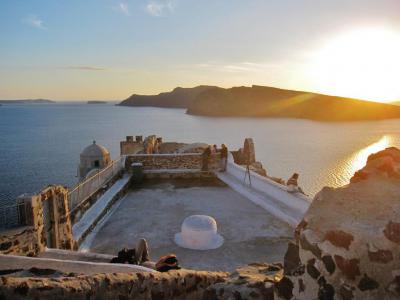
This ancient castle dates back to the late 15th century. The castle's ruins remain one of Oia's most visited attractions and are a popular spot to watch the sunset from.
Oia Castle was built to protect the island and its residents against pirates. Pirates would steal property, kidnap men and women, and sell the kidnapped people at slave markets.
Because of the constant threat, residents built their houses close together in hard-to-reach cliffs. Then, when residents saw pirates approaching, they fled to the castle and hid their valuables in pits under the castle.
The castle's high location made it an excellent lookout station. Venetian rules had residences in the middle of the castle. Its defensive structure made it hard to conquer, but Turkish invaders did succeed in capturing the castle in 1577.
A 1956 earthquake heavily damaged the castle, and most structures fell into the sea. The castle's tower and wall fragments are all that remain. From the castle's ruins, visitors can enjoy beautiful views of the Santorini islands, the volcanic islands of Nea Kameni, Palea Kameni. Visitors can also see Thira and Thirassia from this vantage point.
Today, tourists and locals come to the castle to watch the sunset each night. If you want to participate in this special nightly celebration, come early and grab your spot.
Oia Castle was built to protect the island and its residents against pirates. Pirates would steal property, kidnap men and women, and sell the kidnapped people at slave markets.
Because of the constant threat, residents built their houses close together in hard-to-reach cliffs. Then, when residents saw pirates approaching, they fled to the castle and hid their valuables in pits under the castle.
The castle's high location made it an excellent lookout station. Venetian rules had residences in the middle of the castle. Its defensive structure made it hard to conquer, but Turkish invaders did succeed in capturing the castle in 1577.
A 1956 earthquake heavily damaged the castle, and most structures fell into the sea. The castle's tower and wall fragments are all that remain. From the castle's ruins, visitors can enjoy beautiful views of the Santorini islands, the volcanic islands of Nea Kameni, Palea Kameni. Visitors can also see Thira and Thirassia from this vantage point.
Today, tourists and locals come to the castle to watch the sunset each night. If you want to participate in this special nightly celebration, come early and grab your spot.
6) Windmill of Oia
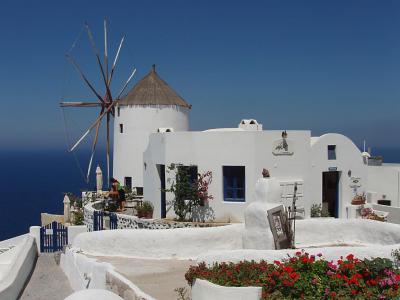
The Windmill of Oia is one of Oia's most iconic photography spots. This picture-perfect windmill is also available as a unique villa rental. If you want to capture the best sunset-watching spot and make memories to last a lifetime, look into renting the Windmill of Oia.
The Windmill of Oia features two bedrooms, a bathroom, and a small kitchen. A winding stone staircase takes guests to each room in the windmill villa. An enormous deck provides breathtaking views and a great spot to relax and watch the world go by.
Santorini is a windy island and is home to about 70 historic windmills. The original windmills might have been built as early as the 14th century. Traditional Santorini windmills were used to grind flour and housed bakeries as well. Most of the windmills you see today were built during the 17th century or later.
The Windmill of Oia features two bedrooms, a bathroom, and a small kitchen. A winding stone staircase takes guests to each room in the windmill villa. An enormous deck provides breathtaking views and a great spot to relax and watch the world go by.
Santorini is a windy island and is home to about 70 historic windmills. The original windmills might have been built as early as the 14th century. Traditional Santorini windmills were used to grind flour and housed bakeries as well. Most of the windmills you see today were built during the 17th century or later.
7) Armeni Port of Oia
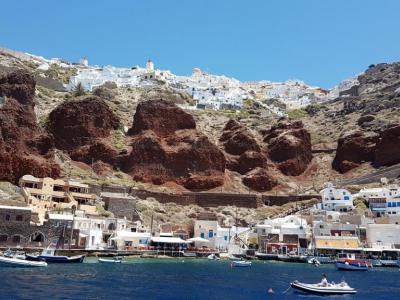
Armeni Port, nestled below the picturesque village of Oia on the northwest side of Santorini, is a quaint and historic harbor offering stunning views of the caldera, the volcanic islands, and the nearby island of Therasia. Believed to be the oldest port in this region of the island, Armeni once thrived as the main harbor of Oia, supporting wine trade and fishing activities. Large ships would anchor offshore, with sailors using small boats, known as "Lantzes," to reach the port.
Accessing Armeni can be somewhat challenging, particularly in the summer months. Visitors have three main options: a boat ride from Ammoudi Bay, a walk down 291 steep steps, or a mule ride to navigate the descent from Oia. Despite the effort required to reach Armeni, the serene environment is well worth the journey.
Today, Armeni is a peaceful retreat featuring a few whitewashed houses, a traditional tavern, and a concrete pier where small yachts and boats can moor. The harbor, although no longer bustling with trade, provides an idyllic setting for relaxation. The Tavern by the Sea offers savory local dishes, enhancing the experience with its serene ambiance and spectacular views.
The small beach at Armeni is ideal for swimming and wall diving, boasting deep, crystalline waters and volcanic pebbles. Though unorganized and lacking facilities, its unspoiled nature adds to the charm and natural beauty of the landscape. A diving center is also available for those interested in exploring the underwater scenery. As swimmers enjoy the clear waters, they are treated to awe-inspiring views of the caldera cliffs and the captivating settlement of Oia above, creating a thrilling and overwhelming experience.
Accessing Armeni can be somewhat challenging, particularly in the summer months. Visitors have three main options: a boat ride from Ammoudi Bay, a walk down 291 steep steps, or a mule ride to navigate the descent from Oia. Despite the effort required to reach Armeni, the serene environment is well worth the journey.
Today, Armeni is a peaceful retreat featuring a few whitewashed houses, a traditional tavern, and a concrete pier where small yachts and boats can moor. The harbor, although no longer bustling with trade, provides an idyllic setting for relaxation. The Tavern by the Sea offers savory local dishes, enhancing the experience with its serene ambiance and spectacular views.
The small beach at Armeni is ideal for swimming and wall diving, boasting deep, crystalline waters and volcanic pebbles. Though unorganized and lacking facilities, its unspoiled nature adds to the charm and natural beauty of the landscape. A diving center is also available for those interested in exploring the underwater scenery. As swimmers enjoy the clear waters, they are treated to awe-inspiring views of the caldera cliffs and the captivating settlement of Oia above, creating a thrilling and overwhelming experience.
8) Three Bells of Fira (must see)
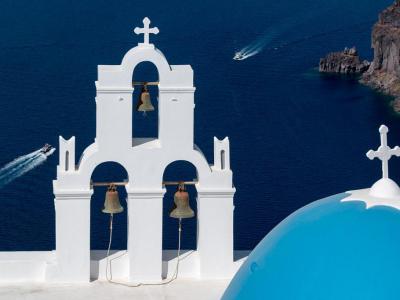
The Three Bells of Fira, officially known as The Catholic Church of the Dormition, is a prominent Greek Catholic church situated on the island of Santorini. Renowned for its striking blue dome and three bells, the church offers stunning views from its location in the town of Fira, perched high above the western cliffs of Santorini.
Historically, the site of the Three Bells of Fira has been home to several structures. In the mid-17th century, two modest cave churches were carved into the solid cliff face. These early churches were eventually lost due to the cliff's recession, which was caused by the ongoing expansion of Fira. An infirmary was then built on the site, which later came under the occupancy of Jesuits until the land was transferred to the Diocese of Santorini.
The present-day church was constructed in 1757 and has undergone multiple refurbishments and expansions throughout its history. One of the significant events in its timeline was the 1956 Amorgos earthquake, which caused considerable damage to the structure. Subsequently, the church was restored to its former glory.
The Catholic Church of the Dormition celebrates its feast day on 15 August each year, marking an important event in its religious calendar. The Three Bells of Fira remains a significant landmark and a testament to the rich historical and cultural tapestry of Santorini.
Historically, the site of the Three Bells of Fira has been home to several structures. In the mid-17th century, two modest cave churches were carved into the solid cliff face. These early churches were eventually lost due to the cliff's recession, which was caused by the ongoing expansion of Fira. An infirmary was then built on the site, which later came under the occupancy of Jesuits until the land was transferred to the Diocese of Santorini.
The present-day church was constructed in 1757 and has undergone multiple refurbishments and expansions throughout its history. One of the significant events in its timeline was the 1956 Amorgos earthquake, which caused considerable damage to the structure. Subsequently, the church was restored to its former glory.
The Catholic Church of the Dormition celebrates its feast day on 15 August each year, marking an important event in its religious calendar. The Three Bells of Fira remains a significant landmark and a testament to the rich historical and cultural tapestry of Santorini.
9) St. John the Baptist Cathedral (must see)
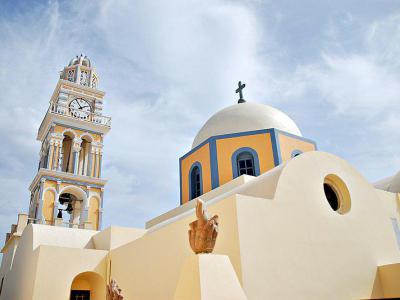
One cannot help but notice the beautiful grand churches and cathedrals that decorate the landscape of the island known as Thera or Fira. They are as much part of the community as are the many lava remnants. Dedicated to Saint John the Baptist, the Catholic Cathedral of Santorini is a handsome and unique place of worship. Its peach exterior contrasts with the many white and blue domed churches that dot the landscape of this quaint, yet beautiful town. It was built in the 17th century by the Jesuit monks, missionaries of the Apostolic Order.
Santorini has experienced a lot of seismic activity throughout its existence. An earthquake in 1956 completely destroyed the previous church. The house of worship that we may enjoy today was restored and opened in 1975.
You will be impressed by the exquisiteness of the structure with its magnificent clock tower and accompanying bells. Once you enter the place of worship, you will find the confessional that is located to the side. The interior is eye-catching and features blue, orange, and cream accents throughout the building. A striking chandelier hangs below a religious painting, which is featured on a domed ceiling, and spectacular arches border the framed portraits of religious figures. Located on an island that the crusaders visited, this cathedral is simply stunning.
Why You Should Visit:
Not only do you experience the architecture of the island, but also, you may find a narrow street where all the souvenir shops are located, and you can eat a typical, local gyro as you look around the shops.
Tip:
You'll probably feel at ease attending a Sunday mass here (10am), as most attendees are usually tourists and there are parts where you may even recite in your own language instead of Greek, as there are many languages represented among the congregation.
Santorini has experienced a lot of seismic activity throughout its existence. An earthquake in 1956 completely destroyed the previous church. The house of worship that we may enjoy today was restored and opened in 1975.
You will be impressed by the exquisiteness of the structure with its magnificent clock tower and accompanying bells. Once you enter the place of worship, you will find the confessional that is located to the side. The interior is eye-catching and features blue, orange, and cream accents throughout the building. A striking chandelier hangs below a religious painting, which is featured on a domed ceiling, and spectacular arches border the framed portraits of religious figures. Located on an island that the crusaders visited, this cathedral is simply stunning.
Why You Should Visit:
Not only do you experience the architecture of the island, but also, you may find a narrow street where all the souvenir shops are located, and you can eat a typical, local gyro as you look around the shops.
Tip:
You'll probably feel at ease attending a Sunday mass here (10am), as most attendees are usually tourists and there are parts where you may even recite in your own language instead of Greek, as there are many languages represented among the congregation.
10) Santorini Old Harbor
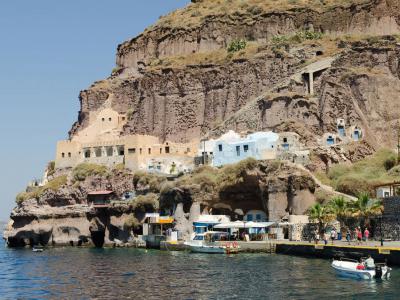
The Old Harbor was formed by volcanic activity in 1650 BC. It used to serve all of Santorini until the Athinos Port was established. The nautical haven is a harbor for cruise ship travelers, while the other harbor handles ferry and commercial boats. Originally, the only way one could reach the harbor was by travelling the hundreds of steps that lead to it.
The most affordable way to travel to Old Harbor, in first class style, is by the Blue Star Ferry. The trip will take nine hours. Passengers will be picked up from the transport and delivered to their destination by smaller vessels, since cruise ships do not anchor at the harbor.
The waterfront has many shops, restaurants, and taverns that you will enjoy. The best way to travel to the top is by cable car, which takes no more than five minutes and offers a pleasant view of the area. Donkeys, a tradition from the past, are also available for those who are afraid of heights. For the truly fit, a hike up the mountain’s 580 steps is a healthy adventure. During the summer months, tours are offered to the nearby volcano and hot springs. The spot is a popular destination, with as many as 80,000 visitors travelling through the port each day in peak season.
The most affordable way to travel to Old Harbor, in first class style, is by the Blue Star Ferry. The trip will take nine hours. Passengers will be picked up from the transport and delivered to their destination by smaller vessels, since cruise ships do not anchor at the harbor.
The waterfront has many shops, restaurants, and taverns that you will enjoy. The best way to travel to the top is by cable car, which takes no more than five minutes and offers a pleasant view of the area. Donkeys, a tradition from the past, are also available for those who are afraid of heights. For the truly fit, a hike up the mountain’s 580 steps is a healthy adventure. During the summer months, tours are offered to the nearby volcano and hot springs. The spot is a popular destination, with as many as 80,000 visitors travelling through the port each day in peak season.
11) Akrotiri Lighthouse
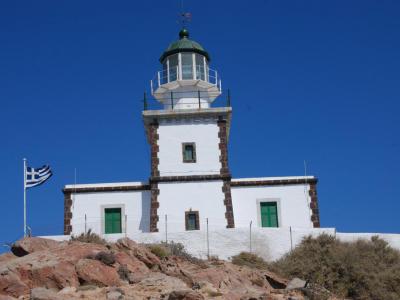
The Akrotiri Lighthouse, located on the southwestern tip of Santorini, is one of the island's most beautiful and historically significant landmarks. Built in 1892 by a French trading company, it is one of the oldest lighthouses in Greece. Initially powered by petrol fuel and manually operated, the lighthouse transitioned to electricity in 1893. Although it ceased operation during World War II, it was recommissioned by the Greek Navy in 1945 and remains operational today.
Perched atop a high cliff, the lighthouse stands 10 meters tall, above a whitewashed building that once housed the warden. The structure emits a bright white light every 10 seconds, continuing its vital role in ensuring the safety of maritime traffic. The surrounding village of Akrotiri is a tranquil spot, located 5 kilometers from the village center and a 26-minute drive from Fira Town, Santorini’s bustling hub.
The lighthouse is renowned for its stunning sunset views, where visitors can watch the sun dip into the Aegean Sea, creating a breathtaking romantic atmosphere. The site offers panoramic vistas of the sea, the impressive Santorini volcano, and the caldera cliffs dotted with picturesque villages.
A visit to the Akrotiri Lighthouse is often complemented by exploring the nearby Excavations of Akrotiri and the distinctive Red Beach, known for its unique color. The combination of historical significance, natural beauty, and captivating sunset views makes the Akrotiri Lighthouse a must-visit destination on the island of Santorini.
Perched atop a high cliff, the lighthouse stands 10 meters tall, above a whitewashed building that once housed the warden. The structure emits a bright white light every 10 seconds, continuing its vital role in ensuring the safety of maritime traffic. The surrounding village of Akrotiri is a tranquil spot, located 5 kilometers from the village center and a 26-minute drive from Fira Town, Santorini’s bustling hub.
The lighthouse is renowned for its stunning sunset views, where visitors can watch the sun dip into the Aegean Sea, creating a breathtaking romantic atmosphere. The site offers panoramic vistas of the sea, the impressive Santorini volcano, and the caldera cliffs dotted with picturesque villages.
A visit to the Akrotiri Lighthouse is often complemented by exploring the nearby Excavations of Akrotiri and the distinctive Red Beach, known for its unique color. The combination of historical significance, natural beauty, and captivating sunset views makes the Akrotiri Lighthouse a must-visit destination on the island of Santorini.
12) Perissa Black Sand Beach (must see)
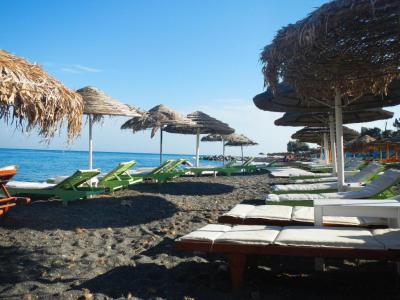
Perissa Beach is famous for its black volcanic sand and crystal clear water. Thousands of years ago, the volcano erupted and covered the island in black volcanic ash, pumice, and lava. As a result, Perissa Black Sand Beach has a high level of volcanic mix, making the sand appear black.
Visitors can stroll along the shore or relax on a sun lounger. Many restaurants provide beach umbrellas for patrons. Persissa Beach is cosmopolitan and offers a variety of shore-side and water activities. Visitors can also enjoy watersports such as swimming, canoeing, windsurfing, diving, or jet skiing.
Popular beach bars and restaurants line the beach. DJs play lively music while visitors try beachside cocktails. At night, check out the exciting nightlife and enjoy the beach clubs.
In addition, Perissa Beach has a waterpark with waterslides and pools. The waterpark is a great place for kids and adults to have fun.
Perissa Beach is a Blue Flag beach. This designation indicates that the beach is clean and sustainable.
Visitors can stroll along the shore or relax on a sun lounger. Many restaurants provide beach umbrellas for patrons. Persissa Beach is cosmopolitan and offers a variety of shore-side and water activities. Visitors can also enjoy watersports such as swimming, canoeing, windsurfing, diving, or jet skiing.
Popular beach bars and restaurants line the beach. DJs play lively music while visitors try beachside cocktails. At night, check out the exciting nightlife and enjoy the beach clubs.
In addition, Perissa Beach has a waterpark with waterslides and pools. The waterpark is a great place for kids and adults to have fun.
Perissa Beach is a Blue Flag beach. This designation indicates that the beach is clean and sustainable.
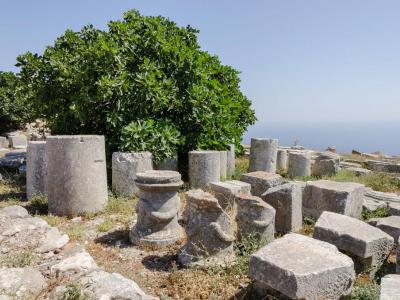
13) Ancient Thera (must see)
Ancient Thera was once a great civilization. Today, visitors can explore Ancient Thera's ruins. Ancient Thera was built on Mesa Vouno Mountain. This 365 meter (1197 feet) tall site provided the Lacedaemonian colonists with a strategic position for their town. The colonists originally arrived in the eighth century BC with King Theras and named the island after their king.
Later, the Ptolemaic dynasty inhabited the island, and Thera was Egpyt's military base in the fourth century BC.
The site was excavated from 1896 to 1961. Archeologists discovered a settlement that included extensive buildings and streets. The settlement dates to as early as the 9th century BC. Most of the settlement dates to the Hellenistic period. Archeologists unearthed cemeteries, temples, churches, markets, and a theatre.
The site features the Terrace of the Festivals, where men would dance to honor Apollo. Visitors can also see a spring inside a cave. This spring was vital to the settlement as it provided vital drinking water.
Visitors can tour the archeological site and enjoy the fabulous mountain-top views.
Why You Should Visit:
The views from Thera are just amazing and almost worth the time and price to get in to see. From Kamari and its beach to the Aegean Sea and Perissa to the south with its beaches and domed churches, there's much to see and appreciate.
Tip:
Depending on your fitness level, the walk up could easily take 30 mins to an hour. It's very windy at the top and throughout Thera, so be prepared – the wind gusts can be strong at times.
Later, the Ptolemaic dynasty inhabited the island, and Thera was Egpyt's military base in the fourth century BC.
The site was excavated from 1896 to 1961. Archeologists discovered a settlement that included extensive buildings and streets. The settlement dates to as early as the 9th century BC. Most of the settlement dates to the Hellenistic period. Archeologists unearthed cemeteries, temples, churches, markets, and a theatre.
The site features the Terrace of the Festivals, where men would dance to honor Apollo. Visitors can also see a spring inside a cave. This spring was vital to the settlement as it provided vital drinking water.
Visitors can tour the archeological site and enjoy the fabulous mountain-top views.
Why You Should Visit:
The views from Thera are just amazing and almost worth the time and price to get in to see. From Kamari and its beach to the Aegean Sea and Perissa to the south with its beaches and domed churches, there's much to see and appreciate.
Tip:
Depending on your fitness level, the walk up could easily take 30 mins to an hour. It's very windy at the top and throughout Thera, so be prepared – the wind gusts can be strong at times.
