Custom Walk in Valletta, Malta by c_kwo_9974a created on 2025-06-16
Guide Location: Malta » Valletta
Guide Type: Custom Walk
# of Sights: 10
Tour Duration: 2 Hour(s)
Travel Distance: 4.4 Km or 2.7 Miles
Share Key: XU5TD
Guide Type: Custom Walk
# of Sights: 10
Tour Duration: 2 Hour(s)
Travel Distance: 4.4 Km or 2.7 Miles
Share Key: XU5TD
How It Works
Please retrieve this walk in the GPSmyCity app. Once done, the app will guide you from one tour stop to the next as if you had a personal tour guide. If you created the walk on this website or come to the page via a link, please follow the instructions below to retrieve the walk in the app.
Retrieve This Walk in App
Step 1. Download the app "GPSmyCity: Walks in 1K+ Cities" on Apple App Store or Google Play Store.



Step 2. In the GPSmyCity app, download(or launch) the guide "Valletta Map and Walking Tours".
Step 3. Tap the menu button located at upper right corner of the "Walks" screen and select "Retrieve custom walk". Enter the share key: XU5TD
1) Valletta Waterfront (must see)
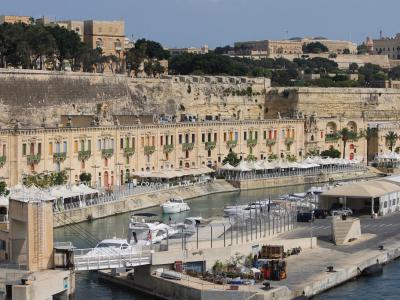
The Valletta Waterfront, located in Floriana, is a picturesque promenade distinguished by three notable buildings: a centrally positioned Church of the Flight into Egypt, the Pinto Stores (also known as the Pinto Wharf) to the left, and the Forni Stores (or Forni Shopping Complex) to the right.
Originally established in July 1727 by Grand Master Anton Manuel de Vilhena, the Valletta Marina underwent subsequent development in 1752 under the direction of Grandmaster Manuel Pinto de Fonseca. This expansion saw the addition of 19 impressive stores and a church, all designed in the Baroque style attributed to Andrea Belli.
During World War II, the area suffered significant damage from aerial bombardment due to its proximity to the Malta Dockyard and British naval forces in Grand Harbour. However, extensive restoration efforts were undertaken post-war to revive and enhance the waterfront.
Today, management of the Valletta Waterfront falls under a private consortium, overseeing Malta's cruise liner operations. The waterfront boasts approximately twelve restaurants, several bars, and retail outlets. It serves as a venue for various events, including the Malta Jazz Festival and the Malta Fireworks Festival.
The Church of the Flight into Egypt, constructed in 1752 alongside the stores, endured bombing during World War II. However, damaged portions were faithfully reconstructed to match the original design, with restored original elements. Mass is conducted at the church every Saturday evening. Additionally, a bronze image of Jesus's face, originally affixed to the church, now adorns the facade of the Co-Cathedral of Saint John in Valletta.
Recognized for their historical significance, the Pinto Stores were designated as a grade 1 national monument and listed on the National Inventory of the Cultural Property of the Maltese Islands (NICPMI), having been included on the Antiquities List of 1925.
Originally established in July 1727 by Grand Master Anton Manuel de Vilhena, the Valletta Marina underwent subsequent development in 1752 under the direction of Grandmaster Manuel Pinto de Fonseca. This expansion saw the addition of 19 impressive stores and a church, all designed in the Baroque style attributed to Andrea Belli.
During World War II, the area suffered significant damage from aerial bombardment due to its proximity to the Malta Dockyard and British naval forces in Grand Harbour. However, extensive restoration efforts were undertaken post-war to revive and enhance the waterfront.
Today, management of the Valletta Waterfront falls under a private consortium, overseeing Malta's cruise liner operations. The waterfront boasts approximately twelve restaurants, several bars, and retail outlets. It serves as a venue for various events, including the Malta Jazz Festival and the Malta Fireworks Festival.
The Church of the Flight into Egypt, constructed in 1752 alongside the stores, endured bombing during World War II. However, damaged portions were faithfully reconstructed to match the original design, with restored original elements. Mass is conducted at the church every Saturday evening. Additionally, a bronze image of Jesus's face, originally affixed to the church, now adorns the facade of the Co-Cathedral of Saint John in Valletta.
Recognized for their historical significance, the Pinto Stores were designated as a grade 1 national monument and listed on the National Inventory of the Cultural Property of the Maltese Islands (NICPMI), having been included on the Antiquities List of 1925.
2) Triton Fountain (must see)
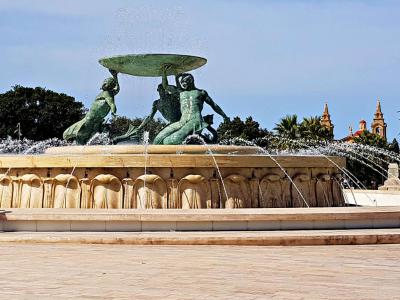
Just outside Valletta’s City Gate stands the Triton Fountain, a familiar sight for anyone arriving in Malta’s capital. Completed in the late 1950s and inaugurated in 1959, it was created by sculptor Chevalier Vincent Apap with draftsman Victor Anastasi. Today it serves not only as a monument but also as a kind of entry point, giving visitors their first impression of Valletta’s blend of Mediterranean heritage and modern life.
The fountain is composed of three bronze Tritons, figures from Greek mythology known for their ties to the sea. They raise a broad circular basin above their heads, supported by a round platform finished in travertine. Each figure carries the weight differently: two Tritons balance on one knee, while the third kneels fully. Viewed from City Gate, their faces all come into view, giving the composition a sense of unity and rhythm. The arrangement was influenced by Rome’s Fontana delle Tartarughe, a fountain admired for the interaction among its sculptures.
Here, the Tritons are portrayed with strong, expressive bodies, their muscles defined as if caught mid-motion. Their poses create a sense of cooperation, as though they are working together to lift the basin above them. The travertine platform beneath them adds texture and warmth, especially under Malta’s bright sunlight, which brings out the greenish tones of the bronze. The water that spills from the basin softens the monumental forms, adding movement and sound to the open square.
The fountain is composed of three bronze Tritons, figures from Greek mythology known for their ties to the sea. They raise a broad circular basin above their heads, supported by a round platform finished in travertine. Each figure carries the weight differently: two Tritons balance on one knee, while the third kneels fully. Viewed from City Gate, their faces all come into view, giving the composition a sense of unity and rhythm. The arrangement was influenced by Rome’s Fontana delle Tartarughe, a fountain admired for the interaction among its sculptures.
Here, the Tritons are portrayed with strong, expressive bodies, their muscles defined as if caught mid-motion. Their poses create a sense of cooperation, as though they are working together to lift the basin above them. The travertine platform beneath them adds texture and warmth, especially under Malta’s bright sunlight, which brings out the greenish tones of the bronze. The water that spills from the basin softens the monumental forms, adding movement and sound to the open square.
3) City Gate
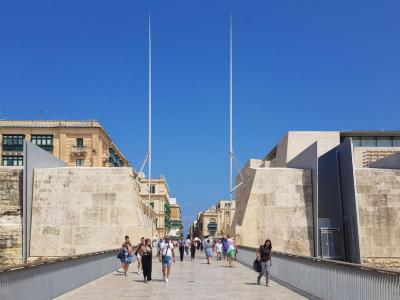
City Gate serves as the main entrance to Valletta. Often referred to as the “Door to the City,” it marks the point where visitors step from the modern world into the historic grid of streets planned in the 16th century.
The first gate on this site, known as San Giorgio Gate, was built between 1566 and 1569 by military engineer Francesco Laparelli, following the Great Siege. It was a fortified opening in the city walls, designed very much with defense in mind. In 1632, it was replaced by a more decorative gate by Maltese architect Tommaso Dingli, reflecting the city’s growing confidence and stability.
Under British rule, a new gate was built in 1853, designed by Colonel Thompson of the Royal Engineers. Featuring two large central arches and two smaller side arches, it became known as the Reale Gate and stood throughout the colonial period. In 1964, a fourth gate was inaugurated as part of a redevelopment plan for the entrance and the nearby Royal Opera House, although the full project was never completed.
As you approach today, you will see the fifth and current City Gate, completed in 2014 and designed by Italian architect Renzo Piano. Walking through it, you will find a clean, modern opening that intentionally contrasts with the historic stone walls. Don’t miss the way the gate frames Republic Street—the city’s main axis—drawing your eye straight into Valletta’s orderly layout.
The first gate on this site, known as San Giorgio Gate, was built between 1566 and 1569 by military engineer Francesco Laparelli, following the Great Siege. It was a fortified opening in the city walls, designed very much with defense in mind. In 1632, it was replaced by a more decorative gate by Maltese architect Tommaso Dingli, reflecting the city’s growing confidence and stability.
Under British rule, a new gate was built in 1853, designed by Colonel Thompson of the Royal Engineers. Featuring two large central arches and two smaller side arches, it became known as the Reale Gate and stood throughout the colonial period. In 1964, a fourth gate was inaugurated as part of a redevelopment plan for the entrance and the nearby Royal Opera House, although the full project was never completed.
As you approach today, you will see the fifth and current City Gate, completed in 2014 and designed by Italian architect Renzo Piano. Walking through it, you will find a clean, modern opening that intentionally contrasts with the historic stone walls. Don’t miss the way the gate frames Republic Street—the city’s main axis—drawing your eye straight into Valletta’s orderly layout.
4) Republic Street
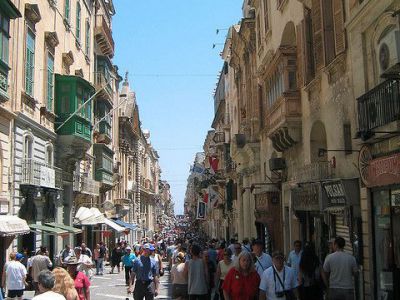
Republic Street is the main artery of Valletta and the center of the capital’s administrative life. Stretching for just one kilometer, it runs straight from City Gate to the granaries beside Fort Saint Elmo, forming the backbone of the city’s grid. Today it is primarily pedestrian, making it an easy and enjoyable place to explore on foot.
As you walk along Republic Street, you will see many of Malta’s key institutions and landmarks. You will pass the modern Parliament of Malta near the entrance, followed by the Courts of Justice and the Grand Master’s Palace further along. The street also intersects several important squares, each offering different views of Valletta’s government buildings, churches, cafés, and small museums.
Down the street, you will find yourself moving through centuries of Maltese history. Don’t miss the traditional shopfronts and the contrast between older limestone facades and recent restorations. This is one of the best places to watch daily life unfold—office workers, shoppers, and visitors all sharing the same historic path.
Republic Street has carried many names. Laid out soon after the Great Siege of 1565, it was originally called San Giorgio Street. Under French rule it became National Street, followed by Royal Road during the early British period. In 1936 it was renamed Kingsway, a name many older residents still remember. After independence, it received its present name: Republic Street.
Bombed during World War II and later rebuilt, the street remains the heart of Valletta—busy, historic, and central to understanding the city.
As you walk along Republic Street, you will see many of Malta’s key institutions and landmarks. You will pass the modern Parliament of Malta near the entrance, followed by the Courts of Justice and the Grand Master’s Palace further along. The street also intersects several important squares, each offering different views of Valletta’s government buildings, churches, cafés, and small museums.
Down the street, you will find yourself moving through centuries of Maltese history. Don’t miss the traditional shopfronts and the contrast between older limestone facades and recent restorations. This is one of the best places to watch daily life unfold—office workers, shoppers, and visitors all sharing the same historic path.
Republic Street has carried many names. Laid out soon after the Great Siege of 1565, it was originally called San Giorgio Street. Under French rule it became National Street, followed by Royal Road during the early British period. In 1936 it was renamed Kingsway, a name many older residents still remember. After independence, it received its present name: Republic Street.
Bombed during World War II and later rebuilt, the street remains the heart of Valletta—busy, historic, and central to understanding the city.
5) Caffe Cordina
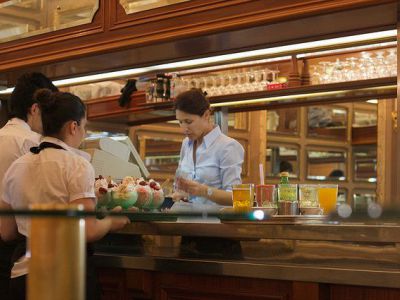
Caffe Cordina, located in the center of Valletta, serves as a symbol of the lasting charm of classic cafes. Established in 1837, it began as a modest sweet shop in Bormla. However, under the direction of Cesare Cordina, it evolved into the esteemed cafe it is now after moving to Valletta in 1944. This relocation, driven by vision and resolve, elevated Caffe Cordina to a level of unmatched sophistication and historical importance.
Occupying a stunning historic palazzo, Caffe Cordina captivates visitors with its exquisite interior, featuring vaulted ceilings and affreschi. Over the years, Cesare Cordina expanded the cafe to include a diverse array of offerings, such as a restaurant, tea room, pasticceria, coffee bar, and gelateria, catering to a wide range of tastes and preferences.
Renowned for its handmade, traditional sweets and pastries produced in-house, Caffe Cordina also offers a line of gourmet products, maintaining the high standards of quality, service, and innovation set by its founder. The Cordina family, now in its third generation, continues to uphold these values, ensuring that the cafe remains a beloved institution in the city.
Located on Republic Square, Caffe Cordina offers outdoor seating with picturesque views, making it a prime spot for enjoying an authentic Italian coffee and snack under the gaze of Queen Victoria’s monument. It's not just a cafe; it's a social landmark where locals and visitors alike can immerse themselves in the vibrant square vibe, making it a prime location for people-watching and soaking up the local culture.
Occupying a stunning historic palazzo, Caffe Cordina captivates visitors with its exquisite interior, featuring vaulted ceilings and affreschi. Over the years, Cesare Cordina expanded the cafe to include a diverse array of offerings, such as a restaurant, tea room, pasticceria, coffee bar, and gelateria, catering to a wide range of tastes and preferences.
Renowned for its handmade, traditional sweets and pastries produced in-house, Caffe Cordina also offers a line of gourmet products, maintaining the high standards of quality, service, and innovation set by its founder. The Cordina family, now in its third generation, continues to uphold these values, ensuring that the cafe remains a beloved institution in the city.
Located on Republic Square, Caffe Cordina offers outdoor seating with picturesque views, making it a prime spot for enjoying an authentic Italian coffee and snack under the gaze of Queen Victoria’s monument. It's not just a cafe; it's a social landmark where locals and visitors alike can immerse themselves in the vibrant square vibe, making it a prime location for people-watching and soaking up the local culture.
6) Republic Square
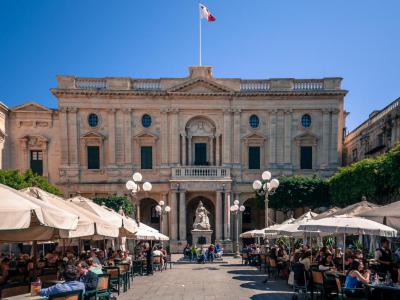
Initially known as Treasury Square due to its hosting of the Order of Saint John's treasury, this area was later renamed Queen's Square after a statue of Queen Victoria was placed there during the British era. Nowadays, it's officially called Republic Square, but many people still refer to it as Queen's Square.
On the northwest side, you'll find a significant building, the Common Treasure House, which stored important documents and financial records for the Order of Saint John. Over time, this building has served various purposes, including government offices, a hotel, and a cinema. It suffered damage during World War II but was repaired and is now the Casino Maltese, with cafes and shops occupying the ground level. One notable spot here is Cafe Cordina - one of Malta’s most historic cafés and a longtime gathering place for locals, artists, writers, and politicians.
The southeast side faces the National Library of Malta, a necessity for more space for the Order's growing collection of books. Designed by Stefano Ittar, a Polish-Italian architect, the library was completed in 1796.
The square's northeast side is next to the Grandmaster's Palace, the official residence of Malta's ruler, while the southwest side features a shopping arcade. Today, the square is a lively area with outdoor cafes and restaurants.
On the northwest side, you'll find a significant building, the Common Treasure House, which stored important documents and financial records for the Order of Saint John. Over time, this building has served various purposes, including government offices, a hotel, and a cinema. It suffered damage during World War II but was repaired and is now the Casino Maltese, with cafes and shops occupying the ground level. One notable spot here is Cafe Cordina - one of Malta’s most historic cafés and a longtime gathering place for locals, artists, writers, and politicians.
The southeast side faces the National Library of Malta, a necessity for more space for the Order's growing collection of books. Designed by Stefano Ittar, a Polish-Italian architect, the library was completed in 1796.
The square's northeast side is next to the Grandmaster's Palace, the official residence of Malta's ruler, while the southwest side features a shopping arcade. Today, the square is a lively area with outdoor cafes and restaurants.
7) St. John's Co-Cathedral (must see)
Saint John's Co-Cathedral in Valletta represents the rich heritage of the Knights of Malta. Commissioned in 1572 by Grand Master Jean de la Cassière and completed just a few years later, it served as the conventual church of the Order of Saint John. The design was entrusted to Glormu Cassar, the Maltese architect responsible for many of Valletta’s early buildings.
From the outside, the cathedral has a plain, fortress-like appearance—a reminder that it was built shortly after the Great Siege of 1565, during a time when defense shaped every corner of the new capital. The simplicity of the façade prepares visitors for the dramatic contrast they will encounter inside.
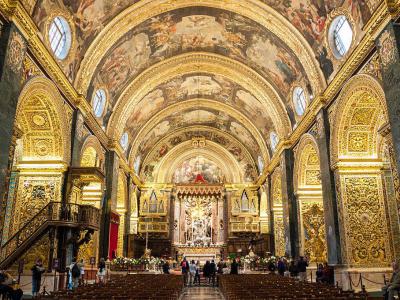
Once inside, you enter a very different world. Richly decorated walls are carved directly into the stone, and painted scenes from the life of Saint John by 17th-century Italian Baroque artist Mattia Preti cover the interior. Don’t miss the ceiling: Preti’s use of light and shadow makes some figures appear almost to lift off the surface. One of the most remarkable features is that the elaborate carvings were created directly on the walls, rather than being added later.
Make your way to the Oratory, located just beyond the right-hand side chapels. Here you’ll find Caravaggio’s The Beheading of Saint John the Baptist, the cathedral’s best-known masterpiece and the only painting he ever signed. The vast canvas fills nearly an entire wall and is a striking example of his dramatic use of light and shadow. In the same space, look for his smaller work, Saint Jerome Writing, which is equally compelling.
Before leaving, pause in the Nave, where about 400 inlaid marble tombstones form a colorful, detailed floor. Each tombstone marks the final resting place of a knight of the Order of St. John and is decorated with heraldic symbols, coats of arms, and carvings highlighting the knight’s rank, achievements, and virtues. Many include allegorical figures, religious motifs, and inscriptions about their lives. The vibrant marbles, ranging from deep reds to soft whites and greens, create a mosaic-like effect across the cathedral’s nave and chapels.
Tip:
Get there early! This is a very popular attraction and the groups and cruise ship passengers descend by 10:30 or so.
From the outside, the cathedral has a plain, fortress-like appearance—a reminder that it was built shortly after the Great Siege of 1565, during a time when defense shaped every corner of the new capital. The simplicity of the façade prepares visitors for the dramatic contrast they will encounter inside.
Once inside, you enter a very different world. Richly decorated walls are carved directly into the stone, and painted scenes from the life of Saint John by 17th-century Italian Baroque artist Mattia Preti cover the interior. Don’t miss the ceiling: Preti’s use of light and shadow makes some figures appear almost to lift off the surface. One of the most remarkable features is that the elaborate carvings were created directly on the walls, rather than being added later.
Make your way to the Oratory, located just beyond the right-hand side chapels. Here you’ll find Caravaggio’s The Beheading of Saint John the Baptist, the cathedral’s best-known masterpiece and the only painting he ever signed. The vast canvas fills nearly an entire wall and is a striking example of his dramatic use of light and shadow. In the same space, look for his smaller work, Saint Jerome Writing, which is equally compelling.
Before leaving, pause in the Nave, where about 400 inlaid marble tombstones form a colorful, detailed floor. Each tombstone marks the final resting place of a knight of the Order of St. John and is decorated with heraldic symbols, coats of arms, and carvings highlighting the knight’s rank, achievements, and virtues. Many include allegorical figures, religious motifs, and inscriptions about their lives. The vibrant marbles, ranging from deep reds to soft whites and greens, create a mosaic-like effect across the cathedral’s nave and chapels.
Tip:
Get there early! This is a very popular attraction and the groups and cruise ship passengers descend by 10:30 or so.
8) Upper Barrakka Gardens (must see)
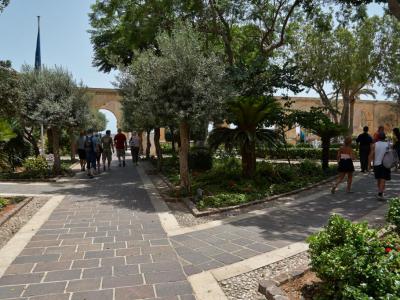
Built on the upper level of the Saint Peter & Paul Bastion, the Upper Barrakka Gardens offer stunning views of the Grand Harbour and a wonderful respite from the humming city. The gardens are built on the highest point of the city walls, meaning that the terrace has one of the best views of anywhere in town.
The bastion was built in 1560, and the terraced arches of the garden were added in 1661. The original purpose of the garden was as entertainment for the knights from the Order of Saint John who were stationed in the bastion. After the French occupation, the gardens were opened to the public in the year 1800.
Around the gardens, you'll see various monuments and dedications. For example, there are memorials to Sir Winston Churchill, Thomas Maitland, and Gerald Strickland. To get to the gardens from the ditch, you can opt to take the Barrakka Lift.
The bastion was built in 1560, and the terraced arches of the garden were added in 1661. The original purpose of the garden was as entertainment for the knights from the Order of Saint John who were stationed in the bastion. After the French occupation, the gardens were opened to the public in the year 1800.
Around the gardens, you'll see various monuments and dedications. For example, there are memorials to Sir Winston Churchill, Thomas Maitland, and Gerald Strickland. To get to the gardens from the ditch, you can opt to take the Barrakka Lift.
9) Lower Barrakka Gardens (must see)
Lower Barrakka Gardens is a public garden located on the waterfront of the Grand Harbour, offering a calm spot to enjoy the views and explore several monuments and statues. It’s an easy place to stop while wandering through Valletta, and the combination of open space, greenery, and historic features makes it well worth a visit.
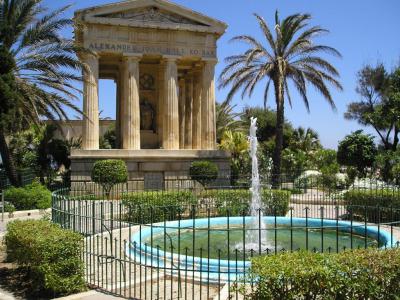
The most notable feature here is the Neo-classical temple dedicated to Sir Alexander Ball, built in 1810. Ball was a British admiral and the first Civil Commissioner of Malta. Architect Giorgio Pullicino designed the monument in the style of an ancient Greek temple, taking inspiration from the Temple of Hephaestus in Athens. Impossible to miss, it stands right in the middle of the gardens. Notice how the terrace’s elevated position overlooks the harbor—a fitting location for a monument to a naval officer who played a key role in Malta’s history.
As you walk through the gardens, look for the various commemorative plaques scattered around the terrace. You will find tributes to the 50th anniversary of the European Union, the 1956 Hungarian Revolution, the Prague Spring, and other notable events and individuals. The combination of history and quiet green space creates a reflective atmosphere amid the city’s bustle.
Across Quarry Wharf, don’t miss the Siege Bell War Memorial, which honors those who lost their lives defending Malta during World War II. For a break, there is a small café kiosk where you can enjoy coffee, drinks, or a quick snack.
For an even wider view of Valletta and the Grand Harbour, consider heading to the Upper Barrakka Gardens, located on the upper level of the Saint Peter & Paul Bastion. From here, you can enjoy an extended perspective of the city and harbor, complementing your visit to Lower Barrakka Gardens and giving a fuller sense of Valletta’s waterfront and historical importance.
The most notable feature here is the Neo-classical temple dedicated to Sir Alexander Ball, built in 1810. Ball was a British admiral and the first Civil Commissioner of Malta. Architect Giorgio Pullicino designed the monument in the style of an ancient Greek temple, taking inspiration from the Temple of Hephaestus in Athens. Impossible to miss, it stands right in the middle of the gardens. Notice how the terrace’s elevated position overlooks the harbor—a fitting location for a monument to a naval officer who played a key role in Malta’s history.
As you walk through the gardens, look for the various commemorative plaques scattered around the terrace. You will find tributes to the 50th anniversary of the European Union, the 1956 Hungarian Revolution, the Prague Spring, and other notable events and individuals. The combination of history and quiet green space creates a reflective atmosphere amid the city’s bustle.
Across Quarry Wharf, don’t miss the Siege Bell War Memorial, which honors those who lost their lives defending Malta during World War II. For a break, there is a small café kiosk where you can enjoy coffee, drinks, or a quick snack.
For an even wider view of Valletta and the Grand Harbour, consider heading to the Upper Barrakka Gardens, located on the upper level of the Saint Peter & Paul Bastion. From here, you can enjoy an extended perspective of the city and harbor, complementing your visit to Lower Barrakka Gardens and giving a fuller sense of Valletta’s waterfront and historical importance.
10) Barrakka Lift
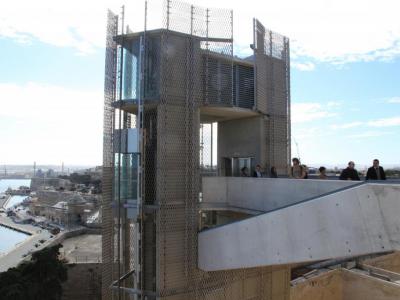
The Barrakka Lifts serve as a modern gateway to the historic heart of Valletta. Opened in December 2012, these lifts are a significant landmark, connecting the Grand Harbour with the Upper Barrakka Gardens and the bustling city center of Valletta. They stand on the very spot where a previous lift system operated from 1905 until its dismantlement in 1983, reinstating a vital link that had been lost for nearly three decades.
The structure comprises two lifts, each soaring to a height of 58 meters. They are designed to accommodate up to twenty-one passengers in a single journey, whisking visitors from the waterfront to the city in approximately twenty-five seconds. This makes it not only the quickest route into Valletta from the Valletta Waterfront but also a modern marvel that offers unparalleled convenience and accessibility.
The introduction of the Barrakka Lifts has been particularly beneficial for the throngs of tourists arriving by cruise ships at the Valletta Passenger Terminal. These lifts provide them with an easy and efficient means of reaching the city's core, where a plethora of shops, restaurants, churches, and museums await exploration. Additionally, the option to combine the lift ticket with a ferry crossing across the Grand Harbour to or from The Three Cities enhances the overall visitor experience, facilitating seamless travel and sightseeing opportunities across Valletta's historic and scenic locales.
The structure comprises two lifts, each soaring to a height of 58 meters. They are designed to accommodate up to twenty-one passengers in a single journey, whisking visitors from the waterfront to the city in approximately twenty-five seconds. This makes it not only the quickest route into Valletta from the Valletta Waterfront but also a modern marvel that offers unparalleled convenience and accessibility.
The introduction of the Barrakka Lifts has been particularly beneficial for the throngs of tourists arriving by cruise ships at the Valletta Passenger Terminal. These lifts provide them with an easy and efficient means of reaching the city's core, where a plethora of shops, restaurants, churches, and museums await exploration. Additionally, the option to combine the lift ticket with a ferry crossing across the Grand Harbour to or from The Three Cities enhances the overall visitor experience, facilitating seamless travel and sightseeing opportunities across Valletta's historic and scenic locales.
