Custom Walk in Catania, Italy by kayleighbrycegates_558c6 created on 2025-06-19
Guide Location: Italy » Catania
Guide Type: Custom Walk
# of Sights: 12
Tour Duration: 4 Hour(s)
Travel Distance: 7.5 Km or 4.7 Miles
Share Key: JDZRD
Guide Type: Custom Walk
# of Sights: 12
Tour Duration: 4 Hour(s)
Travel Distance: 7.5 Km or 4.7 Miles
Share Key: JDZRD
How It Works
Please retrieve this walk in the GPSmyCity app. Once done, the app will guide you from one tour stop to the next as if you had a personal tour guide. If you created the walk on this website or come to the page via a link, please follow the instructions below to retrieve the walk in the app.
Retrieve This Walk in App
Step 1. Download the app "GPSmyCity: Walks in 1K+ Cities" on Apple App Store or Google Play Store.



Step 2. In the GPSmyCity app, download(or launch) the guide "Catania Map and Walking Tours".
Step 3. Tap the menu button located at upper right corner of the "Walks" screen and select "Retrieve custom walk". Enter the share key: JDZRD
1) At 'Piscaria (Catania Fish Market) (must see)
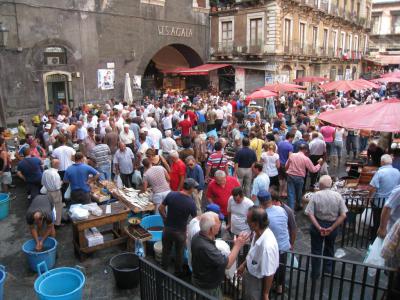
A'Piscaria, is "fish market" in Sicilian. Here is the most venerable and hectic place in Catania, take a stroll through the always busy fish market of Catania. This market makes the one in Palermo look tame. The market and the stalls extend from one street to another.
So many different kinds of fish and the people are of different kinds as well. Cockles, clams, mussels, urchins, what would you like? Everything, the shouting, the smells, the colors, the humor beneath the red awnings are all a happy frenzy here.
The market has been open every day since 1800. That's a long run on Broadway. Together with the Mondays Fair it is the most exciting market in Sicily.
Only a few steps away from the Cathedral of Catania and the Palace of the Elephants, the Piscaria extends out in all directions. It sneaks into streets, hides and reappears unexpectedly. Visitors are welcome. The main attraction is a toss-up; the people, or the fish?
Walk through the stalls of sea bass, shrimp, swordfish, oops, some are still moving! The fish are processed and cut, the sellers call out "vuciata!" the loudest gets the sale.
So many different kinds of fish and the people are of different kinds as well. Cockles, clams, mussels, urchins, what would you like? Everything, the shouting, the smells, the colors, the humor beneath the red awnings are all a happy frenzy here.
The market has been open every day since 1800. That's a long run on Broadway. Together with the Mondays Fair it is the most exciting market in Sicily.
Only a few steps away from the Cathedral of Catania and the Palace of the Elephants, the Piscaria extends out in all directions. It sneaks into streets, hides and reappears unexpectedly. Visitors are welcome. The main attraction is a toss-up; the people, or the fish?
Walk through the stalls of sea bass, shrimp, swordfish, oops, some are still moving! The fish are processed and cut, the sellers call out "vuciata!" the loudest gets the sale.
2) Elephant Fountain
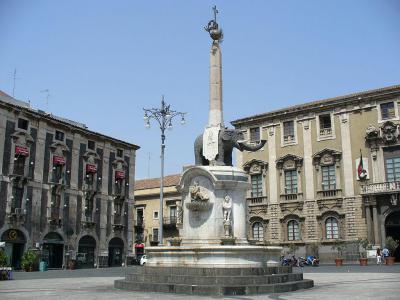
The Elephant Fountain (Fontana dell'Elefante) is a striking landmark in the heart of Cathedral Square (Piazza del Duomo) in Catania. Designed by architect Giovanni Battista Vaccarini between 1735 and 1737, this monument has become the emblem of Catania, showcasing the city’s resilience and cultural richness following the devastating earthquake of 1693.
The fountain's centerpiece is a black basalt statue of an elephant, affectionately called U Liotru, a symbol of the city. The origins of Vaccarini's inspiration are debated, with some attributing it to Gian Lorenzo Bernini’s Elephant and Obelisk in Rome, while others see a link to the Hypnerotomachia Poliphili, a Renaissance text.
The fountain’s base, made of white marble, features sculptures representing the Simeto and Amenano rivers, the key to Catania’s identity. The elephant statue itself faces the Cathedral of Saint Agatha, the city's patron saint, with an Egyptian-style obelisk mounted on its back. This granite obelisk, likely from ancient Syene, bears decorative motifs but no decipherable hieroglyphs. Atop the obelisk are symbolic elements: a globe, palm leaves for martyrdom, lilies for purity, and a metal tablet inscribed with a dedication to Saint Agatha, crowned by a cross.
Since its creation, the fountain has undergone multiple renovations, reflecting its central role in Catania’s history. Initially completed in 1737, a marble basin was added in 1757. In 1826, an iron fence and garden were installed, though these were later removed in 1998 to create a more accessible public space. Notably, the fountain narrowly escaped relocation to Piazza Palestro in 1862, thanks to a popular uprising led by Bonaventura Gravina.
Today, the Elephant Fountain stands as a symbol of Catania's spirit, blending history, artistry, and devotion in one iconic monument.
The fountain's centerpiece is a black basalt statue of an elephant, affectionately called U Liotru, a symbol of the city. The origins of Vaccarini's inspiration are debated, with some attributing it to Gian Lorenzo Bernini’s Elephant and Obelisk in Rome, while others see a link to the Hypnerotomachia Poliphili, a Renaissance text.
The fountain’s base, made of white marble, features sculptures representing the Simeto and Amenano rivers, the key to Catania’s identity. The elephant statue itself faces the Cathedral of Saint Agatha, the city's patron saint, with an Egyptian-style obelisk mounted on its back. This granite obelisk, likely from ancient Syene, bears decorative motifs but no decipherable hieroglyphs. Atop the obelisk are symbolic elements: a globe, palm leaves for martyrdom, lilies for purity, and a metal tablet inscribed with a dedication to Saint Agatha, crowned by a cross.
Since its creation, the fountain has undergone multiple renovations, reflecting its central role in Catania’s history. Initially completed in 1737, a marble basin was added in 1757. In 1826, an iron fence and garden were installed, though these were later removed in 1998 to create a more accessible public space. Notably, the fountain narrowly escaped relocation to Piazza Palestro in 1862, thanks to a popular uprising led by Bonaventura Gravina.
Today, the Elephant Fountain stands as a symbol of Catania's spirit, blending history, artistry, and devotion in one iconic monument.
3) Piazza Duomo (Cathedral Square) (must see)
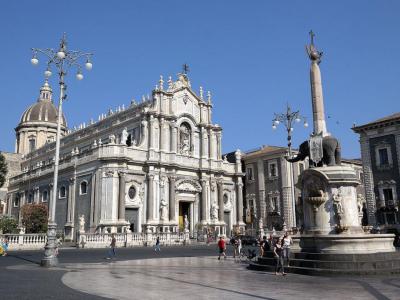
In the Cathedral Square there is a black lava elephant with an obelisk on his back. It is thought of as the symbol of Catania even if the inference is obscure. The elephant was brought here with his obelisk by Giovanni Battista Vaccarini. Giovanni was the architect charged with restoring the Square after the earthquake of 1693.
The Cathedral Square is the busy center of Catania. The Baroque square and the buildings around it are the restorations of architect Vaccarini, They are Uzeda Gate, from 1696, The great Cathedral, 1739, the Church of Saint Agatha, 1767, the Town Hall Building, 1741 and our friend, the Elephant, 1736. Altogether a stunning achievement.
Three streets connect to the square. First is Etnea Street. This is the cardo maximus, the north-south axis of the Ancient Roman City. Next is the Giuseppe Garibaldi Street, named for the great Italian patriot. Lastly we have the Vittorio Emanuele II Street, crossing the city from east to west.
The Town Hall Building, is on the north side of the square, facing the lava elephant of Vaccarini. On the opposite side the the Palace of the Clerics faces the Amenano fountain. The fountain is fed by the underground Amenano River.
The Festival of Saint Agatha is a three day celebration that starts on February 3 of each year. It involves a procession called "della luminaria", followed by a concert and fireworks.
The Cathedral Square is the busy center of Catania. The Baroque square and the buildings around it are the restorations of architect Vaccarini, They are Uzeda Gate, from 1696, The great Cathedral, 1739, the Church of Saint Agatha, 1767, the Town Hall Building, 1741 and our friend, the Elephant, 1736. Altogether a stunning achievement.
Three streets connect to the square. First is Etnea Street. This is the cardo maximus, the north-south axis of the Ancient Roman City. Next is the Giuseppe Garibaldi Street, named for the great Italian patriot. Lastly we have the Vittorio Emanuele II Street, crossing the city from east to west.
The Town Hall Building, is on the north side of the square, facing the lava elephant of Vaccarini. On the opposite side the the Palace of the Clerics faces the Amenano fountain. The fountain is fed by the underground Amenano River.
The Festival of Saint Agatha is a three day celebration that starts on February 3 of each year. It involves a procession called "della luminaria", followed by a concert and fireworks.
4) Cathedral of Catania (must see)
Agatha was a pious virgin from a noble Catania family in 231 AD. The Roman prefect Quintianus made amorous moves on her. She rebuffed him. He martyred her. But things went bad for Quintianus. His horse kicked him in the river. He hasn't been seen since.
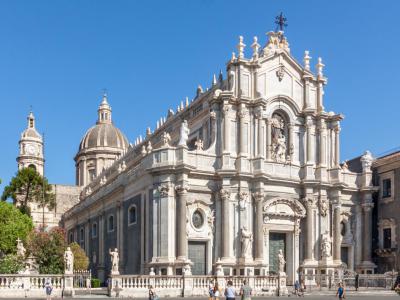
The Cathedral of Catania, also known as Cathedral of Saint Agatha, stands in the Cathedral Square (Piazza del Duomo). It is built in Italian Baroque style. The facade was fashioned in 1700 after a devastating earthquake in 1693. It has three levels with niches and columns of Corinthian granite.
The main entrance has a carved wooden door showing 32 plaques of the life of the Saint. The dome was created in 1802. The bell tower is a rebuilt. A parvis with a white stone balustrade harbors five statues of saints in Carrara marble.
The interior has a Latin Cross plan and three naves. The apse dates from the 12th century. In the north transept is the Chapel of the Holy Crucifix. The cathedral holds the tombs of Vincenzo Bellini, the great Italian composer, and King Frederick III, John of Randazzo and Constance of Aragon.
They say Saint Agatha protects Sicily against enemies, corrupt officials and even Mount Etna. Carved into the facade of the cathedral are the letters N.O.P.A.Q.V.I.E. which are the initial letters of each word in a sentence in Latin that says "Agatha will revenge any injustice perpetrated by those who offend her land".
A promise that has been kept for 1,800 years.
The Cathedral of Catania, also known as Cathedral of Saint Agatha, stands in the Cathedral Square (Piazza del Duomo). It is built in Italian Baroque style. The facade was fashioned in 1700 after a devastating earthquake in 1693. It has three levels with niches and columns of Corinthian granite.
The main entrance has a carved wooden door showing 32 plaques of the life of the Saint. The dome was created in 1802. The bell tower is a rebuilt. A parvis with a white stone balustrade harbors five statues of saints in Carrara marble.
The interior has a Latin Cross plan and three naves. The apse dates from the 12th century. In the north transept is the Chapel of the Holy Crucifix. The cathedral holds the tombs of Vincenzo Bellini, the great Italian composer, and King Frederick III, John of Randazzo and Constance of Aragon.
They say Saint Agatha protects Sicily against enemies, corrupt officials and even Mount Etna. Carved into the facade of the cathedral are the letters N.O.P.A.Q.V.I.E. which are the initial letters of each word in a sentence in Latin that says "Agatha will revenge any injustice perpetrated by those who offend her land".
A promise that has been kept for 1,800 years.
5) Badia di Sant'Agata (Church of the Abbey of Saint Agata)
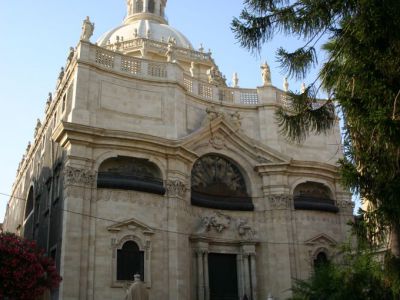
The Church of the Abbey of Saint Agatha (Badia di Sant'Agata), a masterpiece of 18th-century Baroque architecture, stands prominently in Catania, Italy, across the street from the left transept of the city’s cathedral. This Roman Catholic church, part of a female Benedictine convent, is dedicated to Saint Agatha, the patron saint of Catania, and embodies a rich history intertwined with resilience and devotion.
The nunnery was originally founded in 1620 under the Benedictine rule. However, the devastating 1693 earthquake destroyed the convent, claiming the lives of 15 of its 28 nuns. Reconstruction efforts began modestly with cloisters and a perimeter fence, but the ambitious rebuilding of the church itself only commenced in 1736 under the architect Giovanni Battista Vaccarini. His design incorporated a surviving 17th-century portal by Giovanni Maria Amato, preserving a tangible link to the pre-earthquake structure.
The church’s façade, completed by 1742, exudes Baroque elegance, while the octagonal dome, finished in 1768, offers panoramic views of Catania and the imposing Mount Etna. The elongated octagonal interior features a harmonious blend of white marble flooring and yellow Castronovo marble, handpicked by the architect Nicolò Daniele. A metal grill behind the main altar enables the cloistered nuns to observe mass discreetly, while a glass chandelier hangs beneath the dome, adding a touch of grandeur.
The side altars house stucco statues crafted in 1782 by Giovanni Battista Marino, Mario Biondo, and Giovanni Battista Amato, depicting Saint Benedict, the Immaculate Conception, Saint Joseph, and Saint Euplio. The centerpiece of the main altar is a striking statue of Saint Agatha, a fitting tribute to the saint to whom the church is dedicated.
The church was consecrated in 1796, marking its completion as a spiritual and architectural triumph. Over the centuries, the structure endured additional challenges, including earthquake damage in 1990. A comprehensive restoration completed in 2012 ensured its preservation for future generations.
The nunnery was originally founded in 1620 under the Benedictine rule. However, the devastating 1693 earthquake destroyed the convent, claiming the lives of 15 of its 28 nuns. Reconstruction efforts began modestly with cloisters and a perimeter fence, but the ambitious rebuilding of the church itself only commenced in 1736 under the architect Giovanni Battista Vaccarini. His design incorporated a surviving 17th-century portal by Giovanni Maria Amato, preserving a tangible link to the pre-earthquake structure.
The church’s façade, completed by 1742, exudes Baroque elegance, while the octagonal dome, finished in 1768, offers panoramic views of Catania and the imposing Mount Etna. The elongated octagonal interior features a harmonious blend of white marble flooring and yellow Castronovo marble, handpicked by the architect Nicolò Daniele. A metal grill behind the main altar enables the cloistered nuns to observe mass discreetly, while a glass chandelier hangs beneath the dome, adding a touch of grandeur.
The side altars house stucco statues crafted in 1782 by Giovanni Battista Marino, Mario Biondo, and Giovanni Battista Amato, depicting Saint Benedict, the Immaculate Conception, Saint Joseph, and Saint Euplio. The centerpiece of the main altar is a striking statue of Saint Agatha, a fitting tribute to the saint to whom the church is dedicated.
The church was consecrated in 1796, marking its completion as a spiritual and architectural triumph. Over the centuries, the structure endured additional challenges, including earthquake damage in 1990. A comprehensive restoration completed in 2012 ensured its preservation for future generations.
6) Palazzo Biscari (Biscari Palace) (must see)
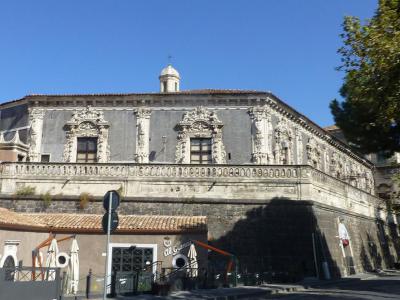
After the devastating earthquake of 1693, Ignazio Paterno Castello, 3rd prince of Biscari, felt the need to build his palace. Construction began in 1702. In 1763 the project was completed by the fifth prince of Biscari. The grand opening was marked by extravagant celebrations.
The palace is on the Museo Biscari Street in Catania. Although some members of the family Biscari still reside there, the palace is open to guided tours and cultural events. The facade on the Biscari Palace is in mild disrepair. The visitors entrance is a stone portal. It is adorned with cartouches and the coat of arms of Biscari.
After the the main entrance is a large courtyard with an outdoor entrance staircase. The interior of the palace is Rococo. There are frescoes and decorations in stucco. In the great octagonal ballroom there are mirrors, frescoes and stucco decorations painted by Matteo Desiderato and Sebastian Lo Monaco. A dome balcony can hold an orchestra.
The rooms are large and they have names. The "Fief Room" has large paintings of Biscari feudal fiefdoms. The "Princess Apartment", made for the wife of Ignazio V, is paved with salvaged Roman marble. There is a "Birds Gallery" and a "Don Quixote Room". There is the aforementioned ballroom and a museum for the collections of Ignazio V.
The palace is on the Museo Biscari Street in Catania. Although some members of the family Biscari still reside there, the palace is open to guided tours and cultural events. The facade on the Biscari Palace is in mild disrepair. The visitors entrance is a stone portal. It is adorned with cartouches and the coat of arms of Biscari.
After the the main entrance is a large courtyard with an outdoor entrance staircase. The interior of the palace is Rococo. There are frescoes and decorations in stucco. In the great octagonal ballroom there are mirrors, frescoes and stucco decorations painted by Matteo Desiderato and Sebastian Lo Monaco. A dome balcony can hold an orchestra.
The rooms are large and they have names. The "Fief Room" has large paintings of Biscari feudal fiefdoms. The "Princess Apartment", made for the wife of Ignazio V, is paved with salvaged Roman marble. There is a "Birds Gallery" and a "Don Quixote Room". There is the aforementioned ballroom and a museum for the collections of Ignazio V.
7) Via Etnea (Etnea Street)
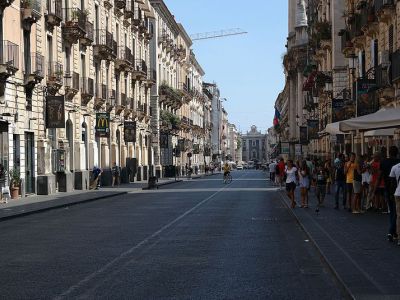
Etnea Street is Catania's main Street. It extends three miles from the Cathedral Square all the way to the park Tondo Gioeni at the edge of town. The street dates from Roman times but the current Etnea Street came about after the earthquake of 1693.
The buildings along the route were mostly leveled in the earthquake. They were replaced with Baroque style buildings designed by Giovanni Battista Vaccarini and Francesco Battaglia. The street today is pedestrianized to a large extent. The sidewalks are made wholly of lava stone, courtesy of Mount Etna.
Among the buildings along the road is the palace of Gioeni Asmundo in the University square. The San Demetrio Palace and Toscano Palace are both in the Stesicore Square with the Vincenzo Bellini monument. The Post Office Building still serves as a post office. Last is the Villa Bellini, the garden of Catania.
Etnea Street is also shopping street. As you walk along you notice the ground floors of these fine Baroque buildings are shops. The shops seem to alternate among restaurants, cafes and bars. A lot of tasting goes on here. Pasta alla Norma, arancini and cannoli and many other traditional dishes await the hungry stroller.
The buildings along the route were mostly leveled in the earthquake. They were replaced with Baroque style buildings designed by Giovanni Battista Vaccarini and Francesco Battaglia. The street today is pedestrianized to a large extent. The sidewalks are made wholly of lava stone, courtesy of Mount Etna.
Among the buildings along the road is the palace of Gioeni Asmundo in the University square. The San Demetrio Palace and Toscano Palace are both in the Stesicore Square with the Vincenzo Bellini monument. The Post Office Building still serves as a post office. Last is the Villa Bellini, the garden of Catania.
Etnea Street is also shopping street. As you walk along you notice the ground floors of these fine Baroque buildings are shops. The shops seem to alternate among restaurants, cafes and bars. A lot of tasting goes on here. Pasta alla Norma, arancini and cannoli and many other traditional dishes await the hungry stroller.
8) Giardino Bellini (Bellini Garden) (must see)
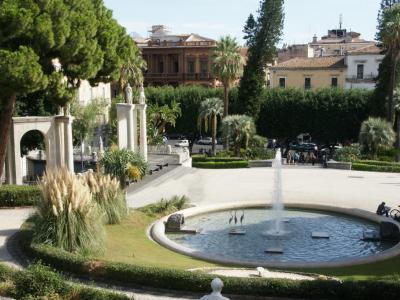
Bellini Garden is the most popular garden in which to go for a walk among locals. It is dedicated to the famous Italian composer born in Catania, V. Bellini.
Before the construction of a public garden, the area was occupied by the garden maze or labyrinth owned by the Ignazio Paternò Castello, prince of Biscari. In 1854, the Municipality of Catania bought the area of the maze, and in 1864 started to adapt the area into a public garden.
Starting from 1875, the municipality acquired several further areas surrounding the maze, and two years later the work to unify these areas was undertaken. The Bellini Garden was inaugurated in 1883.
Inside, the villa is equipped with numerous architectural features such as ponds, fountains, statues and busts of many distinguished people from Catania.
Before the construction of a public garden, the area was occupied by the garden maze or labyrinth owned by the Ignazio Paternò Castello, prince of Biscari. In 1854, the Municipality of Catania bought the area of the maze, and in 1864 started to adapt the area into a public garden.
Starting from 1875, the municipality acquired several further areas surrounding the maze, and two years later the work to unify these areas was undertaken. The Bellini Garden was inaugurated in 1883.
Inside, the villa is equipped with numerous architectural features such as ponds, fountains, statues and busts of many distinguished people from Catania.
9) Monastery of St. Nicholas Arena (must see)
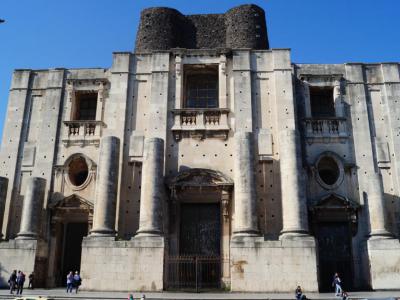
Formerly a Benedictine establishment, the monastery is located at Dante Square in Catania. It is part of Val di Noto Works Heritage Site. There are no monks to be found on the premises but the humanities department of the University of Catania has found a home here.
The monastery was founded in 1558 and dedicated to San Nicolo "l'Arena." The monastery is in the center of town. It stands beside the Church of San Nicolo l'Arena. After the 1669 eruption of Mount Etna and the 1693 earthquake, the monastery was level with the ground.
Rebuilding commenced in 1702 and continued until the monastery was confiscated by the government in 1866. The current monastery rests on top of the original one (what was left of it). It has a new cloister and area designed by Giovanni Battista Vaccarini.
The original monastery used a square floor plan. A cloister in the center was called the "marble" cloister. It had a marble colonnade and a clover shaped fountain with refined renaissance decorations. In 1693 all this was destroyed.
The "Marble" cloister was rebuilt with late baroque decorations. The Eastern Cloister was a new addition. A new area on the North side was also added.
Giancarlo De Carlo, architect, has said, "...the old meanings have been substituted by a new one that allows the old architecture get a new structure and an important role for the contemporary world."
The monastery was founded in 1558 and dedicated to San Nicolo "l'Arena." The monastery is in the center of town. It stands beside the Church of San Nicolo l'Arena. After the 1669 eruption of Mount Etna and the 1693 earthquake, the monastery was level with the ground.
Rebuilding commenced in 1702 and continued until the monastery was confiscated by the government in 1866. The current monastery rests on top of the original one (what was left of it). It has a new cloister and area designed by Giovanni Battista Vaccarini.
The original monastery used a square floor plan. A cloister in the center was called the "marble" cloister. It had a marble colonnade and a clover shaped fountain with refined renaissance decorations. In 1693 all this was destroyed.
The "Marble" cloister was rebuilt with late baroque decorations. The Eastern Cloister was a new addition. A new area on the North side was also added.
Giancarlo De Carlo, architect, has said, "...the old meanings have been substituted by a new one that allows the old architecture get a new structure and an important role for the contemporary world."
10) Chiesa San Benedetto (Church of St. Benedict)
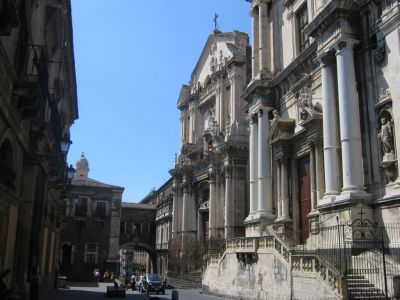
In 1334 the Church of Saint Benedict of Nursia was completed. In 1693, like most of Catania, the church was destroyed by the great earthquake. Only five nuns lived to tell the tale. In 1714 the church was rebuilt but the monastery was not finished until 1763. Rebuilding was mainly the the work of architect Giovanni Battista Vaccarini.
The facade has pilasters and several statues. The pediment of the tympanum has two feminine figures representing Fortitude and Temperence. Above the entrance is a statue of the Virgin Mary. The wooden main door has panels showing scenes from the life of Saint Benedict. The marble Angel Staircase has angels and railings of wrought iron.
The interior has one nave. It is lushly adorned with stucco and frescoes on the walls, vault and semi-dome. Artists include Matteo Desiderato and Giovanni Tuccari. Pictures of the life of Saint Benedict are everywhere in scenes both lively and cheerful. The main altar is of polychrome marble with panels of bronze.
The facade has pilasters and several statues. The pediment of the tympanum has two feminine figures representing Fortitude and Temperence. Above the entrance is a statue of the Virgin Mary. The wooden main door has panels showing scenes from the life of Saint Benedict. The marble Angel Staircase has angels and railings of wrought iron.
The interior has one nave. It is lushly adorned with stucco and frescoes on the walls, vault and semi-dome. Artists include Matteo Desiderato and Giovanni Tuccari. Pictures of the life of Saint Benedict are everywhere in scenes both lively and cheerful. The main altar is of polychrome marble with panels of bronze.
11) Roman Theater of Catania (must see)
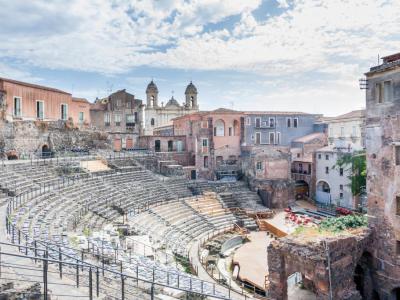
The Roman Theater of Catania is actually two open air semicircular theaters. The site is bordered by San Francesco Square, Vittorio Emanuele Street and Teatro Greco Street in central Catania. The large theater and the smaller one, called the Odeon, are part of Graeco-Roman Archaeological Park of Catania.
The theater was built in the 2nd century AD. It was not completely excavated until the 19th century. Seats rise up a hillside facing the sea. The orchestra and stage have a diameter of 84 feet. The cavea (seating) section has a depth of 322 feet. Twenty-one rows of seats could hold up to 7,000 spactators. Exits were below the seats.
After the fifth century AD the theater and Odeon were no longer used. Digging on the site began in the 18th century during the rule of Ignazio Paterno Castello, the Prince of Biscari.
Finally, in 1959 the site was cleared of houses that were encroaching on the area and the theater and the Odeon were exposed. Artifacts removed from the dig are displayed nearby in the Pandolfo House and Liberti House.
The theater was built in the 2nd century AD. It was not completely excavated until the 19th century. Seats rise up a hillside facing the sea. The orchestra and stage have a diameter of 84 feet. The cavea (seating) section has a depth of 322 feet. Twenty-one rows of seats could hold up to 7,000 spactators. Exits were below the seats.
After the fifth century AD the theater and Odeon were no longer used. Digging on the site began in the 18th century during the rule of Ignazio Paterno Castello, the Prince of Biscari.
Finally, in 1959 the site was cleared of houses that were encroaching on the area and the theater and the Odeon were exposed. Artifacts removed from the dig are displayed nearby in the Pandolfo House and Liberti House.
12) Catania Beaches
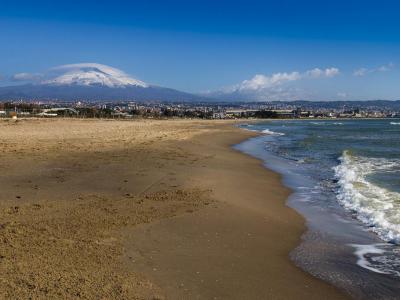
Catania, perched on Sicily's eastern coast, offers more than just awe-inspiring views of Mount Etna and historic landmarks-it boasts some of the region’s most beautiful beaches. Whether you’re a fan of golden sands, volcanic coastlines, or tranquil seaside escapes, Catania’s beaches cater to every taste, making it a top destination for sunseekers and nature lovers alike.
Located just a short distance from Catania’s city center, La Playa is the city’s most iconic beach. Its long stretch of fine sand and calm, turquoise waters create a lively atmosphere perfect for families and friends. The beach is lined with clubs offering sun loungers, umbrellas, and restaurants, making it easy to spend an entire day relaxing or enjoying activities like beach volleyball, water sports, or boat trips.
For a unique twist, visit San Giovanni Li Cuti, Catania’s stunning black pebble beach. This smaller, volcanic gem offers a tranquil escape from the city’s buzz. With its striking natural beauty, San Giovanni Li Cuti is ideal for a peaceful day by the sea, where the black stones contrast dramatically with the deep blue Ionian waters.
A short trip away, the picturesque village of Santa Maria La Scala along the Riviera dei Ciclopi offers rocky beaches framed by traditional Sicilian architecture. The vibrant stonework and scenic coastal paths provide a serene backdrop for sunbathing and swimming. Don’t miss exploring nearby attractions like the Acitrezza area, famous for its ancient volcanic formations.
For those seeking unspoiled beauty, Marina di Cottone delivers with its mix of sandy and pebbly shores set within a protected nature reserve. Surrounded by lush greenery, this beach is perfect for birdwatching, hiking, or simply unwinding in the serene atmosphere. The lack of commercial development makes it a hidden gem for those seeking peace and a deeper connection with nature.
Thanks to Sicily’s mild Mediterranean climate, the beach season extends from May to October, with summer months being particularly ideal. Public transportation and easy access to nearby resorts make exploring these coastal treasures a breeze.
Catania’s beaches blend natural beauty with cultural charm, offering something for everyone-whether it’s lively beach clubs, volcanic landscapes, or serene nature reserves.
Located just a short distance from Catania’s city center, La Playa is the city’s most iconic beach. Its long stretch of fine sand and calm, turquoise waters create a lively atmosphere perfect for families and friends. The beach is lined with clubs offering sun loungers, umbrellas, and restaurants, making it easy to spend an entire day relaxing or enjoying activities like beach volleyball, water sports, or boat trips.
For a unique twist, visit San Giovanni Li Cuti, Catania’s stunning black pebble beach. This smaller, volcanic gem offers a tranquil escape from the city’s buzz. With its striking natural beauty, San Giovanni Li Cuti is ideal for a peaceful day by the sea, where the black stones contrast dramatically with the deep blue Ionian waters.
A short trip away, the picturesque village of Santa Maria La Scala along the Riviera dei Ciclopi offers rocky beaches framed by traditional Sicilian architecture. The vibrant stonework and scenic coastal paths provide a serene backdrop for sunbathing and swimming. Don’t miss exploring nearby attractions like the Acitrezza area, famous for its ancient volcanic formations.
For those seeking unspoiled beauty, Marina di Cottone delivers with its mix of sandy and pebbly shores set within a protected nature reserve. Surrounded by lush greenery, this beach is perfect for birdwatching, hiking, or simply unwinding in the serene atmosphere. The lack of commercial development makes it a hidden gem for those seeking peace and a deeper connection with nature.
Thanks to Sicily’s mild Mediterranean climate, the beach season extends from May to October, with summer months being particularly ideal. Public transportation and easy access to nearby resorts make exploring these coastal treasures a breeze.
Catania’s beaches blend natural beauty with cultural charm, offering something for everyone-whether it’s lively beach clubs, volcanic landscapes, or serene nature reserves.
