Custom Walk in Athens, Greece by allaurena_22abb created on 2025-06-21
Guide Location: Greece » Athens
Guide Type: Custom Walk
# of Sights: 8
Tour Duration: 1 Hour(s)
Travel Distance: 2.2 Km or 1.4 Miles
Share Key: GVVE4
Guide Type: Custom Walk
# of Sights: 8
Tour Duration: 1 Hour(s)
Travel Distance: 2.2 Km or 1.4 Miles
Share Key: GVVE4
How It Works
Please retrieve this walk in the GPSmyCity app. Once done, the app will guide you from one tour stop to the next as if you had a personal tour guide. If you created the walk on this website or come to the page via a link, please follow the instructions below to retrieve the walk in the app.
Retrieve This Walk in App
Step 1. Download the app "GPSmyCity: Walks in 1K+ Cities" on Apple App Store or Google Play Store.



Step 2. In the GPSmyCity app, download(or launch) the guide "Athens Map and Walking Tours".
Step 3. Tap the menu button located at upper right corner of the "Walks" screen and select "Retrieve custom walk". Enter the share key: GVVE4
1) Central Municipal Market (Varvakeios Agora)
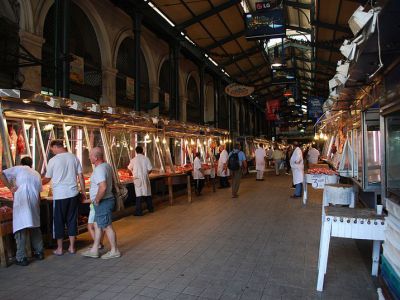
If you're in need of a break from exploring Athens' historical sites, looking to save on dining expenses, or simply curious about the city's culinary scene, a visit to the busy Central Market along Athinas street is a must. Offering a sensory overload of exotic sights, smells and colors, it is simply an ideal location for capturing authentic snapshots of daily life.
On one side of the market, you'll encounter open-air stalls brimming with fresh fruits and vegetables, while tucked away at the rear are a few shops specializing in Eastern European foods. Across the street, the vast neoclassical covered market, constructed in the late 19th century and renovated in 1996, houses the meat market adjacent to the fish market. Here, you'll witness a surreal juxtaposition of suspended carcasses and glistening fish artfully displayed on marble counters. Head towards the north end of the market, to the right on Sofokleous street, to discover shops offering the finest selection of cheese, olives, halvah, bread, spices, and cold cuts, including 'pastourma' (spicy cured beef), available in Athens.
Finally, you may treat yourself to a freshly-cooked meal at one of the first-come, first-served grill areas, where you must try the grilled calamari. Additionally, consider visiting these two standout spots:
EPIRUS TAVERN ("Oinomageireio Epirus"; Filopimenos 4; Mon-Sat: 6 am–6:30 pm)
With a pleasant and laid-back atmosphere, you'll find a warm and hospitable team of staff and owners. This eatery serves up classic dishes that evoke the comforting flavors of your grandma's recipes, all expertly prepared and served in generously large portions. Try the tripe soup or goat soup for a more adventurous palate or stick to chicken soup or vegan options if you prefer.
KRINOS ("Κρίνος"; Aiolou 87; Mon-Sat: 8:30 am–8:30 pm)
Great spot for enjoying a snack of delicious "loukoumades", or Greek doughnuts, deep-fried to a perfect crispy brown, then drizzled with honey syrup and dusted with a sprinkle of cinnamon. For an extra burst of flavor, don't hesitate to request a serving of soft ice-cream, available in vanilla, chocolate, or a combination of both!
Tip:
While the market operates from early morning until late in the afternoon (Monday through Saturday), it's advisable to do your shopping here first before heading to dine at EPIRUS or KRINOS, as many market stalls and nearby shops start closing up around 3 pm.
On one side of the market, you'll encounter open-air stalls brimming with fresh fruits and vegetables, while tucked away at the rear are a few shops specializing in Eastern European foods. Across the street, the vast neoclassical covered market, constructed in the late 19th century and renovated in 1996, houses the meat market adjacent to the fish market. Here, you'll witness a surreal juxtaposition of suspended carcasses and glistening fish artfully displayed on marble counters. Head towards the north end of the market, to the right on Sofokleous street, to discover shops offering the finest selection of cheese, olives, halvah, bread, spices, and cold cuts, including 'pastourma' (spicy cured beef), available in Athens.
Finally, you may treat yourself to a freshly-cooked meal at one of the first-come, first-served grill areas, where you must try the grilled calamari. Additionally, consider visiting these two standout spots:
EPIRUS TAVERN ("Oinomageireio Epirus"; Filopimenos 4; Mon-Sat: 6 am–6:30 pm)
With a pleasant and laid-back atmosphere, you'll find a warm and hospitable team of staff and owners. This eatery serves up classic dishes that evoke the comforting flavors of your grandma's recipes, all expertly prepared and served in generously large portions. Try the tripe soup or goat soup for a more adventurous palate or stick to chicken soup or vegan options if you prefer.
KRINOS ("Κρίνος"; Aiolou 87; Mon-Sat: 8:30 am–8:30 pm)
Great spot for enjoying a snack of delicious "loukoumades", or Greek doughnuts, deep-fried to a perfect crispy brown, then drizzled with honey syrup and dusted with a sprinkle of cinnamon. For an extra burst of flavor, don't hesitate to request a serving of soft ice-cream, available in vanilla, chocolate, or a combination of both!
Tip:
While the market operates from early morning until late in the afternoon (Monday through Saturday), it's advisable to do your shopping here first before heading to dine at EPIRUS or KRINOS, as many market stalls and nearby shops start closing up around 3 pm.
2) Psirri / Agion Anargyron street
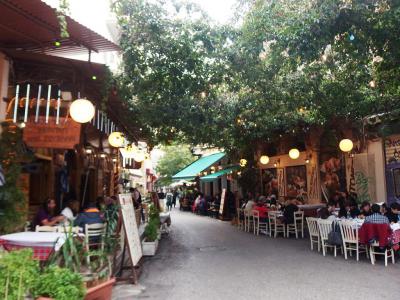
Psirri is a happening arty and bohemian neighborhood nestled between Athinas shopping area, Monastiraki and Agion Asomaton squares. Once working-class-industrial district turned scaled-down version of NYC Soho mixed up with the East Village, today's Psirri is an entertainment mecca renowned for its cool, relaxed vibe, but just as importantly for its vibrant food scene manifested in the myriad of small newly-opened cafes coexisting harmoniously with the unpretentious 50-year-old taverns, ouzerie-mezedopouleon-style eateries (Greek versions of tapas bars, reminiscent of 1960s luncheonettes) tucked away in the winding streets and smaller alleyways.
Situated right next to the picturesque yet overwhelmingly touristy Plaka district, Psirri charges just a fraction of its prices, for which it is much loved by the local students and other hip, young and restless flocking here in droves for affordable entertainment. Overall, the area resembles a theatrical show, where each person is an actor, seemingly casual while fully, if not say – happily, dedicated to their part. To share the mood of the crowd and to follow their rhythm, it is best to park yourself at one of the tables and chairs outside the many bars and coffee shops and enjoy some of their freshly made delights, heavenly delicious, served in generous portions.
As you head toward Plateia Iroon via Agíon Anargýron street, you'll pass through a relatively tranquil zone dotted with small cafes, all offering free Wi-Fi, ideal for a quiet breakfast or a leisurely moment to catch up on news and emails. The farther you go up the street, the closer you get to the main drag, and the louder and higher-key it becomes.
Down the road, you'll come across NIKITAS, likely the oldest taverna in the neighborhood, founded in 1967. They offer a short yet sweet menu, along with daily specials such as oven-baked cheese pie. Drink options are limited to beer or ouzo, and there are no desserts, but it's unbeatable in terms of value, especially when you're seated outdoors under the trees next to the Agíon Anargýron church.
At the very end of Anargýron street, you'll bump into another popular location – PAME PSIRRI restaurant, renowned for its live laika and rembetika performances, as well as its good portions of delicious food, particularly the meat dishes.
Situated right next to the picturesque yet overwhelmingly touristy Plaka district, Psirri charges just a fraction of its prices, for which it is much loved by the local students and other hip, young and restless flocking here in droves for affordable entertainment. Overall, the area resembles a theatrical show, where each person is an actor, seemingly casual while fully, if not say – happily, dedicated to their part. To share the mood of the crowd and to follow their rhythm, it is best to park yourself at one of the tables and chairs outside the many bars and coffee shops and enjoy some of their freshly made delights, heavenly delicious, served in generous portions.
As you head toward Plateia Iroon via Agíon Anargýron street, you'll pass through a relatively tranquil zone dotted with small cafes, all offering free Wi-Fi, ideal for a quiet breakfast or a leisurely moment to catch up on news and emails. The farther you go up the street, the closer you get to the main drag, and the louder and higher-key it becomes.
Down the road, you'll come across NIKITAS, likely the oldest taverna in the neighborhood, founded in 1967. They offer a short yet sweet menu, along with daily specials such as oven-baked cheese pie. Drink options are limited to beer or ouzo, and there are no desserts, but it's unbeatable in terms of value, especially when you're seated outdoors under the trees next to the Agíon Anargýron church.
At the very end of Anargýron street, you'll bump into another popular location – PAME PSIRRI restaurant, renowned for its live laika and rembetika performances, as well as its good portions of delicious food, particularly the meat dishes.
3) Monastiraki Square (must see)
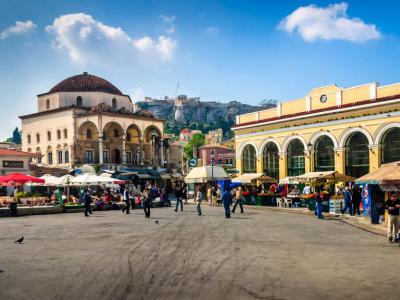
Monastiraki Square is a major gathering spot for locals and tourists in Athens. As such, it is well worth a visit, if only for a few minutes, just to soak up the lively and often festive atmosphere, which is as Greek as it gets. You can also indulge in some local street snacks like "koulouri", a bagel-like roll sprinkled with sesame seeds.
Monastiraki Square is renowned for its striking juxtaposition of architectural styles. Visitors are greeted by the iconic clock tower of the Ottoman-era Tzistarakis Mosque, which stands alongside the remnants of the ancient Agora and the ruins of the Hadrian’s Library. This eclectic mix of historical landmarks reflects the square’s evolution through various periods, from ancient Greece to Roman, Byzantine, and Ottoman times.
The vibrant flea market offers everything from antiques and souvenirs to contemporary fashion. On weekends, the square comes alive with an energetic atmosphere, showcasing traditional Greek music, street performances, and a lively exchange of local culture. And if that's not enough, the surrounding streets are dotted with shops, taverns, bistros, cafes, and tea houses, luring visitors with a chance for a pleasant break.
Monastiraki Square is renowned for its striking juxtaposition of architectural styles. Visitors are greeted by the iconic clock tower of the Ottoman-era Tzistarakis Mosque, which stands alongside the remnants of the ancient Agora and the ruins of the Hadrian’s Library. This eclectic mix of historical landmarks reflects the square’s evolution through various periods, from ancient Greece to Roman, Byzantine, and Ottoman times.
The vibrant flea market offers everything from antiques and souvenirs to contemporary fashion. On weekends, the square comes alive with an energetic atmosphere, showcasing traditional Greek music, street performances, and a lively exchange of local culture. And if that's not enough, the surrounding streets are dotted with shops, taverns, bistros, cafes, and tea houses, luring visitors with a chance for a pleasant break.
4) Monastiraki Flea Market
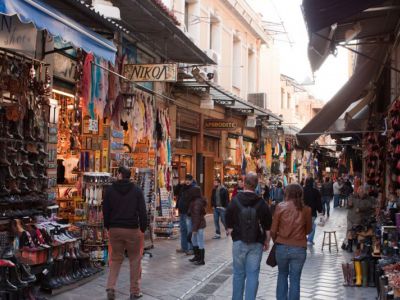
One of the most captivating and vibrant places you must explore during your stay in Athens is the Flea Market in Monastiraki. Stretching from Monastiraki Square and extending to Thissio and Psiri, this lively market hub is most bustling around Avissinias Square, where the heart of the flea market thrives. It primarily consists of quaint antique shops, though you'll also encounter street vendors, particularly along Andrianou Street and near the Thissio metro station.
At the flea market, you'll come across a diverse array of items, from quirky knick-knacks to second-hand books and clothing, vintage magazines, newspapers, and photographs, as well as valuable antiques and retro furniture. The flea market truly offers it all, and prices are always open for negotiation, so don't hesitate to haggle.
In addition to the shops, you'll discover cafes, cozy Greek taverns, and Asian restaurants. Keep in mind that some of the alleys and passageways lead to enchanting hidden gardens or terraces with fantastic views. Last but not least, consider the flea market an excellent and unique source for purchasing souvenirs from Greece. You'll find a wide variety of distinctive items that go beyond the ordinary souvenir offerings.
Tip:
For the liveliest flea market experience, try visiting on a Sunday morning when the large open-air market, known as "Yussuroum" by locals, is set up.
At the flea market, you'll come across a diverse array of items, from quirky knick-knacks to second-hand books and clothing, vintage magazines, newspapers, and photographs, as well as valuable antiques and retro furniture. The flea market truly offers it all, and prices are always open for negotiation, so don't hesitate to haggle.
In addition to the shops, you'll discover cafes, cozy Greek taverns, and Asian restaurants. Keep in mind that some of the alleys and passageways lead to enchanting hidden gardens or terraces with fantastic views. Last but not least, consider the flea market an excellent and unique source for purchasing souvenirs from Greece. You'll find a wide variety of distinctive items that go beyond the ordinary souvenir offerings.
Tip:
For the liveliest flea market experience, try visiting on a Sunday morning when the large open-air market, known as "Yussuroum" by locals, is set up.
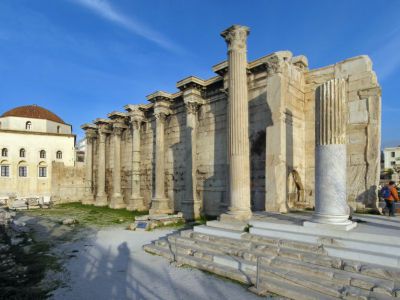
5) Hadrian's Library
While not much remains of this Roman-era library today, back in the 2nd century AD, it was the place to be. Imagine a massive cloistered courtyard, a hundred grand columns, and enough space to make even the most extravagant book hoarder jealous. And who do we have to thank for this intellectual paradise?-Emperor Hadrian, the ultimate fanboy of Greek culture. In fact, he was so enamored with it, that they nicknamed him “Graecula” (which means “Little Greek”).
He decked out this sprawling complex with art galleries, lecture halls, and a magnificent public space-because why stop at books when you can have everything? His reign ushered in a golden age of peace and prosperity, giving arts and culture a serious upgrade across the empire.
In its prime, the library housed precious papyrus scrolls and exquisite artworks-until the barbaric Herules (from modern-day Germany) came knocking (not for a book club meeting, unfortunately). After their invasion, a Roman official named Herculius took on restoration duties, but history had more plans for the ruins. Over time, they became the foundations for not one, not two, but three different churches-a Byzantine one in the 5th century, another in the 7th, and a cathedral in the 12th. That's what they call re-purposing real estate!
These days, the site is finally open to the public, though excavation is still ongoing. A few original Corinthian columns have survived the centuries, hinting at the library’s former grandeur. And here’s a fun twist: the remains of the Tetraconch Church, smack in the middle of the ruins, were built entirely inside the library’s old courtyard.
Tip:
Your Acropolis ticket covers entry, so if you’re in the area, it’s a no-brainer to check it out. Or, if you’re feeling more mysterious, just walk along the perimeter fence and steal a few glances through the gaps-because who doesn’t love a little architectural intrigue?
He decked out this sprawling complex with art galleries, lecture halls, and a magnificent public space-because why stop at books when you can have everything? His reign ushered in a golden age of peace and prosperity, giving arts and culture a serious upgrade across the empire.
In its prime, the library housed precious papyrus scrolls and exquisite artworks-until the barbaric Herules (from modern-day Germany) came knocking (not for a book club meeting, unfortunately). After their invasion, a Roman official named Herculius took on restoration duties, but history had more plans for the ruins. Over time, they became the foundations for not one, not two, but three different churches-a Byzantine one in the 5th century, another in the 7th, and a cathedral in the 12th. That's what they call re-purposing real estate!
These days, the site is finally open to the public, though excavation is still ongoing. A few original Corinthian columns have survived the centuries, hinting at the library’s former grandeur. And here’s a fun twist: the remains of the Tetraconch Church, smack in the middle of the ruins, were built entirely inside the library’s old courtyard.
Tip:
Your Acropolis ticket covers entry, so if you’re in the area, it’s a no-brainer to check it out. Or, if you’re feeling more mysterious, just walk along the perimeter fence and steal a few glances through the gaps-because who doesn’t love a little architectural intrigue?
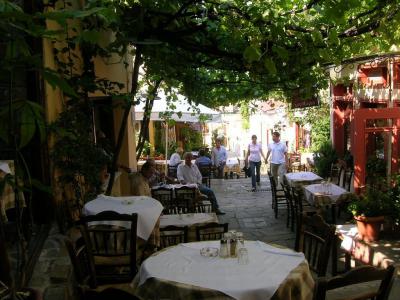
6) Anafiotika and Plaka Stairs (must see)
Nestled in the shadow of the Acropolis and frequently likened to the charming whitewashed villages of the rural Greek islands, Anafiotika is one of Athens' most delightful and idiosyncratic neighborhoods. Situated in the capital's Plaka district, it is poetically described as a "breeze of the Aegean" in the heart of the city, and as such exudes a unique character and ambiance.
Originally settled by the descendants of Anafi stonemasons, who arrived in the 19th century to work in the expanding capital, Anafiotika has retained much of its original charm. The area features simple stone houses, some of which are built directly into the bedrock. Many of them remain unchanged while others have undergone restoration over the years.
The cascades of vibrant bougainvillea and pots of geraniums and marigolds adorn the balconies and rooftops, adding to the prevailing tranquility that contrasts the bustle and noise of modern Athens. Back in antiquity, this area was abandoned because the Delphic Oracle claimed it as a sacred ground. Later, during Ottoman rule, locals ingeniously constructed their homes overnight, taking advantage of the law that granted ownership of the property if it were erected between sunset and sunrise.
Recently renovated, the Plaka Stairs neighborhood abounds in small eateries and bars scattered on the slopes of the Acropolis, particularly along Mnisikleous pedestrian street and its vicinity. Due to the hilly landscape, this street is designed in the form of steps, lined with cafes and restaurants on both sides. Creative and often compact seating arrangements along the steps create a lively atmosphere filled with music and the cheerful voices of the passers-by. This unique dining experience is guaranteed from early lunchtime until the evening.
Tip:
For those seeking a lovely spot for dinner and drinks, the Anafiotika Cafe Restaurant, located on the narrow Plaka Steps, offers a spacious patio area and a rooftop terrace that is perfect for catching the sunset.
Originally settled by the descendants of Anafi stonemasons, who arrived in the 19th century to work in the expanding capital, Anafiotika has retained much of its original charm. The area features simple stone houses, some of which are built directly into the bedrock. Many of them remain unchanged while others have undergone restoration over the years.
The cascades of vibrant bougainvillea and pots of geraniums and marigolds adorn the balconies and rooftops, adding to the prevailing tranquility that contrasts the bustle and noise of modern Athens. Back in antiquity, this area was abandoned because the Delphic Oracle claimed it as a sacred ground. Later, during Ottoman rule, locals ingeniously constructed their homes overnight, taking advantage of the law that granted ownership of the property if it were erected between sunset and sunrise.
Recently renovated, the Plaka Stairs neighborhood abounds in small eateries and bars scattered on the slopes of the Acropolis, particularly along Mnisikleous pedestrian street and its vicinity. Due to the hilly landscape, this street is designed in the form of steps, lined with cafes and restaurants on both sides. Creative and often compact seating arrangements along the steps create a lively atmosphere filled with music and the cheerful voices of the passers-by. This unique dining experience is guaranteed from early lunchtime until the evening.
Tip:
For those seeking a lovely spot for dinner and drinks, the Anafiotika Cafe Restaurant, located on the narrow Plaka Steps, offers a spacious patio area and a rooftop terrace that is perfect for catching the sunset.
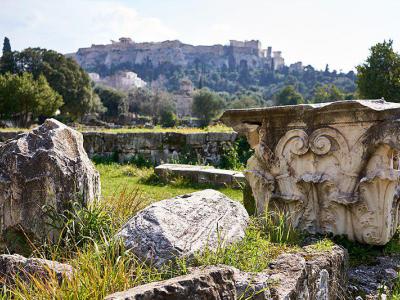
7) Ancient Agora of Athens (must see)
The ancient Agora of Athens sits beneath the revered hill of the Acropolis. This sprawling site contains the remnants of what was once a vast and intricate marketplace complex. In ancient times, the Agora served as the beating heart of public life in the city-state of Athens. Numerous administrative buildings, temples, altars, and roofed shopping arcades known as 'stoas', as well as fountains were constructed around the open square, which took its final shape in the 2nd century AD. Common citizens would gather here to engage in political discussions and participate in the voting process for proposed laws. It was within the Agora council buildings, law courts, and streets that democracy took root and thrived.
In 507 BC, Athenian leader Cleisthenes introduced a system of political reforms which he termed "demokratia", or the "rule of the people". This consisted of three distinct institutions, such as the "ekklesia", a sovereign governing body responsible for drafting laws and shaping foreign policy; the "boule", a council of representatives from the ten Athenian tribes; and the "dikasteria" – popular courts where citizens presented cases to a panel of randomly selected jurors. Although Athenian democracy lasted only two centuries, it stands as one of ancient Greece's most enduring legacies to the modern world.
Beyond its role as the city's political center, the Agora also served as a venue for religious ceremonies, commercial transactions, theatrical and musical shows, and even athletic competitions. The city mint producing Athens' silver currency was here, just as the state prison in which philosopher Socrates was executed in 399 BC.
Tips:
Admission to the on-site museum is included in the Agora ticket. Water fountains and restrooms are conveniently located nearby.
The site also features a well-marked ancient temple complete with the remains of the ancient drainage system.
In 507 BC, Athenian leader Cleisthenes introduced a system of political reforms which he termed "demokratia", or the "rule of the people". This consisted of three distinct institutions, such as the "ekklesia", a sovereign governing body responsible for drafting laws and shaping foreign policy; the "boule", a council of representatives from the ten Athenian tribes; and the "dikasteria" – popular courts where citizens presented cases to a panel of randomly selected jurors. Although Athenian democracy lasted only two centuries, it stands as one of ancient Greece's most enduring legacies to the modern world.
Beyond its role as the city's political center, the Agora also served as a venue for religious ceremonies, commercial transactions, theatrical and musical shows, and even athletic competitions. The city mint producing Athens' silver currency was here, just as the state prison in which philosopher Socrates was executed in 399 BC.
Tips:
Admission to the on-site museum is included in the Agora ticket. Water fountains and restrooms are conveniently located nearby.
The site also features a well-marked ancient temple complete with the remains of the ancient drainage system.
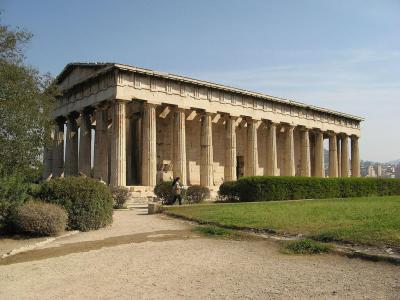
8) Temple of Hephaestus (must see)
The Temple of Hephaestus is arguably the best-kept piece of real estate in ancient Athens. While other temples crumbled under time, earthquakes, and general neglect, this one decided to stick around, much like a friend who refuses to leave a party.
Dedicated to Hephaestus, the god of fire, metalworking, and crafting all things indestructible (including the Olympian gods’ celestial mansions), this temple sits proudly on Agoraios Kolonos hill, as if keeping an eye on the Agora below. Thanks to its side hustle as a Greek Orthodox church from the 7th century until 1834, it avoided the fate of so many ancient ruins-namely, becoming an oversized jigsaw puzzle.
Its construction started in 449 BC during the Golden Days of Athens, but progress was a bit delayed. Why? Because Athens was busy throwing money at the Parthenon. Eventually, circa 421–415 BC, the builders got back to it, completing this Doric peripteral beauty-a 13+ by 31+ meter marble masterpiece, with six columns at the front, thirteen on the sides, and all the classical elegance you’d expect. Inside, it once housed bronze statues of Hephaestus and Athena, as noted by the Greek travel influencer of antiquity, Pausanias.
The decoration?-A delightful mix of Doric and Ionic flair. The east pediment showed Athena being born (classic), while the west pediment depicted Hephaestus returning to Olympus (presumably after being thrown off it as a baby-tough childhood). The pronaos frieze captured Theseus vs. the Pallantides, while the opisthodomos frieze threw in a good old-fashioned Centaurs vs. Lapiths battle. Meanwhile, 18 sculpted metopes (out of 68) focused on the heroic labors of Heracles and Theseus.
Like all good historical sites, the temple went through a few career changes. By the late Roman Empire, it stopped serving as a pagan sanctuary, and by 700 AD, it was reborn as the Church of Saint George Akamates (why "Akamates"? No one quite knows). Then, in 1833, it hosted one last Divine Liturgy to welcome Greece’s first modern king, Otto, before transforming into a museum. By 1934, the temple officially retired, designated as an ancient monument.
Tips:
The surrounding garden offers shaded spots-perfect for a scenic break.
It’s included in the Acropolis multi-site ticket, so bundle up for the full Athenian experience.
An audio guide is a smart move for deeper insight.
While you can’t waltz inside, the exterior friezes are well worth the admiration.
In short, whether you're a history buff, an architecture lover, or just here for the views, the Temple of Hephaestus is a must-see survivor of ancient Athens-no time machine required.
Dedicated to Hephaestus, the god of fire, metalworking, and crafting all things indestructible (including the Olympian gods’ celestial mansions), this temple sits proudly on Agoraios Kolonos hill, as if keeping an eye on the Agora below. Thanks to its side hustle as a Greek Orthodox church from the 7th century until 1834, it avoided the fate of so many ancient ruins-namely, becoming an oversized jigsaw puzzle.
Its construction started in 449 BC during the Golden Days of Athens, but progress was a bit delayed. Why? Because Athens was busy throwing money at the Parthenon. Eventually, circa 421–415 BC, the builders got back to it, completing this Doric peripteral beauty-a 13+ by 31+ meter marble masterpiece, with six columns at the front, thirteen on the sides, and all the classical elegance you’d expect. Inside, it once housed bronze statues of Hephaestus and Athena, as noted by the Greek travel influencer of antiquity, Pausanias.
The decoration?-A delightful mix of Doric and Ionic flair. The east pediment showed Athena being born (classic), while the west pediment depicted Hephaestus returning to Olympus (presumably after being thrown off it as a baby-tough childhood). The pronaos frieze captured Theseus vs. the Pallantides, while the opisthodomos frieze threw in a good old-fashioned Centaurs vs. Lapiths battle. Meanwhile, 18 sculpted metopes (out of 68) focused on the heroic labors of Heracles and Theseus.
Like all good historical sites, the temple went through a few career changes. By the late Roman Empire, it stopped serving as a pagan sanctuary, and by 700 AD, it was reborn as the Church of Saint George Akamates (why "Akamates"? No one quite knows). Then, in 1833, it hosted one last Divine Liturgy to welcome Greece’s first modern king, Otto, before transforming into a museum. By 1934, the temple officially retired, designated as an ancient monument.
Tips:
The surrounding garden offers shaded spots-perfect for a scenic break.
It’s included in the Acropolis multi-site ticket, so bundle up for the full Athenian experience.
An audio guide is a smart move for deeper insight.
While you can’t waltz inside, the exterior friezes are well worth the admiration.
In short, whether you're a history buff, an architecture lover, or just here for the views, the Temple of Hephaestus is a must-see survivor of ancient Athens-no time machine required.
