Custom Walk in Aberdeen, Scotland by bmwiesman_76f3d created on 2025-08-12
Guide Location: Scotland » Aberdeen
Guide Type: Custom Walk
# of Sights: 12
Tour Duration: 4 Hour(s)
Travel Distance: 8.3 Km or 5.2 Miles
Share Key: URXAA
Guide Type: Custom Walk
# of Sights: 12
Tour Duration: 4 Hour(s)
Travel Distance: 8.3 Km or 5.2 Miles
Share Key: URXAA
How It Works
Please retrieve this walk in the GPSmyCity app. Once done, the app will guide you from one tour stop to the next as if you had a personal tour guide. If you created the walk on this website or come to the page via a link, please follow the instructions below to retrieve the walk in the app.
Retrieve This Walk in App
Step 1. Download the app "GPSmyCity: Walks in 1K+ Cities" on Apple App Store or Google Play Store.



Step 2. In the GPSmyCity app, download(or launch) the guide "Aberdeen Map and Walking Tours".
Step 3. Tap the menu button located at upper right corner of the "Walks" screen and select "Retrieve custom walk". Enter the share key: URXAA
1) Brig o' Balgownie
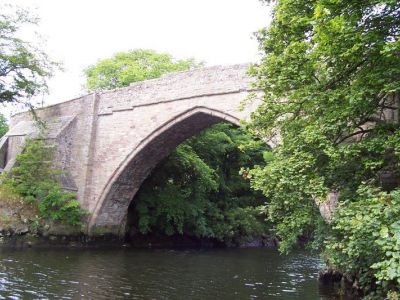
The Brig o' Balgownie is a 13th century bridge over the River Don. Made from granite and sandstone at the likely behest of Robert the Bruce, Scottish King from 1306 to 1329. Some say it was commissioned by Bishop Henry Cheyne. Neither the exact year nor the designing engineer of the bridge are known.
The Gothic diamond arch style of the bridge has caused some to believe it was designed by Richard Cementarius. This is probably due to a design that is similar to that of Drum Castle, which is also said to be a Cementarius work. The bridge 39 feet long with an arch that is 56 feet above the water line.
The bridge was originally called the Bridge of Don. It is unknown exactly where the name Balgownie originated. There is consensus that it is based on the local barony, which was probably called Palgoueny or Polgowny.
Visitors should plan to cross the bridge as part of their Aberdeen visit, but they should also look for a distant spot from which they can admire the Brig o' Balgownie and the picturesque River Don.
The Gothic diamond arch style of the bridge has caused some to believe it was designed by Richard Cementarius. This is probably due to a design that is similar to that of Drum Castle, which is also said to be a Cementarius work. The bridge 39 feet long with an arch that is 56 feet above the water line.
The bridge was originally called the Bridge of Don. It is unknown exactly where the name Balgownie originated. There is consensus that it is based on the local barony, which was probably called Palgoueny or Polgowny.
Visitors should plan to cross the bridge as part of their Aberdeen visit, but they should also look for a distant spot from which they can admire the Brig o' Balgownie and the picturesque River Don.
2) Old Aberdeen
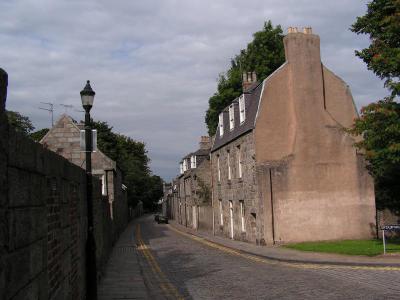
Old Aberdeen, now part of the city of Aberdeen, was originally a separate burgh, officially recognized as a burgh of barony in 1489. This historic area was merged with Aberdeen through an Act of Parliament in 1891, yet retains a unique identity as a community council area.
Known for its motto ''through harmony, small things increase," Old Aberdeen is a conservation area filled with historical charm. The central part of the town features buildings dating back to the Middle Ages, and vernacular architecture from the 17th to early 19th centuries, built from the locally prevalent grey granite. One of the distinctive architectural features is the use of hand-made bricks for gables and garden walls, a rarity in Scotland before the late 19th century. Many of the streets still retain their original stone-sett paving, further adding to the area’s historical ambiance.
Serving as the main campus for the University of Aberdeen, Old Aberdeen blends academic life with its rich history. Aside from university facilities, the area contains residential and commercial properties, often linked to the university community. Key local landmarks include Saint Machar’s Cathedral, a medieval structure that predates the University’s establishment in 1495, and which, along with other ecclesiastical buildings, forms the heart of Old Aberdeen.
Major historical buildings include the 15th-century King’s College Chapel, noted for its rare open "crown" spire and its collection of medieval woodcarving, the early 18th-century Old Town House, and the 14th-century Brig o' Balgownie, now pedestrianized and considered one of Scotland's oldest surviving bridges.
Known for its motto ''through harmony, small things increase," Old Aberdeen is a conservation area filled with historical charm. The central part of the town features buildings dating back to the Middle Ages, and vernacular architecture from the 17th to early 19th centuries, built from the locally prevalent grey granite. One of the distinctive architectural features is the use of hand-made bricks for gables and garden walls, a rarity in Scotland before the late 19th century. Many of the streets still retain their original stone-sett paving, further adding to the area’s historical ambiance.
Serving as the main campus for the University of Aberdeen, Old Aberdeen blends academic life with its rich history. Aside from university facilities, the area contains residential and commercial properties, often linked to the university community. Key local landmarks include Saint Machar’s Cathedral, a medieval structure that predates the University’s establishment in 1495, and which, along with other ecclesiastical buildings, forms the heart of Old Aberdeen.
Major historical buildings include the 15th-century King’s College Chapel, noted for its rare open "crown" spire and its collection of medieval woodcarving, the early 18th-century Old Town House, and the 14th-century Brig o' Balgownie, now pedestrianized and considered one of Scotland's oldest surviving bridges.
3) St. Machar's Cathedral (must see)
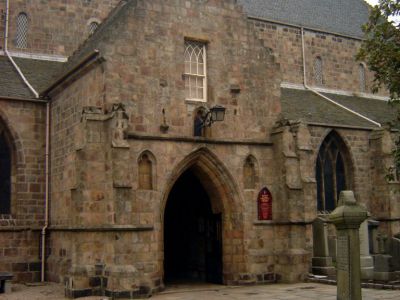
Saint Machar's Cathedral, sometimes called Old Machar, is a Church of Scotland church. The church is named in honor of Saint Machar who was said to have accompanied Saint Columba on his travel to Iona. The legend states that, on this journey, God told Machar to establish a church at the River Don. Saint Machar is said to have founded the church in the year 580.
A cathedral was built on this site in 1131. It was replaced in 1290 with the current Early English style building. Work continued on the cathedral for more than 150 years before it was fully functional. During that time, a quarter of Sir William Wallace's remains were interred in the walls of the cathedral. The church was finally completed in 1530.
Visitors to the church will find a stone interior with massive gothic archways. There are multiple stained glass windows throughout the church with dates that range from 1870s to 1970s. The Sanctuary Cross in the south aisle is a conglomerate from a 21st century shaft and a 12th century head. The Barbour Tryptich, made from wood, was created by Roland Fraser in 1997.
The three effigies are some of the most striking features of the church. These effigies represent three clerics that date to the 1400s. They were previously held outside of the church but were moved to the interior during one of the many restoration projects.
A number of notable Scottish individuals have been interred on the church grounds and inside the building itself. Along with William Wallace, some of these burials include John Joy Bell, James Edward Crombie, George Dickie and David Gill.
Why You Should Visit:
See the beautiful stained glass cathedral, enjoy the English and gothic architecture, and pay respects to some of Scotland's most notable individuals.
A cathedral was built on this site in 1131. It was replaced in 1290 with the current Early English style building. Work continued on the cathedral for more than 150 years before it was fully functional. During that time, a quarter of Sir William Wallace's remains were interred in the walls of the cathedral. The church was finally completed in 1530.
Visitors to the church will find a stone interior with massive gothic archways. There are multiple stained glass windows throughout the church with dates that range from 1870s to 1970s. The Sanctuary Cross in the south aisle is a conglomerate from a 21st century shaft and a 12th century head. The Barbour Tryptich, made from wood, was created by Roland Fraser in 1997.
The three effigies are some of the most striking features of the church. These effigies represent three clerics that date to the 1400s. They were previously held outside of the church but were moved to the interior during one of the many restoration projects.
A number of notable Scottish individuals have been interred on the church grounds and inside the building itself. Along with William Wallace, some of these burials include John Joy Bell, James Edward Crombie, George Dickie and David Gill.
Why You Should Visit:
See the beautiful stained glass cathedral, enjoy the English and gothic architecture, and pay respects to some of Scotland's most notable individuals.
4) Old Town House
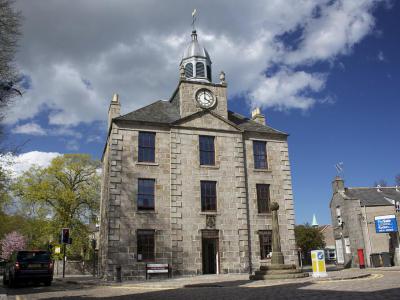
The Old Town House in Aberdeen, Scotland, is a historic municipal building located on the High Street in Old Aberdeen. Originally built to serve as the meeting place for the burgh council, the structure is now home to the King's Museum and holds Category A listed status due to its architectural and historical significance.
In the early 17th century, the burgh council met in a small room above Saint Machar's Cathedral. As this arrangement became insufficient, a dedicated townhouse was commissioned and constructed in 1642. This initial building served multiple purposes: a school and a weigh-house on the ground floor, while the first floor housed the council chamber. In 1702, the structure was expanded to include prison cells and a clock tower.
By the 1780s, the building had fallen into disrepair, and in 1788 construction began on a new townhouse designed by local architect George Jaffrey. The completed Georgian-style structure featured a symmetrical granite façade with three bays, a central doorway, and sash windows on each level. The clock tower, crowned by a belfry, incorporated a bell cast in 1754 by John Mowat, a relic from the previous building.
The Old Town House remained the council's meeting place until 1891 when Old Aberdeen was annexed by the City of Aberdeen. Subsequently, the building served various community roles, including as a school and later as a library. In 2001, the University of Aberdeen acquired the building, and following renovations supported by the Heritage Lottery Fund, the structure was refurbished. The King's Museum moved into the Old Town House in 2013, showcasing a collection of artifacts originally assembled at King's College dating back to 1727.
In the early 17th century, the burgh council met in a small room above Saint Machar's Cathedral. As this arrangement became insufficient, a dedicated townhouse was commissioned and constructed in 1642. This initial building served multiple purposes: a school and a weigh-house on the ground floor, while the first floor housed the council chamber. In 1702, the structure was expanded to include prison cells and a clock tower.
By the 1780s, the building had fallen into disrepair, and in 1788 construction began on a new townhouse designed by local architect George Jaffrey. The completed Georgian-style structure featured a symmetrical granite façade with three bays, a central doorway, and sash windows on each level. The clock tower, crowned by a belfry, incorporated a bell cast in 1754 by John Mowat, a relic from the previous building.
The Old Town House remained the council's meeting place until 1891 when Old Aberdeen was annexed by the City of Aberdeen. Subsequently, the building served various community roles, including as a school and later as a library. In 2001, the University of Aberdeen acquired the building, and following renovations supported by the Heritage Lottery Fund, the structure was refurbished. The King's Museum moved into the Old Town House in 2013, showcasing a collection of artifacts originally assembled at King's College dating back to 1727.
5) King's College Chapel
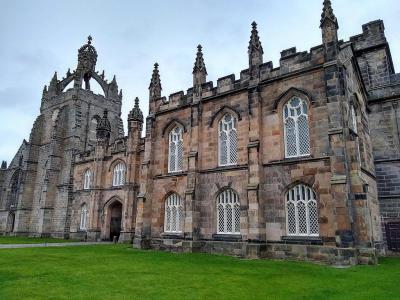
The King’s College Chapel in Aberdeen is a central part of the University of Aberdeen's historical landscape. Founded in 1495 as the University and King’s College of Aberdeen, this formerly independent institution is now a key part of the University of Aberdeen, with its most iconic structure being the late 15th-century King's College Chapel. Situated in Old Aberdeen, this chapel stands as the focal point of the King’s College campus, with its construction beginning in 1498 and concluding with its consecration in 1509.
The chapel’s most remarkable feature is its Crown Tower, a distinctive architectural element that has become symbolic of the university itself. The chapel is dedicated to the Trinity and the Blessed Virgin Mary, with its name also paying tribute to King James IV of Scotland, the institution’s principal patron. Inside, the chapel holds one of the most complete medieval church interiors in Scotland, notably featuring 16th-century choir stalls and a rood screen dating from around 1509.
Serving as more than just a place of worship, since 1928, the ante-chapel has acted as a war memorial for the university, commemorating 524 students who lost their lives in the First and Second World Wars. The chapel also holds historical significance as the burial site of the college’s founder, Bishop Elphinstone, and its first principal, Hector Boece, although the exact location of Elphinstone’s body remains a mystery. The chapel’s design, inspired by Solomon’s Temple, gives it a unique place in both religious and academic history.
The chapel’s most remarkable feature is its Crown Tower, a distinctive architectural element that has become symbolic of the university itself. The chapel is dedicated to the Trinity and the Blessed Virgin Mary, with its name also paying tribute to King James IV of Scotland, the institution’s principal patron. Inside, the chapel holds one of the most complete medieval church interiors in Scotland, notably featuring 16th-century choir stalls and a rood screen dating from around 1509.
Serving as more than just a place of worship, since 1928, the ante-chapel has acted as a war memorial for the university, commemorating 524 students who lost their lives in the First and Second World Wars. The chapel also holds historical significance as the burial site of the college’s founder, Bishop Elphinstone, and its first principal, Hector Boece, although the exact location of Elphinstone’s body remains a mystery. The chapel’s design, inspired by Solomon’s Temple, gives it a unique place in both religious and academic history.
6) Marischal College
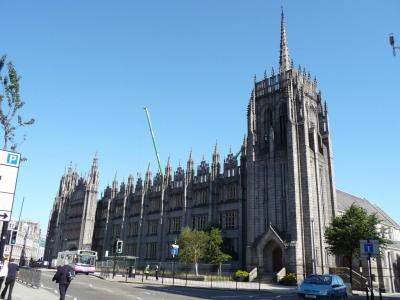
Marischal College is an iconic, granite building that was originally created for the University of Aberdeen. It is the second largest granite building in the world. The building was designed in the Gothic Revival architecture style by architect Archibald Simpson.
Construction on Marischal College began in 1835 and was completed during the early 20th century. It was used as office space and to hold classes for the campus. However, over time, the building fell into disrepair. Only Mitchell Hall, the anatomy department and the Marischal Museum were still in use through 2009 when renovations took place.
Though still owned by the University of Aberdeen, the building has served as the headquarters of Aberdeen City Council since 2011. Parts of the college are used as office space for the university. It is remains the home of the Marischal Museum.
A statue of Scottish King Robert the Bruce was erected outside of Marischal College in 2011. Robert the Bruce was King of Scots from 1306 to his death in 1329. He was one of the most famous warriors of his time and led the Kingdom of Scotland during the First War of Scottish Independence against England. King Robert the Bruce is revered in Scotland as a national hero. He sits on horseback holding the university charter.
Construction on Marischal College began in 1835 and was completed during the early 20th century. It was used as office space and to hold classes for the campus. However, over time, the building fell into disrepair. Only Mitchell Hall, the anatomy department and the Marischal Museum were still in use through 2009 when renovations took place.
Though still owned by the University of Aberdeen, the building has served as the headquarters of Aberdeen City Council since 2011. Parts of the college are used as office space for the university. It is remains the home of the Marischal Museum.
A statue of Scottish King Robert the Bruce was erected outside of Marischal College in 2011. Robert the Bruce was King of Scots from 1306 to his death in 1329. He was one of the most famous warriors of his time and led the Kingdom of Scotland during the First War of Scottish Independence against England. King Robert the Bruce is revered in Scotland as a national hero. He sits on horseback holding the university charter.
7) Provost Skene's House
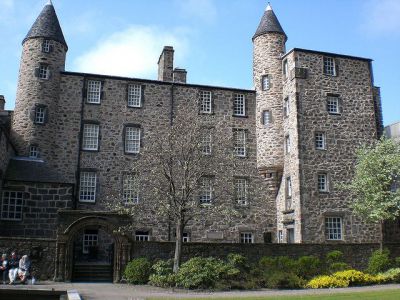
Provost Skene's House, located in the heart of Aberdeen, is a remarkable piece of the city’s architectural history. Originally built in 1545 by Matthew Lumsden, it is the oldest surviving townhouse in Aberdeen. The house gained its name from Sir George Skene, a prosperous merchant and provost (mayor) of Aberdeen from 1676 to 1685, who purchased the property in 1669 and likely commissioned the exquisite 17th-century plaster ceilings that still adorn the interior.
The building has undergone several transformations over the centuries. It was remodeled in the mid-18th century when larger windows were added, but it retains its medieval burgh architecture, making it one of the rare surviving examples in the city. One of the most notable features is the Renaissance-painted ceiling in the attic gallery, commissioned by a member of the Lumsden family, which includes strapwork decoration and religious scenes.
Provost Skene’s House opened as a museum in 1953, offering a glimpse into Aberdeen’s past with period rooms furnished in the styles of the 17th, 18th, and early 19th centuries. Visitors could explore local history, admire antique furniture, and view period costumes in the Costume Gallery. The museum offers interactive exhibits across nine themed displays, including a Hall of Heroes, and is family-friendly with hands-on activities for children. Admission is free, making it a delightful and accessible way to explore Aberdeen’s history repeatedly.
Provost Skene’s House is an enduring symbol of Aberdeen’s architectural and cultural heritage, showcasing how life in the city has evolved over the centuries while celebrating the pioneering individuals who have left a lasting impact on both the local and global stage.
The building has undergone several transformations over the centuries. It was remodeled in the mid-18th century when larger windows were added, but it retains its medieval burgh architecture, making it one of the rare surviving examples in the city. One of the most notable features is the Renaissance-painted ceiling in the attic gallery, commissioned by a member of the Lumsden family, which includes strapwork decoration and religious scenes.
Provost Skene’s House opened as a museum in 1953, offering a glimpse into Aberdeen’s past with period rooms furnished in the styles of the 17th, 18th, and early 19th centuries. Visitors could explore local history, admire antique furniture, and view period costumes in the Costume Gallery. The museum offers interactive exhibits across nine themed displays, including a Hall of Heroes, and is family-friendly with hands-on activities for children. Admission is free, making it a delightful and accessible way to explore Aberdeen’s history repeatedly.
Provost Skene’s House is an enduring symbol of Aberdeen’s architectural and cultural heritage, showcasing how life in the city has evolved over the centuries while celebrating the pioneering individuals who have left a lasting impact on both the local and global stage.
8) Kirk of St. Nicholas
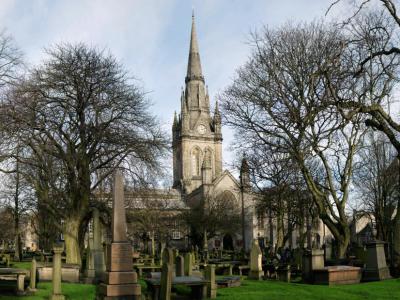
The Kirk of Saint Nicholas is a historic church that dates as far back as 1151. The church was significantly upgraded in the 15th century and again in 1755. It is considered the Mither Kirk, or mother church, of the city. Saint Nicholas is the patron saint of Aberdeen due to the miraculous rescue of sailor in a treacherous storm.
The interior of the church is outfitted in dark oak. It contains a large, stained glass window that celebrated the church's 500th anniversary. The carillon of 36 bells was installed in the granite tower in 1887. They were replaced in 1950 with 48 bells, making it one of the largest carillons in the country.
The graveyard surrounds the church on three sides. Monuments, dating to the mid-17th century, include a number of notable burials from the city's history. Some of these include Sir Thomas Blaikie, Alexander Dingwall Fordycce, Captain William Penny, William Rickart and Archibald Simpson. Rev. Prof. William Laurence Brown is buried inside the church.
The interior of the church is outfitted in dark oak. It contains a large, stained glass window that celebrated the church's 500th anniversary. The carillon of 36 bells was installed in the granite tower in 1887. They were replaced in 1950 with 48 bells, making it one of the largest carillons in the country.
The graveyard surrounds the church on three sides. Monuments, dating to the mid-17th century, include a number of notable burials from the city's history. Some of these include Sir Thomas Blaikie, Alexander Dingwall Fordycce, Captain William Penny, William Rickart and Archibald Simpson. Rev. Prof. William Laurence Brown is buried inside the church.
9) Gilcomston South Church
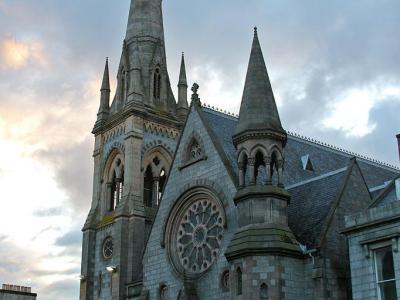
Gilcomston South Church, located on Union Street in Aberdeen, is a striking example of 19th-century ecclesiastical architecture, blending sandstone and granite in a design by renowned architect William Smith. Opened in 1868, this church initially served as the second, more elaborate premises of the United Free Church in Aberdeen, replacing a simpler structure on Huntly Street. The church’s slender spire, a defining feature of its exterior, was added in 1875 and later rebuilt in 1995. The building is notable for its asymmetrical layout, a style influenced by the Camden Society and Ecclesiologists, and continued by the Aberdeen Ecclesiological Society into the late 19th century.
Inside, the church offers a warm and inviting atmosphere, with its oak screen and choir stalls, a 1902 Binns pipe organ, and beautiful stained glass windows by artists such as David Gauld, Douglas Strachan, and Jane Bayliss. In 2004, the interior was refurbished by LDN Architects, ensuring that its historical charm was preserved while updating its functionality.
Known today simply as Gilcomston Church, the congregation is part of the evangelical Didasko fellowship. Formerly affiliated with the Church of Scotland, Gilcomston became a notable center for evangelicalism, particularly due to its commitment to biblically based expository preaching. The congregation’s revival following World War II, despite near closure, played a key role in shaping its influential approach to worship.
Visitors to Gilcomston South Church are often struck by both its aesthetic appeal and its welcoming environment. The engaging services, led by Minister Jerry, are highlighted by sermons rich in conviction and empathy, making the church not only a historic landmark but also a vibrant part of Aberdeen’s spiritual community.
Inside, the church offers a warm and inviting atmosphere, with its oak screen and choir stalls, a 1902 Binns pipe organ, and beautiful stained glass windows by artists such as David Gauld, Douglas Strachan, and Jane Bayliss. In 2004, the interior was refurbished by LDN Architects, ensuring that its historical charm was preserved while updating its functionality.
Known today simply as Gilcomston Church, the congregation is part of the evangelical Didasko fellowship. Formerly affiliated with the Church of Scotland, Gilcomston became a notable center for evangelicalism, particularly due to its commitment to biblically based expository preaching. The congregation’s revival following World War II, despite near closure, played a key role in shaping its influential approach to worship.
Visitors to Gilcomston South Church are often struck by both its aesthetic appeal and its welcoming environment. The engaging services, led by Minister Jerry, are highlighted by sermons rich in conviction and empathy, making the church not only a historic landmark but also a vibrant part of Aberdeen’s spiritual community.
10) Cathedral Church of Saint Andrew
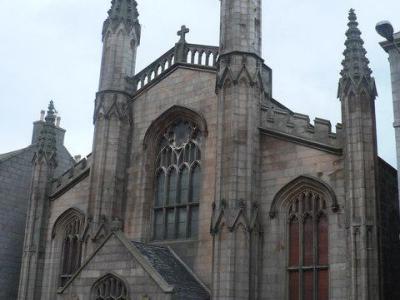
The Cathedral Church of Saint Andrew, also known as Saint Andrew's Cathedral, is an important landmark in Aberdeen. It serves as the seat of the Bishop of Aberdeen and Orkney within the Scottish Episcopal Church, making it the focal point of the Diocese of Aberdeen and Orkney. Originally opened in 1817 as Saint Andrew’s Chapel, the building was elevated to cathedral status in 1914. This Category A listed building is noted for its distinctive architectural history and its significance in the religious landscape of Aberdeen.
The original structure, designed by renowned Aberdeen architect Archibald Simpson, showcases the perpendicular Gothic style. While much of the building is constructed from the local granite, typical of Aberdeen’s architecture, the front façade facing King Street was built from sandstone for economic reasons. Despite Simpson’s opposition to the use of sandstone, this choice has become a defining feature of the cathedral. Over time, the building saw significant additions, including a chancel by George Edmund Street in 1880 and a porch by Robert Lorimer in 1911.
The cathedral holds historical importance as the site is closely linked to the consecration of Samuel Seabury, the first bishop of the Episcopal Church in the United States, who was ordained in Aberdeen in 1784. His consecration, performed by Robert Kilgour, Bishop of Aberdeen, and other bishops, took place in an upper room of a house near the present cathedral. This event is commemorated by a granite plaque on the wall of Marischal College.
In the 1930s, renovations for the 150th anniversary of Seabury’s consecration expanded the cathedral, with architect Ninian Comper adding ornate designs like a vaulted ceiling and gold-painted baldachino. The Kennedy family, including Joseph and John F. Kennedy, attended the opening of an extension in 1938. Originally Anglo-Catholic, the cathedral saw liturgical reforms in the 1980s under Provost Donald Howard, making worship more inclusive. Today, Saint Andrew’s Cathedral honors its history while evolving in its practices.
The original structure, designed by renowned Aberdeen architect Archibald Simpson, showcases the perpendicular Gothic style. While much of the building is constructed from the local granite, typical of Aberdeen’s architecture, the front façade facing King Street was built from sandstone for economic reasons. Despite Simpson’s opposition to the use of sandstone, this choice has become a defining feature of the cathedral. Over time, the building saw significant additions, including a chancel by George Edmund Street in 1880 and a porch by Robert Lorimer in 1911.
The cathedral holds historical importance as the site is closely linked to the consecration of Samuel Seabury, the first bishop of the Episcopal Church in the United States, who was ordained in Aberdeen in 1784. His consecration, performed by Robert Kilgour, Bishop of Aberdeen, and other bishops, took place in an upper room of a house near the present cathedral. This event is commemorated by a granite plaque on the wall of Marischal College.
In the 1930s, renovations for the 150th anniversary of Seabury’s consecration expanded the cathedral, with architect Ninian Comper adding ornate designs like a vaulted ceiling and gold-painted baldachino. The Kennedy family, including Joseph and John F. Kennedy, attended the opening of an extension in 1938. Originally Anglo-Catholic, the cathedral saw liturgical reforms in the 1980s under Provost Donald Howard, making worship more inclusive. Today, Saint Andrew’s Cathedral honors its history while evolving in its practices.
11) Castlegate Square
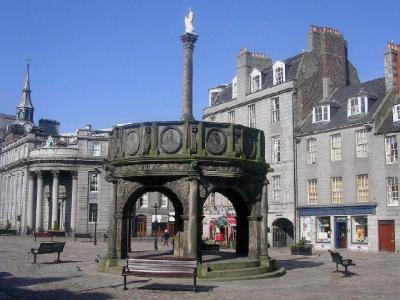
Castlegate Square is a small section of the city of Aberdeen. The area is surrounded by Castle Street and Castle Terrace. It is signified by the Mercat cross, which was built in 1686.
The Mercat Cross was designed by John Montgomery. It is a hexagonal structure that is enclosed and adorned with medallions featuring Stewart monarchs, the Royal arms and the burgh's arms. A gilded, marble unicorn sits atop the structure.
Castlegate Square was once the spot where merchants met to peddle their wares. The cobbled streets still give visitors access to shops, restaurants and pop-up vendors who may sell arts, crafts or antiques. It is also home to the Salvation Army Citadel.
The square is the traditional location of the city Christmas Tree, which usually stands next to the Mercat Cross. It is also known as being the site of public executions. The last of these took place in 1857.
The Mercat Cross was designed by John Montgomery. It is a hexagonal structure that is enclosed and adorned with medallions featuring Stewart monarchs, the Royal arms and the burgh's arms. A gilded, marble unicorn sits atop the structure.
Castlegate Square was once the spot where merchants met to peddle their wares. The cobbled streets still give visitors access to shops, restaurants and pop-up vendors who may sell arts, crafts or antiques. It is also home to the Salvation Army Citadel.
The square is the traditional location of the city Christmas Tree, which usually stands next to the Mercat Cross. It is also known as being the site of public executions. The last of these took place in 1857.

12) Footdee (Fittie)
Footdee is an old fishing village that is now a part of Aberdeen. It is known locally by the name Fittie, which is a reference to Saint Fittick. The area has also been called Fort Dee.
Footdee is a planned housing development that was create for the express purpose of providing homes to the fishing community. It was planned by John Smith, Superintendent of Public Works. It was originally laid out in a grid-like pattern with 28 thatched houses. More homes were added in 1837 and again in 1855.
The homes saw significant changes once they were sold to occupiers rather than fishermen. They were allowed to reconstruct the buildings and add to them as they pleased. This helped to forge the unique atmosphere that now exists throughout Footdee.
Though the development wasn't planned until 1809, there is evidence of settlement in the Footdee area that dates to 1398. The entire village of Footdee was given Conservation Area status in 1968.
Footdee is a planned housing development that was create for the express purpose of providing homes to the fishing community. It was planned by John Smith, Superintendent of Public Works. It was originally laid out in a grid-like pattern with 28 thatched houses. More homes were added in 1837 and again in 1855.
The homes saw significant changes once they were sold to occupiers rather than fishermen. They were allowed to reconstruct the buildings and add to them as they pleased. This helped to forge the unique atmosphere that now exists throughout Footdee.
Though the development wasn't planned until 1809, there is evidence of settlement in the Footdee area that dates to 1398. The entire village of Footdee was given Conservation Area status in 1968.
