Custom Walk in Seoul, South Korea by juliansmith476 created on 2026-04-26
Guide Location: South Korea » Seoul
Guide Type: Custom Walk
# of Sights: 13
Tour Duration: 3 Hour(s)
Travel Distance: 6.2 Km or 3.9 Miles
Share Key: MGBSQ
Guide Type: Custom Walk
# of Sights: 13
Tour Duration: 3 Hour(s)
Travel Distance: 6.2 Km or 3.9 Miles
Share Key: MGBSQ
How It Works
Please retrieve this walk in the GPSmyCity app. Once done, the app will guide you from one tour stop to the next as if you had a personal tour guide. If you created the walk on this website or come to the page via a link, please follow the instructions below to retrieve the walk in the app.
Retrieve This Walk in App
Step 1. Download the app "GPSmyCity: Walks in 1K+ Cities" on Apple App Store or Google Play Store.



Step 2. In the GPSmyCity app, download(or launch) the guide "Seoul Map and Walking Tours".
Step 3. Tap the menu button located at upper right corner of the "Walks" screen and select "Retrieve custom walk". Enter the share key: MGBSQ
1) Tapgol Park
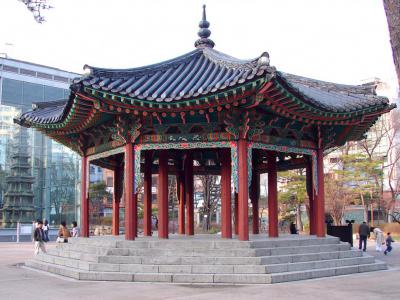
Tapgol Park holds the distinction of being Seoul’s first modern public park, officially established in 1897 on the site of the former Wongaksa Buddhist Temple, which had existed since the Joseon Dynasty in the 15th century. Its transformation from temple grounds into an urban garden marked a milestone in Seoul’s civic planning and public space design.
The park’s centerpiece is the stunning Wongaksa Ten‑Story Stone Pagoda, a 12-meter tall marble pagoda constructed in 1467, and designated as National Treasure No. 2 of South Korea. Visitors can also discover other historical fixtures like the Monument of Wongaksa-a 1471 tortoise‑base stele adorned with a dragon motif-and a series of bas‑relief sculptures and memorials commemorating the March 1, 1919 Independence Movement, during which the Proclamation of Independence was first read at the park’s famed Palgakjeong octagonal pavilion.
Today, Tapgol Park offers tourists a peaceful retreat-a green oasis amidst bustling Jongno. With shaded walking paths and benches, it’s a tranquil place to recharge while absorbing layers of Korean history-from the Joseon era and its Buddhist heritage to its role in the modern independence struggle.
The park’s centerpiece is the stunning Wongaksa Ten‑Story Stone Pagoda, a 12-meter tall marble pagoda constructed in 1467, and designated as National Treasure No. 2 of South Korea. Visitors can also discover other historical fixtures like the Monument of Wongaksa-a 1471 tortoise‑base stele adorned with a dragon motif-and a series of bas‑relief sculptures and memorials commemorating the March 1, 1919 Independence Movement, during which the Proclamation of Independence was first read at the park’s famed Palgakjeong octagonal pavilion.
Today, Tapgol Park offers tourists a peaceful retreat-a green oasis amidst bustling Jongno. With shaded walking paths and benches, it’s a tranquil place to recharge while absorbing layers of Korean history-from the Joseon era and its Buddhist heritage to its role in the modern independence struggle.
2) Beautiful Tea Museum
The Beautiful Tea Museum, also known as Teastory, offers visitors an authentic taste of Korea’s tea heritage. Housed in a charming hanok‑style building, it was established to promote tea culture through exhibits and tasting experiences, all set within a gracefully preserved traditional courtyard environment.
Although the name suggests a museum, most guests find it feels more like an elegant tea house with a small museum section. A few curated artifacts-such as traditional teapots, ceramics, and utensils from Korea, China, Tibet and beyond-are displayed in modest gallery corners. Yet, ongoing reviews point out that the real draw is the tea tasting itself rather than a full museum walkthrough.
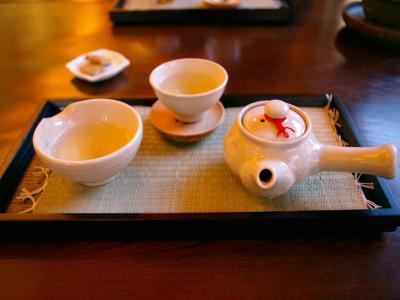
Visitors can choose from an impressive selection of over 110 teas sourced from Korea, China, Japan, Taiwan, Sri Lanka and Europe. The menu includes Korean favorites like yellow tea and jasmine green tea, as well as flower, herbal, and black tea varieties. Each table is equipped with its own kettle to allow you to steep multiple rounds, making it easy to savour and compare flavors at your own pace.
Although the name suggests a museum, most guests find it feels more like an elegant tea house with a small museum section. A few curated artifacts-such as traditional teapots, ceramics, and utensils from Korea, China, Tibet and beyond-are displayed in modest gallery corners. Yet, ongoing reviews point out that the real draw is the tea tasting itself rather than a full museum walkthrough.
Visitors can choose from an impressive selection of over 110 teas sourced from Korea, China, Japan, Taiwan, Sri Lanka and Europe. The menu includes Korean favorites like yellow tea and jasmine green tea, as well as flower, herbal, and black tea varieties. Each table is equipped with its own kettle to allow you to steep multiple rounds, making it easy to savour and compare flavors at your own pace.
3) Ssamziegil Complex
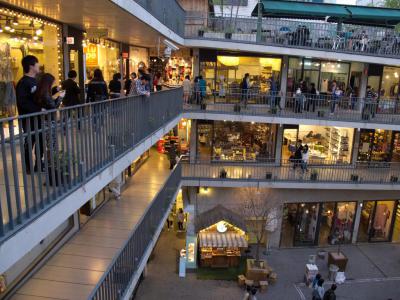
Ssamziegil Complex is a modern shopping center that opened in 2004. There are four levels of shops centered around an open courtyard.
A 500 meter (1,640 foot) footpath begins at the first level and winds its way around the four levels until it reaches the top. This modern shopping center feels like a traditional shopping experience as visitors find quaint shops along the winding footpath.
The first floor features 12 original workshops that existed before the new shopping center was built.
The second floor has handicraft shops. On the third floor, you can find shops selling traditional Korean handicrafts. This is a great place to find a special souvenir or gift. Choose from hand painted fans, beautiful scarves, and smart neckties. For a unique souvenir, talented street artists can capture a quick, remarkable portrait or caricature.
The fourth floor has a book store, an art gallery, and SkyGarden. The views toward Insa-dong and the courtyard below are beautiful, so be sure to bring your camera.
A 500 meter (1,640 foot) footpath begins at the first level and winds its way around the four levels until it reaches the top. This modern shopping center feels like a traditional shopping experience as visitors find quaint shops along the winding footpath.
The first floor features 12 original workshops that existed before the new shopping center was built.
The second floor has handicraft shops. On the third floor, you can find shops selling traditional Korean handicrafts. This is a great place to find a special souvenir or gift. Choose from hand painted fans, beautiful scarves, and smart neckties. For a unique souvenir, talented street artists can capture a quick, remarkable portrait or caricature.
The fourth floor has a book store, an art gallery, and SkyGarden. The views toward Insa-dong and the courtyard below are beautiful, so be sure to bring your camera.
4) Shin Old Tea House
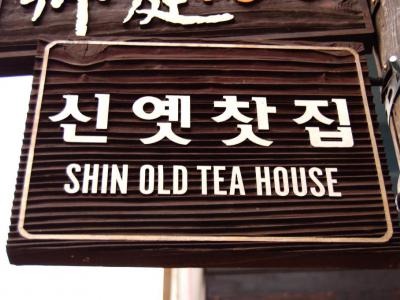
Shin Old Tea House, located in a hanok- a traditional Korean house, exudes a refined simplicity-just a modest wooden sign marks the entrance, inviting you into a quiet hideaway from Seoul’s bustling energy.
Step inside, and you'll be greeted by the warm creak of wooden floors, the comfort of silk floor pillows, and the gentle glow of dim, lantern-like lighting. Shelves brimming with colorful tapestries, ceramic teapots, framed knick‑knacks, and even a small goldfish tank lend a playful yet soothing character to the intimate space.
The tea selection at Shin Old Tea House spans both familiar and unique flavors-from plum, ginger, jujube, and omija teas to medicinal blends like ssanghwa-cha. Both hot and cold varieties are offered-a refreshing choice in warm seasons. Your drink comes paired with complimentary traditional rice snacks such as sticky rice cakes or puffed rice treats.
Born from a converted ancestral hanok, it is said to have served as a creative refuge for its owner’s art-college friends, offering a place to sketch, write, and sip tea in tranquility. For travelers, it’s an especially enchanting place to pause-ideally in the early afternoon, when you might have the space nearly to yourself.
Step inside, and you'll be greeted by the warm creak of wooden floors, the comfort of silk floor pillows, and the gentle glow of dim, lantern-like lighting. Shelves brimming with colorful tapestries, ceramic teapots, framed knick‑knacks, and even a small goldfish tank lend a playful yet soothing character to the intimate space.
The tea selection at Shin Old Tea House spans both familiar and unique flavors-from plum, ginger, jujube, and omija teas to medicinal blends like ssanghwa-cha. Both hot and cold varieties are offered-a refreshing choice in warm seasons. Your drink comes paired with complimentary traditional rice snacks such as sticky rice cakes or puffed rice treats.
Born from a converted ancestral hanok, it is said to have served as a creative refuge for its owner’s art-college friends, offering a place to sketch, write, and sip tea in tranquility. For travelers, it’s an especially enchanting place to pause-ideally in the early afternoon, when you might have the space nearly to yourself.
5) Jogyesa Temple
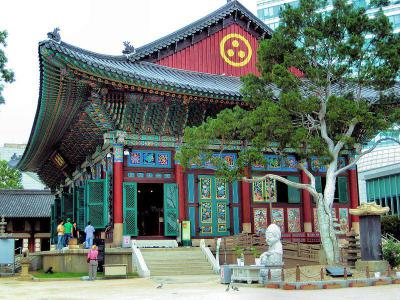
Jogyesa Temple serves as the spiritual headquarters of the Jogye Order, the main sect of Korean Buddhism. Though the temple's lineage traces back to the Joseon era, the present complex was established in 1910, originally named Gakhwangsa, and adopted the name Jogyesa in 1954 as a symbol of Korean religious independence after Japanese colonial rule. It was the first modern temple built inside Seoul’s four historic city gates.
Upon entering the temple grounds through the One-Pillar Gate, visitors are welcomed by the courtyard adorned with lotus lanterns and ancient trees, including a 500‑year-old white pine and a towering Chinese Scholar tree-both designated natural monuments for their cultural and environmental significance. The richly painted Main Buddha Hall, built in 1938, houses three magnificent golden Buddha statues and is surrounded by other notable buildings like Paradise Hall and a towering stone pagoda holding relics of Shakyamuni Buddha.
Jogyesa is not only a place of worship but also a cultural venue. Its Dharma Hall hosts year‑round lectures, rituals, and ceremonies, and the temple is a central site for the Lotus Lantern Festival each spring in celebration of Buddha’s birthday-when the grounds glow with thousands of illuminated lanterns and festive energy. For those looking to immerse more deeply, Jogyesa offers Templestay programs that include meditation, tea ceremonies, and communal meals.
Upon entering the temple grounds through the One-Pillar Gate, visitors are welcomed by the courtyard adorned with lotus lanterns and ancient trees, including a 500‑year-old white pine and a towering Chinese Scholar tree-both designated natural monuments for their cultural and environmental significance. The richly painted Main Buddha Hall, built in 1938, houses three magnificent golden Buddha statues and is surrounded by other notable buildings like Paradise Hall and a towering stone pagoda holding relics of Shakyamuni Buddha.
Jogyesa is not only a place of worship but also a cultural venue. Its Dharma Hall hosts year‑round lectures, rituals, and ceremonies, and the temple is a central site for the Lotus Lantern Festival each spring in celebration of Buddha’s birthday-when the grounds glow with thousands of illuminated lanterns and festive energy. For those looking to immerse more deeply, Jogyesa offers Templestay programs that include meditation, tea ceremonies, and communal meals.
6) Jongno Tower
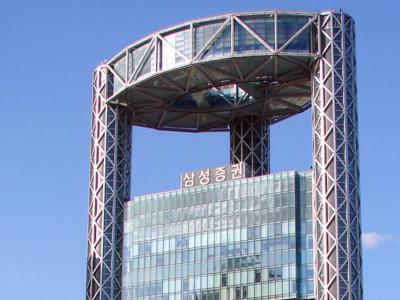
Jongno Tower, also known as Samsung Jong‑Ro Tower, is a modern landmark that rises to approximately 132 m over 33 floors. Completed in 1999, this distinctive glass-and-steel tower was designed by Uruguayan architect Rafael Viñoly in collaboration with Samoo Architects & Engineers. A bold visual contrast to the traditional architecture of Jongno, it was built on the site of the old Whashin Department Store.
One of Jongno Tower’s most memorable design features is its UFO‑like structure: a hollow mid-section from floors 23 to 30 topped by an oval ring-a signature form both futuristic and symbolic. Despite its office function, the tower was known for offering city views from a restaurant on its top floor, although that facility closed in 2022.
One of Jongno Tower’s most memorable design features is its UFO‑like structure: a hollow mid-section from floors 23 to 30 topped by an oval ring-a signature form both futuristic and symbolic. Despite its office function, the tower was known for offering city views from a restaurant on its top floor, although that facility closed in 2022.
7) Bosingak Pavilion
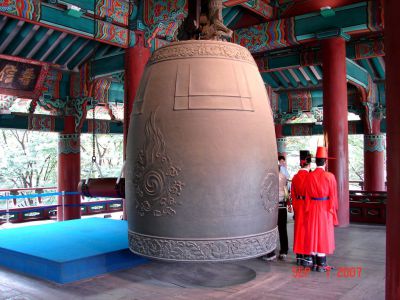
Bosingak Pavilion is a historic bell pavilion that gave its name to the surrounding district of Jongno, which translates to “Bell Street” in reference to the pavilion’s original function. Originally constructed in 1396 during the Joseon Dynasty, Bosingak has been rebuilt multiple times across centuries, most recently in 1979. The original 1468 bronze bell is now housed at the National Museum of Korea, while a faithful modern replica takes its place today.
This pavilion once served as Seoul’s public clock: during the Joseon era, the bell was struck to signal the opening of the city gates at 4 am and closing at 10 pm, with 33 tolls marking each event. It also functioned as a fire and danger alarm for residents. Today, the bell is rung only on special occasions, most notably at midnight on New Year’s Eve, when crowds gather to hear its powerful 33 strikes ushering in the next year in a cherished city-wide tradition.
Beyond New Year’s Eve, visitors can occasionally experience a bell ringing at noon-an echo of its former role in keeping time for the entire city. While entry into the pavilion interior is generally restricted, the ornate two-tiered wooden structure-with elegant dancheong painted patterns and a raised platform-offers a contrast set against modern high-rises.
This pavilion once served as Seoul’s public clock: during the Joseon era, the bell was struck to signal the opening of the city gates at 4 am and closing at 10 pm, with 33 tolls marking each event. It also functioned as a fire and danger alarm for residents. Today, the bell is rung only on special occasions, most notably at midnight on New Year’s Eve, when crowds gather to hear its powerful 33 strikes ushering in the next year in a cherished city-wide tradition.
Beyond New Year’s Eve, visitors can occasionally experience a bell ringing at noon-an echo of its former role in keeping time for the entire city. While entry into the pavilion interior is generally restricted, the ornate two-tiered wooden structure-with elegant dancheong painted patterns and a raised platform-offers a contrast set against modern high-rises.
8) Cheonggye Plaza and Stream (must see)
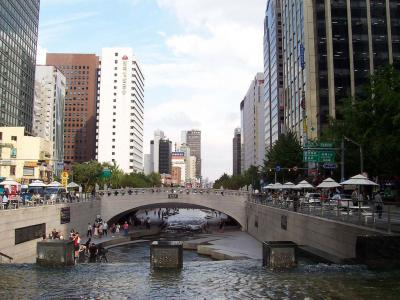
Cheonggyecheon Stream flows through downtown Seoul. The stream was covered up with concrete for many decades. In 2003, work to remove the elevated highway and restore the stream began. The stream was officially re-opened in 2005.
The stream runs under 22 bridges and flows into the Hangang River. Gwangtonggyo Bridge was one of the busiest and most important bridges of the Joseon Dynasty. It was also buried for 100 years during Seoul's economic boom. Now restored, it's one of the most scenic places on the Cheonggyecheon Stream.
Cheonggye Plaza is located at the head of Cheonggyecheon Stream. The plaza celebrates the re-opening of the stream. The vibrant red and blue Spring Sculpture dominates the plaza. The sculpture's design is reminiscent of a shell rising like a pagoda. The colorful ribbons represent traditional Korean wrapping cloth known as a bojagi.
The Candlelight Fountain at the plaza is a stunning two-tiered, four-meter (13-foot) tall waterfall. It's stunning at night when the lights of Seoul are reflected in the water.
The stream runs under 22 bridges and flows into the Hangang River. Gwangtonggyo Bridge was one of the busiest and most important bridges of the Joseon Dynasty. It was also buried for 100 years during Seoul's economic boom. Now restored, it's one of the most scenic places on the Cheonggyecheon Stream.
Cheonggye Plaza is located at the head of Cheonggyecheon Stream. The plaza celebrates the re-opening of the stream. The vibrant red and blue Spring Sculpture dominates the plaza. The sculpture's design is reminiscent of a shell rising like a pagoda. The colorful ribbons represent traditional Korean wrapping cloth known as a bojagi.
The Candlelight Fountain at the plaza is a stunning two-tiered, four-meter (13-foot) tall waterfall. It's stunning at night when the lights of Seoul are reflected in the water.
9) Seoul City Hall
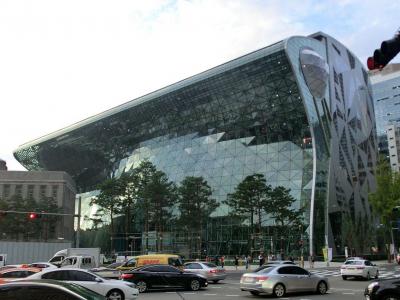
Seoul City Hall serves as the seat of the Seoul Metropolitan Government-the administrative heart of South Korea’s capital. The complex comprises two distinct structures: the original 1926 neoclassical building, now transformed into the Seoul Metropolitan Library, and a sleek modern extension, opened in August 2012, whose design echoes the curved eaves of traditional Korean houses.
The complex dedicates about 62% of its space to government offices and 38% to public spaces. Inside, visitors are greeted by a seven-story “Green Wall” vertical garden, adorned with over 70,000 plants across 14 species, recognized as possibly the largest indoor vertical garden globally. The entrance lobby also features a captivating media wall, alongside digital aquariums and public art installations, including the symbolic “Meta Epic: SeoBeol”, which reflects Seoul’s 2,000-year history through light, myth, and hope motifs.
The Tong‑Tong Tour-available both on-site and online-offers a rich guided experience through the entire complex. Without prior booking, visitors can explore the main building’s public spaces, the Seoul Metropolitan Library’s historic rooms like the former mayor’s office and archival services, and the Seoul Citizens’ Hall exhibits. Select tours include the Seoul Outdoor Library in Seoul Plaza during its season.
Strategically placed in front of the complex, Seoul Plaza brings the space to life with seasonal activities-festivals, markets, outdoor libraries in warmer months, and ice rinks in winter. The rooftop garden atop the old building and social spots like the Sky Plaza Café and a robot café offer scenic views and relaxed atmospheres-all accessible without admission fees.
Beyond its architectural marvels and civic amenities, Seoul City Hall remains a fully functional government center, hosting the mayor’s office, various bureaus, and departments that oversee public education, libraries, sanitation, welfare, public safety, and recreation across the metropolis.
The complex dedicates about 62% of its space to government offices and 38% to public spaces. Inside, visitors are greeted by a seven-story “Green Wall” vertical garden, adorned with over 70,000 plants across 14 species, recognized as possibly the largest indoor vertical garden globally. The entrance lobby also features a captivating media wall, alongside digital aquariums and public art installations, including the symbolic “Meta Epic: SeoBeol”, which reflects Seoul’s 2,000-year history through light, myth, and hope motifs.
The Tong‑Tong Tour-available both on-site and online-offers a rich guided experience through the entire complex. Without prior booking, visitors can explore the main building’s public spaces, the Seoul Metropolitan Library’s historic rooms like the former mayor’s office and archival services, and the Seoul Citizens’ Hall exhibits. Select tours include the Seoul Outdoor Library in Seoul Plaza during its season.
Strategically placed in front of the complex, Seoul Plaza brings the space to life with seasonal activities-festivals, markets, outdoor libraries in warmer months, and ice rinks in winter. The rooftop garden atop the old building and social spots like the Sky Plaza Café and a robot café offer scenic views and relaxed atmospheres-all accessible without admission fees.
Beyond its architectural marvels and civic amenities, Seoul City Hall remains a fully functional government center, hosting the mayor’s office, various bureaus, and departments that oversee public education, libraries, sanitation, welfare, public safety, and recreation across the metropolis.
10) Deoksugung Palace
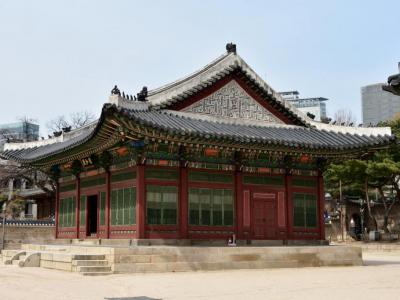
Deoksugung Palace is the smallest of the Five Grand Palaces built by the Joseon Dynasty. This residence became a royal palace after the other palaces burned in 1592. King Gwanghaegun and King Injo were crowned in Jeukjodang Hall in the 1600s.
Deoksugung Palace was heavily damaged during colonial rule. The palace is now only about one-third of its original size. Hamnyeongjeon Hall was the sleeping residence for King Gojong after he moved to the palace in 1897.
Deoksugung Palace has many interesting architectural features. It includes buildings made from stucco, stone, and wood with architectural style blend eastern and western designs. Visitors will also find a beautiful western-style garden and fountain.
The neoclassical Seokjojeon Hall was built in 1910. With its triangular roof and tall collonades, this building is a striking departure from traditional Korean architecture. The Daehan Empire History Museum is located inside Seokjojeon Hall.
Jeonggwanheon, built around 1910, combines eastern and western styles. Kings in the Joseon Dynasty had their portraits enshrined here.
Don't miss the colorful changing of the guard outside Daehanmun Gate.
Why You Should Visit:
This is the only palace in Seoul where you can take photos with the Royal Guards after the changing ceremony. Unlike other palaces, you can also enter the grounds at night to enjoy a moonlit stroll. Beyond the palace, you can explore the historic neighborhood and the famous Stonewall Walkway along the palace walls.
Tip:
Going inside the castle, you'll need to pay a fee, unless you're wearing a 'hanbik' – then it's free!
Make sure you check out the Jeongdong Observatory, located next door to the palace. From the observation deck (18th floor) you can capture panoramic views of the Deoksugung Palace grounds, CBD skyline, City Hall grounds and other landmarks – and its free! You'll get some amazing photos as a souvenir.
Deoksugung Palace was heavily damaged during colonial rule. The palace is now only about one-third of its original size. Hamnyeongjeon Hall was the sleeping residence for King Gojong after he moved to the palace in 1897.
Deoksugung Palace has many interesting architectural features. It includes buildings made from stucco, stone, and wood with architectural style blend eastern and western designs. Visitors will also find a beautiful western-style garden and fountain.
The neoclassical Seokjojeon Hall was built in 1910. With its triangular roof and tall collonades, this building is a striking departure from traditional Korean architecture. The Daehan Empire History Museum is located inside Seokjojeon Hall.
Jeonggwanheon, built around 1910, combines eastern and western styles. Kings in the Joseon Dynasty had their portraits enshrined here.
Don't miss the colorful changing of the guard outside Daehanmun Gate.
Why You Should Visit:
This is the only palace in Seoul where you can take photos with the Royal Guards after the changing ceremony. Unlike other palaces, you can also enter the grounds at night to enjoy a moonlit stroll. Beyond the palace, you can explore the historic neighborhood and the famous Stonewall Walkway along the palace walls.
Tip:
Going inside the castle, you'll need to pay a fee, unless you're wearing a 'hanbik' – then it's free!
Make sure you check out the Jeongdong Observatory, located next door to the palace. From the observation deck (18th floor) you can capture panoramic views of the Deoksugung Palace grounds, CBD skyline, City Hall grounds and other landmarks – and its free! You'll get some amazing photos as a souvenir.
11) Gwanghwamun Gate
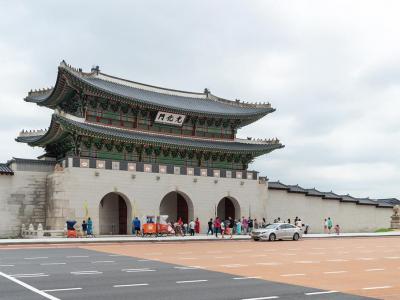
Gwanghwamun Gate is main entrance into Gyeongbokgung Palace, and so it is also the largest and most imposing of the four gates. It features three grand arched gates--the center gate was reserved for use by the king, while the crown prince and royal officials used the other two smaller arches.
The tall granite structure of the gate supports the ornately decorated wooden gate tower, which watches over the city. The pavilon housed a bell that announced the time of the day to the city. Two majestic Haetae sculptures guard the gate. These mythical lion-like beasts were stationed there to protect the palace against fire.
Gwanghwamun Gate was one of only four gates constructed in the palace walls. They were originally constructed in 1395 during the reign of King Taejo of the Joseon Dynasty. But the gates and walls have been through many cycles of destruction and reconstruction.
It was destroyed by fire during the Imjin Wars in 1592 and laid in ruins until it was rebuilt in 1867. In 1926, the Japanese government moved Gwanghwamun Gate. The double-roofed wooden pavilion on the gate was destroyed during the Korean War. The gate was moved again in 1968.
Gwanghwamun Gate was moved back to its original location in 2006, and the restoration was completed in 2010. The restoration included recreating the base with traditional materials, recreating the original wooden pavilion structure with Korean pine, and recreating the wooden nameplate.
The area in front of Gwanghwamun Gate is known as Gwanghwamun Plaza. Here, visitors can watch the impressive royal changing of the guard ceremony. This ceremony is held daily, every hour, on the hour, from 10:00 to 15:00.
Tip:
The square housing the gate contains fountains, statues and sculptures that are also definitely worth seeing, plus an underground museum dedicated to Sejong the Great, the 4th king of the Joseon Dynasty.
The tall granite structure of the gate supports the ornately decorated wooden gate tower, which watches over the city. The pavilon housed a bell that announced the time of the day to the city. Two majestic Haetae sculptures guard the gate. These mythical lion-like beasts were stationed there to protect the palace against fire.
Gwanghwamun Gate was one of only four gates constructed in the palace walls. They were originally constructed in 1395 during the reign of King Taejo of the Joseon Dynasty. But the gates and walls have been through many cycles of destruction and reconstruction.
It was destroyed by fire during the Imjin Wars in 1592 and laid in ruins until it was rebuilt in 1867. In 1926, the Japanese government moved Gwanghwamun Gate. The double-roofed wooden pavilion on the gate was destroyed during the Korean War. The gate was moved again in 1968.
Gwanghwamun Gate was moved back to its original location in 2006, and the restoration was completed in 2010. The restoration included recreating the base with traditional materials, recreating the original wooden pavilion structure with Korean pine, and recreating the wooden nameplate.
The area in front of Gwanghwamun Gate is known as Gwanghwamun Plaza. Here, visitors can watch the impressive royal changing of the guard ceremony. This ceremony is held daily, every hour, on the hour, from 10:00 to 15:00.
Tip:
The square housing the gate contains fountains, statues and sculptures that are also definitely worth seeing, plus an underground museum dedicated to Sejong the Great, the 4th king of the Joseon Dynasty.
12) Gyeongbokgung Palace (must see)
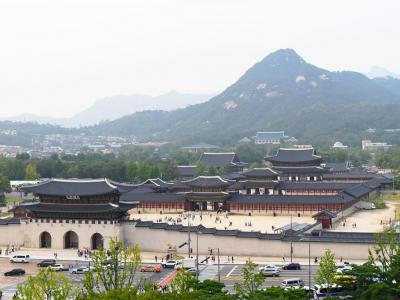
Gyeongbokgung Palace was built in 1395 by the Joseon Dynasty. This impressive complex served as the Joseon Dynasty's main palace and is the largest of the Five Grand Palaces.
It was destroyed by fire during the Imjin War in 1592 and sat abandoned for over two centuries. In 1867, the palace was reconstructed with 330 buildings and 5,792 rooms. In 1895, Japanese agents assassinated Empress Myeongseong. Emperor Gojong, her husband, left the palace and never returned.
In the early 20th century, Japan's colonial government destroyed palace buildings and constructed the enormous Japanese General Government Building outside the throne hall.
Only a few 19th-century buildings survived the Japanese government and the Korean War. These buildings include Geunjeongjeon (the Imperial Throne Hall), Hyangwonjeong Pavilion, Gyeonghoeru Pavilion, Sujeongjeon Hall, Jagyeongjeon Hall, Sajeongjeon Hall, and Jibokjae Hall.
In 1989, reconstruction began to restore the palace to its former glory. About 40 percent of the building have since been reconstructed or restored.
Geunjeongjeon, the Imperial Throne Hall, is truly impressive. Its constructed mainly of wood and sits in a courtyard lined with stones. Known as rank stones, they indicated where officials of different ranks could stand during ceremonies. The entire courtyard is cloistered.
Gyeongbokgung Palace features dozens of architecturally interesting buildings. Hyangwonjeong, a beautiful hexagonal pavilion, sits attractively on an island.
Why You Should Visit:
Gyeongbokgung Palace is the largest and grandest of the Five Grand Palaces. Visit the National Folk Museum of Korea on the palace grounds to learn about the history of the Korean people. The National Palace Museum of Korea is also located on the palace grounds and houses priceless 14th century Joseon dynasty treasures.
Tips:
You can rent traditional costumes to immerse yourself in 14th-century royal Korea.
For a memorable experience, sign up for a night tour and see the palace lit up. Gyeonghoeru looks spectacular as its warm lights are reflected in the pond.
For a once in a lifetime experience, take part in a Gyeongbokgung Royal Dining event. Sample royal food and watch a traditional performance.
It was destroyed by fire during the Imjin War in 1592 and sat abandoned for over two centuries. In 1867, the palace was reconstructed with 330 buildings and 5,792 rooms. In 1895, Japanese agents assassinated Empress Myeongseong. Emperor Gojong, her husband, left the palace and never returned.
In the early 20th century, Japan's colonial government destroyed palace buildings and constructed the enormous Japanese General Government Building outside the throne hall.
Only a few 19th-century buildings survived the Japanese government and the Korean War. These buildings include Geunjeongjeon (the Imperial Throne Hall), Hyangwonjeong Pavilion, Gyeonghoeru Pavilion, Sujeongjeon Hall, Jagyeongjeon Hall, Sajeongjeon Hall, and Jibokjae Hall.
In 1989, reconstruction began to restore the palace to its former glory. About 40 percent of the building have since been reconstructed or restored.
Geunjeongjeon, the Imperial Throne Hall, is truly impressive. Its constructed mainly of wood and sits in a courtyard lined with stones. Known as rank stones, they indicated where officials of different ranks could stand during ceremonies. The entire courtyard is cloistered.
Gyeongbokgung Palace features dozens of architecturally interesting buildings. Hyangwonjeong, a beautiful hexagonal pavilion, sits attractively on an island.
Why You Should Visit:
Gyeongbokgung Palace is the largest and grandest of the Five Grand Palaces. Visit the National Folk Museum of Korea on the palace grounds to learn about the history of the Korean people. The National Palace Museum of Korea is also located on the palace grounds and houses priceless 14th century Joseon dynasty treasures.
Tips:
You can rent traditional costumes to immerse yourself in 14th-century royal Korea.
For a memorable experience, sign up for a night tour and see the palace lit up. Gyeonghoeru looks spectacular as its warm lights are reflected in the pond.
For a once in a lifetime experience, take part in a Gyeongbokgung Royal Dining event. Sample royal food and watch a traditional performance.
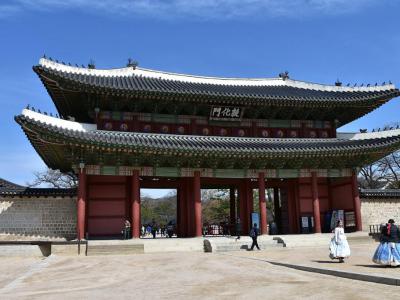
13) Changdeokgung Palace (must see)
Changdeokgung Palace, also known as Prospering Virtue Palace, has a beautiful setting in one of Seoul's parks. The palace enjoys status as one of the Joseon Dynasty's Five Grand Palaces. One of the noteworthy things about this 15th-century palace is that it blends into the natural topography in a way not commonly seen in other buildings.
The Donhwamun Gate and Geumcheongyo Bridge are two of the oldest structures on the property built in the 15th century. Injeongjeon Hall served as an area for coronations, as well as the reception of envoys. Seonjeongjeon Hall was the location for daily meetings with the king and government ministers, while Juhamnu Pavilion was once the royal library.
Huijeongdang Hall, a residence for the king, and Daejojeon Hall, the queen's residence, are also noteworthy. Yeon-gyeongdang Residence is an 1827 audience hall. Huwon is a garden consisting of 78 acres in the back of the palace.
Changdeokgung Palace is a UNESCO World Heritage Site.
Why You Should Visit:
Although sometimes referred as a 'backup' palace to Gyeongbokgung, the interior is actually more complete. As such, you will be able to have a better understanding of how life in a palace is like. The "Secret Garden" is a must-see.
Tip:
Those wearing 'hanbok' can enter the palace free. You can also buy the Royal Palace Pass that gives you free entrance to 5 palaces (including the 'Secret Garden', which is a highlight of this palace visit).
The Donhwamun Gate and Geumcheongyo Bridge are two of the oldest structures on the property built in the 15th century. Injeongjeon Hall served as an area for coronations, as well as the reception of envoys. Seonjeongjeon Hall was the location for daily meetings with the king and government ministers, while Juhamnu Pavilion was once the royal library.
Huijeongdang Hall, a residence for the king, and Daejojeon Hall, the queen's residence, are also noteworthy. Yeon-gyeongdang Residence is an 1827 audience hall. Huwon is a garden consisting of 78 acres in the back of the palace.
Changdeokgung Palace is a UNESCO World Heritage Site.
Why You Should Visit:
Although sometimes referred as a 'backup' palace to Gyeongbokgung, the interior is actually more complete. As such, you will be able to have a better understanding of how life in a palace is like. The "Secret Garden" is a must-see.
Tip:
Those wearing 'hanbok' can enter the palace free. You can also buy the Royal Palace Pass that gives you free entrance to 5 palaces (including the 'Secret Garden', which is a highlight of this palace visit).
