Custom Walk in Hanover, Germany by lunacamizq_69c22 created on 2025-12-05
Guide Location: Germany » Hanover
Guide Type: Custom Walk
# of Sights: 5
Tour Duration: 3 Hour(s)
Travel Distance: 6.5 Km or 4 Miles
Share Key: L6TAM
Guide Type: Custom Walk
# of Sights: 5
Tour Duration: 3 Hour(s)
Travel Distance: 6.5 Km or 4 Miles
Share Key: L6TAM
How It Works
Please retrieve this walk in the GPSmyCity app. Once done, the app will guide you from one tour stop to the next as if you had a personal tour guide. If you created the walk on this website or come to the page via a link, please follow the instructions below to retrieve the walk in the app.
Retrieve This Walk in App
Step 1. Download the app "GPSmyCity: Walks in 1K+ Cities" on Apple App Store or Google Play Store.



Step 2. In the GPSmyCity app, download(or launch) the guide "Hanover Map and Walking Tours".
Step 3. Tap the menu button located at upper right corner of the "Walks" screen and select "Retrieve custom walk". Enter the share key: L6TAM
1) Bahnhofstrasse (Train Station Street)
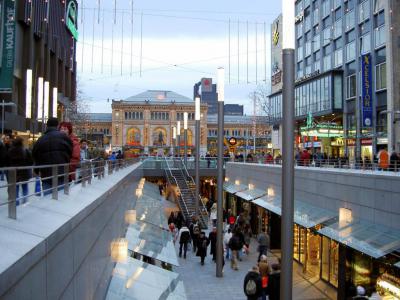
Train Station Street--or Bahnhofstrasse, as the locals say--is Hanover's main shopping street. It runs from Kropcke Platz, the central square, to the main train station. Until 1968, Train Station Street was a regular road with car traffic and city trams. But today, the street has been pedestrianized.
The main roadway was built in 1843 to connect Ernst August City with the train station. It was surrounded by commercial buildings, but most of those were destroyed during World War II. As a result, most of the buildings you see today have been built in the post-war era of the 20th century. Today you'll find typical chain stores.
Below street level is the Niki-de-Saint-Phalle Promenade. The Promenade may sit below the street, but it is open at the top to feel more like a lower level than a tunnel. It was built in the 1970s as part of a project to expand the city's underground rail infrastructure. Four lines of light commuter rail run under the Promenade level.
The Promenade is named in honor of Niki de Saint Phalle, a Franco-Swiss modern painter and sculptor. She created the famous "Nana" figures in Hannover that you can find on Sculpture Mile (Skulpturenmeile). Additionally, the Sprengel Museum houses over 400 of her works.
The main roadway was built in 1843 to connect Ernst August City with the train station. It was surrounded by commercial buildings, but most of those were destroyed during World War II. As a result, most of the buildings you see today have been built in the post-war era of the 20th century. Today you'll find typical chain stores.
Below street level is the Niki-de-Saint-Phalle Promenade. The Promenade may sit below the street, but it is open at the top to feel more like a lower level than a tunnel. It was built in the 1970s as part of a project to expand the city's underground rail infrastructure. Four lines of light commuter rail run under the Promenade level.
The Promenade is named in honor of Niki de Saint Phalle, a Franco-Swiss modern painter and sculptor. She created the famous "Nana" figures in Hannover that you can find on Sculpture Mile (Skulpturenmeile). Additionally, the Sprengel Museum houses over 400 of her works.
2) Altes Rathaus (Old Town Hall) (must see)
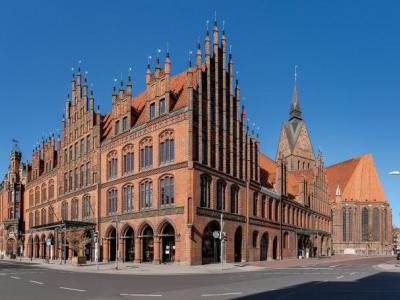
The Old Town Hall was built in 1410 and is Hannover's oldest secular building. Old Town Hall features an impressive red-brick Gothic facade.
The Koebelinger Street wing is known as the Chemist's Wingand housed the town's pharmacy. Architect Conrad Wilhelm Hase rebuilt this wing in Italian Romanesque style in the 1800s.
Hase also renovated the other wings to reflect their original 16th-century style with stunning gothic gables and decorative panels.
Visitors will find a variety of royal portraits and coats of arms on the walls. In addition, visitors can see a picture showing the "Luderziehen," a game played in the Middle Ages. Instead of using a rope, participants would play tug of war with their little fingers.
The town hall was damaged during World War II and restored in 1953 and 1964. Today, visitors can tour the building and enjoy the modern restaurant on the first floor.
The Koebelinger Street wing is known as the Chemist's Wingand housed the town's pharmacy. Architect Conrad Wilhelm Hase rebuilt this wing in Italian Romanesque style in the 1800s.
Hase also renovated the other wings to reflect their original 16th-century style with stunning gothic gables and decorative panels.
Visitors will find a variety of royal portraits and coats of arms on the walls. In addition, visitors can see a picture showing the "Luderziehen," a game played in the Middle Ages. Instead of using a rope, participants would play tug of war with their little fingers.
The town hall was damaged during World War II and restored in 1953 and 1964. Today, visitors can tour the building and enjoy the modern restaurant on the first floor.
3) Aegidienkirche (Aegidia Church) (must see)
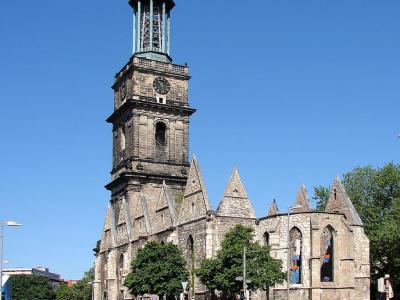
The Gothic-style Aegidien Church was built in 1347. It sits on the location of a 12th-century Romanesque church. Hanover's 16th century Reformation began in Aegidiean Church. In the early 1700s, a Baroque facade was added to the church's steeple. In 1826, Georg Ludwig Friedrich Laves remodeled the church's interior.
In 1943, the church was destroyed by World War II bombs. The church was left in ruins with only its outer walls intact. The church was not rebuilt after the war, rather it today functions as a war memorial. In 1959, Kurt Lehmann designed and installed a monumental sculpture called Humility.
The outer walls feature many Baroque epitaphs, including one dedicated to Susanna Magdalena Oldekop, who died as a child in 1648.
A relief known as the Siebenmannenstein shows seven praying men who allegedly sacrificed themselves to save the town. The men are known as "Hannover's Spartans," who died during an attack on Dohren Tower in 1480. The Siebenmannenstein relief is a copy. The original can be seen in the Hannover Historical Museum.
The contemplative Schattenlinie artwork features a white stone line that capture's the church's shadow. This artwork is a symbol of life and death, and of light and shadows.
Hiroshima, Japan, is Hanover's sister city. Hiroshima donated a peace bell to Hanover, and it is now located in the Aegidien Church's tower. It is rung every year on Hiroshima Day which is August 6th.
In 1943, the church was destroyed by World War II bombs. The church was left in ruins with only its outer walls intact. The church was not rebuilt after the war, rather it today functions as a war memorial. In 1959, Kurt Lehmann designed and installed a monumental sculpture called Humility.
The outer walls feature many Baroque epitaphs, including one dedicated to Susanna Magdalena Oldekop, who died as a child in 1648.
A relief known as the Siebenmannenstein shows seven praying men who allegedly sacrificed themselves to save the town. The men are known as "Hannover's Spartans," who died during an attack on Dohren Tower in 1480. The Siebenmannenstein relief is a copy. The original can be seen in the Hannover Historical Museum.
The contemplative Schattenlinie artwork features a white stone line that capture's the church's shadow. This artwork is a symbol of life and death, and of light and shadows.
Hiroshima, Japan, is Hanover's sister city. Hiroshima donated a peace bell to Hanover, and it is now located in the Aegidien Church's tower. It is rung every year on Hiroshima Day which is August 6th.
4) Neues Rathaus (New City Hall) (must see)
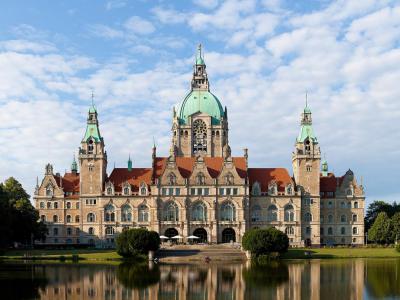
The New City Hall, which was inaugurated in 1913 and dedicated by Emperor Wilhelm II, is an impressive architectural masterpiece. During its construction, the city director proudly informed the Emperor that the entire building had been funded with cash, amounting to over ten million marks.
This remarkable edifice resembles a castle and boasts an eclectic architectural style. Situated alongside the Leine River, New City Hall presents a breathtaking sight at night when its lights cast shimmering reflections in the water.
The centerpiece of New City Hall is its towering dome, reaching a height of 97.73 meters (320.6 feet) and offering panoramic views of the Harz mountain range from its observation platform. The dome is equipped with a unique elevator that ascends at a 17-degree angle, covering a distance of 50 meters (160 feet). Originally in operation from 1913 to 2007, this lift was eventually replaced with a new one.
Unfortunately, New City Hall suffered damage during World War II when American forces bombed the city. In 1946, the proclamation of the German state of Niedersachsen was made from within its walls.
Presently, New City Hall serves as the administrative hub for the Lord Mayor's offices and hosts various political committee meetings, as well as official receptions for guests. Additionally, the building hosts a range of exhibitions throughout the year.
Visitors to New City Hall can explore four Hannover city models on the ground floor, each depicting the city's evolution over different historical periods, including the Middle Ages, pre-World War II, post-World War II, and the contemporary era. Furthermore, guests are invited to savor a refined dining experience at the Garden Hall bistro.
Tip:
Pay a few euros and take the elevator to the dome. With its glass floor, the view up and down is brilliant! Once you emerge from the shaft you have to take several spiral staircases to the very top of the dome. Be prepared to be blown away by the wind and by the incredible views of Hannover itself. Finally, you can have a casual lunch or tea in the beautifully appointed restaurant.
This remarkable edifice resembles a castle and boasts an eclectic architectural style. Situated alongside the Leine River, New City Hall presents a breathtaking sight at night when its lights cast shimmering reflections in the water.
The centerpiece of New City Hall is its towering dome, reaching a height of 97.73 meters (320.6 feet) and offering panoramic views of the Harz mountain range from its observation platform. The dome is equipped with a unique elevator that ascends at a 17-degree angle, covering a distance of 50 meters (160 feet). Originally in operation from 1913 to 2007, this lift was eventually replaced with a new one.
Unfortunately, New City Hall suffered damage during World War II when American forces bombed the city. In 1946, the proclamation of the German state of Niedersachsen was made from within its walls.
Presently, New City Hall serves as the administrative hub for the Lord Mayor's offices and hosts various political committee meetings, as well as official receptions for guests. Additionally, the building hosts a range of exhibitions throughout the year.
Visitors to New City Hall can explore four Hannover city models on the ground floor, each depicting the city's evolution over different historical periods, including the Middle Ages, pre-World War II, post-World War II, and the contemporary era. Furthermore, guests are invited to savor a refined dining experience at the Garden Hall bistro.
Tip:
Pay a few euros and take the elevator to the dome. With its glass floor, the view up and down is brilliant! Once you emerge from the shaft you have to take several spiral staircases to the very top of the dome. Be prepared to be blown away by the wind and by the incredible views of Hannover itself. Finally, you can have a casual lunch or tea in the beautifully appointed restaurant.
5) Berggarten (Mountain Garden) (must see)
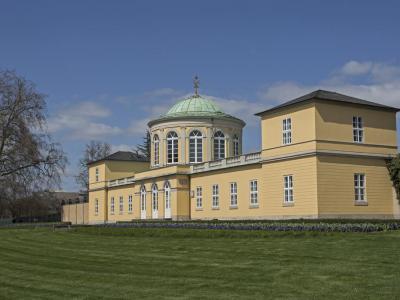
The Mountain Garden (Berggarten), located in the Herrenhausen district of Hanover, originally started as a vegetable and nursery garden on the side of an Ice Age sand dune. Over time, it transformed into a botanical garden. In the year 2000, a rainforest house was constructed here, which was later converted into an aquarium in 2006. This garden is part of the Herrenhausen Gardens, along with the Great Garden, Georgengarten, and Welfengarten.
Within the Mountain Garden, you can explore various show houses and themed gardens that currently house an impressive collection of 11,000 different plants from diverse climatic regions. Notably, it boasts the largest orchid collection in Europe.
There are plans to replace the 40-year-old Canary House with a new three-part show house. This new structure will provide a better environment for the growth of trees and towering inflorescences from the Canary Islands and the Mediterranean region. One section of the building will accommodate a warm water basin for giant tropical water lilies and serve as a habitat for exotic butterflies. Construction is set to commence in 2022 with an expected completion date in 2024.
Previously, the site where the Rainforest House stands was the location of the Palm House Expo 2000. The Rainforest House was initially designed to replicate an artificial tropical landscape, housing butterflies, frogs, and smaller bird species from tropical regions. However, it had to be closed down in 2006 due to its high operational costs.
Subsequently, the Rainforest House was transformed into a Sealife Aquarium, preserving the tropical rainforest environment. It is the first almost entirely tropical sealife center, featuring a deep-sea basin with a capacity of 300,000 liters of water. Visitors can observe a large ocean basin inhabited by sharks and turtles through an eight-meter-long acrylic glass tunnel, which is four meters deep.
Within the Mountain Garden, you can explore various show houses and themed gardens that currently house an impressive collection of 11,000 different plants from diverse climatic regions. Notably, it boasts the largest orchid collection in Europe.
There are plans to replace the 40-year-old Canary House with a new three-part show house. This new structure will provide a better environment for the growth of trees and towering inflorescences from the Canary Islands and the Mediterranean region. One section of the building will accommodate a warm water basin for giant tropical water lilies and serve as a habitat for exotic butterflies. Construction is set to commence in 2022 with an expected completion date in 2024.
Previously, the site where the Rainforest House stands was the location of the Palm House Expo 2000. The Rainforest House was initially designed to replicate an artificial tropical landscape, housing butterflies, frogs, and smaller bird species from tropical regions. However, it had to be closed down in 2006 due to its high operational costs.
Subsequently, the Rainforest House was transformed into a Sealife Aquarium, preserving the tropical rainforest environment. It is the first almost entirely tropical sealife center, featuring a deep-sea basin with a capacity of 300,000 liters of water. Visitors can observe a large ocean basin inhabited by sharks and turtles through an eight-meter-long acrylic glass tunnel, which is four meters deep.
