Custom Walk in Verona, Italy by domnadk7322 created on 2025-12-10
Guide Location: Italy » Verona
Guide Type: Custom Walk
# of Sights: 6
Tour Duration: 1 Hour(s)
Travel Distance: 2.1 Km or 1.3 Miles
Share Key: KJL5L
Guide Type: Custom Walk
# of Sights: 6
Tour Duration: 1 Hour(s)
Travel Distance: 2.1 Km or 1.3 Miles
Share Key: KJL5L
How It Works
Please retrieve this walk in the GPSmyCity app. Once done, the app will guide you from one tour stop to the next as if you had a personal tour guide. If you created the walk on this website or come to the page via a link, please follow the instructions below to retrieve the walk in the app.
Retrieve This Walk in App
Step 1. Download the app "GPSmyCity: Walks in 1K+ Cities" on Apple App Store or Google Play Store.



Step 2. In the GPSmyCity app, download(or launch) the guide "Verona Map and Walking Tours".
Step 3. Tap the menu button located at upper right corner of the "Walks" screen and select "Retrieve custom walk". Enter the share key: KJL5L
1) Verona Cathedral (must see)
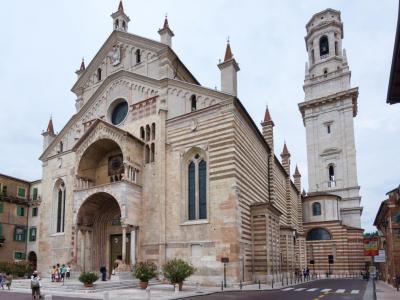
Verona Cathedral is dedicated to the Assumption of the Virgin Mary and stands on the site of earlier churches destroyed in the 1117 earthquake. The present structure, consecrated in 1187, is largely Romanesque, with Gothic elements added during later renovations. It remains the heart of Verona’s historic religious complex.
The west façade features a double porch, Lombard bands, and small pinnacles typical of northern Italian Romanesque. The main portal, sculpted by Maestro Nicolò in 1139, includes reliefs of Saint John the Evangelist and Saint John the Baptist, as well as legendary protectors Roland and Oliver.
Ten prophets flank the doorway, and the tympanum above depicts the Virgin and Child, the Adoration of the Magi, and the Adoration of the Shepherds, forming a complete Nativity cycle. On the south side, a 12th-century portal carved by Peregrinus shows scenes from the story of Jonah. The bell tower, begun in the 16th century and finished only in the 20th, reflects a mix of styles.
Inside, a 15th-century Gothic renovation introduced pointed arches supported by alternating red and white Verona marble columns. The church contains several noteworthy works of art, including Titian’s “Assumption of the Virgin” in the left transept — one of Verona’s finest Renaissance paintings — and a Crucifixion by Giambattista da Verona from 1534. In the western bays, frescoes by Giovanni Maria Falconetto date to 1503.
The Chapter Library, connected to the cathedral, is among Europe’s most important ecclesiastical libraries and holds exceptional manuscripts, including the Leonine Sacramentary, regarded as the oldest surviving text of the Roman Rite. Just steps away, the Canons’ Cloister reveals archaeological remains of earlier cathedral buildings, helping visitors visualize how the site evolved from early Christianity onward.
Tip:
Continue to the Baptistery of Saint Giovanni in Fonte, featuring an impressive octagonal baptismal font richly carved with Biblical scenes. The archaeological areas and audio guide provide helpful explanations of the cathedral’s Roman origins and later transformations.
The west façade features a double porch, Lombard bands, and small pinnacles typical of northern Italian Romanesque. The main portal, sculpted by Maestro Nicolò in 1139, includes reliefs of Saint John the Evangelist and Saint John the Baptist, as well as legendary protectors Roland and Oliver.
Ten prophets flank the doorway, and the tympanum above depicts the Virgin and Child, the Adoration of the Magi, and the Adoration of the Shepherds, forming a complete Nativity cycle. On the south side, a 12th-century portal carved by Peregrinus shows scenes from the story of Jonah. The bell tower, begun in the 16th century and finished only in the 20th, reflects a mix of styles.
Inside, a 15th-century Gothic renovation introduced pointed arches supported by alternating red and white Verona marble columns. The church contains several noteworthy works of art, including Titian’s “Assumption of the Virgin” in the left transept — one of Verona’s finest Renaissance paintings — and a Crucifixion by Giambattista da Verona from 1534. In the western bays, frescoes by Giovanni Maria Falconetto date to 1503.
The Chapter Library, connected to the cathedral, is among Europe’s most important ecclesiastical libraries and holds exceptional manuscripts, including the Leonine Sacramentary, regarded as the oldest surviving text of the Roman Rite. Just steps away, the Canons’ Cloister reveals archaeological remains of earlier cathedral buildings, helping visitors visualize how the site evolved from early Christianity onward.
Tip:
Continue to the Baptistery of Saint Giovanni in Fonte, featuring an impressive octagonal baptismal font richly carved with Biblical scenes. The archaeological areas and audio guide provide helpful explanations of the cathedral’s Roman origins and later transformations.
2) Torre dei Lamberti (Lamberti Tower) (must see)
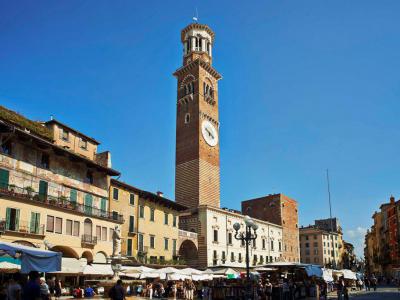
Lamberti Tower is one of Verona’s most recognizable landmarks, built beginning in 1172 by the influential Lamberti family, at a time when prominent Veronese households constructed tall towers to express their wealth and political influence. Over the centuries, the tower has undergone several phases of modification, including a major restoration following a lightning strike in 1403. This reconstruction campaign, which lasted from 1448 to 1464, introduced visible changes in materials and extended the structure to its current height of 84 metres.
The tower features two bells, each with a distinct civic purpose. The Rengo bell once summoned citizens to arms or to public assemblies, while the Marangona signaled work hours, timekeeping, and fire warnings. These bells were central to the daily lives of medieval and Renaissance residents, long before the advent of printed notices or municipal clocks. Their sound was so important that strict laws governed when and how each bell could be rung.
Visitors today can take an elevator partway up and then climb the remaining stairs to reach the main viewing terrace. From the top, the view extends across the historic center — from Market Square directly below to the rooftops and bell towers that define Verona’s skyline — and outward to the Adige River and the surrounding hills. The tower’s clock, a late-18th-century addition, enhanced its civic importance and remains one of the most visible timekeepers in the city.
Today, Lamberti Tower is part of the vast Palace of the Reason complex and is included in Verona’s network of civic museums, hosting temporary exhibitions and occasional special events in its interior spaces. It continues to serve as a key point of orientation for locals and travellers alike.
The tower features two bells, each with a distinct civic purpose. The Rengo bell once summoned citizens to arms or to public assemblies, while the Marangona signaled work hours, timekeeping, and fire warnings. These bells were central to the daily lives of medieval and Renaissance residents, long before the advent of printed notices or municipal clocks. Their sound was so important that strict laws governed when and how each bell could be rung.
Visitors today can take an elevator partway up and then climb the remaining stairs to reach the main viewing terrace. From the top, the view extends across the historic center — from Market Square directly below to the rooftops and bell towers that define Verona’s skyline — and outward to the Adige River and the surrounding hills. The tower’s clock, a late-18th-century addition, enhanced its civic importance and remains one of the most visible timekeepers in the city.
Today, Lamberti Tower is part of the vast Palace of the Reason complex and is included in Verona’s network of civic museums, hosting temporary exhibitions and occasional special events in its interior spaces. It continues to serve as a key point of orientation for locals and travellers alike.
3) Casa de Giulietta (House of Juliet) (must see)
The House of Juliet is one of the most famous landmarks associated with William Shakespeare’s Romeo and Juliet, often visited by those seeking to experience the legendary romance between Juliet Capulet and Romeo Montague. Though the story is fictional, the house itself has become a symbol of love and tragedy, drawing countless visitors who are eager to connect with Verona’s most romantic tale.
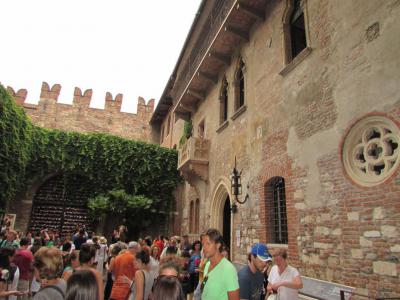
The house dates back to the 13th century and is believed to have belonged to the Cappelletti family, traditionally linked to Juliet’s fictional lineage. The most famous feature of the house is its balcony, now an enduring emblem of Juliet’s longing in the play. Visitors often picture the moment when Romeo whispers his devotion from below. Although the balcony itself was added during restoration in the 20th century, it remains one of the city’s most photographed sights and a key highlight for fans of Shakespeare’s work.
The building is a fine example of medieval architecture, featuring Gothic elements, a brick façade, and intricately carved details. In the courtyard, a bronze statue of Juliet stands beneath the balcony, and the tradition of rubbing its right breast for good luck in love has made it a popular spot for photos. The walls nearby are covered with love messages, notes, and padlocks left by couples hoping for lasting affection.
Inside, the house has been transformed into a museum, displaying period furnishings, costumes used in film adaptations, and exhibits about the cultural impact of Shakespeare’s tragic story. From its romantic folklore to its historical roots, the House of Juliet continues to inspire visitors from around the world with the enduring power of love and imagination.
The house dates back to the 13th century and is believed to have belonged to the Cappelletti family, traditionally linked to Juliet’s fictional lineage. The most famous feature of the house is its balcony, now an enduring emblem of Juliet’s longing in the play. Visitors often picture the moment when Romeo whispers his devotion from below. Although the balcony itself was added during restoration in the 20th century, it remains one of the city’s most photographed sights and a key highlight for fans of Shakespeare’s work.
The building is a fine example of medieval architecture, featuring Gothic elements, a brick façade, and intricately carved details. In the courtyard, a bronze statue of Juliet stands beneath the balcony, and the tradition of rubbing its right breast for good luck in love has made it a popular spot for photos. The walls nearby are covered with love messages, notes, and padlocks left by couples hoping for lasting affection.
Inside, the house has been transformed into a museum, displaying period furnishings, costumes used in film adaptations, and exhibits about the cultural impact of Shakespeare’s tragic story. From its romantic folklore to its historical roots, the House of Juliet continues to inspire visitors from around the world with the enduring power of love and imagination.
4) Arena di Verona (Verona Amphitheater) (must see)
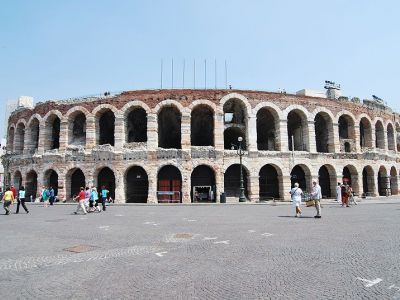
Verona Amphitheater stands as one of the most remarkable Roman amphitheatres still in existence. Built around 30 AD, it once formed the lively heart of entertainment in ancient Verona. Its elliptical shape, strong stone arches, and imposing tiers made it a masterpiece of Roman engineering, perfectly designed to host crowds who came to witness gladiatorial combat and public spectacles. Today, more than 500,000 visitors each year step into the Arena to reconnect with this extraordinary past.
Constructed from pink and white limestone quarried in nearby Valpolicella, the amphitheatre originally seated up to 30,000 spectators. A devastating earthquake in 1117 damaged the structure and destroyed most of its outer ring, leaving only a single surviving portion, known as the “Wing”. Even with a reduced capacity of around 22,000, the Arena still conveys the scale and innovation that made it one of the largest venues in the Roman world.
In the modern era, the Arena has earned international acclaim as the home of the Verona Opera Festival, held every summer beneath the open sky. Its acoustics are so exceptional that performers often sing without amplification, their voices carried naturally through the ancient stone. Legendary operatic stars such as Maria Callas, Plácido Domingo, and Luciano Pavarotti have graced this stage, along with world-renowned rock and pop artists.
Visiting the Arena offers a chance to explore its historic passageways, climb the stone seating tiers, and admire views across Bra Square. Yet the most unforgettable experience comes at night, when the amphitheatre glows beneath the lights and a performance begins.
Constructed from pink and white limestone quarried in nearby Valpolicella, the amphitheatre originally seated up to 30,000 spectators. A devastating earthquake in 1117 damaged the structure and destroyed most of its outer ring, leaving only a single surviving portion, known as the “Wing”. Even with a reduced capacity of around 22,000, the Arena still conveys the scale and innovation that made it one of the largest venues in the Roman world.
In the modern era, the Arena has earned international acclaim as the home of the Verona Opera Festival, held every summer beneath the open sky. Its acoustics are so exceptional that performers often sing without amplification, their voices carried naturally through the ancient stone. Legendary operatic stars such as Maria Callas, Plácido Domingo, and Luciano Pavarotti have graced this stage, along with world-renowned rock and pop artists.
Visiting the Arena offers a chance to explore its historic passageways, climb the stone seating tiers, and admire views across Bra Square. Yet the most unforgettable experience comes at night, when the amphitheatre glows beneath the lights and a performance begins.
5) Piazza Bra (Bra Square) (must see)
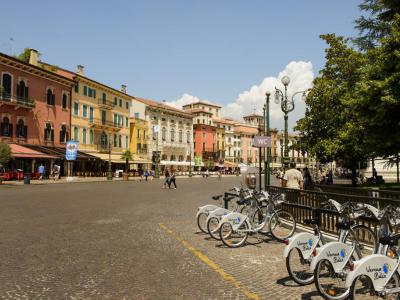
Bra Square, often simply called “La Bra”, is the largest and most prominent square in Verona. Positioned at the edge of the historic center, it acts as a welcoming entrance to the city’s most celebrated landmarks. Its name derives from the Lombard word braida, meaning “wide open space”, a reminder of when this area lay just beyond the Roman city walls, used as an open field for markets and gatherings.
The square began to develop its current shape in the Middle Ages, as Verona expanded outward from the ancient core. Over the centuries, noble families and city authorities commissioned grand residences and civic buildings around the perimeter. By the 17th and 18th centuries, the area had transformed into an elegant public space, reflecting influences from Palladian and later Neoclassical styles. It has hosted everything from military parades to community celebrations and remains one of the busiest civic squares in northern Italy.
The dominant feature of the square is the Verona Arena, a 1st-century Roman amphitheater renowned for its impressive state of preservation and exceptional acoustics. Nearby stands Barbieri Palace, Verona’s neoclassical City Hall, completed in the mid-19th century, and Gran Guardia Palace, a large 17th-century building that now serves as a venue for major exhibitions and cultural events.
Visitors can stroll along the Liston, the marble-paved walkway lined with cafés and restaurants — a popular place to sit outdoors and enjoy the atmosphere. On the southern side, small green gardens provide shaded seating and feature monuments such as the Bersaglieri Monument, dedicated to Italy’s historic light infantry regiment. Traces of the ancient Roman walls and later fortifications remain are also visible.
The square began to develop its current shape in the Middle Ages, as Verona expanded outward from the ancient core. Over the centuries, noble families and city authorities commissioned grand residences and civic buildings around the perimeter. By the 17th and 18th centuries, the area had transformed into an elegant public space, reflecting influences from Palladian and later Neoclassical styles. It has hosted everything from military parades to community celebrations and remains one of the busiest civic squares in northern Italy.
The dominant feature of the square is the Verona Arena, a 1st-century Roman amphitheater renowned for its impressive state of preservation and exceptional acoustics. Nearby stands Barbieri Palace, Verona’s neoclassical City Hall, completed in the mid-19th century, and Gran Guardia Palace, a large 17th-century building that now serves as a venue for major exhibitions and cultural events.
Visitors can stroll along the Liston, the marble-paved walkway lined with cafés and restaurants — a popular place to sit outdoors and enjoy the atmosphere. On the southern side, small green gardens provide shaded seating and feature monuments such as the Bersaglieri Monument, dedicated to Italy’s historic light infantry regiment. Traces of the ancient Roman walls and later fortifications remain are also visible.
6) Ponte Scaligero (Scaligero Bridge) (must see)
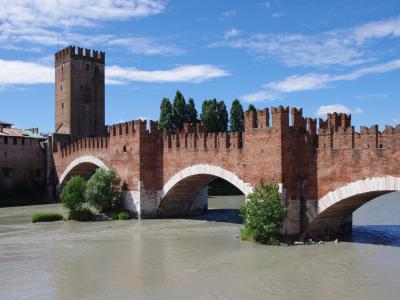
The Scaligero Bridge, also known as the Castelvecchio Bridge, is a remarkable three-arch span crossing the Adige River. Built around 1354 and 1356 by the Scaliger family, it served a vital defensive purpose as a swift escape route from the Old Castle toward the protection of the family’s allies in Tyrol, where ruler Cangrande II’s son-in-law held influence. Today, its elevated walkway provides stunning views of Verona and the river winding through the city.
Stretching roughly 120 meters, the bridge is one of Verona’s most photographed landmarks and remains a popular pedestrian route. The original structure was destroyed in 1945 by retreating German troops during World War II, but a meticulous reconstruction in the 1950s reused a significant portion of the recovered stonework, restoring the bridge closely to its medieval appearance. During reconstruction, archaeologists documented original Roman foundations beneath parts of the structure, highlighting the strategic importance of this river crossing long before the Scaligers’ fortifications.
Its fortified design — red brick battlements above and white stone below — gives the impression of a fortress set across the river. A charming local legend claims that the Lord of Verona rewarded the bridge’s anonymous engineer with Saint Martin’s sword for his success. Because the bridge was designed wide enough for mounted soldiers to cross quickly, it stood out as one of the most innovative defensive bridges of its time.
By day, the bridge’s crenellations appear bold and powerful, while at night, illuminated against the water, it becomes one of Verona’s most atmospheric and romantic sights. The viewpoint from the bridge also frames Saint Peter’s Castle in the distance, another historically significant hilltop fortification.
Stretching roughly 120 meters, the bridge is one of Verona’s most photographed landmarks and remains a popular pedestrian route. The original structure was destroyed in 1945 by retreating German troops during World War II, but a meticulous reconstruction in the 1950s reused a significant portion of the recovered stonework, restoring the bridge closely to its medieval appearance. During reconstruction, archaeologists documented original Roman foundations beneath parts of the structure, highlighting the strategic importance of this river crossing long before the Scaligers’ fortifications.
Its fortified design — red brick battlements above and white stone below — gives the impression of a fortress set across the river. A charming local legend claims that the Lord of Verona rewarded the bridge’s anonymous engineer with Saint Martin’s sword for his success. Because the bridge was designed wide enough for mounted soldiers to cross quickly, it stood out as one of the most innovative defensive bridges of its time.
By day, the bridge’s crenellations appear bold and powerful, while at night, illuminated against the water, it becomes one of Verona’s most atmospheric and romantic sights. The viewpoint from the bridge also frames Saint Peter’s Castle in the distance, another historically significant hilltop fortification.
