Custom Walk in Cartagena, Colombia by jyao2007_747eb2 created on 2026-01-15
Guide Location: Colombia » Cartagena
Guide Type: Custom Walk
# of Sights: 8
Tour Duration: 3 Hour(s)
Travel Distance: 6.5 Km or 4 Miles
Share Key: SVRUN
Guide Type: Custom Walk
# of Sights: 8
Tour Duration: 3 Hour(s)
Travel Distance: 6.5 Km or 4 Miles
Share Key: SVRUN
How It Works
Please retrieve this walk in the GPSmyCity app. Once done, the app will guide you from one tour stop to the next as if you had a personal tour guide. If you created the walk on this website or come to the page via a link, please follow the instructions below to retrieve the walk in the app.
Retrieve This Walk in App
Step 1. Download the app "GPSmyCity: Walks in 1K+ Cities" on Apple App Store or Google Play Store.



Step 2. In the GPSmyCity app, download(or launch) the guide "Cartagena Map and Walking Tours".
Step 3. Tap the menu button located at upper right corner of the "Walks" screen and select "Retrieve custom walk". Enter the share key: SVRUN
1) Convento de la Popa (La Popa Convent) (must see)
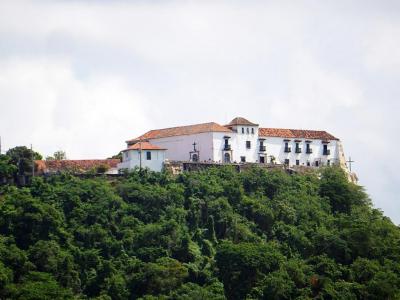
La Popa Convent (Convento de la Popa) stands in a stunning location atop Mount la Popa, the highest point in Cartagena. The origins of this marvelous convent date back to the early 17th century when, around 1607, the first wooden chapel was built. Soon after, the construction of a monastery began and was completed several years later.
La Popa Convent translates to "Convent of the Stern." It gets its name from the high hill where it stands, called this for its resemblance to the stern of a boat. The convent features classic Spanish Colonial architecture, with white stucco walls, arched entryways, small balconies, and a red tiled roof.
There is a lovely little chapel with a superb altarpiece, very ornately done in gold. In a central spot on the altar is an elaborately costumed statue of Our Lady of the Candles (La Virgen de la Candelaria). A feast is held in Cartagena each year in early February to celebrate her. Around the monastery are displays and artifacts that help visitors learn about the history of the convent.
A visit to the convent would not be complete without a stroll through the charming inner courtyard (also known as the cloister). This beautiful courtyard sits surrounded by a two-story stone arcade and a mezzanine that overlooks the brick patio below. It is gorgeous, filled with potted palm trees, hanging plants, and Bougainvillea vines.
This convent is open to the public. Access to the convent is via a curved road up the hill. Its location, high above the city, offers spectacular panoramic views of Cartagena and the Caribbean sea.
La Popa Convent translates to "Convent of the Stern." It gets its name from the high hill where it stands, called this for its resemblance to the stern of a boat. The convent features classic Spanish Colonial architecture, with white stucco walls, arched entryways, small balconies, and a red tiled roof.
There is a lovely little chapel with a superb altarpiece, very ornately done in gold. In a central spot on the altar is an elaborately costumed statue of Our Lady of the Candles (La Virgen de la Candelaria). A feast is held in Cartagena each year in early February to celebrate her. Around the monastery are displays and artifacts that help visitors learn about the history of the convent.
A visit to the convent would not be complete without a stroll through the charming inner courtyard (also known as the cloister). This beautiful courtyard sits surrounded by a two-story stone arcade and a mezzanine that overlooks the brick patio below. It is gorgeous, filled with potted palm trees, hanging plants, and Bougainvillea vines.
This convent is open to the public. Access to the convent is via a curved road up the hill. Its location, high above the city, offers spectacular panoramic views of Cartagena and the Caribbean sea.
2) Castillo San Felipe de Barajas (San Felipe de Barajas Castle) (must see)
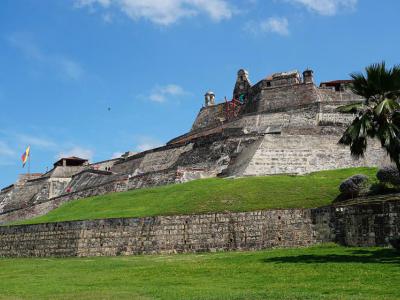
San Felipe de Barajas Castle (Castillo San Felipe de Barajas) is an old fortress located in Cartagena. It was built by the Spanish during the colonial period, to protect the city from attack by enemies and pirates.
The construction of the fortress began in 1536 under the direction of the Spanish engineer Antonio de Arévalo. However, the original structure was small and inadequate, so it was expanded and improved by subsequent Spanish engineers.
The most significant expansion of the fortress took place in the 17th century when the Spanish engineer Bautista Antonelli designed and built the present-day structure. Antonelli's design included a series of walls and bastions that made the fortress nearly impregnable.
The fortress played a crucial role in Cartagena's defense against various attacks by enemies and pirates, including the English, in 1741, during the War of Jenkins' Ear. The fortress held off the English for two months, and the battle ended with the Spanish victory.
During the 19th and 20th centuries, the fortress lost its military significance and was used for various purposes, including as a prison and a hospital. In 1984, UNESCO declared the historic center of Cartagena, including the fortress, a World Heritage Site.
Today, San Felipe de Barajas Castle is a popular tourist attraction in Cartagena. Visitors can explore the castle and learn about its history through exhibits and guided tours. The fortress also offers panoramic views of the city and the Caribbean Sea.
The construction of the fortress began in 1536 under the direction of the Spanish engineer Antonio de Arévalo. However, the original structure was small and inadequate, so it was expanded and improved by subsequent Spanish engineers.
The most significant expansion of the fortress took place in the 17th century when the Spanish engineer Bautista Antonelli designed and built the present-day structure. Antonelli's design included a series of walls and bastions that made the fortress nearly impregnable.
The fortress played a crucial role in Cartagena's defense against various attacks by enemies and pirates, including the English, in 1741, during the War of Jenkins' Ear. The fortress held off the English for two months, and the battle ended with the Spanish victory.
During the 19th and 20th centuries, the fortress lost its military significance and was used for various purposes, including as a prison and a hospital. In 1984, UNESCO declared the historic center of Cartagena, including the fortress, a World Heritage Site.
Today, San Felipe de Barajas Castle is a popular tourist attraction in Cartagena. Visitors can explore the castle and learn about its history through exhibits and guided tours. The fortress also offers panoramic views of the city and the Caribbean Sea.
3) Callejón Angosto (Narrow Alley)/Calle de las Sombrillas (Umbrella Street)
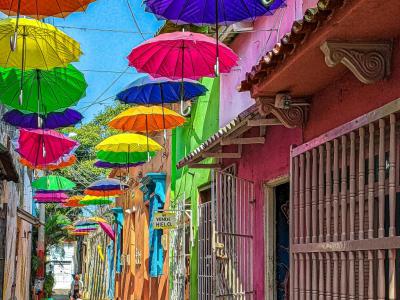
Formerly known as Callejón Angosto (Narrow Alley), this is indeed one of the narrowest streets in Getsemani. In recent years, in a bid to add color to its coral stone walls, the area – just like many other places around the world – embraced a new look with the help of an old accessory, the umbrella.
Being the first place in Colombia to put on such a look, the alleyway was subsequently renamed Calle de las Sombrillas (Umbrellas Street), becoming Cartagena's own Instagramable spot purposely designed for photo taking. A combination of overhanging umbrellas, colorful houses, and street art makes it undoubtedly one of the most picturesque locations in the city, especially when it's lit up at night.
The umbrellas proved a welcome addition from both artistic and practical standpoints, too, providing the much-needed shade from the scorching heat during midday, as well as protecting walkers from torrential rains when they come.
Having taken your must-have picture here, consider leaving a small tip in the box at the end of the street, as this is one of the few spots in Getsemaní that is still predominantly residential.
Being the first place in Colombia to put on such a look, the alleyway was subsequently renamed Calle de las Sombrillas (Umbrellas Street), becoming Cartagena's own Instagramable spot purposely designed for photo taking. A combination of overhanging umbrellas, colorful houses, and street art makes it undoubtedly one of the most picturesque locations in the city, especially when it's lit up at night.
The umbrellas proved a welcome addition from both artistic and practical standpoints, too, providing the much-needed shade from the scorching heat during midday, as well as protecting walkers from torrential rains when they come.
Having taken your must-have picture here, consider leaving a small tip in the box at the end of the street, as this is one of the few spots in Getsemaní that is still predominantly residential.
4) Calle de San Juan (San Juan Street)
Stemming from Calle de la Sierpe to the south is a curved, narrow alley – Calle de San Juan (San Juan Street). Named after Saint John the Baptist, this is one of the few places in Cartagena to retain its original name from colonial times.
At 187 meters, this is also one of the longest “inner” streets in the Getsemaní neighborhood, and with a great deal of history packed inside these 187 meters, too. A century ago, this street was famed as the one inhabited by Admiral José Prudencio Padilla, the hero of the Expulsion of Mexico’s Spaniards in 1821-1836. More recently, it was the home of the notorious gangster, Samir Beetar, who made the name for himself among locals by helping needy neighbors and those with sick children pay for their medicine.
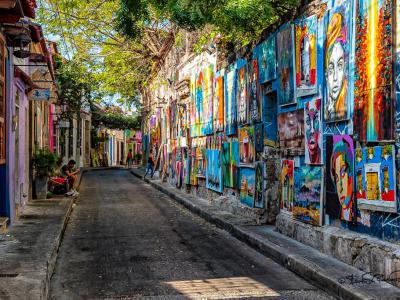
Still, what makes Calle de San Juan stand out today, at least in the eyes of numerous visitors, is the impressive collection of wall paintings coupled with an array of delightful cafes and restaurants lining the street. While the eateries and drinking establishments lure passers-by with their cozy atmosphere, the color palette of the surrounding artwork makes one feel as if drifting down the river of ink... Both pastimes are equally engaging!
At 187 meters, this is also one of the longest “inner” streets in the Getsemaní neighborhood, and with a great deal of history packed inside these 187 meters, too. A century ago, this street was famed as the one inhabited by Admiral José Prudencio Padilla, the hero of the Expulsion of Mexico’s Spaniards in 1821-1836. More recently, it was the home of the notorious gangster, Samir Beetar, who made the name for himself among locals by helping needy neighbors and those with sick children pay for their medicine.
Still, what makes Calle de San Juan stand out today, at least in the eyes of numerous visitors, is the impressive collection of wall paintings coupled with an array of delightful cafes and restaurants lining the street. While the eateries and drinking establishments lure passers-by with their cozy atmosphere, the color palette of the surrounding artwork makes one feel as if drifting down the river of ink... Both pastimes are equally engaging!
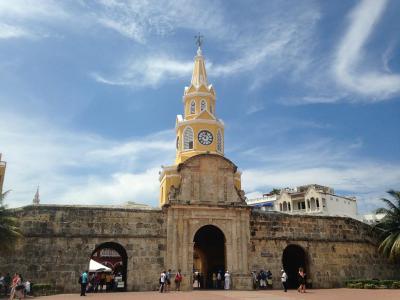
5) Torre del Reloj (Clock Tower) (must see)
The main entrance to the historic walled city of Cartagena is famously known as the Clock Tower (Torre del Reloj). This significant landmark, built into the city wall, features a trio of open archways that offer a gateway into the Old City. A stunning clock tower crowns the central arch. With Baroque architecture, this beautiful eight-sided tower is painted golden-yellow with white trim.
Construction of this gateway took place between 1601 and 1631. Initially, only the central archway existed as a portal to the city. It was known as the Mouth of the Bridge (Boca del Puente). The other two housed an armory and a chapel. The clock tower was added later, during the early 18th century.
The Clock Tower is located next to Cars Square (Plaza de Los Coches) just inside the city walls. This triangular-shaped city square has a dark past as the place that once held Cartagena's slave market. This past also included public gallows in the center of the town square. On the plaza, directly across from the clock tower, you'll find the well-liked Cartagena sweets market known as Sweets Portal (Portal de Los Dulces).
The clock tower gate also serves as a connection from the city to the nearby Getsemani neighborhood just outside the walls. Getsemani is now a hip neighborhood filled with graffiti art and brightly painted buildings. Don't miss the two statues of Pegasus located on a nearby road that leads to the outside of the clock tower.
Construction of this gateway took place between 1601 and 1631. Initially, only the central archway existed as a portal to the city. It was known as the Mouth of the Bridge (Boca del Puente). The other two housed an armory and a chapel. The clock tower was added later, during the early 18th century.
The Clock Tower is located next to Cars Square (Plaza de Los Coches) just inside the city walls. This triangular-shaped city square has a dark past as the place that once held Cartagena's slave market. This past also included public gallows in the center of the town square. On the plaza, directly across from the clock tower, you'll find the well-liked Cartagena sweets market known as Sweets Portal (Portal de Los Dulces).
The clock tower gate also serves as a connection from the city to the nearby Getsemani neighborhood just outside the walls. Getsemani is now a hip neighborhood filled with graffiti art and brightly painted buildings. Don't miss the two statues of Pegasus located on a nearby road that leads to the outside of the clock tower.
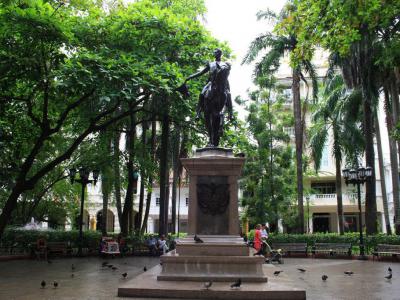
6) Plaza de Bolivar (Bolivar Square)
In the heart of the old walled city of Cartagena, you'll find Bolivar Square (Plaza de Bolivar). Inside this lovely square is a park full of lush greenery, shady trees, fountains, and plenty of benches that are perfect for relaxing on a sunny day. With its central location, it is considered the main square of the city.
In the center of the square is an equestrian statue of Simon Bolivar, the first president of Colombia, who was famously known as "The Liberator." The bronze statue rests on a granite pedestal and has had a prominent place in the square since 1896. It was created by Venezuelan artist and sculptor Eloy Palacios.
Around Bolivar Square are some lovely historic buildings stylized with features that include arcaded walkways, balconies, and tiled roofs. At one corner, you'll find the impressive Cartagena Cathedral. You will also find several intriguing museums around this square and nearby. Museums include the Palace of the Inquisition, the Zenu Gold Museum, and the Emerald Museum inside Caribe Jewelry.
Bolivar Square offers a shady tropical oasis in the center of Cartagena. You won't want to miss an exploration of this charming historical place.
In the center of the square is an equestrian statue of Simon Bolivar, the first president of Colombia, who was famously known as "The Liberator." The bronze statue rests on a granite pedestal and has had a prominent place in the square since 1896. It was created by Venezuelan artist and sculptor Eloy Palacios.
Around Bolivar Square are some lovely historic buildings stylized with features that include arcaded walkways, balconies, and tiled roofs. At one corner, you'll find the impressive Cartagena Cathedral. You will also find several intriguing museums around this square and nearby. Museums include the Palace of the Inquisition, the Zenu Gold Museum, and the Emerald Museum inside Caribe Jewelry.
Bolivar Square offers a shady tropical oasis in the center of Cartagena. You won't want to miss an exploration of this charming historical place.
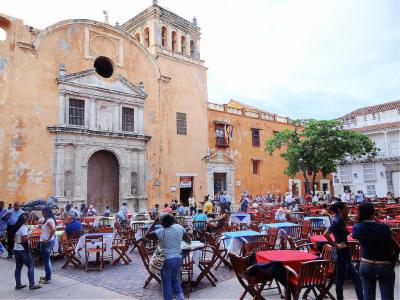
7) Plaza de Santo Domingo (Santo Domingo Square) (must see)
Plaza de Santo Domingo (Santo Domingo Square) is a vibrant square in the Old City of Cartagena. It was named after the beautiful church and convent Santo Domingo Church (also known as Santo Domingo Convent), which stands on one of its corners. The orange-yellow facade of the church and its massive arched entryway is striking. Check out the twisted bell tower on top.
With a gruesome past, this square was used during the Spanish Inquisition as a place for executions. The buildings surrounding Santo Domino Square boast Spanish Colonial architecture featuring balconies and red tile roofs. Around the square are shops, street vendors, lively restaurants, and plenty of outdoor tables for dining and relaxing.
Don't miss the famous "La Gorda Gertrudis" (Fat Gertrudis), a statue of a naked Rubenesque woman done in bronze. The sculpture was created by renowned artist Fernando Botero and stands in front of the church. It is a popular spot for taking photographs. The narrow nearby alleyways that branch off Santo Domingo Square are just ripe for exploration!
With a gruesome past, this square was used during the Spanish Inquisition as a place for executions. The buildings surrounding Santo Domino Square boast Spanish Colonial architecture featuring balconies and red tile roofs. Around the square are shops, street vendors, lively restaurants, and plenty of outdoor tables for dining and relaxing.
Don't miss the famous "La Gorda Gertrudis" (Fat Gertrudis), a statue of a naked Rubenesque woman done in bronze. The sculpture was created by renowned artist Fernando Botero and stands in front of the church. It is a popular spot for taking photographs. The narrow nearby alleyways that branch off Santo Domingo Square are just ripe for exploration!
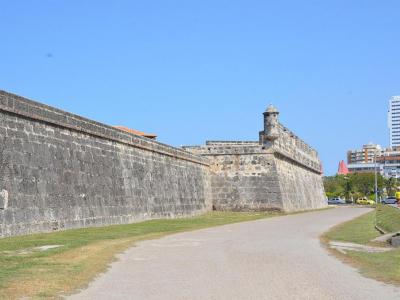
8) Murallas de Cartagena (Cartagena City Walls) (must see)
The walls around the Old City of Cartagena were built as protection against enemy attacks and pirate raids. The city walls reached completion in 1796 after nearly two centuries of construction. The wall is thick and well-constructed. Today, the walls represent one of the best-preserved fortifications in South America.
Walking along the Murallas de Cartagena (Cartagena City Walls) is a fun way to explore the walled site and offers fabulous views of the city and the glistening Caribbean Sea. The walls surround the historic Old Cartagena and stretch for 11 kilometers (just under seven miles). In spots along the wall, you'll find watch towers, old iron cannons, and lookout points.
A popular place to watch the sunset is from the Bastion of Santo Domingo, a fortification that marks the origin of the efforts to secure the city. Cafe del Mar is a restaurant with a central spot at the top of the bastion along the city walls. Relaxing on the walls and enjoying a drink is a great way to end a day exploring Cartagena.
Walking along the Murallas de Cartagena (Cartagena City Walls) is a fun way to explore the walled site and offers fabulous views of the city and the glistening Caribbean Sea. The walls surround the historic Old Cartagena and stretch for 11 kilometers (just under seven miles). In spots along the wall, you'll find watch towers, old iron cannons, and lookout points.
A popular place to watch the sunset is from the Bastion of Santo Domingo, a fortification that marks the origin of the efforts to secure the city. Cafe del Mar is a restaurant with a central spot at the top of the bastion along the city walls. Relaxing on the walls and enjoying a drink is a great way to end a day exploring Cartagena.
