Custom Walk in Aachen, Germany by christianbergemann92_f8e8da created on 2026-02-02
Guide Location: Germany » Aachen
Guide Type: Custom Walk
# of Sights: 14
Tour Duration: 3 Hour(s)
Travel Distance: 5.5 Km or 3.4 Miles
Share Key: 22TPT
Guide Type: Custom Walk
# of Sights: 14
Tour Duration: 3 Hour(s)
Travel Distance: 5.5 Km or 3.4 Miles
Share Key: 22TPT
How It Works
Please retrieve this walk in the GPSmyCity app. Once done, the app will guide you from one tour stop to the next as if you had a personal tour guide. If you created the walk on this website or come to the page via a link, please follow the instructions below to retrieve the walk in the app.
Retrieve This Walk in App
Step 1. Download the app "GPSmyCity: Walks in 1K+ Cities" on Apple App Store or Google Play Store.



Step 2. In the GPSmyCity app, download(or launch) the guide "Aachen Map and Walking Tours".
Step 3. Tap the menu button located at upper right corner of the "Walks" screen and select "Retrieve custom walk". Enter the share key: 22TPT
1) Hotmannspief (water fountain)
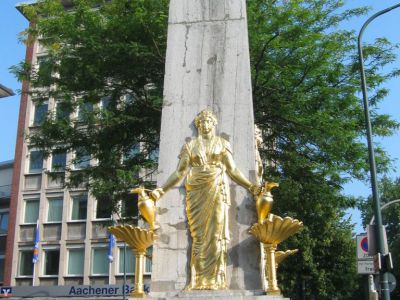
Hotmannspief is one of the oldest known water fountains in the historic town area. Records mention a fountain here as early as 1334, linked to the medieval water supply system. The name combines the Hodtman family, including a city treasurer, with “Spief” (or “Pief”), the local dialect word for pipe or spout. For centuries, it provided water for nearby homes and workshops.
The fountain seen today is not medieval, but it follows the same practical purpose. The current structure was designed in 1734 by Jakob Couven. Although he was known for decorative Baroque buildings, this fountain was kept simple. Made of stone, it has a clear and functional shape, with a basin and spout designed for regular use rather than display. Its modest size fits its role as a working public fountain.
With modern water systems, Hotmannspief lost its original function. It survived heavy damage during the Second World War and was later restored to reflect its 18th-century form. Today, it remains a reminder of earlier water use and daily life.
The fountain seen today is not medieval, but it follows the same practical purpose. The current structure was designed in 1734 by Jakob Couven. Although he was known for decorative Baroque buildings, this fountain was kept simple. Made of stone, it has a clear and functional shape, with a basin and spout designed for regular use rather than display. Its modest size fits its role as a working public fountain.
With modern water systems, Hotmannspief lost its original function. It survived heavy damage during the Second World War and was later restored to reflect its 18th-century form. Today, it remains a reminder of earlier water use and daily life.
2) Belvedere Water Tower
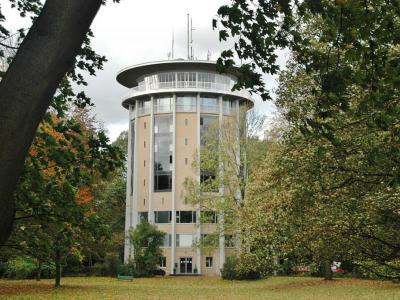
The Belvedere Water Tower, also known as the Drehturm, was built between 1956 and 1958 after the Second World War. It stands on the Lousberg hill and was designed as a reinforced-concrete water tower. At the same time, it was meant to be more than just a technical structure, which is why it was planned as a visible landmark. For many years, it stored water in its upper section, a tank that was later removed in 2012.
The most unusual feature of the tower is the revolving restaurant on the eighth floor. It opened in 1966 and makes one full rotation in about 56 minutes, giving changing views while seated. Over time, the building’s use changed. Today, it is privately owned and mainly used as office and event space. The restaurant level is not open daily but is usually accessible during special events or planned brunches.
The name “Belvedere” comes from an earlier building that once stood on the same hill. A social and restaurant building existed here in the 19th century, burned down in 1836, and was rebuilt before later disappearing. The current tower kept the historic name because of its location on the Belvedere plateau. Even without entering the building, visitors often walk around the hilltop paths to enjoy the wide views and quiet surroundings.
The most unusual feature of the tower is the revolving restaurant on the eighth floor. It opened in 1966 and makes one full rotation in about 56 minutes, giving changing views while seated. Over time, the building’s use changed. Today, it is privately owned and mainly used as office and event space. The restaurant level is not open daily but is usually accessible during special events or planned brunches.
The name “Belvedere” comes from an earlier building that once stood on the same hill. A social and restaurant building existed here in the 19th century, burned down in 1836, and was rebuilt before later disappearing. The current tower kept the historic name because of its location on the Belvedere plateau. Even without entering the building, visitors often walk around the hilltop paths to enjoy the wide views and quiet surroundings.
3) Rathaus (Town Hall) (must see)
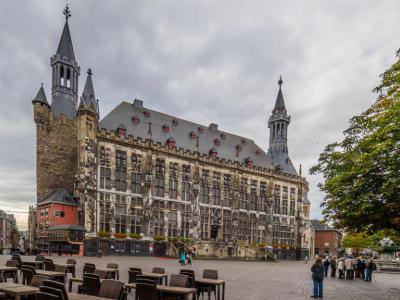
Built in the early 14th century, the Aachen Town Hall has long been used for local government. In the Middle Ages, it was closely linked to imperial ceremonies. After being crowned in the nearby cathedral, rulers came here for official banquets. Between 936 and 1531, 31 Holy Roman Emperors were crowned. The Coronation Hall is still one of the most important rooms, and visitors can see replicas of imperial objects such as the crown, sword, and gospel book.
The building stands on the remains of Charlemagne’s palace from the late 8th century. When the medieval town hall was built, parts of this earlier complex were reused. Some of this early stonework is still visible today, especially on the south wall, where older masonry survived later rebuilding. These remains link the building to both medieval rule and Charlemagne’s earlier imperial center.
Over the centuries, fires and changing tastes altered the town hall’s appearance. After a large fire in 1656, the roof and towers were rebuilt in baroque style. During the 18th century, many Gothic details were removed. In the 19th century, a neo-Gothic restoration brought back medieval elements and added wall paintings showing scenes from Charlemagne’s life, along with statues on the façade. The towers were badly damaged during the Second World War and rebuilt by the late 1960s.
Today, the town hall is also known for hosting the Charlemagne Prize ceremony, which honors efforts toward European cooperation. Past recipients include Pope John Paul II, Bill Clinton, and Angela Merkel, showing that the building still plays a role in international political life.
The building stands on the remains of Charlemagne’s palace from the late 8th century. When the medieval town hall was built, parts of this earlier complex were reused. Some of this early stonework is still visible today, especially on the south wall, where older masonry survived later rebuilding. These remains link the building to both medieval rule and Charlemagne’s earlier imperial center.
Over the centuries, fires and changing tastes altered the town hall’s appearance. After a large fire in 1656, the roof and towers were rebuilt in baroque style. During the 18th century, many Gothic details were removed. In the 19th century, a neo-Gothic restoration brought back medieval elements and added wall paintings showing scenes from Charlemagne’s life, along with statues on the façade. The towers were badly damaged during the Second World War and rebuilt by the late 1960s.
Today, the town hall is also known for hosting the Charlemagne Prize ceremony, which honors efforts toward European cooperation. Past recipients include Pope John Paul II, Bill Clinton, and Angela Merkel, showing that the building still plays a role in international political life.
4) Marktplatz (Market Square) (must see)
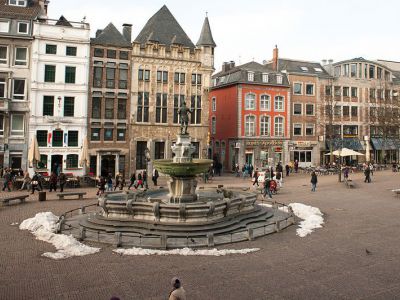
The Market Square has been an important meeting place since medieval times. People came here to buy and sell goods, hear news, and meet others. Public announcements, celebrations, and official events were also held in this open space. Because it sits at the center of the historic area, the square stayed busy over the centuries and is still used as a main gathering point today.
One side of the square is taken up by Aachen Town Hall. It was built in the 14th century on the remains of Charlemagne’s former palace and shows how important this place once was for political life. Close by is the Market Fountain from the early 1600s. On top stands a bronze figure of Charlemagne, reminding visitors of the city’s strong link to his rule.
Just north of the square, in the courtyard of the Karlshof building, stands the Karlshof Fountain, built in 1969. The fountain has seven sides. Each side shows one of the Seven Liberal Arts known in Roman times: grammar, rhetoric, logic, arithmetic, geometry, music, and astronomy. Its modern style clearly differs from the older buildings around it.
Today, the square is used in everyday life as well as for events. Cafés and small shops invite people to sit, talk, or take a short break. During the year, the space changes with markets and public events, including the Christmas market in winter. Even with these changes, the square still shows how public life has worked here for hundreds of years.
One side of the square is taken up by Aachen Town Hall. It was built in the 14th century on the remains of Charlemagne’s former palace and shows how important this place once was for political life. Close by is the Market Fountain from the early 1600s. On top stands a bronze figure of Charlemagne, reminding visitors of the city’s strong link to his rule.
Just north of the square, in the courtyard of the Karlshof building, stands the Karlshof Fountain, built in 1969. The fountain has seven sides. Each side shows one of the Seven Liberal Arts known in Roman times: grammar, rhetoric, logic, arithmetic, geometry, music, and astronomy. Its modern style clearly differs from the older buildings around it.
Today, the square is used in everyday life as well as for events. Cafés and small shops invite people to sit, talk, or take a short break. During the year, the space changes with markets and public events, including the Christmas market in winter. Even with these changes, the square still shows how public life has worked here for hundreds of years.
5) Granusturm (Granus Tower)
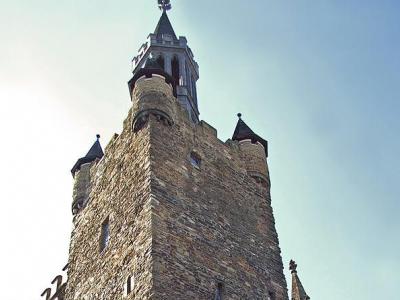
Granusturm is much older than many visitors expect. It was completed around 788 AD as part of Charlemagne’s palace complex, built alongside the King’s Hall. Today it forms one side of the Town Hall building, because the later Gothic hall from the 14th century was raised on the palace remains and reused parts of the older structure.
The tower is square, not round. Each side measures about 8.85 meters, and the oldest part is the lower section: the first four storeys, up to about 20 meters high, still belong to the Carolingian period. Later centuries added extra upper storeys, and the spire you see today is modern (rebuilt in 1979 after earlier damage over time).
Its original purpose is still discussed. One well-supported idea is that it worked mainly as a staircase tower, with stairs winding around inner rooms and linking different levels of the palace buildings and galleries. The name “Granus Tower” is linked to Grannus, a Celtic healing god, but the naming itself became common much later-especially in the Renaissance, when people connected old ruins with Roman stories.
The tower is square, not round. Each side measures about 8.85 meters, and the oldest part is the lower section: the first four storeys, up to about 20 meters high, still belong to the Carolingian period. Later centuries added extra upper storeys, and the spire you see today is modern (rebuilt in 1979 after earlier damage over time).
Its original purpose is still discussed. One well-supported idea is that it worked mainly as a staircase tower, with stairs winding around inner rooms and linking different levels of the palace buildings and galleries. The name “Granus Tower” is linked to Grannus, a Celtic healing god, but the naming itself became common much later-especially in the Renaissance, when people connected old ruins with Roman stories.
6) Krämerstraße (Kramer Street)
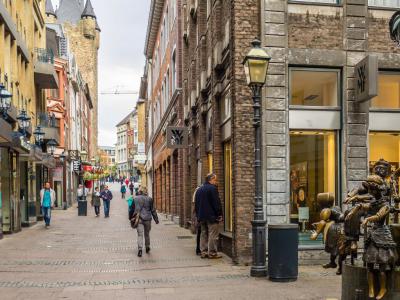
Krämerstraße is a narrow pedestrian street with a medieval layout. Its name comes from Krämer, meaning small traders, reflecting its long role in everyday trade. The short length and narrow width show how people once moved through the old town.
Most buildings stand on very old plots, but their façades come from different periods. Some houses follow traditional shapes with steep roofs and narrow fronts, while others show simpler designs from later rebuilding phases. War damage and earlier fires led to reconstruction, especially in the mid-20th century, so styles vary from building to building. This mix gives the street a layered look rather than a single, planned design.
Today, the ground floors are used by small shops, cafés, and service places. Bookshops, boutiques, and souvenir stores are close together, which keeps the street busy during the day. Because the street is narrow, people usually pass through rather than stay long. In the evening it becomes quieter, but lighting and nearby restaurants keep it active and easy to walk through.
Most buildings stand on very old plots, but their façades come from different periods. Some houses follow traditional shapes with steep roofs and narrow fronts, while others show simpler designs from later rebuilding phases. War damage and earlier fires led to reconstruction, especially in the mid-20th century, so styles vary from building to building. This mix gives the street a layered look rather than a single, planned design.
Today, the ground floors are used by small shops, cafés, and service places. Bookshops, boutiques, and souvenir stores are close together, which keeps the street busy during the day. Because the street is narrow, people usually pass through rather than stay long. In the evening it becomes quieter, but lighting and nearby restaurants keep it active and easy to walk through.
7) Puppenbrunnen (Dolls' Fountain) (must see)
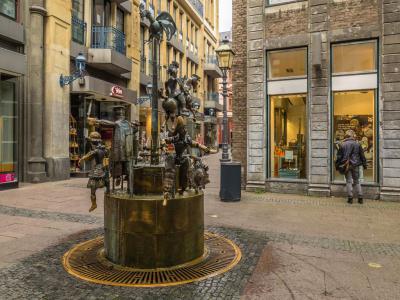
The Dolls’ Fountain is a small bronze fountain with movable figures. It was created by local sculptor Bonifatius Stirnberg and installed in 1975. At first glance, it looks like a typical decorative fountain, but its design quickly sets it apart from others.
Unlike most public fountains, the figures are not fixed in place. Many arms, heads, and other parts can be turned by hand. Visitors are encouraged to touch the sculptures, which is unusual for outdoor artworks. Children are often the first to notice that the figures move, but adults usually stop as well, either to help or to try it themselves. This direct interaction makes the fountain feel open and easy to approach.
Each figure represents a part of local history or everyday life. A market woman stands for trade and daily work that once shaped the economy. A horse and rider refer to riding events and tournaments from earlier times. A professor wearing a monocle points to education and learning, which still play an important role today. At the top, a rooster adds a playful detail and is sometimes linked to music or to the French period. A small doll refers to textile production, while masks and a clown reflect carnival traditions and public celebrations.
People often pause here to move the figures, take photos, or talk about what the characters might mean. Because the figures can be repositioned, the fountain never looks exactly the same twice. This constant change turns it into more than decoration. It becomes a simple, hands-on way to experience local history through movement, touch, and curiosity, even during a short stop.
Unlike most public fountains, the figures are not fixed in place. Many arms, heads, and other parts can be turned by hand. Visitors are encouraged to touch the sculptures, which is unusual for outdoor artworks. Children are often the first to notice that the figures move, but adults usually stop as well, either to help or to try it themselves. This direct interaction makes the fountain feel open and easy to approach.
Each figure represents a part of local history or everyday life. A market woman stands for trade and daily work that once shaped the economy. A horse and rider refer to riding events and tournaments from earlier times. A professor wearing a monocle points to education and learning, which still play an important role today. At the top, a rooster adds a playful detail and is sometimes linked to music or to the French period. A small doll refers to textile production, while masks and a clown reflect carnival traditions and public celebrations.
People often pause here to move the figures, take photos, or talk about what the characters might mean. Because the figures can be repositioned, the fountain never looks exactly the same twice. This constant change turns it into more than decoration. It becomes a simple, hands-on way to experience local history through movement, touch, and curiosity, even during a short stop.
8) Domschatzkammer (Cathedral Treasury) (must see)
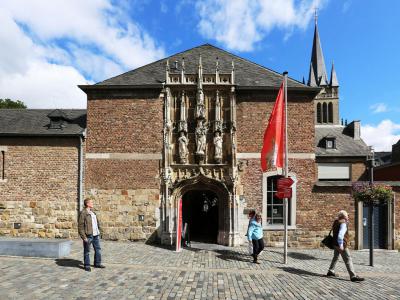
Inside the Cathedral Treasury, one of Europe’s most extraordinary church treasure troves awaits. The collection, rumored to have begun with Charlemagne’s spoils from Jerusalem and Constantinople, is so impressive it secured the very first German spot on the UNESCO World Heritage list, along with Aachen Cathedral itself.
This treasure chest of history includes relics and artifacts from the late antique, Carolingian, Ottonian, Staufian, and Gothic eras. Since its grand redesign in 1995, the Treasury showcases over 100 dazzling works of art across five themed sections, all spread out over a space larger than six tennis courts.
The first section highlight the Cathedral as Charlemagne’s personal church. Here, you’ll find a silver and gilded bust of the emperor (post-1349) taking center stage. Next come Aachen’s liturgical roots, featuring the ornate Lothar Cross (circa the year 1000) and the so-called Aachen Altar (circa 1520). Another collection showcases ceremonial pieces tied to royal coronations held here between 936 and 1531, like an exquisite ivory holy water vessel. Elsewhere, Marian devotion and the city’s storied pilgrimages come to life through reliquaries, Hungarian donations, and breathtaking sculptures of the Virgin Mary.
Downstairs, a rotating display of the Cathedral’s textile treasures surrounds the legendary coronation mantle, the “Cappa Leonis,” from the early 16th century. It’s all a testament to Aachen’s centuries-long place at the crossroads of religion, art, and history.
This treasure chest of history includes relics and artifacts from the late antique, Carolingian, Ottonian, Staufian, and Gothic eras. Since its grand redesign in 1995, the Treasury showcases over 100 dazzling works of art across five themed sections, all spread out over a space larger than six tennis courts.
The first section highlight the Cathedral as Charlemagne’s personal church. Here, you’ll find a silver and gilded bust of the emperor (post-1349) taking center stage. Next come Aachen’s liturgical roots, featuring the ornate Lothar Cross (circa the year 1000) and the so-called Aachen Altar (circa 1520). Another collection showcases ceremonial pieces tied to royal coronations held here between 936 and 1531, like an exquisite ivory holy water vessel. Elsewhere, Marian devotion and the city’s storied pilgrimages come to life through reliquaries, Hungarian donations, and breathtaking sculptures of the Virgin Mary.
Downstairs, a rotating display of the Cathedral’s textile treasures surrounds the legendary coronation mantle, the “Cappa Leonis,” from the early 16th century. It’s all a testament to Aachen’s centuries-long place at the crossroads of religion, art, and history.
9) Aachener Dom (Aachen Cathedral) (must see)
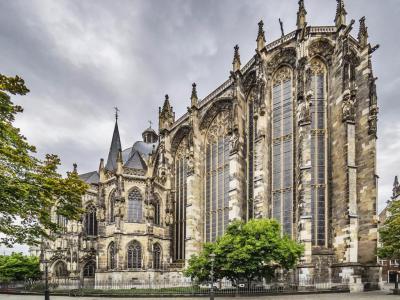
Aachen Cathedral, also known as the Imperial Cathedral, was built in the late 8th century on the orders of Charlemagne. It is one of the oldest cathedrals in Europe and became the first German site added to the UNESCO World Heritage list in 1978. From the start, the building was meant to express political authority as well as religious power.
At the center of the complex is the Palatine Chapel, completed around 805. Its octagonal plan reflects strong Byzantine influence, especially the church of San Vitale in Ravenna. The number eight had Christian meaning, linked to resurrection and renewal. The design also follows strict proportions: both the dome height and the diameter measure 100 Carolingian feet. In medieval thinking, multiples of ten symbolized order and completeness, reinforcing the chapel’s role as a sacred and carefully planned space.
After Charlemagne’s death, the chapel became his burial place. Over time, the cathedral gained major political importance. Between 936 and 1531, 31 German kings and 12 queens were crowned here, making it a central stage for imperial ceremony in the Holy Roman Empire.
The cathedral’s Treasury is one of the most important church treasuries in Europe. Its objects include the Throne of Charlemagne, the four large Aachen relics-among them a cloth linked by tradition to the Virgin Mary-and the Pala d’Oro, a gold altar screen decorated with detailed metalwork.
The building did not remain unchanged. Later centuries added new structures around the original chapel. The most striking addition is the Gothic choir hall from the 13th century, built with tall walls and large stained-glass windows. Its height and light contrast clearly with the solid, compact form of the Carolingian core, showing how the cathedral reflects many phases of European history within a single structure.
At the center of the complex is the Palatine Chapel, completed around 805. Its octagonal plan reflects strong Byzantine influence, especially the church of San Vitale in Ravenna. The number eight had Christian meaning, linked to resurrection and renewal. The design also follows strict proportions: both the dome height and the diameter measure 100 Carolingian feet. In medieval thinking, multiples of ten symbolized order and completeness, reinforcing the chapel’s role as a sacred and carefully planned space.
After Charlemagne’s death, the chapel became his burial place. Over time, the cathedral gained major political importance. Between 936 and 1531, 31 German kings and 12 queens were crowned here, making it a central stage for imperial ceremony in the Holy Roman Empire.
The cathedral’s Treasury is one of the most important church treasuries in Europe. Its objects include the Throne of Charlemagne, the four large Aachen relics-among them a cloth linked by tradition to the Virgin Mary-and the Pala d’Oro, a gold altar screen decorated with detailed metalwork.
The building did not remain unchanged. Later centuries added new structures around the original chapel. The most striking addition is the Gothic choir hall from the 13th century, built with tall walls and large stained-glass windows. Its height and light contrast clearly with the solid, compact form of the Carolingian core, showing how the cathedral reflects many phases of European history within a single structure.

10) Kreislauf des Geldes ("Money Cycle" Fountain)
Kreislauf des Geldes was created in 1976 by sculptor Karl-Henning Seemann. The fountain uses bronze figures to show how money moves through society. They are placed around a round basin, with water flowing steadily in a circle. The scene does not rely on text or explanation. Instead, the figures and their gestures make the idea easy to understand at a glance.
Each figure shows a different way people relate to money. There is a figure holding money tightly to show greed, another guarding a purse to suggest stinginess, and one giving money away as a sign of patronage. A beggar represents poverty, while a father talking to his son shows how ideas about money are passed on. All figures reach toward the next, so money moves from hand to hand, highlighting that it changes owners through human interaction.
The water in the basin flows constantly, reinforcing the idea of a continuous cycle. Even in winter, it does not freeze, as the water is warmed using waste heat from the nearby Sparkasse building. Visitors often walk around the fountain to follow the figures in order, which supports the idea of money constantly moving through different hands.
Each figure shows a different way people relate to money. There is a figure holding money tightly to show greed, another guarding a purse to suggest stinginess, and one giving money away as a sign of patronage. A beggar represents poverty, while a father talking to his son shows how ideas about money are passed on. All figures reach toward the next, so money moves from hand to hand, highlighting that it changes owners through human interaction.
The water in the basin flows constantly, reinforcing the idea of a continuous cycle. Even in winter, it does not freeze, as the water is warmed using waste heat from the nearby Sparkasse building. Visitors often walk around the fountain to follow the figures in order, which supports the idea of money constantly moving through different hands.
11) Bahkauv statue
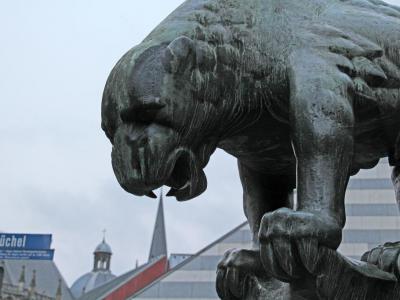
Bahkauv Statue comes from a local folk legend about a creature known as the Bahkauv or Bachkalb, meaning “stream calf” or “brook calf.” Stories say it lived in sewers and near thermal springs during the Middle Ages. Unlike many fear-based legends, this one had a specific target: drunken men walking home late at night. According to folklore, the creature would jump onto their backs and force them to carry it home.
A key detail in the story is how the Bahkauv behaved once on its victim’s back. If the man prayed, the creature became heavier; if he cursed, it grew lighter. This made escape difficult and added a moral twist to the tale. The legend also worked as a social excuse-men who returned home late and without money could blame the Bahkauv, claiming it had “robbed” them rather than admitting they had spent their wages on drink.
The current bronze statue was installed in 1967 and made by sculptor Kurt-Wolf von Borries. It replaced an earlier version from 1902, which was melted down during World War II. The sculpture shows the creature with sharp fangs and a scaly tail, mixing different animal features. Today, it is seen with humor and is a common photo stop.
A key detail in the story is how the Bahkauv behaved once on its victim’s back. If the man prayed, the creature became heavier; if he cursed, it grew lighter. This made escape difficult and added a moral twist to the tale. The legend also worked as a social excuse-men who returned home late and without money could blame the Bahkauv, claiming it had “robbed” them rather than admitting they had spent their wages on drink.
The current bronze statue was installed in 1967 and made by sculptor Kurt-Wolf von Borries. It replaced an earlier version from 1902, which was melted down during World War II. The sculpture shows the creature with sharp fangs and a scaly tail, mixing different animal features. Today, it is seen with humor and is a common photo stop.
12) Klenkes (statue)
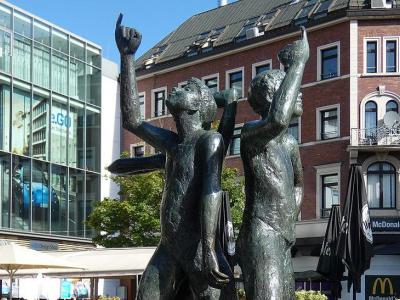
The Klenkes is a small bronze monument linked to needle production. The raised little finger comes from factory work, where workers used their pinky to sort defective needles in a motion called ausklinken. Over time, this habit became a sign of the trade, and the name “Klenkes” refers to this local term.
Over time, the raised pinky became a quiet way for people from the region to recognize each other, even far from home. Lifting the finger was enough to signal a shared background connected to needle making, which once played a central role in the local economy. This gesture combined work, identity, and everyday communication, without needing explanation. Even after industrial production declined, the sign remained part of local culture and humor.
The bronze sculpture was created by Hubert Löneke and erected in 1970. It shows three hands with raised little fingers reaching toward each other, emphasizing shared identity rather than individuals. Small and placed at eye level, it is often touched by passersby, reflecting its role as a simple gesture shaped by work and memory.
Over time, the raised pinky became a quiet way for people from the region to recognize each other, even far from home. Lifting the finger was enough to signal a shared background connected to needle making, which once played a central role in the local economy. This gesture combined work, identity, and everyday communication, without needing explanation. Even after industrial production declined, the sign remained part of local culture and humor.
The bronze sculpture was created by Hubert Löneke and erected in 1970. It shows three hands with raised little fingers reaching toward each other, emphasizing shared identity rather than individuals. Small and placed at eye level, it is often touched by passersby, reflecting its role as a simple gesture shaped by work and memory.
13) Elisenbrunnen (Elise Fountain) (must see)
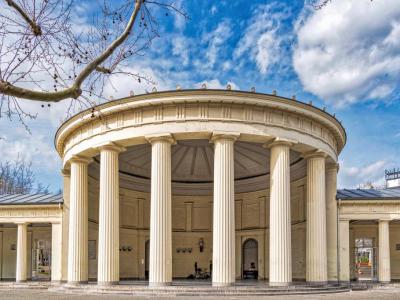
The Elise Fountain is one of Aachen’s most famous landmarks, a neoclassical masterpiece that has been drawing visitors since 1827. With its grand colonnade and two charming pavilions, it exudes an air of old-world elegance.
Named after Princess Elisabeth Ludovika of Bavaria-later the Queen of Prussia-who visited Aachen in her younger years, the fountain sits atop the city’s legendary hot springs. These springs have been bubbling away since Roman times, celebrated for their therapeutic properties. Inside, two fountains still flow with that famous mineral-rich water. A quick warning, though: the distinct sulfur aroma might not be to your taste, and officially, the water is considered a medicinal product, so no casual sipping unless you’ve got a prescription!
Back in the 19th century, this was the go-to hangout for Europe’s upper crust-royalty, politicians, and artists flocked here to “take the waters” and rub elbows. Over the years, the fountain has become a proud symbol of Aachen’s spa tradition and its reputation as a cultural meeting point.
Although it suffered damage during World War II, the structure rose from the ashes and was carefully restored. Today, it remains a popular gathering place in the city center. Snap a photo against its stately colonnade, or peek inside to see those famous thermal waters.
Named after Princess Elisabeth Ludovika of Bavaria-later the Queen of Prussia-who visited Aachen in her younger years, the fountain sits atop the city’s legendary hot springs. These springs have been bubbling away since Roman times, celebrated for their therapeutic properties. Inside, two fountains still flow with that famous mineral-rich water. A quick warning, though: the distinct sulfur aroma might not be to your taste, and officially, the water is considered a medicinal product, so no casual sipping unless you’ve got a prescription!
Back in the 19th century, this was the go-to hangout for Europe’s upper crust-royalty, politicians, and artists flocked here to “take the waters” and rub elbows. Over the years, the fountain has become a proud symbol of Aachen’s spa tradition and its reputation as a cultural meeting point.
Although it suffered damage during World War II, the structure rose from the ashes and was carefully restored. Today, it remains a popular gathering place in the city center. Snap a photo against its stately colonnade, or peek inside to see those famous thermal waters.
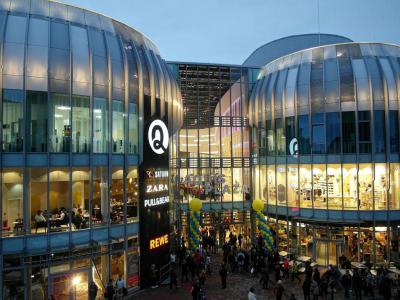
14) Aquis Plaza (shopping mall)
Aquis Plaza opened in October 2015 as part of a large redevelopment project. The building has several floors arranged around a central open space with a glass roof that brings in natural light. Clear signs, wide walkways, and open views between levels make it easy to find shops and move around without difficulty.
Inside, there are around 120 to 130 shops, including international brands and well-known German retailers. Most stores focus on everyday shopping, such as clothing, shoes, cosmetics, electronics, books, and basic services. A large supermarket on the lower level is commonly used for groceries and quick purchases. The overall focus is on practical shopping rather than high-end brands, which suits different budgets.
Food options are mainly casual and located on the upper floors, where visitors can find cafés, fast food, and simple restaurants. The food court has a large seating area designed for short breaks during shopping. Elevators, escalators, and restrooms are easy to access throughout the mall, which is helpful for families and travelers. Many visitors spend about one to two hours here before continuing with other activities.
Inside, there are around 120 to 130 shops, including international brands and well-known German retailers. Most stores focus on everyday shopping, such as clothing, shoes, cosmetics, electronics, books, and basic services. A large supermarket on the lower level is commonly used for groceries and quick purchases. The overall focus is on practical shopping rather than high-end brands, which suits different budgets.
Food options are mainly casual and located on the upper floors, where visitors can find cafés, fast food, and simple restaurants. The food court has a large seating area designed for short breaks during shopping. Elevators, escalators, and restrooms are easy to access throughout the mall, which is helpful for families and travelers. Many visitors spend about one to two hours here before continuing with other activities.
