Custom Walk in Montevideo, Uruguay by szilberman_5f988 created on 2026-02-17
Guide Location: Uruguay » Montevideo
Guide Type: Custom Walk
# of Sights: 11
Tour Duration: 5 Hour(s)
Travel Distance: 13.3 Km or 8.3 Miles
Share Key: YLRSA
Guide Type: Custom Walk
# of Sights: 11
Tour Duration: 5 Hour(s)
Travel Distance: 13.3 Km or 8.3 Miles
Share Key: YLRSA
How It Works
Please retrieve this walk in the GPSmyCity app. Once done, the app will guide you from one tour stop to the next as if you had a personal tour guide. If you created the walk on this website or come to the page via a link, please follow the instructions below to retrieve the walk in the app.
Retrieve This Walk in App
Step 1. Download the app "GPSmyCity: Walks in 1K+ Cities" on Apple App Store or Google Play Store.



Step 2. In the GPSmyCity app, download(or launch) the guide "Montevideo Map and Walking Tours".
Step 3. Tap the menu button located at upper right corner of the "Walks" screen and select "Retrieve custom walk". Enter the share key: YLRSA
1) Mercado del Puerto (Port Market) (must see)
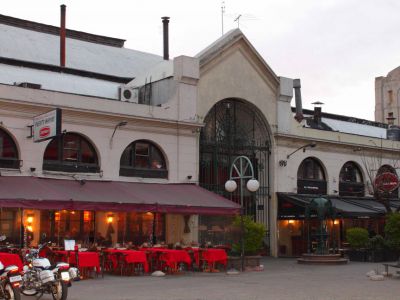
The Port Market is often described as the city’s most famous gathering place for traditional food, particularly grilled meat. Despite its name, it no longer functions as a market in the usual sense. While it once operated as a true food and produce market, that role faded long ago. Today, the iron structure houses a collection of restaurants, many centered on the parrilla, Uruguay’s distinctive style of barbecue.
Its construction began in 1865 and followed a design trend popular in Europe at the time, using prefabricated iron elements inspired by 19th-century industrial architecture. After nearly three years of work, the building was inaugurated in 1868, during the presidency of Lorenzo Batlle. . From the outset, it reflected Montevideo’s ambition to present itself as a modern port city connected to global trade and design.
Over time, the Market evolved into a culinary destination. Today it is especially associated with meat-focused restaurants, reflecting Uruguay’s long-standing cattle-raising traditions and national food culture. Visitors will find classic parrillas offering cuts grilled over wood embers, often accompanied by simple side dishes and local wine. While individual restaurants come and go, the overall experience remains centered on informal, hearty dining and a lively, social atmosphere.
Architecturally, the building retains its 19th-century iron framework, giving it an industrial character rather than a colonial one, softened by constant activity and the aromas of open grills. The market is open throughout the week, with Sundays typically the busiest, when locals and visitors alike gather for long lunches that can stretch well into the afternoon.
Its construction began in 1865 and followed a design trend popular in Europe at the time, using prefabricated iron elements inspired by 19th-century industrial architecture. After nearly three years of work, the building was inaugurated in 1868, during the presidency of Lorenzo Batlle. . From the outset, it reflected Montevideo’s ambition to present itself as a modern port city connected to global trade and design.
Over time, the Market evolved into a culinary destination. Today it is especially associated with meat-focused restaurants, reflecting Uruguay’s long-standing cattle-raising traditions and national food culture. Visitors will find classic parrillas offering cuts grilled over wood embers, often accompanied by simple side dishes and local wine. While individual restaurants come and go, the overall experience remains centered on informal, hearty dining and a lively, social atmosphere.
Architecturally, the building retains its 19th-century iron framework, giving it an industrial character rather than a colonial one, softened by constant activity and the aromas of open grills. The market is open throughout the week, with Sundays typically the busiest, when locals and visitors alike gather for long lunches that can stretch well into the afternoon.

2) Legislative Palace of Uruguay
The Legislative Palace of Uruguay, located in the Aguada neighborhood of Montevideo, serves as a significant landmark and the primary meeting place of the General Assembly of Uruguay. This monumental building is not only the hub of the legislative activities of the Uruguayan government but also a celebrated architectural feat, declared a National Historic Monument in 1975.
The need for a new legislative building arose at the turn of the 20th century due to the inadequacies of the old headquarters, the Montevideo Cabildo. In response, a law was passed in 1902 to initiate an international competition for the design of a new legislative palace. The winning design was submitted by Italian architect Vittorio Meano, also known for his work on the Palace of the Argentine National Congress. Tragically, Meano died before he could be informed that his project had been selected. His plans, along with contributions from another Italian architect, Gaetano Moretti, and notable sculptor José Belloni, shaped the grandiose structure that stands today.
Construction began in 1904 under the auspices of President José Batlle y Ordoñez and spanned over two decades, culminating in the building's inauguration on August 25, 1925-exactly 100 years after Uruguay’s Declaration of Independence. This event was overseen by President José Serrato, although the building’s elaborate decorations were not fully completed until 1964.
Designed in a Greco-Roman eclecticist style, the palace features facades, interior walls, vaults, and columns extensively adorned with various Uruguayan marbles, showcasing the rich natural resources and artistic craftsmanship of the nation. The building houses three large halls, several adjoining rooms, and an upper floor that contains the Legislative Power Library, boasting over 250,000 volumes, alongside some parliamentary offices. The basement accommodates additional offices, storage spaces, and workshops for printing and binding.
The main facade of the Legislative Palace is strategically aligned with the axis of symmetry of Libertador Avenue, making it not only a center of governance but also a symbol of national pride and architectural heritage in Uruguay.
The need for a new legislative building arose at the turn of the 20th century due to the inadequacies of the old headquarters, the Montevideo Cabildo. In response, a law was passed in 1902 to initiate an international competition for the design of a new legislative palace. The winning design was submitted by Italian architect Vittorio Meano, also known for his work on the Palace of the Argentine National Congress. Tragically, Meano died before he could be informed that his project had been selected. His plans, along with contributions from another Italian architect, Gaetano Moretti, and notable sculptor José Belloni, shaped the grandiose structure that stands today.
Construction began in 1904 under the auspices of President José Batlle y Ordoñez and spanned over two decades, culminating in the building's inauguration on August 25, 1925-exactly 100 years after Uruguay’s Declaration of Independence. This event was overseen by President José Serrato, although the building’s elaborate decorations were not fully completed until 1964.
Designed in a Greco-Roman eclecticist style, the palace features facades, interior walls, vaults, and columns extensively adorned with various Uruguayan marbles, showcasing the rich natural resources and artistic craftsmanship of the nation. The building houses three large halls, several adjoining rooms, and an upper floor that contains the Legislative Power Library, boasting over 250,000 volumes, alongside some parliamentary offices. The basement accommodates additional offices, storage spaces, and workshops for printing and binding.
The main facade of the Legislative Palace is strategically aligned with the axis of symmetry of Libertador Avenue, making it not only a center of governance but also a symbol of national pride and architectural heritage in Uruguay.
3) Mercado Agricola de Montevideo (MAM) (Agricultural Market) (must see)
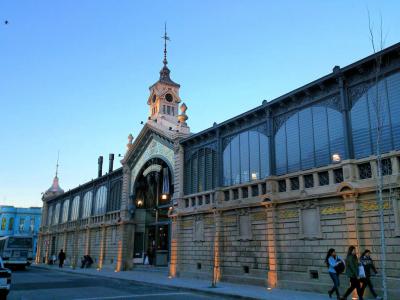
The Agricultural Market (Mercado Agrícola de Montevideo) is a significant landmark in Montevideo, serving as one of the city's primary agricultural markets. Nestled in the Aguada neighborhood, the market stands as the last remaining iron-constructed market in Montevideo, alongside others like the Mercado de la Abundancia and the Mercado del Puerto.
Constructed in 1906 and inaugurated in 1913, the market was originally built to centralize the agricultural food merchants of Montevideo, who previously gathered in the old Plaza de las Carretas. The land for the market was donated by Carlos Crocker, with the building designed to meet the rigorous health and hygiene standards of the time. Notable for its architectural style, it features false towers at its four corners, each culminating in a spire.
Despite its initial role, by 1937 the Agricultural Market was deemed too small and was supplanted by the Mercado Modelo. It then continued to operate as a retail market. In 2006, the market came under the ownership of the Municipality of Montevideo, sparking a major revitalization project for the market and the surrounding Goes neighborhood, supported by the Inter-American Bank. This led to its reopening in 2013.
The Agricultural Market covers an entire city block, bordered by Dr. Juan José de Amezaga, Ramón del Valle Inclan, Martín García, and Dr. José L. Terra streets. It is strategically located near the Faculties of Chemistry and Medicine of the University of the Republic, as well as several state offices including the Ministry of the Interior and the Telecommunications Administration. The market offers a broad array of products and services, including gastronomy, clothing, accessories, and groceries, and features a guarded parking lot.
Adding to its cultural footprint, the Agricultural Market hosts a TV signal, MAM TV, which broadcasts from Vera TV. This feature underscores its role not only as a market but also as a vibrant community hub within Montevideo.
Constructed in 1906 and inaugurated in 1913, the market was originally built to centralize the agricultural food merchants of Montevideo, who previously gathered in the old Plaza de las Carretas. The land for the market was donated by Carlos Crocker, with the building designed to meet the rigorous health and hygiene standards of the time. Notable for its architectural style, it features false towers at its four corners, each culminating in a spire.
Despite its initial role, by 1937 the Agricultural Market was deemed too small and was supplanted by the Mercado Modelo. It then continued to operate as a retail market. In 2006, the market came under the ownership of the Municipality of Montevideo, sparking a major revitalization project for the market and the surrounding Goes neighborhood, supported by the Inter-American Bank. This led to its reopening in 2013.
The Agricultural Market covers an entire city block, bordered by Dr. Juan José de Amezaga, Ramón del Valle Inclan, Martín García, and Dr. José L. Terra streets. It is strategically located near the Faculties of Chemistry and Medicine of the University of the Republic, as well as several state offices including the Ministry of the Interior and the Telecommunications Administration. The market offers a broad array of products and services, including gastronomy, clothing, accessories, and groceries, and features a guarded parking lot.
Adding to its cultural footprint, the Agricultural Market hosts a TV signal, MAM TV, which broadcasts from Vera TV. This feature underscores its role not only as a market but also as a vibrant community hub within Montevideo.
4) Parque Battle (Battle Park)
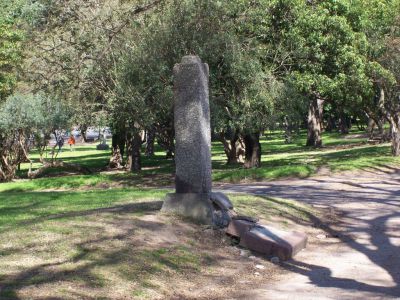
Battle Park (Parque Batlle) is a central public park in Montevideo. The park, named in honor of José Batlle y Ordóñez, a former President of Uruguay (1911-1915), spans approximately 60 hectares (150 acres) and is commonly referred to as the "lung" of Montevideo due to its extensive variety of trees. As a major urban green space, Battle Park plays a crucial role in the city's environment and serves as a hub for both recreation and residential living, with high-density housing within its vicinity.
At the heart of Battle Park is the Centennial Stadium, a historic football stadium with a capacity of 70,000 seats. Constructed for the first soccer World Cup in 1930, this stadium is not only a key sports venue but also houses a football museum, celebrating the rich history of the sport. In addition to the stadium, the park features several other sports facilities including the Municipal Velodrome, the Parque Palermo and Parque Luis Méndez Piana stadiums, and a target shooting facility.
One of the park's most notable features is "La Carreta", a bronze monument created by José Belloni in 1934. Positioned on Lorenzo Merola Avenue near the Centennial Stadium, this striking sculpture depicts oxen pulling a loaded wagon and was declared a national monument in 1976. Additionally, the park houses a bronze replica of the ancient Greek statue, the Discobolus of Myron, enhancing its cultural and aesthetic appeal.
At the heart of Battle Park is the Centennial Stadium, a historic football stadium with a capacity of 70,000 seats. Constructed for the first soccer World Cup in 1930, this stadium is not only a key sports venue but also houses a football museum, celebrating the rich history of the sport. In addition to the stadium, the park features several other sports facilities including the Municipal Velodrome, the Parque Palermo and Parque Luis Méndez Piana stadiums, and a target shooting facility.
One of the park's most notable features is "La Carreta", a bronze monument created by José Belloni in 1934. Positioned on Lorenzo Merola Avenue near the Centennial Stadium, this striking sculpture depicts oxen pulling a loaded wagon and was declared a national monument in 1976. Additionally, the park houses a bronze replica of the ancient Greek statue, the Discobolus of Myron, enhancing its cultural and aesthetic appeal.
5) Palacio Salvo (Salvo Palace)
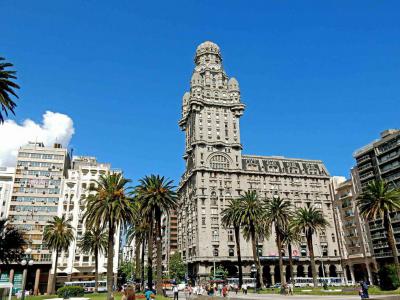
The Salvo Palace was designed by Italian architect Mario Palanti and inaugurated in 1928. Rising to approximately 95 meters, it was among the tallest buildings in South America at the time of its completion and remains one of the most prominent structures on Montevideo’s skyline.
Palanti drew conceptual inspiration from Dante Alighieri’s Divine Comedy, an idea he also explored in his earlier Barolo Palace in Buenos Aires. While the symbolic division of the building into “Hell”, “Purgatory”, and “Heaven” is not formally labeled within the structure, the vertical progression of spaces and decorative elements reflects this allegorical narrative, culminating in the tower and lighthouse-like crown.
Architecturally, Salvo Palace is best described as eclectic, blending Art Deco massing with Neoclassical, Gothic, and Renaissance-inspired details. Its ornate facade, varied textures, and vertical emphasis reflect the optimism and ambition of Montevideo during the early 20th century, a period marked by economic growth and cultural confidence. Over time, the building has become a visual symbol of the city and an enduring reference point in its urban identity.
Today, Salvo Palace contains a mix of private apartments, offices, and ground-floor commercial spaces, including cafes and small shops. It also houses the Museum of Tango, dedicated in part to La Cumparsita, one of the most famous tangos in the world, composed in Montevideo. The museum highlights the city’s role in the development of tango and explores Uruguay’s contribution to the genre’s history and international reach.
Palanti drew conceptual inspiration from Dante Alighieri’s Divine Comedy, an idea he also explored in his earlier Barolo Palace in Buenos Aires. While the symbolic division of the building into “Hell”, “Purgatory”, and “Heaven” is not formally labeled within the structure, the vertical progression of spaces and decorative elements reflects this allegorical narrative, culminating in the tower and lighthouse-like crown.
Architecturally, Salvo Palace is best described as eclectic, blending Art Deco massing with Neoclassical, Gothic, and Renaissance-inspired details. Its ornate facade, varied textures, and vertical emphasis reflect the optimism and ambition of Montevideo during the early 20th century, a period marked by economic growth and cultural confidence. Over time, the building has become a visual symbol of the city and an enduring reference point in its urban identity.
Today, Salvo Palace contains a mix of private apartments, offices, and ground-floor commercial spaces, including cafes and small shops. It also houses the Museum of Tango, dedicated in part to La Cumparsita, one of the most famous tangos in the world, composed in Montevideo. The museum highlights the city’s role in the development of tango and explores Uruguay’s contribution to the genre’s history and international reach.
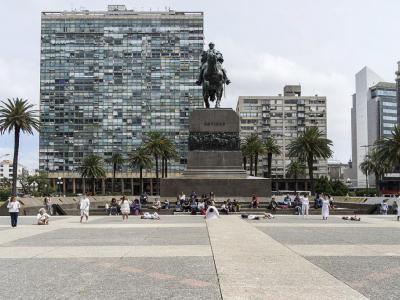
6) Plaza Independencia (Independence Square) (must see)
José Gervasio Artigas, the national hero of Uruguayan independence, was deeply influenced by Enlightenment and revolutionary thinkers such as Thomas Paine, Thomas Jefferson, and Jean-Jacques Rousseau. Although he is widely regarded as the father of Uruguayan nationhood, Artigas spent his final years in exile in Paraguay, where he died in 1850. His remains were later repatriated and today rest in the Artigas Mausoleum, located beneath Independence Square, at the symbolic center of Montevideo.
Independence Square was first conceived in the 1830s by Italian architect Carlo Zucchi, who drew inspiration from large European civic squares. The space was later redesigned in the mid-19th century by Bernardo Poncini, a Swiss architect and sculptor. In the center of the square stands the equestrian statue of Artigas, created by Italian sculptor Angelo Zanelli and inaugurated in 1923. Beneath the monument lies the underground mausoleum, accessed by stairways descending from the base of the statue.
Standing in the square, the western side is marked by the Citadel Gate, the last surviving entrance of the colonial fortifications. Facing east, the square opens directly onto 18 de Julio Avenue, Montevideo’s principal boulevard, with the Salvo Palace rising prominently at its beginning. Along the southern edge of the square, stands the Estévez Palace, a 19th-century presidential residence now used for ceremonial functions; immediately behind and adjoining it rises the glass-and-steel Executive Tower, the current workplace of the President of Uruguay.
Independence Square was first conceived in the 1830s by Italian architect Carlo Zucchi, who drew inspiration from large European civic squares. The space was later redesigned in the mid-19th century by Bernardo Poncini, a Swiss architect and sculptor. In the center of the square stands the equestrian statue of Artigas, created by Italian sculptor Angelo Zanelli and inaugurated in 1923. Beneath the monument lies the underground mausoleum, accessed by stairways descending from the base of the statue.
Standing in the square, the western side is marked by the Citadel Gate, the last surviving entrance of the colonial fortifications. Facing east, the square opens directly onto 18 de Julio Avenue, Montevideo’s principal boulevard, with the Salvo Palace rising prominently at its beginning. Along the southern edge of the square, stands the Estévez Palace, a 19th-century presidential residence now used for ceremonial functions; immediately behind and adjoining it rises the glass-and-steel Executive Tower, the current workplace of the President of Uruguay.
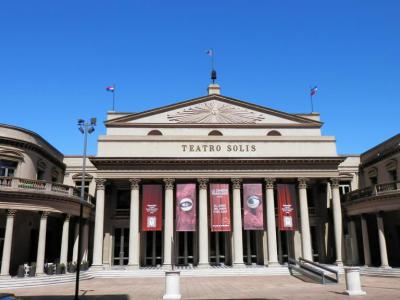
7) Teatro Solis (Solis Theatre) (must see)
The Solís Theater was conceived as a grand venue for opera and the performing arts, intended to place Montevideo among the great cultural capitals of the 19th century. It opened in 1856 and is considered Uruguay’s oldest operating theater. The building is named after Juan Díaz de Solís, the 16th-century Spanish explorer traditionally credited as the first European to navigate the River Plate region.
Between 1998 and 2004, the Solís Theater underwent a comprehensive restoration and modernization. The project focused on structural reinforcement, stage technology, audience comfort, and acoustics, while preserving the historic character of the building. The renovation included contemporary design elements by Philippe Starck, most notably in interior features rather than structural columns, and the acoustic design was carried out by the French firm Avel Acoustique.
Architecturally, the theater is best described as Neoclassical, inspired by Italian opera houses of the 18th and 19th centuries. The facade features a Greek-style portico with Corinthian columns, while the interior follows an elliptical plan, echoing the horseshoe-shaped auditoriums typical of traditional Italian theaters. Comparisons are often made to major European opera houses, though the Solís maintains a distinctly local interpretation of the style.
Today, the Solís Theater serves as a leading venue for opera, ballet, theater, symphonic concerts, and contemporary performances. Performances are generally held in the evenings, while guided tours allow visitors to explore the auditorium, stage areas, and public spaces during the day. The theater remains a central reference point for Montevideo’s cultural life, balancing historical prestige with a modern performance program.
Between 1998 and 2004, the Solís Theater underwent a comprehensive restoration and modernization. The project focused on structural reinforcement, stage technology, audience comfort, and acoustics, while preserving the historic character of the building. The renovation included contemporary design elements by Philippe Starck, most notably in interior features rather than structural columns, and the acoustic design was carried out by the French firm Avel Acoustique.
Architecturally, the theater is best described as Neoclassical, inspired by Italian opera houses of the 18th and 19th centuries. The facade features a Greek-style portico with Corinthian columns, while the interior follows an elliptical plan, echoing the horseshoe-shaped auditoriums typical of traditional Italian theaters. Comparisons are often made to major European opera houses, though the Solís maintains a distinctly local interpretation of the style.
Today, the Solís Theater serves as a leading venue for opera, ballet, theater, symphonic concerts, and contemporary performances. Performances are generally held in the evenings, while guided tours allow visitors to explore the auditorium, stage areas, and public spaces during the day. The theater remains a central reference point for Montevideo’s cultural life, balancing historical prestige with a modern performance program.
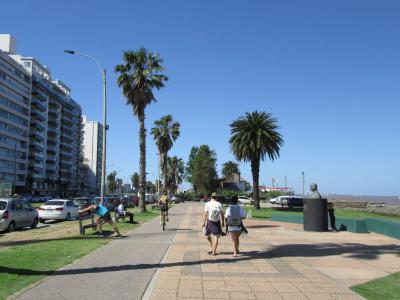
8) Rambla de Montevideo (Rambla of Montevideo) (must see)
The Rambla of Montevideo is a long coastal promenade that traces the shoreline of the River Plate along the southern and eastern edges of the city. Stretching for approximately 22 to 24 kilometers, it forms one of the longest continuous urban waterfront promenades in the world. The Rambla borders a sequence of well-known urban beaches, including Ramírez, Pocitos, Buceo, Malvín, and Carrasco. Walking, jogging, cycling, sunbathing, and socializing are daily rituals here.
The Rambla passes by many squares along its way and one of them is the Spain Square. Here you are on a widened section of the Rambla where the coastal road, pedestrian paths, and waterfront align in a clear, open layout. The square sits directly beside the shoreline, with uninterrupted views across the River Plate. From here, the Rambla continues in both directions with broad sidewalks, traffic lanes, and low stone barriers separating the pedestrian areas from the water.
If you walk west, you soon encounter the Tribute to Isabella the Catholic, a commemorative monument reflecting early-20th-century views on Spain’s role in the history of the Americas. Nearby stands the Old Sewer Vent, a small piece of urban infrastructure, built as part of Montevideo’s early modern sanitation system. Heading east instead, you reach Argentine Republic Square, a green waterfront square, followed by Mauá Waterfront Space, a former port area.
Deeply embedded in Montevideo’s identity, the Montevideo Rambla has been declared a National Historic Monument, recognized for its role as a defining urban feature shaped by daily use, coastal geography, and long-term city planning.
The Rambla passes by many squares along its way and one of them is the Spain Square. Here you are on a widened section of the Rambla where the coastal road, pedestrian paths, and waterfront align in a clear, open layout. The square sits directly beside the shoreline, with uninterrupted views across the River Plate. From here, the Rambla continues in both directions with broad sidewalks, traffic lanes, and low stone barriers separating the pedestrian areas from the water.
If you walk west, you soon encounter the Tribute to Isabella the Catholic, a commemorative monument reflecting early-20th-century views on Spain’s role in the history of the Americas. Nearby stands the Old Sewer Vent, a small piece of urban infrastructure, built as part of Montevideo’s early modern sanitation system. Heading east instead, you reach Argentine Republic Square, a green waterfront square, followed by Mauá Waterfront Space, a former port area.
Deeply embedded in Montevideo’s identity, the Montevideo Rambla has been declared a National Historic Monument, recognized for its role as a defining urban feature shaped by daily use, coastal geography, and long-term city planning.
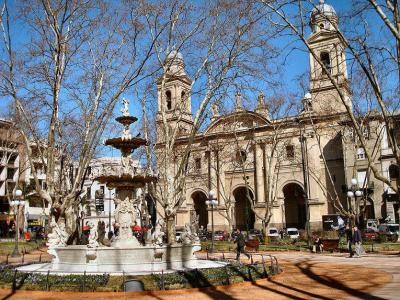
9) Catedral de Montevideo (Metropolitan Cathedral) (must see)
The Metropolitan Cathedral of Montevideo is the principal Catholic church of the city and the seat of the Archdiocese of Montevideo. Standing on Constitution Square, the site has been used for religious worship since the Spanish colonial period, with the first brick church on this location dating from 1740.
Architecturally, the cathedral is a restrained example of Colonial Neoclassicism, reflecting late-colonial tastes rather than high European academic neoclassicism. The project is traditionally attributed to Spanish architect Tomás Toribio, though, as with many colonial works, it evolved through multiple phases and hands. The main facade was completed in 1860, giving the building its present external appearance.
The interior follows a basilica plan, with a main altar, several side chapels, memorials, tombs, patterned tiled floors, and hanging chandeliers that contribute to its sober, dignified atmosphere. Along the right-hand side of the nave, in a dedicated side chapel, stands a image of Our Lady of the Thirty-Three, Patroness of Uruguay. The title refers to the Thirty-Three Orientals who led the independence movement in 1825.
The cathedral also serves as a burial place for a number of notable figures from Uruguay’s history, including clergy, military leaders, and political personalities, reinforcing its role as both a religious and national monument. The building inspired the Paraguayan guitarist and composer Agustín Pío Barrios, who composed the work “La Catedral” after visiting Montevideo.
The cathedral houses artworks by prominent Uruguayan artists, including José Belloni and Juan Manuel Blanes, among others. Its bicentennial was celebrated in 2004, marking two hundred years since its consecration and underscoring its enduring place in Montevideo’s religious, cultural, and historical landscape.
Architecturally, the cathedral is a restrained example of Colonial Neoclassicism, reflecting late-colonial tastes rather than high European academic neoclassicism. The project is traditionally attributed to Spanish architect Tomás Toribio, though, as with many colonial works, it evolved through multiple phases and hands. The main facade was completed in 1860, giving the building its present external appearance.
The interior follows a basilica plan, with a main altar, several side chapels, memorials, tombs, patterned tiled floors, and hanging chandeliers that contribute to its sober, dignified atmosphere. Along the right-hand side of the nave, in a dedicated side chapel, stands a image of Our Lady of the Thirty-Three, Patroness of Uruguay. The title refers to the Thirty-Three Orientals who led the independence movement in 1825.
The cathedral also serves as a burial place for a number of notable figures from Uruguay’s history, including clergy, military leaders, and political personalities, reinforcing its role as both a religious and national monument. The building inspired the Paraguayan guitarist and composer Agustín Pío Barrios, who composed the work “La Catedral” after visiting Montevideo.
The cathedral houses artworks by prominent Uruguayan artists, including José Belloni and Juan Manuel Blanes, among others. Its bicentennial was celebrated in 2004, marking two hundred years since its consecration and underscoring its enduring place in Montevideo’s religious, cultural, and historical landscape.
10) Plaza Constitución (Constitution Square)
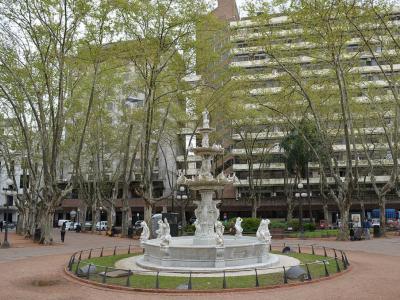
Constitution Square, also known as the Main Square (Plaza Matriz), is the oldest city square in Montevideo. Situated in the Old City (Ciudad Vieja) neighborhood, the square has been a central part of the city since its establishment as the Main Square in 1726. It was originally the city's only open public space and has remained the heart of the historic district, encircled by significant structures such as the Metropolitan Cathedral and the Cabildo. This makes it a pivotal tourist destination.
The square itself was founded in 1726, shortly after the city of Montevideo, starting as a mere dusty plain. It wasn't until the late 18th century that buildings began to rise around it, transforming it into a venue for official events and celebrations, including bullfights, reflecting its cultural and social significance over the centuries.
In 1851, Constitution Square was redesigned with diagonal tree-lined paths, benches, and lanterns, enhancing its appeal and functionality. Its importance grew with the 1868 start of a project delivering water from the Santa Lucía River to Montevideo, involving a steam pump and a 60 km pipeline. A new fountain, created by architect Juan Manuel Ferrari and inaugurated in 1871 by President Lorenzo Batlle y Grau, featured griffins and national symbols around a circular pool and ornate column, becoming the plaza's centerpiece.
Today, Constitution Square continues to serve as a vital commercial and tourist axis within the Old City, flanked by pedestrian streets like Peatonal Sarandí. It is surrounded by a vibrant mix of offices, government buildings, banks, shops, and cultural institutions, remaining a focal point for both locals and visitors in Montevideo.
The square itself was founded in 1726, shortly after the city of Montevideo, starting as a mere dusty plain. It wasn't until the late 18th century that buildings began to rise around it, transforming it into a venue for official events and celebrations, including bullfights, reflecting its cultural and social significance over the centuries.
In 1851, Constitution Square was redesigned with diagonal tree-lined paths, benches, and lanterns, enhancing its appeal and functionality. Its importance grew with the 1868 start of a project delivering water from the Santa Lucía River to Montevideo, involving a steam pump and a 60 km pipeline. A new fountain, created by architect Juan Manuel Ferrari and inaugurated in 1871 by President Lorenzo Batlle y Grau, featured griffins and national symbols around a circular pool and ornate column, becoming the plaza's centerpiece.
Today, Constitution Square continues to serve as a vital commercial and tourist axis within the Old City, flanked by pedestrian streets like Peatonal Sarandí. It is surrounded by a vibrant mix of offices, government buildings, banks, shops, and cultural institutions, remaining a focal point for both locals and visitors in Montevideo.
11) Plaza Zabala (Zabala Square)
Bruno Mauricio de Zabala, a Spanish military officer, played a key role in securing Spanish control of the River Plate in the early 18th century. To strengthen Spain’s presence in the region, Zabala ordered the establishment of a fortified settlement on the coast in 1726. The coastal fortress built under Zabala remained a defining feature of the site for more than a century. In 1878, during the rule of Colonel Lorenzo Latorre, the decision was made to demolish the old fortifications and convert the area into a public square.
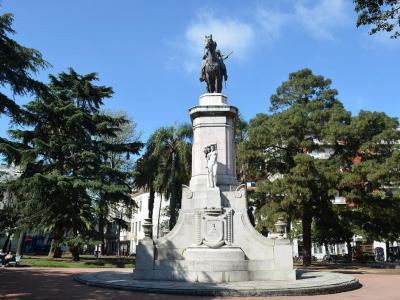
The square itself was officially inaugurated in December 1890, but without a central monument. The equestrian statue of Zabala was installed much later and inaugurated on December 27, 1931. The statue stands at the center of the square, with Zabala on horseback oriented toward the north.
The landscaped gardens surrounding the monument were designed by French landscape architect Édouard André. His plan organizes the square with radial walkways leading inward to the statue, framed by structured greenery and enclosed by ornamental iron fences and gates. The square is fully encircled by Durango Ring Road, the ring street that traces the former defensive perimeter and is named after Zabala’s birthplace.
On the southern edge of the square, facing the gardens, stands Taranco Palace, now the Museum of Decorative Arts. Together, the square, monument, and surrounding buildings mark Montevideo’s shift from fortified outpost to civic capital, visible in both layout and orientation.
The square itself was officially inaugurated in December 1890, but without a central monument. The equestrian statue of Zabala was installed much later and inaugurated on December 27, 1931. The statue stands at the center of the square, with Zabala on horseback oriented toward the north.
The landscaped gardens surrounding the monument were designed by French landscape architect Édouard André. His plan organizes the square with radial walkways leading inward to the statue, framed by structured greenery and enclosed by ornamental iron fences and gates. The square is fully encircled by Durango Ring Road, the ring street that traces the former defensive perimeter and is named after Zabala’s birthplace.
On the southern edge of the square, facing the gardens, stands Taranco Palace, now the Museum of Decorative Arts. Together, the square, monument, and surrounding buildings mark Montevideo’s shift from fortified outpost to civic capital, visible in both layout and orientation.
