Custom Walk in Marseille, France by plee0211_854b9a created on 2026-04-07
Guide Location: France » Marseille
Guide Type: Custom Walk
# of Sights: 7
Tour Duration: 3 Hour(s)
Travel Distance: 6.7 Km or 4.2 Miles
Share Key: Z8UDV
Guide Type: Custom Walk
# of Sights: 7
Tour Duration: 3 Hour(s)
Travel Distance: 6.7 Km or 4.2 Miles
Share Key: Z8UDV
How It Works
Please retrieve this walk in the GPSmyCity app. Once done, the app will guide you from one tour stop to the next as if you had a personal tour guide. If you created the walk on this website or come to the page via a link, please follow the instructions below to retrieve the walk in the app.
Retrieve This Walk in App
Step 1. Download the app "GPSmyCity: Walks in 1K+ Cities" on Apple App Store or Google Play Store.



Step 2. In the GPSmyCity app, download(or launch) the guide "Marseille Map and Walking Tours".
Step 3. Tap the menu button located at upper right corner of the "Walks" screen and select "Retrieve custom walk". Enter the share key: Z8UDV
1) Fort Saint-Jean
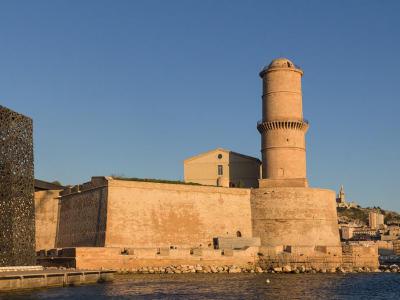
Fort Saint-Jean, established in 1660 by king Louis XIV, is one of Marseille’s most formidable fortifications. Its construction incorporated two earlier structures: the 12th-century Commandery of the Knights Hospitaller of Saint John of Jerusalem, which once served as a monastic hospice during the Crusades, and the 15th-century tower of René I, King of Provence.
In April 1790, Fort Saint-Jean was seized by a revolutionary mob that executed the commander of the royal garrison. During the French Revolution, the fort was converted into a prison and held several prominent figures, including Louis Philippe II, Duke of Orléans, and his sons Louis-Charles, Count of Beaujolais, and Antoine Philippe, Duke of Montpensier. Following Robespierre’s downfall in 1794, around one hundred Jacobin prisoners-members of a radical political faction during the Revolution-detained in the fort were brutally massacred.
Throughout the 19th and early 20th centuries, Fort Saint-Jean remained under the control of the French Army, serving as both a barracks and a clearing station for troops bound for North Africa. During World War II, it was occupied by German forces, and in August 1944, as Marseille was liberated, a massive ammunition explosion devastated much of the fort’s historic structure.
Recognized as a Historic Monument in 1964, Fort Saint-Jean underwent extensive reconstruction between 1967 and 1971. Today, it forms part of the Museum of European and Mediterranean Civilizations complex.
In April 1790, Fort Saint-Jean was seized by a revolutionary mob that executed the commander of the royal garrison. During the French Revolution, the fort was converted into a prison and held several prominent figures, including Louis Philippe II, Duke of Orléans, and his sons Louis-Charles, Count of Beaujolais, and Antoine Philippe, Duke of Montpensier. Following Robespierre’s downfall in 1794, around one hundred Jacobin prisoners-members of a radical political faction during the Revolution-detained in the fort were brutally massacred.
Throughout the 19th and early 20th centuries, Fort Saint-Jean remained under the control of the French Army, serving as both a barracks and a clearing station for troops bound for North Africa. During World War II, it was occupied by German forces, and in August 1944, as Marseille was liberated, a massive ammunition explosion devastated much of the fort’s historic structure.
Recognized as a Historic Monument in 1964, Fort Saint-Jean underwent extensive reconstruction between 1967 and 1971. Today, it forms part of the Museum of European and Mediterranean Civilizations complex.
2) Abbaye Saint-Victor (Saint-Victor Abbey) (must see)
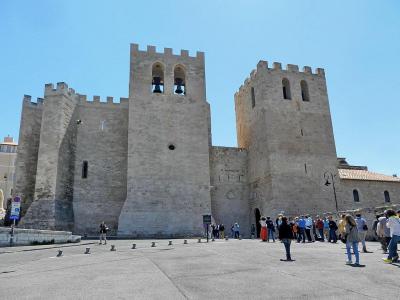
Overlooking the sea stands the Saint-Victor Abbey, a historic monastery that has occupied this site since around 415 CE, being among the first Christian sanctuaries established in Provence. Tradition holds that it was founded by the monk John Cassian, and some believe the crypt contains relics of Saint Victor himself-or even traces of an ancient Greek quarry.
Cassian originally established two monasteries here, one for men and one for women, on opposite sides of the old harbor. Both were destroyed by Saracen raiders in the 8th or 9th centuries, but monastic life resumed in 977. The abbey flourished for several centuries before being stripped of its treasures during the French Revolution in 1794. At various times it served as a warehouse, prison, and barracks, before being restored under Napoleon. In 1934, Pope Pius XI elevated it to the rank of minor basilica following extensive renovation.
Visitors find tombs of saints and bishops, alongside pagan sarcophagi from the early Christian period. Above, the abbey’s crenelated towers offer panoramic views over the harbor and the Mediterranean. Its elevated position near Fort Saint Nicholas once allowed monks to watch for approaching Saracen or Viking ships. Each year on Candlemas, a traditional pilgrimage takes place from the Old Port to the abbey. The Black Madonna, normally kept in the crypt, is wrapped in a green cloak and carried to the square before the church, where she receives a blessing from the bishop.
Tip: It’s worth paying the small entrance fee to visit the crypt-it truly feels like entering another world.
Cassian originally established two monasteries here, one for men and one for women, on opposite sides of the old harbor. Both were destroyed by Saracen raiders in the 8th or 9th centuries, but monastic life resumed in 977. The abbey flourished for several centuries before being stripped of its treasures during the French Revolution in 1794. At various times it served as a warehouse, prison, and barracks, before being restored under Napoleon. In 1934, Pope Pius XI elevated it to the rank of minor basilica following extensive renovation.
Visitors find tombs of saints and bishops, alongside pagan sarcophagi from the early Christian period. Above, the abbey’s crenelated towers offer panoramic views over the harbor and the Mediterranean. Its elevated position near Fort Saint Nicholas once allowed monks to watch for approaching Saracen or Viking ships. Each year on Candlemas, a traditional pilgrimage takes place from the Old Port to the abbey. The Black Madonna, normally kept in the crypt, is wrapped in a green cloak and carried to the square before the church, where she receives a blessing from the bishop.
Tip: It’s worth paying the small entrance fee to visit the crypt-it truly feels like entering another world.
3) Notre-Dame de la Garde (must see)
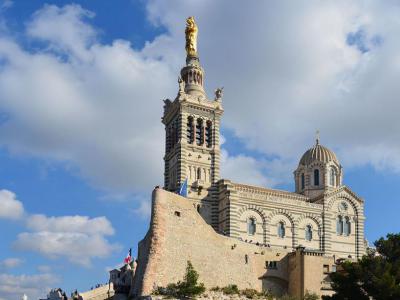
Notre-Dame de la Garde stands proudly as an opulent Neo-Byzantine church situated atop the highest natural point in Marseille, perched upon a 532 feet limestone outcrop on the south side of the Old Port. This majestic site has become a cherished destination for an annual pilgrimage on Assumption Day.
Conceived by the talented architect Henri-Jacques Espérandieu, the basilica received its consecration on the 5th of June in 1864. Its origins trace back to a church with the same name, first erected in 1214 and later reconstructed during the 15th century. Remarkably, the basilica's foundations rest upon a 16th-century fortress built by Francis I of France to fend off Emperor Charles V's siege of the city in 1536.
The basilica comprises two distinct sections: a lower church or crypt, artistically carved into the rock in the Romanesque style, and an upper church boasting Neo-Byzantine elegance adorned with breathtaking mosaics. Towering above is a square bell-tower, reaching a height of 135 feet, crowned with a belfry standing at 42 feet. At its peak, a monumental statue of the Madonna and Child, crafted from copper gilded with gold leaf, soars to an impressive 27 feet.
During its history, the basilica encountered challenges, particularly regarding the stone used in its construction, which proved susceptible to atmospheric corrosion. In response, extensive restoration work took place from 2001 to 2008. This effort encompassed the meticulous repair of the mosaics, damaged by candle smoke over the years, as well as by bullets during the Liberation of France at the end of World War II.
Conceived by the talented architect Henri-Jacques Espérandieu, the basilica received its consecration on the 5th of June in 1864. Its origins trace back to a church with the same name, first erected in 1214 and later reconstructed during the 15th century. Remarkably, the basilica's foundations rest upon a 16th-century fortress built by Francis I of France to fend off Emperor Charles V's siege of the city in 1536.
The basilica comprises two distinct sections: a lower church or crypt, artistically carved into the rock in the Romanesque style, and an upper church boasting Neo-Byzantine elegance adorned with breathtaking mosaics. Towering above is a square bell-tower, reaching a height of 135 feet, crowned with a belfry standing at 42 feet. At its peak, a monumental statue of the Madonna and Child, crafted from copper gilded with gold leaf, soars to an impressive 27 feet.
During its history, the basilica encountered challenges, particularly regarding the stone used in its construction, which proved susceptible to atmospheric corrosion. In response, extensive restoration work took place from 2001 to 2008. This effort encompassed the meticulous repair of the mosaics, damaged by candle smoke over the years, as well as by bullets during the Liberation of France at the end of World War II.

4) Cafés Debout
Located behind the majestic Opéra house in Marseille lies a charming gem known as Cafés Debout. Despite its small size, this century-old house has stood the test of time, offering good quality products to the people of Marseille since 1932. Stepping into Cafés Debout is like taking a delightful journey back in time, with its old-fashioned style that exudes authenticity and a sense of history.
As you enter, you're greeted by the welcoming aroma of freshly brewed coffee and an assortment of teas. With around a hundred varieties of tea and about twenty different coffees, there is something to suit every taste preference. The choice is yours, and as you take a sip of your chosen beverage, you'll find it to be a real pleasure that complements the overall experience.
A visit to Cafés Debout is not complete without indulging in their rich dark chocolate. As you enjoy your tea or coffee, nibbling on a square of their delicious chocolate enhances the experience and leaves you with a satisfied smile.
The walls are adorned with souvenirs, and ornate coffee pots grace the shelves, reminding visitors of the cafe's longstanding tradition and passion for quality products. It is this dedication that has made Cafés Debout a benchmark in Marseille, and generations of Marseillais have cherished this place for decades.
Beyond the beverages and chocolates, Cafés Debout has expanded its offerings over the years. Originally a shop dedicated to selling "coffee, oil, and soap," it has adapted to the changing times while preserving its authentic charm.
As you enter, you're greeted by the welcoming aroma of freshly brewed coffee and an assortment of teas. With around a hundred varieties of tea and about twenty different coffees, there is something to suit every taste preference. The choice is yours, and as you take a sip of your chosen beverage, you'll find it to be a real pleasure that complements the overall experience.
A visit to Cafés Debout is not complete without indulging in their rich dark chocolate. As you enjoy your tea or coffee, nibbling on a square of their delicious chocolate enhances the experience and leaves you with a satisfied smile.
The walls are adorned with souvenirs, and ornate coffee pots grace the shelves, reminding visitors of the cafe's longstanding tradition and passion for quality products. It is this dedication that has made Cafés Debout a benchmark in Marseille, and generations of Marseillais have cherished this place for decades.
Beyond the beverages and chocolates, Cafés Debout has expanded its offerings over the years. Originally a shop dedicated to selling "coffee, oil, and soap," it has adapted to the changing times while preserving its authentic charm.
5) Vieux-Port (Old Port) (must see)
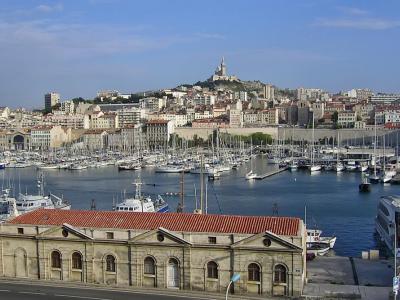
The Old Port is the city’s historic heart and one of the most evocative harbours in Europe, being a centre of maritime life for over 2,600 years. The site was first used as a trading post by the Phoenicians, long before the Greek settlers from Phocaea officially established it in 600 BCE as the port of Massalia, making it the birthplace of the city itself.
Through the centuries, the Old Port became a hub of Mediterranean commerce and naval activity. Kings Louis XII and Louis XIII expanded the shipyards in the 15th and 16th centuries, while King Louis XIV added the imposing Fort Saint John and Fort Saint Nicholas to defend the entrance of the harbour. The port reached its commercial peak in the 19th century, when up to 18,000 merchant vessels docked here annually, rivaling the activity of major ports such as Liverpool and Le Havre. However, with the arrival of large steamships that required deeper waters, Marseille shifted much of its industrial trade to the Port of La Joliette, located farther north.
The Old Port suffered immense damage during World War II, when German forces, assisted by French police, demolished much of the area to block access to Allied troops. Postwar reconstruction reshaped the district, and by the late 20th century, major urban renewal projects restored the port’s vitality. Architect Norman Foster’s redesign, featuring the The Shade Pavilion, a mirrored canopy that reflects the harbour below, marked a new era of pedestrian-friendly space and modern elegance.
Today, the Port serves as a marina for yachts, ferries, and fishing boats, as well as the site of a daily fish market that preserves centuries-old local tradition. Lined with cafés, restaurants, and open-air terraces, it remains a favourite gathering place for both locals and visitors.
Through the centuries, the Old Port became a hub of Mediterranean commerce and naval activity. Kings Louis XII and Louis XIII expanded the shipyards in the 15th and 16th centuries, while King Louis XIV added the imposing Fort Saint John and Fort Saint Nicholas to defend the entrance of the harbour. The port reached its commercial peak in the 19th century, when up to 18,000 merchant vessels docked here annually, rivaling the activity of major ports such as Liverpool and Le Havre. However, with the arrival of large steamships that required deeper waters, Marseille shifted much of its industrial trade to the Port of La Joliette, located farther north.
The Old Port suffered immense damage during World War II, when German forces, assisted by French police, demolished much of the area to block access to Allied troops. Postwar reconstruction reshaped the district, and by the late 20th century, major urban renewal projects restored the port’s vitality. Architect Norman Foster’s redesign, featuring the The Shade Pavilion, a mirrored canopy that reflects the harbour below, marked a new era of pedestrian-friendly space and modern elegance.
Today, the Port serves as a marina for yachts, ferries, and fishing boats, as well as the site of a daily fish market that preserves centuries-old local tradition. Lined with cafés, restaurants, and open-air terraces, it remains a favourite gathering place for both locals and visitors.
6) Cathédrale de la Major (Marseille Cathedral) (must see)
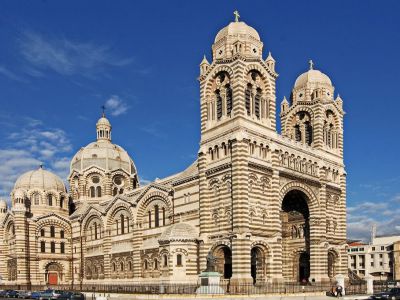
The Marseille Cathedral, also known as the Cathedral of Saint Mary Major, unites two eras of faith and architecture. The site includes both the Old Marseille Cathedral, dating to the 12th century, and the New Marseille Cathedral, constructed under Emperor Napoleon III in the late 19th century. Napoleon ordered the older Provençal Romanesque building replaced but preserved part of it-the choir and one bay of the nave-after public protests over its demolition.
The New Marseille Cathedral dominates the waterfront with its vast Romanesque-Byzantine Revival design. Stretching 469 feet in length, with a main dome reaching 231 feet in height, it can hold about 3,000 worshippers. Its façade alternates bands of white and dark stone, a combination of Florentine limestone and Ligurian green porphyry, producing a striped pattern affectionately nicknamed “the Pajamas” by locals. Inside, the cathedral reveals a rich blend of imported materials: white Carrara marble from Italy, onyx from Tunisia, and dazzling Venetian mosaics that illuminate its chapels and domes.
Beside this grand 19th-century structure lie the remains of the Old Cathedral, a humble yet evocative remnant of Marseille’s medieval heritage. The surviving chancel and apse feature smaller side chapels and a cylindrical vault crowned with octagonal and heptagonal domes. Archaeological traces beneath the site even reveal earlier Christian structures dating to the 5th century, showing that this location has been a place of worship for over fifteen centuries.
A visit to Marseille Cathedral offers not just architectural splendor but also some of the best panoramic views of the port and the Mediterranean. Rising between sea and city, the cathedral stands as both a symbol of continuity and a beacon of faith-undeniably one of Marseille’s must-see attractions.
The New Marseille Cathedral dominates the waterfront with its vast Romanesque-Byzantine Revival design. Stretching 469 feet in length, with a main dome reaching 231 feet in height, it can hold about 3,000 worshippers. Its façade alternates bands of white and dark stone, a combination of Florentine limestone and Ligurian green porphyry, producing a striped pattern affectionately nicknamed “the Pajamas” by locals. Inside, the cathedral reveals a rich blend of imported materials: white Carrara marble from Italy, onyx from Tunisia, and dazzling Venetian mosaics that illuminate its chapels and domes.
Beside this grand 19th-century structure lie the remains of the Old Cathedral, a humble yet evocative remnant of Marseille’s medieval heritage. The surviving chancel and apse feature smaller side chapels and a cylindrical vault crowned with octagonal and heptagonal domes. Archaeological traces beneath the site even reveal earlier Christian structures dating to the 5th century, showing that this location has been a place of worship for over fifteen centuries.
A visit to Marseille Cathedral offers not just architectural splendor but also some of the best panoramic views of the port and the Mediterranean. Rising between sea and city, the cathedral stands as both a symbol of continuity and a beacon of faith-undeniably one of Marseille’s must-see attractions.
7) Museum of European and Mediterranean Civilisations (MuCEM) (must see)
The Museum of European and Mediterranean Civilisations (Musée des Civilisations de l'Europe et de la Méditerranée) is a national institution situated in Marseille. Its inauguration took place on 7th June 2013, coinciding with Marseille's designation as the European Capital of Culture during the Marseille-Provence 2013 celebration. This museum was recognized for its excellence and awarded the prestigious Council of Europe Museum Prize in 2015.
Dedicated to the exploration of European and Mediterranean civilizations, the museum showcases a permanent collection that delves into the historical and cultural interactions within the Mediterranean basin. Adopting an interdisciplinary approach, it covers various aspects of society throughout different eras, right up to modern times.
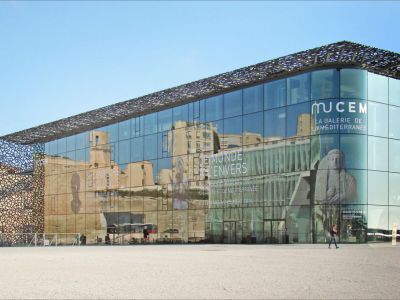
The museum's strategic location lies on reclaimed land at the harbor's entrance, adjacent to the 17th-century Fort Saint-Jean and the former port terminal, J4. A channel separates the contemporary building from the Fort Saint-Jean, which has been renovated as part of the overall project. These two areas are connected via a 130-meter-long high footbridge. Additionally, another footbridge links Fort Saint-Jean to the Esplanade de la Tourette, close to the church of Saint Laurent in the Panier quarter.
Designed by architects Rudy Ricciotti and Roland Carta, the museum embodies the concept of "stone, water, and wind." It features a striking cube-shaped structure spanning 15,000 square meters, enclosed by a latticework shell made of fiber-reinforced concrete. Inside, visitors can explore exhibits on two levels, while an underground auditorium with a seating capacity of 400 enriches the experience. The ground floor houses the permanent collection and a bookshop, while the top terrace hosts a restaurant that offers breathtaking panoramic views of Marseille's bay, the Corniche, and the Prado area.
In addition to its regular exhibitions, the museum presented a special exhibition in 2022 dedicated to Emir Abdelkader. This unique showcase provided an opportunity to delve into significant historical and memorial aspects related to this eminent figure within the Mediterranean context.
Dedicated to the exploration of European and Mediterranean civilizations, the museum showcases a permanent collection that delves into the historical and cultural interactions within the Mediterranean basin. Adopting an interdisciplinary approach, it covers various aspects of society throughout different eras, right up to modern times.
The museum's strategic location lies on reclaimed land at the harbor's entrance, adjacent to the 17th-century Fort Saint-Jean and the former port terminal, J4. A channel separates the contemporary building from the Fort Saint-Jean, which has been renovated as part of the overall project. These two areas are connected via a 130-meter-long high footbridge. Additionally, another footbridge links Fort Saint-Jean to the Esplanade de la Tourette, close to the church of Saint Laurent in the Panier quarter.
Designed by architects Rudy Ricciotti and Roland Carta, the museum embodies the concept of "stone, water, and wind." It features a striking cube-shaped structure spanning 15,000 square meters, enclosed by a latticework shell made of fiber-reinforced concrete. Inside, visitors can explore exhibits on two levels, while an underground auditorium with a seating capacity of 400 enriches the experience. The ground floor houses the permanent collection and a bookshop, while the top terrace hosts a restaurant that offers breathtaking panoramic views of Marseille's bay, the Corniche, and the Prado area.
In addition to its regular exhibitions, the museum presented a special exhibition in 2022 dedicated to Emir Abdelkader. This unique showcase provided an opportunity to delve into significant historical and memorial aspects related to this eminent figure within the Mediterranean context.
