Custom Walk in Birmingham, England by malchannaford_9ce667 created on 2026-02-21
Guide Location: England » Birmingham
Guide Type: Custom Walk
# of Sights: 8
Tour Duration: 1 Hour(s)
Travel Distance: 0.7 Km or 0.4 Miles
Share Key: HK3FK
Guide Type: Custom Walk
# of Sights: 8
Tour Duration: 1 Hour(s)
Travel Distance: 0.7 Km or 0.4 Miles
Share Key: HK3FK
How It Works
Please retrieve this walk in the GPSmyCity app. Once done, the app will guide you from one tour stop to the next as if you had a personal tour guide. If you created the walk on this website or come to the page via a link, please follow the instructions below to retrieve the walk in the app.
Retrieve This Walk in App
Step 1. Download the app "GPSmyCity: Walks in 1K+ Cities" on Apple App Store or Google Play Store.



Step 2. In the GPSmyCity app, download(or launch) the guide "Birmingham Map and Walking Tours".
Step 3. Tap the menu button located at upper right corner of the "Walks" screen and select "Retrieve custom walk". Enter the share key: HK3FK
1) Symphony Hall (must see)
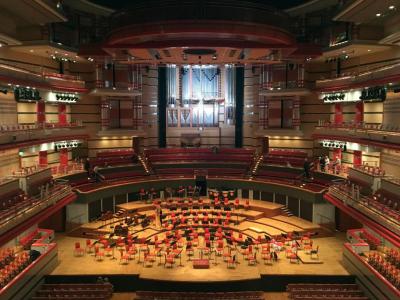
Symphony Hall, located in Birmingham, is a premier 2,262-seat concert venue celebrated for its exceptional acoustics and architectural design. Officially opened by Queen Elizabeth II on June 12, 1991, it began hosting events as early as April 15 of that same year. It serves as the home for the City of Birmingham Symphony Orchestra and accommodates approximately 270 events annually, spanning genres from classical music to jazz, and functions including conferences and business gatherings as part of the International Convention Centre.
The hall was constructed with a budget of £30 million and is aesthetically and acoustically modeled after prestigious venues such as Vienna's Musikverein and Amsterdam's Concertgebouw. Acclaimed by acoustics expert Leo Beranek in 2016, Symphony Hall is rated as having the finest acoustics in the United Kingdom and the seventh-best globally. A testament to its sound quality, during pre-opening tests, a pin dropped on stage could be heard from any seat within the hall.
Designed by the Percy Thomas Partnership and Renton Howard Wood Levin, the hall features innovative acoustic elements. These include a large reverberation chamber that increases the hall's volume by 50%, an adjustable acoustic canopy, and dampening panels that tailor the acoustics to the performance. Further, the structure is built with concrete walls and a ceiling 200 millimeters thick, and it rests on rubber cushions to isolate it from nearby railway vibrations and traffic noise on Broad Street.
An outstanding feature of Symphony Hall is its 6,000-pipe symphony organ, the largest mechanical action organ in the UK, installed in 2001 and crafted by Johannes Klais Orgelbau. Managed by B Limited, Symphony Hall not only entertains but also engages in extensive community and educational outreach, impacting thousands of young people and adults across the region annually. Through its diverse programming and architectural excellence, Symphony Hall stands as a beacon of cultural enrichment and architectural ingenuity in Birmingham.
The hall was constructed with a budget of £30 million and is aesthetically and acoustically modeled after prestigious venues such as Vienna's Musikverein and Amsterdam's Concertgebouw. Acclaimed by acoustics expert Leo Beranek in 2016, Symphony Hall is rated as having the finest acoustics in the United Kingdom and the seventh-best globally. A testament to its sound quality, during pre-opening tests, a pin dropped on stage could be heard from any seat within the hall.
Designed by the Percy Thomas Partnership and Renton Howard Wood Levin, the hall features innovative acoustic elements. These include a large reverberation chamber that increases the hall's volume by 50%, an adjustable acoustic canopy, and dampening panels that tailor the acoustics to the performance. Further, the structure is built with concrete walls and a ceiling 200 millimeters thick, and it rests on rubber cushions to isolate it from nearby railway vibrations and traffic noise on Broad Street.
An outstanding feature of Symphony Hall is its 6,000-pipe symphony organ, the largest mechanical action organ in the UK, installed in 2001 and crafted by Johannes Klais Orgelbau. Managed by B Limited, Symphony Hall not only entertains but also engages in extensive community and educational outreach, impacting thousands of young people and adults across the region annually. Through its diverse programming and architectural excellence, Symphony Hall stands as a beacon of cultural enrichment and architectural ingenuity in Birmingham.
2) International Convention Centre
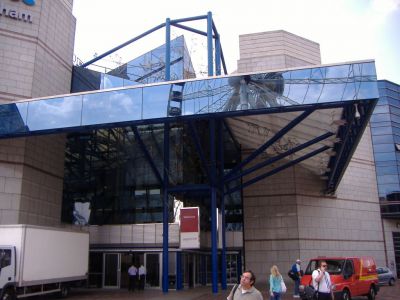
The International Convention Centre (ICC) in Birmingham is a significant conference venue that plays a crucial role in the city's event-hosting capabilities. Designed by the Percy Thomas Partnership and Renton Howard Wood Levin, the ICC is strategically located in Birmingham’s Westside area, adjacent to landmarks such as Symphony Hall, Centenary Square, and the picturesque canals of Birmingham.
The construction of the ICC was a major project involving over 1,500 workers and utilizing more than 60,000 cubic meters of concrete. Its foundation stone was laid by Jacques Delors, marking the beginning of a construction period that lasted over four years. The site was officially opened on June 12, 1991, by Queen Elizabeth II.
The ICC stands on a site steeped in historical significance, previously home to the Prince of Wales Theatre and Bingley Hall, the world's first purpose-built exhibition hall. The area was also marked by residential houses, a brewery, and an inn. A Victorian cast iron urinal, a listed structure, was removed before construction and remains unrestored at Tyseley Locomotive Works.
In terms of events, the ICC has hosted significant gatherings including the 24th G8 summit in May 1998. It also participates in city-wide events such as "Discovery Day," and has been the venue for political conferences for the UK's major parties. The building's design features a blue-tinted window facade and white stone cladding. A notable piece of art, "Birdlife" by Ron Hasledon, adorns the main entrance.
Inside, the ICC boasts an expansive layout with multiple bridges and walkways across its atrium, connecting ten halls and ten additional meeting rooms. It has a total capacity of 8,000 delegates, with its largest hall, Hall 3, capable of accommodating up to 3,000 delegates in a 3,050 square meter space. This makes the ICC not only a hub of historical and architectural significance but also a central player in Birmingham's cultural and political events landscape.
The construction of the ICC was a major project involving over 1,500 workers and utilizing more than 60,000 cubic meters of concrete. Its foundation stone was laid by Jacques Delors, marking the beginning of a construction period that lasted over four years. The site was officially opened on June 12, 1991, by Queen Elizabeth II.
The ICC stands on a site steeped in historical significance, previously home to the Prince of Wales Theatre and Bingley Hall, the world's first purpose-built exhibition hall. The area was also marked by residential houses, a brewery, and an inn. A Victorian cast iron urinal, a listed structure, was removed before construction and remains unrestored at Tyseley Locomotive Works.
In terms of events, the ICC has hosted significant gatherings including the 24th G8 summit in May 1998. It also participates in city-wide events such as "Discovery Day," and has been the venue for political conferences for the UK's major parties. The building's design features a blue-tinted window facade and white stone cladding. A notable piece of art, "Birdlife" by Ron Hasledon, adorns the main entrance.
Inside, the ICC boasts an expansive layout with multiple bridges and walkways across its atrium, connecting ten halls and ten additional meeting rooms. It has a total capacity of 8,000 delegates, with its largest hall, Hall 3, capable of accommodating up to 3,000 delegates in a 3,050 square meter space. This makes the ICC not only a hub of historical and architectural significance but also a central player in Birmingham's cultural and political events landscape.
3) Centenary Square
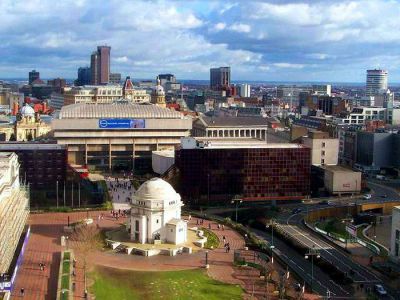
Centenary Square, situated on the north side of Broad Street in Birmingham, was established in 1989 to celebrate the 100th anniversary of Birmingham's city status. Originally an industrial zone filled with small workshops and canal wharves, the area underwent significant transformation after being acquired by the council in the 1920s. Initially intended to be part of a grand civic center scheme featuring museums, council offices, a cathedral, and an opera house, this plan was largely halted by World War II, with only the Hall of Memory and part of Baskerville House completed.
Post-war efforts to revive the original grand scheme in a simplified form did not fully materialize. However, the square saw a substantial redesign in 1991 to complement the newly constructed International Convention Centre. This redesign included new paving, railings, and lamps by artist Tess Jaray, along with a fountain and several sculptures.
Significant changes occurred again with the construction of the Library of Birmingham on the square in 2013, which led to the removal of many elements from the 1991 design and the incorporation of a library amphitheater. In 2014, a competition led to another redesign of the square, with construction commencing in 2017 and completing in 2019.
Today, Centenary Square is a vibrant cultural hub, hosting major city events such as the Frankfurt Christmas Market, arts festivals, Remembrance Day services, and New Year's celebrations. Seasonally, it also features a temporary ice rink and Ferris wheel, adding to its festive allure. This evolution from an industrial site to a centerpiece of urban cultural and civic activity reflects Birmingham's dynamic urban development.
Post-war efforts to revive the original grand scheme in a simplified form did not fully materialize. However, the square saw a substantial redesign in 1991 to complement the newly constructed International Convention Centre. This redesign included new paving, railings, and lamps by artist Tess Jaray, along with a fountain and several sculptures.
Significant changes occurred again with the construction of the Library of Birmingham on the square in 2013, which led to the removal of many elements from the 1991 design and the incorporation of a library amphitheater. In 2014, a competition led to another redesign of the square, with construction commencing in 2017 and completing in 2019.
Today, Centenary Square is a vibrant cultural hub, hosting major city events such as the Frankfurt Christmas Market, arts festivals, Remembrance Day services, and New Year's celebrations. Seasonally, it also features a temporary ice rink and Ferris wheel, adding to its festive allure. This evolution from an industrial site to a centerpiece of urban cultural and civic activity reflects Birmingham's dynamic urban development.
4) Hall of Memory Birmingham
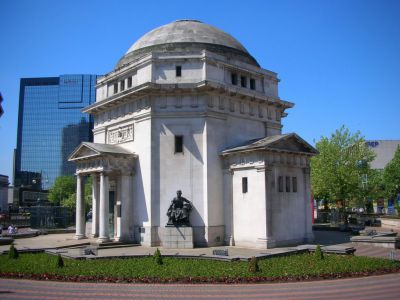
The Hall of Memory in Birmingham stands as a poignant war memorial located in Centenary Square. It was designed by architects S. N. Cooke and W. N. Twist and built between 1922 and 1925 by John Barnsley and Son. The memorial honors the 12,320 Birmingham citizens who perished during World War I.
Constructed over a filled-in canal basin formerly known as Gibson's Arm, the Hall of Memory was envisioned as part of a larger civic project aimed at enhancing the area with new council offices, the mayor's residence, a public library, and a concert hall. However, the outbreak of World War II halted these plans, leaving only part of the Baskerville House completed.
The memorial is made from Portland stone sourced from the Isle of Portland in Dorset. Its foundation stone was laid by the Prince of Wales on June 12, 1923, and it was officially opened by Prince Arthur of Connaught on July 4, 1925, before an assembly of 30,000 people.
Surrounding the exterior of the Hall are four statues crafted by local artist Albert Toft, symbolizing the Army, Navy, Air Force, and Women's Services. Inside, the Hall features three bas-relief plaques measuring 155 cm by 223 cm, created by William Bloye. These plaques depict three scenes: Call (the departure to war), Front Line (the combat), and Return (the homecoming of the wounded). Additionally, a roll of honor illustrated by Sidney Meteyard is displayed, honoring those who served.
The Hall of Memory was upgraded to a Grade I listed building on October 27, 2014, recognizing its significant historical and architectural value.
Constructed over a filled-in canal basin formerly known as Gibson's Arm, the Hall of Memory was envisioned as part of a larger civic project aimed at enhancing the area with new council offices, the mayor's residence, a public library, and a concert hall. However, the outbreak of World War II halted these plans, leaving only part of the Baskerville House completed.
The memorial is made from Portland stone sourced from the Isle of Portland in Dorset. Its foundation stone was laid by the Prince of Wales on June 12, 1923, and it was officially opened by Prince Arthur of Connaught on July 4, 1925, before an assembly of 30,000 people.
Surrounding the exterior of the Hall are four statues crafted by local artist Albert Toft, symbolizing the Army, Navy, Air Force, and Women's Services. Inside, the Hall features three bas-relief plaques measuring 155 cm by 223 cm, created by William Bloye. These plaques depict three scenes: Call (the departure to war), Front Line (the combat), and Return (the homecoming of the wounded). Additionally, a roll of honor illustrated by Sidney Meteyard is displayed, honoring those who served.
The Hall of Memory was upgraded to a Grade I listed building on October 27, 2014, recognizing its significant historical and architectural value.
5) Chamberlain Square
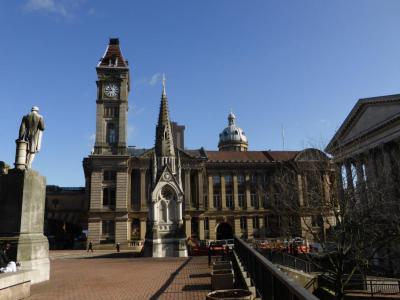
The Chamberlain Memorial, a Victorian neo-gothic spire 66 feet high, was unveiled in Birmingham, England on October, 1880. Joseph Chamberlain was there, watching the proceedings. The Square and the Memorial were named in honor of his services as statesman and Mayor. The memorial was designed by John Henry Chamberlain (no relation).
The crocketted spire and the carvings of capitals were done by Samuel Barfield of Leicester. There was a portrait of Joseph Chamberlain by Thomas Woolner on one side. The finished product was criticized by some as an "architectural scarecrow" and as a "hash of ornamental details." As late as 1966 it was called an "ungainly combination of shapes."
The Square was drastically remade in the 1970s. Most of the neo-gothic Victorian buildings were demolished and replaced by brutalist architecture. The Square was closed from 2015 until March, 2021 for more remodeling and re-landscaping. During this time surrounding buildings were demolished, including the brutalist Central Library.
After five years the Square has reopened. It is completely reformed with more open space, new paving, stairs and lighting. Statues have been moved. The statue of James Watt moved from Paradise Street to the Town Hall. Thomas Atwood is off his plinth and now reclines on steps of the Square among his scattered papers. Joseph Priestly is steadfast.
The crocketted spire and the carvings of capitals were done by Samuel Barfield of Leicester. There was a portrait of Joseph Chamberlain by Thomas Woolner on one side. The finished product was criticized by some as an "architectural scarecrow" and as a "hash of ornamental details." As late as 1966 it was called an "ungainly combination of shapes."
The Square was drastically remade in the 1970s. Most of the neo-gothic Victorian buildings were demolished and replaced by brutalist architecture. The Square was closed from 2015 until March, 2021 for more remodeling and re-landscaping. During this time surrounding buildings were demolished, including the brutalist Central Library.
After five years the Square has reopened. It is completely reformed with more open space, new paving, stairs and lighting. Statues have been moved. The statue of James Watt moved from Paradise Street to the Town Hall. Thomas Atwood is off his plinth and now reclines on steps of the Square among his scattered papers. Joseph Priestly is steadfast.
6) Central Library (must see)
The Brutalist Central Library of Birmingham is no more. The building was brought down and replaced by the new Library of Birmingham. The inverted Ziggurat of the Central Library ended its 41-year career as it began. Some cheered, some were horrified by its looks. The Central was never truly accepted by the city.
The Central was designed by architect John Madin in the Brutalist style. It was part of an ambitious project of the City Council to build a civic center on the new Inner Ring Road. The Library replaced by the Central of John Madin was designed by John Henry Chamberlain. Chamberlain's building opened in 1883. It was demolished in 1974.
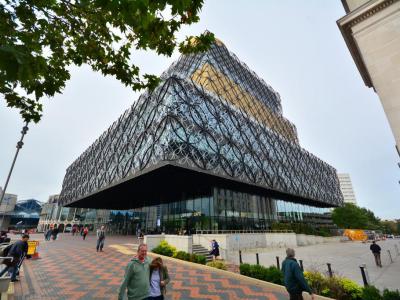
All hail the Library of Birmingham. Architectural design is by Francine Houben. Structural Engineering is by Buro Happold. The new Library has been described as the largest regional library in Europe. The library nestles between and connects to the Birmingham Rep and Baskerville House at Centenary Square.
The Shakespeare Memorial Room, designed by John Chamberlain in 1882 has been reincarnated with each demolition. It has been carefully dismantled and reassembled three times. It is constructed in a Lombardic Renaissance style with a clerestoried reading area. The collection houses 43,000 books, including the First Folio of 1623.
The library was opened in September, 2013 by Malala Youafzai, who was savagely attacked by the Taliban for attending school. She said, "Let us not forget that even one book, one pen, one teacher can change the world."
The Central was designed by architect John Madin in the Brutalist style. It was part of an ambitious project of the City Council to build a civic center on the new Inner Ring Road. The Library replaced by the Central of John Madin was designed by John Henry Chamberlain. Chamberlain's building opened in 1883. It was demolished in 1974.
All hail the Library of Birmingham. Architectural design is by Francine Houben. Structural Engineering is by Buro Happold. The new Library has been described as the largest regional library in Europe. The library nestles between and connects to the Birmingham Rep and Baskerville House at Centenary Square.
The Shakespeare Memorial Room, designed by John Chamberlain in 1882 has been reincarnated with each demolition. It has been carefully dismantled and reassembled three times. It is constructed in a Lombardic Renaissance style with a clerestoried reading area. The collection houses 43,000 books, including the First Folio of 1623.
The library was opened in September, 2013 by Malala Youafzai, who was savagely attacked by the Taliban for attending school. She said, "Let us not forget that even one book, one pen, one teacher can change the world."
7) Birmingham Museum & Art Gallery (must see)
In 1829 the Birmingham Society of Artists opened a private exhibition venue on New Street. The Factory Act of 1833 initiated government funding for education. In June 1880, Allen E. Everitt became the curator of the Free Art Gallery, the precursor of the Birmingham Museum and Art Gallery.
The Prince of Wales officiated at the opening of the new Museum and Art Gallery in 1885. The building occupied the Council House, above the Gas Department (gas was a coming thing in the 1880s). Elaborate metalwork covered both the interior and exterior of the building, including the impressive cast-iron columns in the main gallery space.
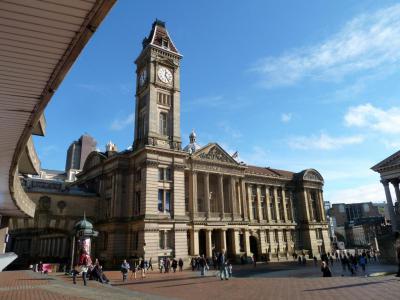
The most stand out features of the exterior were the clock tower and the high portico and a pediment demonstrating Birmingham's contributions to the arts. The main entrance is in Chamberlain Square under the clocktower, referred to locally as "Big Brun." The entrance hall plaque reads, "By the gains of Industry we promote Art."
The Arts promoted by Industry include the Gallery collections, ranging from the 14th to the 21st century. The Gallery holds works by the legendary Pre-Raphelite Brotherhood, including the largest collection of paintings by Edward Burne-Jones.
Schools of art expression in oils in the Gallery are: The English School, with Gainsborough, Hogarth, Turner, and Constable; the Flemish School; the French School; Impressionists Degas, Pisarro, and Renoir. German, Italian and Spanish artists are also represented.
The Prince of Wales officiated at the opening of the new Museum and Art Gallery in 1885. The building occupied the Council House, above the Gas Department (gas was a coming thing in the 1880s). Elaborate metalwork covered both the interior and exterior of the building, including the impressive cast-iron columns in the main gallery space.
The most stand out features of the exterior were the clock tower and the high portico and a pediment demonstrating Birmingham's contributions to the arts. The main entrance is in Chamberlain Square under the clocktower, referred to locally as "Big Brun." The entrance hall plaque reads, "By the gains of Industry we promote Art."
The Arts promoted by Industry include the Gallery collections, ranging from the 14th to the 21st century. The Gallery holds works by the legendary Pre-Raphelite Brotherhood, including the largest collection of paintings by Edward Burne-Jones.
Schools of art expression in oils in the Gallery are: The English School, with Gainsborough, Hogarth, Turner, and Constable; the Flemish School; the French School; Impressionists Degas, Pisarro, and Renoir. German, Italian and Spanish artists are also represented.
8) Birmingham Town Hall
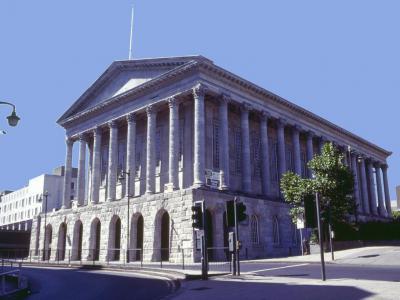
The Birmingham Town Hall, opened in 1834, looks very like the Temple of Castor and Pollux. The Temple once stood in the center of the ancient Forum. The look-alike Town Hall also stands in the center of things, on Paradise Street at Victoria Square.
It rests on a podium of rusticated stone. The columns are finished on top with carved Acanthus leaves below a simple architrave and dentil cornices. The Great Hall has high windows with eared architraves. At the south end of the podium there is an arcade as the main entrance.
The Town Hall was built as a venue for concerts and popular assemblies. It offers more events of jazz, folk, rock, pop and classical music, recitals, dance and educational performances. Not content with that, it goes on to general meetings, product launches, dinners, fashion shows and graduations.
Two construction workers, John Heap and William Badger were killed on the site by a falling crane in January 1833. They were buried in Saint Philip's churchyard. Their memorial was a pillar base originally made for the Town Hall.
In 1853 Charles Dickens gave his first reading in the Hall. The visit of David Lloyd George triggered a riot. Mendelssohn's Elija received its premiere. It was the home of the City of Birmingham Symphony Orchestra until it moved in 1991.
Popular headline acts made their appearance. There has been Buddy Holly, The Beatles, Led Zeppelin, Queen (!), Pink Floyd, Black Sabbath, The rolling Stones and naturally, Bob Dylan (perpetually touring).
It rests on a podium of rusticated stone. The columns are finished on top with carved Acanthus leaves below a simple architrave and dentil cornices. The Great Hall has high windows with eared architraves. At the south end of the podium there is an arcade as the main entrance.
The Town Hall was built as a venue for concerts and popular assemblies. It offers more events of jazz, folk, rock, pop and classical music, recitals, dance and educational performances. Not content with that, it goes on to general meetings, product launches, dinners, fashion shows and graduations.
Two construction workers, John Heap and William Badger were killed on the site by a falling crane in January 1833. They were buried in Saint Philip's churchyard. Their memorial was a pillar base originally made for the Town Hall.
In 1853 Charles Dickens gave his first reading in the Hall. The visit of David Lloyd George triggered a riot. Mendelssohn's Elija received its premiere. It was the home of the City of Birmingham Symphony Orchestra until it moved in 1991.
Popular headline acts made their appearance. There has been Buddy Holly, The Beatles, Led Zeppelin, Queen (!), Pink Floyd, Black Sabbath, The rolling Stones and naturally, Bob Dylan (perpetually touring).
