Custom Walk in Almaty, Kazakhstan by q1_4ee9a4 created on 2026-03-01
Guide Location: Kazakhstan » Almaty
Guide Type: Custom Walk
# of Sights: 13
Tour Duration: 6 Hour(s)
Travel Distance: 13.8 Km or 8.6 Miles
Share Key: BM2ZR
Guide Type: Custom Walk
# of Sights: 13
Tour Duration: 6 Hour(s)
Travel Distance: 13.8 Km or 8.6 Miles
Share Key: BM2ZR
How It Works
Please retrieve this walk in the GPSmyCity app. Once done, the app will guide you from one tour stop to the next as if you had a personal tour guide. If you created the walk on this website or come to the page via a link, please follow the instructions below to retrieve the walk in the app.
Retrieve This Walk in App
Step 1. Download the app "GPSmyCity: Walks in 1K+ Cities" on Apple App Store or Google Play Store.



Step 2. In the GPSmyCity app, download(or launch) the guide "Almaty Map and Walking Tours".
Step 3. Tap the menu button located at upper right corner of the "Walks" screen and select "Retrieve custom walk". Enter the share key: BM2ZR
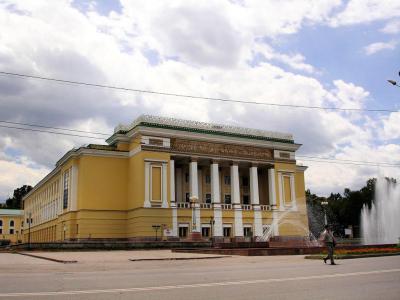
1) Abay National Theater and Opera House
The Abay National Theater and Opera House, situated in Almaty, holds a significant position in Kazakhstani opera and ballet. It was originally established as a music studio in 1933 but transitioned into a theater by 1934, marking the beginning of its journey in the performing arts. In 1941, it moved to a new building and was later named after Abay Qunanbayuli, a revered Kazakh poet, composer, and philosopher, in 1945, highlighting its cultural importance and commitment to Kazakh arts.
The theater's roots can be traced back to the staging of the musical comedy "Aiman Sholpan" in 1934, which led to the establishment of the Kazakh Musical Theater. Evgeny Brusilovsky, the first composer at the theater, played a crucial role in laying the foundation for national opera art in Kazakhstan with compositions like "Kyz-Zhibek" and "Er Targyn," as well as staging Russian and world opera classics. By 1937, it had evolved into the Kazakh Opera and Ballet Theater, expanding its repertoire to include ballet.
The architectural design of the theater, completed in 1941, combines the Stalinist empire style, Italian classicism, and Kazakh elements, reflecting its cultural significance. The façade is adorned with decorative details such as bas-reliefs and thematic reliefs celebrating Kazakh art figures, making it a landmark in Almaty.
Throughout its history, the Abay National Theater and Opera House has been a source of cultural pride for Kazakhstan, preserving and evolving Kazakh performing arts. Its repertoire, encompassing opera and ballet traditions, coupled with its architectural splendor, highlights its pivotal role.
The theater's roots can be traced back to the staging of the musical comedy "Aiman Sholpan" in 1934, which led to the establishment of the Kazakh Musical Theater. Evgeny Brusilovsky, the first composer at the theater, played a crucial role in laying the foundation for national opera art in Kazakhstan with compositions like "Kyz-Zhibek" and "Er Targyn," as well as staging Russian and world opera classics. By 1937, it had evolved into the Kazakh Opera and Ballet Theater, expanding its repertoire to include ballet.
The architectural design of the theater, completed in 1941, combines the Stalinist empire style, Italian classicism, and Kazakh elements, reflecting its cultural significance. The façade is adorned with decorative details such as bas-reliefs and thematic reliefs celebrating Kazakh art figures, making it a landmark in Almaty.
Throughout its history, the Abay National Theater and Opera House has been a source of cultural pride for Kazakhstan, preserving and evolving Kazakh performing arts. Its repertoire, encompassing opera and ballet traditions, coupled with its architectural splendor, highlights its pivotal role.

2) Presidential Palace
The Presidential Palace in Almaty is a significant architectural, historical, and cultural landmark that tells the story of the country's development through its design and the events it has experienced. Situated on Nursultan Nazarbayev Avenue in Almaty, the former capital of Kazakhstan before it moved to Astana, the palace reflects the nation's intricate history and its ambitions.
Initially intended to be the Lenin Museum complex, construction began with grandeur but stopped suddenly in 1986 due to political changes, leaving the building 90% complete. However, in 1993, construction resumed with a new purpose: to serve as the President of Kazakhstan's residence. This shift revitalized the structure, and it was finished in 1995. Despite Astana becoming the new capital, the palace remained the President's residence, often becoming a focal point for public demonstrations, highlighting its symbolic significance in Kazakhstan's social and political landscape.
In 2022, the palace faced turmoil when it was stormed and set on fire during protests against rising fuel prices. This led to significant damage and debates about its future. Initially, there were talks of demolishing it and creating a public park, but ultimately, the decision was made to fully restore the palace, reaffirming its importance.
Architecturally, the palace features a large-span roof supported by four angular structures, allowing for flexible internal planning. The exterior is adorned with Carrara marble and dark blue stained-glass windows, exuding solemnity. Inside, Kazakh classical ornamentation is celebrated, with the Reception Hall featuring a relief drawing inspired by the Kargalin diadem, symbolizing Kazakh cultural identity.
Next to the residence, a park with modern art installations adds to the complex's cultural significance. The Presidential Palace in Almaty continues to be a symbol of Kazakhstan's heritage and evolving identity, thanks to its architectural grandeur and the historical events it has witnessed.
Initially intended to be the Lenin Museum complex, construction began with grandeur but stopped suddenly in 1986 due to political changes, leaving the building 90% complete. However, in 1993, construction resumed with a new purpose: to serve as the President of Kazakhstan's residence. This shift revitalized the structure, and it was finished in 1995. Despite Astana becoming the new capital, the palace remained the President's residence, often becoming a focal point for public demonstrations, highlighting its symbolic significance in Kazakhstan's social and political landscape.
In 2022, the palace faced turmoil when it was stormed and set on fire during protests against rising fuel prices. This led to significant damage and debates about its future. Initially, there were talks of demolishing it and creating a public park, but ultimately, the decision was made to fully restore the palace, reaffirming its importance.
Architecturally, the palace features a large-span roof supported by four angular structures, allowing for flexible internal planning. The exterior is adorned with Carrara marble and dark blue stained-glass windows, exuding solemnity. Inside, Kazakh classical ornamentation is celebrated, with the Reception Hall featuring a relief drawing inspired by the Kargalin diadem, symbolizing Kazakh cultural identity.
Next to the residence, a park with modern art installations adds to the complex's cultural significance. The Presidential Palace in Almaty continues to be a symbol of Kazakhstan's heritage and evolving identity, thanks to its architectural grandeur and the historical events it has witnessed.
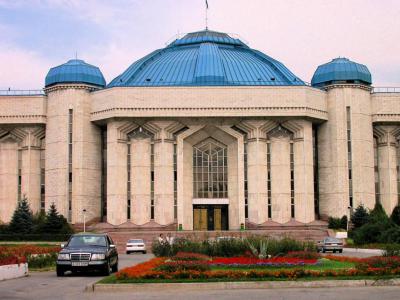
3) Central State Museum of the Kazakh Republic
The Central State Museum of Kazakhstan, situated in Almaty, is a significant symbol of cultural heritage and historical conservation. It was established in 1931 within the Almaty Cathedral, showcasing the resilience of Kazakh history and its diverse cultural landscape. As the largest museum in Almaty and one of the most important in Central Asia, it holds a prominent place in the region.
Its history dates back to a decree by the Kazakh government in 1920, which led to the creation of the Kazakh Central Regional Museum. Over time, it accumulated collections from various sources, including the Orenburg Governor's Museum, laying the groundwork for a comprehensive display of Kazakh history.
The museum underwent notable changes, including relocation to Almaty in 1929 and the incorporation of collections from other regional museums. In 1985, a modern facility was constructed, underscoring Kazakhstan's dedication to preserving its cultural heritage. This facility not only serves as a museum but also hosts the country's largest restoration center, ensuring the conservation of artworks and artifacts.
In 2005, the museum gained recognition as a research organization, enabling historical expeditions and contributing to a deeper understanding of Kazakhstan's history. It actively participates in international events like the "Night of Museums," promoting cultural exchange.
In 2015, there was a proposal to transform the museum into a Cultural Center, aiming to enhance its exhibitions and potentially transfer ownership to municipal authorities, reflecting evolving approaches to cultural engagement in Kazakhstan.
The Central State Museum of Kazakhstan, with its extensive collections, offers a journey through the nation's past, from archaeological origins to modern achievements. It remains a key institution in Almaty, inviting visitors to explore and appreciate Kazakhstan's rich heritage.
Its history dates back to a decree by the Kazakh government in 1920, which led to the creation of the Kazakh Central Regional Museum. Over time, it accumulated collections from various sources, including the Orenburg Governor's Museum, laying the groundwork for a comprehensive display of Kazakh history.
The museum underwent notable changes, including relocation to Almaty in 1929 and the incorporation of collections from other regional museums. In 1985, a modern facility was constructed, underscoring Kazakhstan's dedication to preserving its cultural heritage. This facility not only serves as a museum but also hosts the country's largest restoration center, ensuring the conservation of artworks and artifacts.
In 2005, the museum gained recognition as a research organization, enabling historical expeditions and contributing to a deeper understanding of Kazakhstan's history. It actively participates in international events like the "Night of Museums," promoting cultural exchange.
In 2015, there was a proposal to transform the museum into a Cultural Center, aiming to enhance its exhibitions and potentially transfer ownership to municipal authorities, reflecting evolving approaches to cultural engagement in Kazakhstan.
The Central State Museum of Kazakhstan, with its extensive collections, offers a journey through the nation's past, from archaeological origins to modern achievements. It remains a key institution in Almaty, inviting visitors to explore and appreciate Kazakhstan's rich heritage.
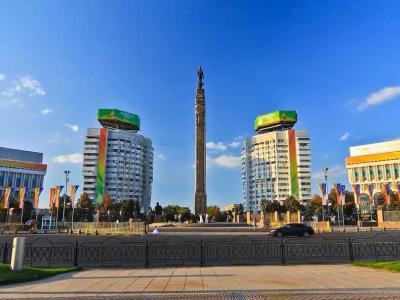
4) Monument of Independence
The Monument of Independence also referred to as the Golden Warrior Monument, stands proudly in Republic Square in Almaty. It's a significant landmark, towering on a 91-foot column, symbolizing Kazakhstan's independence and the crucial role of Almaty, its former capital until 1997. Erected as a tribute to Kazakhstan's path to freedom, it represents the nation's diverse history, from the time of Queen Tomiris to the contemporary era. The monument showcases a statue of the Saka Warrior, known as the Golden Man, alongside a Bary, symbolizing the strength and resilience of the Kazakh people.
The idea for this architectural masterpiece was conceived by a group of esteemed Kazakh architects, led by Shota Valikhanov. Unveiled on December 16, 1996, the Monument of Independence holds immense historical significance for the country. Its prime location near the Presidential Residence, The Akimat House, and other notable monuments makes it a central focal point in Almaty's architectural landscape.
The surrounding complex pays homage to Kazakhstan's cultural heritage and architectural prowess. It features quotations from prominent figures in science, culture, and politics, adding depth to the monument's significance. Not only does the Monument of Independence commemorate Kazakhstan's journey to freedom, but it also serves as a poignant reminder of Almaty's historical and cultural importance in the nation's evolution.
The idea for this architectural masterpiece was conceived by a group of esteemed Kazakh architects, led by Shota Valikhanov. Unveiled on December 16, 1996, the Monument of Independence holds immense historical significance for the country. Its prime location near the Presidential Residence, The Akimat House, and other notable monuments makes it a central focal point in Almaty's architectural landscape.
The surrounding complex pays homage to Kazakhstan's cultural heritage and architectural prowess. It features quotations from prominent figures in science, culture, and politics, adding depth to the monument's significance. Not only does the Monument of Independence commemorate Kazakhstan's journey to freedom, but it also serves as a poignant reminder of Almaty's historical and cultural importance in the nation's evolution.
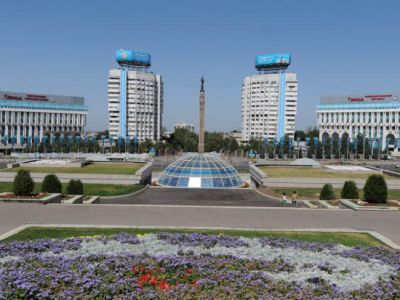
5) Republic Square
Republic Square, also referred to as Independence Square or New Square, serves as the main focal point for public gatherings and events in Almaty. Originally named Brezhnev Square in 1980 to honor the 60th Anniversary of the Kazakh Republic's establishment, it has become a significant symbol of the city's history.
On the southern side of the square stands the former presidential palace, now repurposed as municipal offices. Over the years, Republic Square has been witness to numerous important events, reflecting the political and social changes in Kazakhstan.
During the Soviet period, it was used for mass demonstrations, celebrations, military parades, and rallies, reflecting the political atmosphere of that time. The square was adorned with a variety of trees, including 70 Tien Shan firs planted along its paths in 1981.
One of the pivotal events in Republic Square's history occurred in 1986 when protests erupted following the dismissal of a prominent political figure, leading to a violent uprising. The intervention of internal troops and OMON forces resulted in significant casualties, leaving a lasting impact on the square's history.
Despite its turbulent past, Republic Square continues to be a site of celebration and cultural importance for the people of Almaty. Every year on March 22, thousands gather to celebrate Nauryz, the national holiday marking the vernal equinox. Festivities include traditional food stalls, concerts featuring renowned Kazakh artists, and a lively atmosphere of cultural celebration.
The square has also hosted major commemorations such as parades commemorating the 50th anniversary of victory in World War II and the 5th anniversary of Kazakhstan's independence. These events serve as reminders of the nation's history and accomplishments, celebrated against the backdrop of Republic Square's grandeur.
In more recent times, Republic Square has witnessed periods of unrest, notably during the Bloody January protests in 2022 when demonstrators raided and set fire to the mayor's offices. As a response, plans have been proposed to demolish the damaged building and replace it with an amusement park, marking another chapter in the square's evolving story.
On the southern side of the square stands the former presidential palace, now repurposed as municipal offices. Over the years, Republic Square has been witness to numerous important events, reflecting the political and social changes in Kazakhstan.
During the Soviet period, it was used for mass demonstrations, celebrations, military parades, and rallies, reflecting the political atmosphere of that time. The square was adorned with a variety of trees, including 70 Tien Shan firs planted along its paths in 1981.
One of the pivotal events in Republic Square's history occurred in 1986 when protests erupted following the dismissal of a prominent political figure, leading to a violent uprising. The intervention of internal troops and OMON forces resulted in significant casualties, leaving a lasting impact on the square's history.
Despite its turbulent past, Republic Square continues to be a site of celebration and cultural importance for the people of Almaty. Every year on March 22, thousands gather to celebrate Nauryz, the national holiday marking the vernal equinox. Festivities include traditional food stalls, concerts featuring renowned Kazakh artists, and a lively atmosphere of cultural celebration.
The square has also hosted major commemorations such as parades commemorating the 50th anniversary of victory in World War II and the 5th anniversary of Kazakhstan's independence. These events serve as reminders of the nation's history and accomplishments, celebrated against the backdrop of Republic Square's grandeur.
In more recent times, Republic Square has witnessed periods of unrest, notably during the Bloody January protests in 2022 when demonstrators raided and set fire to the mayor's offices. As a response, plans have been proposed to demolish the damaged building and replace it with an amusement park, marking another chapter in the square's evolving story.

6) St. Nicholas Cathedral
Saint Nicholas Cathedral holds a significant place in Almaty reflecting the spiritual and historical essence of the area. This Russian Orthodox cathedral, under the Astana and Almaty diocese, has a deep-rooted history dating back to the early 20th century. It all began in 1904 when residents of Verny's southwestern region requested Bishop Paisy of Turkestan and Tashkent for permission to construct a church. By 1906, plans were initiated by Andrey Zenkov, a key figure in the city's religious architecture. The cathedral, designed by architect S.K. Troparevsky, was consecrated on December 14, 1908, in honor of Saint Nicholas, with Father Alexander Skalsky as its first rector.
The cathedral's architecture is notable for its distinctive ship-shaped structure, adorned with seven azure domes, lofty vaults, and a prominent belfry, representing its spiritual aspirations and orthodox architectural legacy.
In the early 20th century, Saint Nicholas Cathedral faced challenges, including Bishop Pimen's execution in 1918, leaving the bishopric vacant until 1927. Bishop Aleksandr's arrest in 1936 led to the church's closure, repurposing it as an atheism museum, reflecting the era's socio-political climate. However, the mid-20th century saw revival. In 1945, the Holy Synod reinstated the bishopric, and by December 1946, Bishop Nikolai consecrated the main chapel, restoring the cathedral's status.
In 1995, the cathedral gained official recognition as a state-protected historical and cultural monument by the decision of the Akim of Almaty. This era also witnessed the transfer of the Kazakhstan diocese's cathedra to the Ascension Cathedral, marking a new phase in the region's religious history.
Saint Nicholas Cathedral has served as a hub for religious education, with the establishment of the first Sunday School in 1991 and a new building consecrated in 2010. Moreover, in 2012, a monument to Saint Nicholas was unveiled in front of the cathedral, honoring its patron saint and reaffirming its role as a stronghold of faith and tradition in Kazakhstan.
The cathedral's architecture is notable for its distinctive ship-shaped structure, adorned with seven azure domes, lofty vaults, and a prominent belfry, representing its spiritual aspirations and orthodox architectural legacy.
In the early 20th century, Saint Nicholas Cathedral faced challenges, including Bishop Pimen's execution in 1918, leaving the bishopric vacant until 1927. Bishop Aleksandr's arrest in 1936 led to the church's closure, repurposing it as an atheism museum, reflecting the era's socio-political climate. However, the mid-20th century saw revival. In 1945, the Holy Synod reinstated the bishopric, and by December 1946, Bishop Nikolai consecrated the main chapel, restoring the cathedral's status.
In 1995, the cathedral gained official recognition as a state-protected historical and cultural monument by the decision of the Akim of Almaty. This era also witnessed the transfer of the Kazakhstan diocese's cathedra to the Ascension Cathedral, marking a new phase in the region's religious history.
Saint Nicholas Cathedral has served as a hub for religious education, with the establishment of the first Sunday School in 1991 and a new building consecrated in 2010. Moreover, in 2012, a monument to Saint Nicholas was unveiled in front of the cathedral, honoring its patron saint and reaffirming its role as a stronghold of faith and tradition in Kazakhstan.
7) TsUM
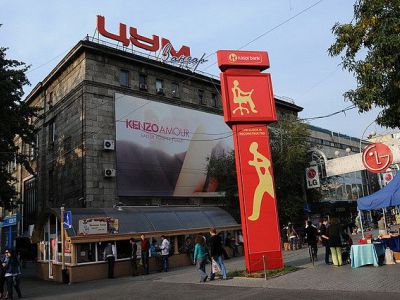
TsUM, short for Central Universal Department Store, is a prominent landmark and shopping hub located in Almaty. Positioned strategically at the lively intersection of Abylai Khan Prospekt and the Arbat pedestrian zone, TsUM boasts an intriguing mix of architectural splendor and commercial history.
Built in 1961 by the Kazgiproselstroy Institute, TsUM's design reflects the grandeur of Stalinist architecture, featuring intricate bas-reliefs and marble staircases adorned with finely carved parapets. Initially spanning 4,500 square meters, the department store quickly garnered success, recording a trade volume of 42.8 million rubles in its inaugural year, prompting the need for expansion.
In 1969, to accommodate increasing space demands, an additional building was constructed adjacent to the original structure. This new extension, inspired by constructivist principles, showcased a modern façade with continuous glass panels and interior marble walls, enhancing both the visual appeal and functionality of the store.
TsUM catered to diverse consumer needs through its five specialized complexes spread across three floors, offering a wide array of products and services. These ranged from household goods and cultural items on the first floor to men's products on the second, and women's products, sewing, and needlework supplies on the third.
Additionally, the store provided 46 types of supplementary services, including garment fittings, credit processing, and home delivery of bulky items. Amenities like a dining room, cafeteria, tailoring atelier, and hairdressing services further enriched the shopping experience, establishing TsUM as a comprehensive destination for varied consumer needs.
Today, TsUM remains a central fixture in the city's retail landscape, offering a unique blend of historical architecture, diverse merchandise, and comprehensive services.
Built in 1961 by the Kazgiproselstroy Institute, TsUM's design reflects the grandeur of Stalinist architecture, featuring intricate bas-reliefs and marble staircases adorned with finely carved parapets. Initially spanning 4,500 square meters, the department store quickly garnered success, recording a trade volume of 42.8 million rubles in its inaugural year, prompting the need for expansion.
In 1969, to accommodate increasing space demands, an additional building was constructed adjacent to the original structure. This new extension, inspired by constructivist principles, showcased a modern façade with continuous glass panels and interior marble walls, enhancing both the visual appeal and functionality of the store.
TsUM catered to diverse consumer needs through its five specialized complexes spread across three floors, offering a wide array of products and services. These ranged from household goods and cultural items on the first floor to men's products on the second, and women's products, sewing, and needlework supplies on the third.
Additionally, the store provided 46 types of supplementary services, including garment fittings, credit processing, and home delivery of bulky items. Amenities like a dining room, cafeteria, tailoring atelier, and hairdressing services further enriched the shopping experience, establishing TsUM as a comprehensive destination for varied consumer needs.
Today, TsUM remains a central fixture in the city's retail landscape, offering a unique blend of historical architecture, diverse merchandise, and comprehensive services.
8) Tengri Umai Gallery
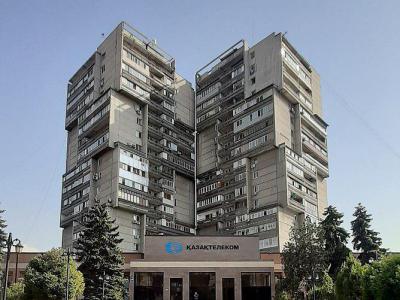
Tengri-Umai ART in Almaty is a leading contemporary art gallery in Kazakhstan. Since it opened in April 1992, the gallery has been a pioneer in showcasing the talents of artists from Kazakhstan and Central Asia. Situated in Almaty's urban landscape, Tengri-Umai ART is admired for its architectural beauty and its significant impact on the local and regional art scenes.
The gallery's founding was a crucial moment in Kazakhstan's art history, as it was one of the earliest private galleries in the country. Its goal is not only to exhibit art but also to encourage dialogue and participation in contemporary art. Through its efforts, Tengri-Umai ART has created a diverse artistic environment, supporting both established artists and up-and-coming talents.
Tengri-Umai ART has played a key role in the development of Kazakhstan's art market by forming partnerships with prestigious local and international institutions such as the Goethe Institute, the French Alliance, and the International Museum of Art. These collaborations have led to an exchange of ideas and artworks, enriching the gallery's offerings and its cultural influence.
The gallery takes pride in its carefully curated collection, which includes paintings, sculptures, and installations. Exhibitions feature around 100 pieces by artists active in Kazakhstan from the 1950s to the 1990s, showcasing a variety of styles and perspectives. The artworks are priced starting at $100, making them accessible to both seasoned collectors and newcomers.
Tengri-Umai ART is dedicated to supporting emerging talent and highlighting the diversity of Kazakhstani and Central Asian art. Its efforts contribute significantly to the appreciation of the region's cultural heritage and contemporary artistic expressions. Whether you're a visitor to Almaty or a resident, Tengri-Umai ART offers a unique cultural experience that's a must-see for art enthusiasts.
The gallery's founding was a crucial moment in Kazakhstan's art history, as it was one of the earliest private galleries in the country. Its goal is not only to exhibit art but also to encourage dialogue and participation in contemporary art. Through its efforts, Tengri-Umai ART has created a diverse artistic environment, supporting both established artists and up-and-coming talents.
Tengri-Umai ART has played a key role in the development of Kazakhstan's art market by forming partnerships with prestigious local and international institutions such as the Goethe Institute, the French Alliance, and the International Museum of Art. These collaborations have led to an exchange of ideas and artworks, enriching the gallery's offerings and its cultural influence.
The gallery takes pride in its carefully curated collection, which includes paintings, sculptures, and installations. Exhibitions feature around 100 pieces by artists active in Kazakhstan from the 1950s to the 1990s, showcasing a variety of styles and perspectives. The artworks are priced starting at $100, making them accessible to both seasoned collectors and newcomers.
Tengri-Umai ART is dedicated to supporting emerging talent and highlighting the diversity of Kazakhstani and Central Asian art. Its efforts contribute significantly to the appreciation of the region's cultural heritage and contemporary artistic expressions. Whether you're a visitor to Almaty or a resident, Tengri-Umai ART offers a unique cultural experience that's a must-see for art enthusiasts.
9) Green Bazaar (must see)
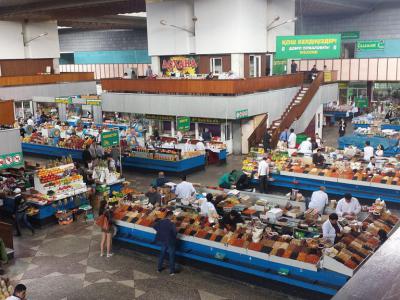
The Green Bazaar (Kök Bazaar), located at the intersection of Zenkov and Jibek Joly streets in Almaty, has been an important trading hub since it opened in 1875. Visitors can find a variety of goods, including spices, prepared foods, produce, textiles, furniture, and antiques. Originally, the area served as a guest yard for traveling merchants and caravans.
The guest yard, which consisted of two pavilions along Torgovaya Street, was completed in 1875. The complex welcomed visitors from all over Central Asia and neighboring countries. It was a symbol of commercial and industrial prosperity and architectural and urban planning art. After the earthquake of 1887, it was reconstructed and renamed the Central Farm Market before becoming known as the Green Bazaar.
In the 1920s, large-scale trade in agricultural products, vegetables, and fruits resumed due to the emergence of collective farms. During World War II, the bazaar was the only place where goods were sold for money, but prices were high due to the war. In the 1970s, the wooden market was demolished and replaced with a covered building designed in the brutalism style.
In 2017, a new shopping pavilion was built on the site of container pavilions and open trade counters. The pavilion occupies an area of about 20,000 square meters and includes retail space and a two-level car parking lot for 400 cars. Since February 2021, "Social shops" have been selling socially significant food products at reduced prices. Today, the Green Bazaar remains a popular tourist attraction in Almaty.
The guest yard, which consisted of two pavilions along Torgovaya Street, was completed in 1875. The complex welcomed visitors from all over Central Asia and neighboring countries. It was a symbol of commercial and industrial prosperity and architectural and urban planning art. After the earthquake of 1887, it was reconstructed and renamed the Central Farm Market before becoming known as the Green Bazaar.
In the 1920s, large-scale trade in agricultural products, vegetables, and fruits resumed due to the emergence of collective farms. During World War II, the bazaar was the only place where goods were sold for money, but prices were high due to the war. In the 1970s, the wooden market was demolished and replaced with a covered building designed in the brutalism style.
In 2017, a new shopping pavilion was built on the site of container pavilions and open trade counters. The pavilion occupies an area of about 20,000 square meters and includes retail space and a two-level car parking lot for 400 cars. Since February 2021, "Social shops" have been selling socially significant food products at reduced prices. Today, the Green Bazaar remains a popular tourist attraction in Almaty.
10) Gorky Park (must see)
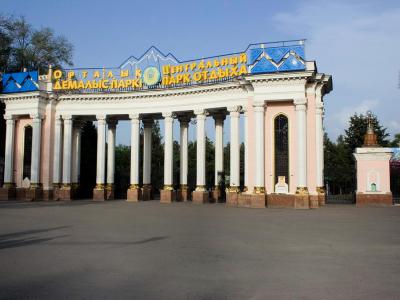
Gorky Park, also referred to as Central Park, is an urban park located in the Medeu District of Almaty. It covers an area of 42 hectares and features different types of trees such as elm, oak, aspen, maple, pine, spruce, poplar, and birch, as well as artificial water reservoirs and various attractions such as a water park, movie theater, sports complex, cultural venues, public catering establishments, and children's attractions, including a children's railway and an aqua park.
The park's history dates back to 1856 when it was established as a public garden for the officers of the Vernensky garrison. The park was developed by scientist-gardener G. Krishtopenko, who planted deciduous and coniferous trees, including species characteristic of Central Russia. The park underwent several developments over the years, including opening a horticulture school, a zoo, and the construction of recreational centers, dance floors, and gazebos.
During the 1905 Russian Revolution and the Russian Civil War in 1918, the park served as a venue for political gatherings and a defensive line for the Red Army. In 1934, the park underwent reconstruction and was equipped with recreation centers for workers and unique irrigation and ditch systems. The park was renamed Gorky Park of Culture and Rest in 1935 and received a monument to Maxim Gorky in 1940.
In 1997, a contract was signed for the trust management of the park, followed by its privatization in 2004. The park underwent a reconstruction in 2018, resulting in the installation of various recreational facilities at the parking site, including children's and street workout playgrounds, basketball and football fields, a roller drome, and a skate track. Additionally, modern lighting and benches were installed throughout the park's premises, while the idle fountains and the amphitheater were updated.
The park's history dates back to 1856 when it was established as a public garden for the officers of the Vernensky garrison. The park was developed by scientist-gardener G. Krishtopenko, who planted deciduous and coniferous trees, including species characteristic of Central Russia. The park underwent several developments over the years, including opening a horticulture school, a zoo, and the construction of recreational centers, dance floors, and gazebos.
During the 1905 Russian Revolution and the Russian Civil War in 1918, the park served as a venue for political gatherings and a defensive line for the Red Army. In 1934, the park underwent reconstruction and was equipped with recreation centers for workers and unique irrigation and ditch systems. The park was renamed Gorky Park of Culture and Rest in 1935 and received a monument to Maxim Gorky in 1940.
In 1997, a contract was signed for the trust management of the park, followed by its privatization in 2004. The park underwent a reconstruction in 2018, resulting in the installation of various recreational facilities at the parking site, including children's and street workout playgrounds, basketball and football fields, a roller drome, and a skate track. Additionally, modern lighting and benches were installed throughout the park's premises, while the idle fountains and the amphitheater were updated.
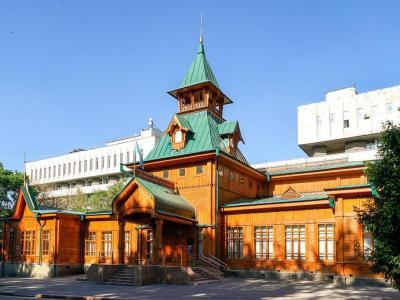
11) Kazakh Museum of Folk Musical Instruments
The Kazakh Museum of Folk Musical Instruments, situated in Almaty's Panfilov Park, is a surviving relic from Verny City (Almaty). Constructed in 1908 alongside the Ascension Cathedral, the wooden tower served as a venue for ceremonies and state receptions hosted by the military leadership of the Turkestan governor-generalship. After the Soviet Union's establishment, the structure served as the House of Officers until its transformation into a musical instruments museum in 1980, named after the Great Kazakh musician Ykylas, who advocated for folk culture's preservation and various national instruments.
The rectangular building with carved wooden platbands and a triaxial space-planning solution has survived several reconstructions. The entrance is marked by a high, keel-shaped porch supported by carved pillars, and the upper level features small square and keeled windows. During the 1979 renovation, Kazakh national patterns were added to the wooden carvings. In front of the tower stands a sculpture of the Kazakh bow instrument.
The museum's collection contains over 1000 musical instruments, including 60 types of Kazakh national instruments, with some dating back to the 17th century. Several halls showcase the history of the musical instruments of Turkic peoples, percussion instruments, winning instruments of the first Republican Instrument-Making Contest, and instruments from Turkic-speaking and world countries.
The rectangular building with carved wooden platbands and a triaxial space-planning solution has survived several reconstructions. The entrance is marked by a high, keel-shaped porch supported by carved pillars, and the upper level features small square and keeled windows. During the 1979 renovation, Kazakh national patterns were added to the wooden carvings. In front of the tower stands a sculpture of the Kazakh bow instrument.
The museum's collection contains over 1000 musical instruments, including 60 types of Kazakh national instruments, with some dating back to the 17th century. Several halls showcase the history of the musical instruments of Turkic peoples, percussion instruments, winning instruments of the first Republican Instrument-Making Contest, and instruments from Turkic-speaking and world countries.

12) Panfilov Heroes Memorial Park (must see)
The urban park situated in east-central Almaty surrounding the Ascension Cathedral is known as the Park of 28 Panfilov Guardsmen. It was named in honor of the Panfilov heroes, a group of 28 soldiers from an Infantry unit who lost their lives while defending Moscow against the German invasion during the Second World War. The group was named after Ivan Panfilov, the General who commanded the 316th division. The park features a giant black monument of soldiers from all 15 Soviet republics and an eternal flame commemorating the fall of World War II.
The park was established in the 1870s in the place of a village cemetery that was destroyed in 1921. It had several different names before being renamed in 1942 in honor of the Panfilov soldiers. The park contains several historical buildings dating back to the early and mid-20th century, including the Ascension Cathedral, which was constructed without a single nail, the Museum of Folk Musical Instruments, and the House of Officers.
Today, the Park of 28 Panfilov Guardsmen is a popular destination for both locals and tourists. Almaty citizens often lay flowers and wreaths at the park's base to honor those who died in World War II during Victory Day celebrations. In 1982, the park's Museum of Folk Instruments building, the Ascension Cathedral, and the Memorial of Glory were added to Kazakhstan's list of historical and cultural monuments of republican significance.
The park was established in the 1870s in the place of a village cemetery that was destroyed in 1921. It had several different names before being renamed in 1942 in honor of the Panfilov soldiers. The park contains several historical buildings dating back to the early and mid-20th century, including the Ascension Cathedral, which was constructed without a single nail, the Museum of Folk Musical Instruments, and the House of Officers.
Today, the Park of 28 Panfilov Guardsmen is a popular destination for both locals and tourists. Almaty citizens often lay flowers and wreaths at the park's base to honor those who died in World War II during Victory Day celebrations. In 1982, the park's Museum of Folk Instruments building, the Ascension Cathedral, and the Memorial of Glory were added to Kazakhstan's list of historical and cultural monuments of republican significance.

13) Ascension Cathedral (must see)
The Ascension Cathedral, also known as the Zenkov Cathedral, is a wooden Russian Orthodox church situated in Panfilov Park, Almaty. Completed in 1907, the building stands at a height of 56 meters and is believed to be the second-tallest wooden structure in the world. Interestingly, the cathedral was constructed entirely without nails.
In the late 19th century, the first bishops of the Turkistan eparchy recognized the need for a Russian Orthodox Church in Almaty. On September 26, 1903, the bishop of Turkestan and Tashkent, Paisii, sanctified the church's foundation, and the construction process began between 1904 and 1907.
The belfry was added in 1906, and the cathedral managed to survive the 1911 earthquake with minimal damage, a feat that some attributed to divine intervention. There are rumors that the decision to avoid using nails was influenced by their role in the crucifixion of Jesus.
The interior of the cathedral was constructed in art workshops in Moscow and Kyiv, and the iconostasis was painted by artist N. Khludov. Following the Russian Revolution, the cathedral was repurposed as the Central State Museum of the Kazakh Soviet Socialist Republic, and from 1930 to 1940, it was utilized by significant public organizations. The belfry even housed the first radio transmitters in Almaty.
From 1973 to 1976, restoration efforts were undertaken, and the cathedral was handed back to the Russian Orthodox Church in May 1995. After further restoration work in 1997, it was reopened for religious services.
From July 2017 to October 2020, the cathedral underwent extensive reconstruction, and it is now open to the public, welcoming visitors and newcomers.
In the late 19th century, the first bishops of the Turkistan eparchy recognized the need for a Russian Orthodox Church in Almaty. On September 26, 1903, the bishop of Turkestan and Tashkent, Paisii, sanctified the church's foundation, and the construction process began between 1904 and 1907.
The belfry was added in 1906, and the cathedral managed to survive the 1911 earthquake with minimal damage, a feat that some attributed to divine intervention. There are rumors that the decision to avoid using nails was influenced by their role in the crucifixion of Jesus.
The interior of the cathedral was constructed in art workshops in Moscow and Kyiv, and the iconostasis was painted by artist N. Khludov. Following the Russian Revolution, the cathedral was repurposed as the Central State Museum of the Kazakh Soviet Socialist Republic, and from 1930 to 1940, it was utilized by significant public organizations. The belfry even housed the first radio transmitters in Almaty.
From 1973 to 1976, restoration efforts were undertaken, and the cathedral was handed back to the Russian Orthodox Church in May 1995. After further restoration work in 1997, it was reopened for religious services.
From July 2017 to October 2020, the cathedral underwent extensive reconstruction, and it is now open to the public, welcoming visitors and newcomers.
