Custom Walk in Pompei, Italy by dougprom_32f6f7 created on 2026-03-05
Guide Location: Italy » Pompei
Guide Type: Custom Walk
# of Sights: 10
Tour Duration: 1 Hour(s)
Travel Distance: 1.8 Km or 1.1 Miles
Share Key: TUHMH
Guide Type: Custom Walk
# of Sights: 10
Tour Duration: 1 Hour(s)
Travel Distance: 1.8 Km or 1.1 Miles
Share Key: TUHMH
How It Works
Please retrieve this walk in the GPSmyCity app. Once done, the app will guide you from one tour stop to the next as if you had a personal tour guide. If you created the walk on this website or come to the page via a link, please follow the instructions below to retrieve the walk in the app.
Retrieve This Walk in App
Step 1. Download the app "GPSmyCity: Walks in 1K+ Cities" on Apple App Store or Google Play Store.



Step 2. In the GPSmyCity app, download(or launch) the guide "Pompei Map and Walking Tours".
Step 3. Tap the menu button located at upper right corner of the "Walks" screen and select "Retrieve custom walk". Enter the share key: TUHMH
1) Street Painted Altar
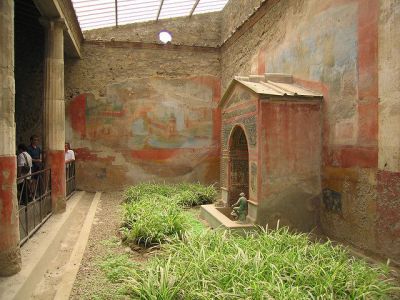
The Street Painted Altar in Pompeii, Italy, presents a fascinating glimpse into the religious and cultural practices of the ancient city before it was buried under volcanic ash in 79 AD. Situated near the Lupinarium, this altar is notable for its vibrant lararium, a sacred space within Roman homes dedicated to household gods. The altar features a distinctive Latin inscription which translates to "This is no place for idle people. No loitering" (OTIOSIS, LOCUS HIC, NON EST DISCEDE MORATOR), serving as a stern reminder to passersby of the importance of diligence and purpose.
The most striking aspect of the altar is the elaborate depiction of serpents that dominate the painted surface. In Roman belief, serpents were often associated with household gods and were believed to offer protection to the home. Their prominent representation on the altar highlights the sanctity of the space and its connection to divine protection. Furthermore, the presence of the figure of Genius on the back wall adds another layer of religious significance. In Roman religion, the Genius was the individual spirit or divine nature present in every individual, place, or thing, embodying the essence of life and an individual's influence on their own surroundings.
The Street Painted Altar, with its unique combination of warning inscription and religious iconography, offers insight into the daily life and spiritual beliefs of Pompeii's inhabitants. It underscores the importance of religion in public and private spaces, as well as the communal values that govern the behavior of its citizens. Through its preservation, the altar remains a compelling artifact that connects the modern world to the complexities of ancient Roman society.
The most striking aspect of the altar is the elaborate depiction of serpents that dominate the painted surface. In Roman belief, serpents were often associated with household gods and were believed to offer protection to the home. Their prominent representation on the altar highlights the sanctity of the space and its connection to divine protection. Furthermore, the presence of the figure of Genius on the back wall adds another layer of religious significance. In Roman religion, the Genius was the individual spirit or divine nature present in every individual, place, or thing, embodying the essence of life and an individual's influence on their own surroundings.
The Street Painted Altar, with its unique combination of warning inscription and religious iconography, offers insight into the daily life and spiritual beliefs of Pompeii's inhabitants. It underscores the importance of religion in public and private spaces, as well as the communal values that govern the behavior of its citizens. Through its preservation, the altar remains a compelling artifact that connects the modern world to the complexities of ancient Roman society.
2) Stabian Baths (must see)
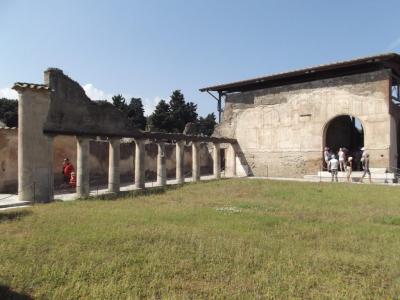
The Stabian Baths are the oldest bath complex discovered in Pompei. Covering 3500 square metres, they are also the largest in the city. Located on Via Stabiana, like the nearby Forum Baths, they are divided into men’s and women’s facilities. The two newer baths in Pompei, the Central and Suburban Baths, both had one large changing facility.
At the entrance to the baths, there is a courtyard, which would have been used as a gymnasium. The yard is surrounded on three sides by colonnades, with a 1.5 metre deep swimming pool on the other side. A door in the right hand corner of the longest colonnade leads to the men’s bath house. The frigidarium, a room for cold bathing, is round, with four corner niches and the bath in the centre. This is the only room for which there is not an equivalent in the women’s section.
Both sides of the bath house feature a whitewashed apodyterium, a tepidarium for warm baths and a caldarium, furthest from the entrance, which was used for hot baths. The baths are richly decorated, with many statues discovered in the ruins. The building has vaulted, ornately decorated ceilings throughout. It was believed to have been built as a symbol of the wealth of Pompei’s ruling classes.
At the entrance to the baths, there is a courtyard, which would have been used as a gymnasium. The yard is surrounded on three sides by colonnades, with a 1.5 metre deep swimming pool on the other side. A door in the right hand corner of the longest colonnade leads to the men’s bath house. The frigidarium, a room for cold bathing, is round, with four corner niches and the bath in the centre. This is the only room for which there is not an equivalent in the women’s section.
Both sides of the bath house feature a whitewashed apodyterium, a tepidarium for warm baths and a caldarium, furthest from the entrance, which was used for hot baths. The baths are richly decorated, with many statues discovered in the ruins. The building has vaulted, ornately decorated ceilings throughout. It was believed to have been built as a symbol of the wealth of Pompei’s ruling classes.
3) Triangular Forum and Doric Temple
The Triangular Forum stands at the highest point of Pompei, on the brow of the hill on which the city was built. It is even visible from ships passing along the coast. A central public space, it has a number of important buildings around its perimeter. The large theatre connects to the forum via a stairway, whilst two gymnasiums and a bakery also back onto the open space. This was at odds with the Triangular Forum’s main purpose as a sacred, reflective spot.
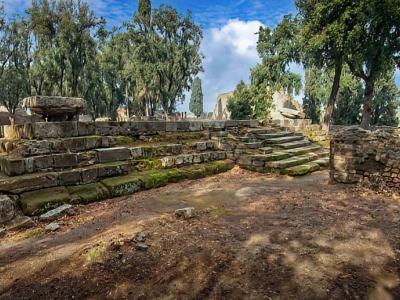
A number of intriguing features remain in the Triangular Forum today. There is a mysterious tomb like structure at the foot of the ruined temple, thought to be a monument to the founder of Pompei. You can also find the remains of three tuff stone altars, dated to the pre-Roman era, and a well flanked by Doric columns. Behind the well, a semi-circular tuff stone seat offers the city’s finest view over the Gulf of Naples to the west.
A Doric temple built from Sarno limestone stands in the centre of the forum. It is one of the oldest buildings in Pompei, and is believed to have stood here since the sixth century BC. At this time, Pompei belonged to Greece, and was part of the powerful state of Cumar.
The temple is believed to have been a place of worship for Hercules, the mythical founder of the city, and later Minerva, goddess of wisdom and war. Reconstructed during the Samnite period, it appears that the temple fell out of usage in the Roman era. Unlike many Roman temples, which often feature a podium at their centre, the entirety of the Doric Temple is raised several feet off the ground, and accessed by broad stone steps on each side.
The temple was once flanked by short, wide columns, though now only stumps remain. At the centre, the cella is divided into two chambers. One chamber features a large flag, embedded into the floor. In front of the temple, there is a small walled enclosure, similar to a cella. This is thought to be a heroon, a small shrine to an idol or hero – in this case, Hercules.
A number of intriguing features remain in the Triangular Forum today. There is a mysterious tomb like structure at the foot of the ruined temple, thought to be a monument to the founder of Pompei. You can also find the remains of three tuff stone altars, dated to the pre-Roman era, and a well flanked by Doric columns. Behind the well, a semi-circular tuff stone seat offers the city’s finest view over the Gulf of Naples to the west.
A Doric temple built from Sarno limestone stands in the centre of the forum. It is one of the oldest buildings in Pompei, and is believed to have stood here since the sixth century BC. At this time, Pompei belonged to Greece, and was part of the powerful state of Cumar.
The temple is believed to have been a place of worship for Hercules, the mythical founder of the city, and later Minerva, goddess of wisdom and war. Reconstructed during the Samnite period, it appears that the temple fell out of usage in the Roman era. Unlike many Roman temples, which often feature a podium at their centre, the entirety of the Doric Temple is raised several feet off the ground, and accessed by broad stone steps on each side.
The temple was once flanked by short, wide columns, though now only stumps remain. At the centre, the cella is divided into two chambers. One chamber features a large flag, embedded into the floor. In front of the temple, there is a small walled enclosure, similar to a cella. This is thought to be a heroon, a small shrine to an idol or hero – in this case, Hercules.
4) Temple of Isis
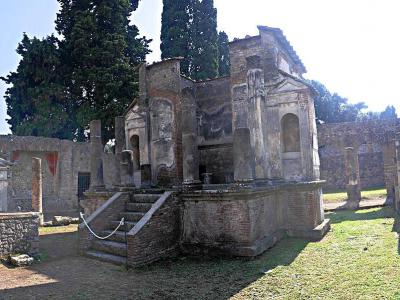
The Temple of Isis is a small Roman temple, though unusually, it is a place of worship for an Egyptian goddess. Isis was worshipped in Ancient Egypt as a form of universal mother goddess, benevolent to all in Egyptian society. She became worshipped by many Roman communities, particularly those, like Pompei, which had strong trade links with Egypt. One of the first buildings discovered in the excavation of 1764, its origins were revealed upon the discovery of an inscription one year later.
The Temple of Isis is located behind the Large Theatre. Originally built in the late 2nd century BC, it was destroyed by the earthquake in 62 AD, and was in the process of being rebuilt. This work was funded from the personal fortune of a freed slave. The temple was thought to have been particularly popular with slaves, servants and the working classes of Pompei.
Like many temples in the city, the Temple of Isis is built in the Hellenic style, and features a cella where sacred statues of the goddess were kept. The temple also features a columned podium, accessed from a stairway, in its centre. Excavation works at the site also unearthed a number of unusual treasures, including a marble hand, bronze candlesticks and a human skull, believed to have been used in cult rituals.
The Temple of Isis is located behind the Large Theatre. Originally built in the late 2nd century BC, it was destroyed by the earthquake in 62 AD, and was in the process of being rebuilt. This work was funded from the personal fortune of a freed slave. The temple was thought to have been particularly popular with slaves, servants and the working classes of Pompei.
Like many temples in the city, the Temple of Isis is built in the Hellenic style, and features a cella where sacred statues of the goddess were kept. The temple also features a columned podium, accessed from a stairway, in its centre. Excavation works at the site also unearthed a number of unusual treasures, including a marble hand, bronze candlesticks and a human skull, believed to have been used in cult rituals.
5) House of the Ceii
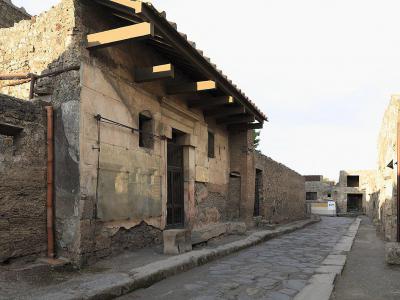
The House of the Ceii is a small dwelling opposite the House of Menander on Vicolo Meridionale. The house’s name derives from a political slogan painted on its façade. The slogan is in support of L. Ceius Secundus, a local politician who may have owned the property. There are a number of fine third style paintings throughout the building. In the triclinium, there is a fresco of Bacchus offering wine to a tiger. A cubiculum adjacent to the garden has a number of excellent depictions of satyrs and maenads, both mythical beasts.
The walled garden features the house’s most spectacular artworks. All three walls have large frescoes in keeping with third style art, depicting Egyptian themed landscapes. A number of animals native to Africa feature, including wolves, wild boars, lions and tigers, a hippopotamus and a crocodile. The floors in the compact house are also notable, with many tiled mosaics forming geometric patterns. There is also a staircase leading to an upper floor, believed to be under construction at the time of the eruption of Vesuvius. The eruption destroyed all upper floors within the city of Pompei; only the presence of staircases shows that buildings in Pompei had upper floors.
The walled garden features the house’s most spectacular artworks. All three walls have large frescoes in keeping with third style art, depicting Egyptian themed landscapes. A number of animals native to Africa feature, including wolves, wild boars, lions and tigers, a hippopotamus and a crocodile. The floors in the compact house are also notable, with many tiled mosaics forming geometric patterns. There is also a staircase leading to an upper floor, believed to be under construction at the time of the eruption of Vesuvius. The eruption destroyed all upper floors within the city of Pompei; only the presence of staircases shows that buildings in Pompei had upper floors.
6) Garden of Fugitives
The many historical wonders of Pompei tell us much about how people lived in this ancient city. One quiet corner amongst its maze of buildings gives a poignant insight into the disaster that destroyed this city overnight. The eruption of Mount Vesuvius in 79 AD is believed to have been one of the most catastrophic volcanic events of all time. It threw a deadly cloud of ash and stone up to 20 miles into the air, and ultimately released enough thermal energy to make a hundred thousand atomic bombs. Those unable to flee Pompei, just a few miles from the volcano, were killed by lava flows that swept through the city. When the ash cloud fell to earth, it buried Pompei, and an estimated 16,000 victims of the deadly eruption.
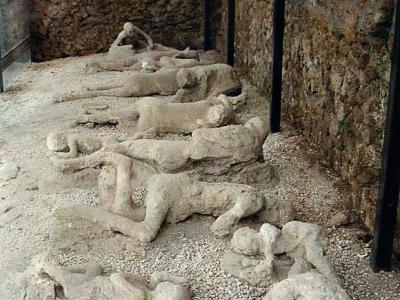
When they began excavating Pompei in the 19th century, archaeologists began finding decomposed bodies of people and animals. By pouring plaster into air pockets left in the rubble, they were able to create casts of many victims. At the Garden of the Fugitives, an area thought to have been a small orchard, thirteen bodies were found, and their casts have been laid out as they were discovered. It is a poignant memorial to those that perished in the eruption that preserved the city for modern visitors. A woman can be seen holding her child, whilst others were clearly trying to protect themselves, in vain, from the deadly lava flow.
When they began excavating Pompei in the 19th century, archaeologists began finding decomposed bodies of people and animals. By pouring plaster into air pockets left in the rubble, they were able to create casts of many victims. At the Garden of the Fugitives, an area thought to have been a small orchard, thirteen bodies were found, and their casts have been laid out as they were discovered. It is a poignant memorial to those that perished in the eruption that preserved the city for modern visitors. A woman can be seen holding her child, whilst others were clearly trying to protect themselves, in vain, from the deadly lava flow.
7) Amphitheater
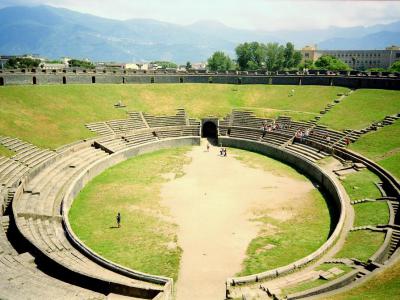
The Pompei Amphitheatre is the oldest building of its kind to have survived from the Roman era. Pompei houses many of the best preserved examples of Roman architecture, after the city was buried under volcanic ash for almost 2000 years. The Amphitheatre, one of Pompei’s most well known attractions, predates the Coliseum in Rome by over a century. It is believed that the success of the Pompei Amphitheatre, the first stone arena built within the Roman Empire, was the inspiration for a larger stone-built arena in Rome itself.
A circular structure with arches and stairways creating several entrance points, the Amphitheatre is still considered by crowd control analysts to be a near perfectly designed venue. Built around 70 BC, it was initially known as the Spectacula. Paid for by wealthy local statesmen Quinctius Valgus and Marcius Porcius, it was primarily used to host gladiatorial games and ceremonies. Twenty years before the eruption that destroyed Pompei, games were banned at the Amphitheatre, following a brawl between locals and residents of nearby Nuceria. In recent years, UK progressive rock band Pink Floyd became the first people for almost two thousand years to perform at the arena, filming a live concert here.
A circular structure with arches and stairways creating several entrance points, the Amphitheatre is still considered by crowd control analysts to be a near perfectly designed venue. Built around 70 BC, it was initially known as the Spectacula. Paid for by wealthy local statesmen Quinctius Valgus and Marcius Porcius, it was primarily used to host gladiatorial games and ceremonies. Twenty years before the eruption that destroyed Pompei, games were banned at the Amphitheatre, following a brawl between locals and residents of nearby Nuceria. In recent years, UK progressive rock band Pink Floyd became the first people for almost two thousand years to perform at the arena, filming a live concert here.
8) Great Palaestra
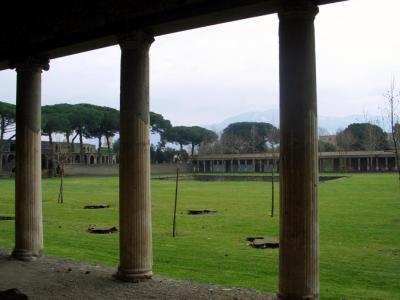
The Great Palaestra is a large rectangular building, flanked by porticoes on three sides, with a pool at its centre. Like many buildings in the city, it was commissioned under the empire of Augustus Caesar. It was used as an exercise complex by the youth associations which he set up, a Roman version of the youth branches of political parties we still see today. There was even a room, in the centre of the western portico, set aside for worship of the emperor. Behind the portico, a double row of sycamore trees provided a shaded area for attendees to relax and unwind.
The tree roots have been recreated with plaster casts. Like many natural organisms, from plant life to human beings, the roots were buried under the ash layers left by the deadly volcanic eruption, and decomposed. This left behind air pockets which were filled with plaster, creating exact replicas of the tree roots. At the time of the eruption in 79 AD the eastern portals and north wall were being restored, having been damaged in the earthquake of 62 AD. The complex even had toilet facilities – a latrine, served by water carried from the pool, can be seen on the south side of the building.
The tree roots have been recreated with plaster casts. Like many natural organisms, from plant life to human beings, the roots were buried under the ash layers left by the deadly volcanic eruption, and decomposed. This left behind air pockets which were filled with plaster, creating exact replicas of the tree roots. At the time of the eruption in 79 AD the eastern portals and north wall were being restored, having been damaged in the earthquake of 62 AD. The complex even had toilet facilities – a latrine, served by water carried from the pool, can be seen on the south side of the building.
9) Villa di Giulia Felice (House of Julia Felix)
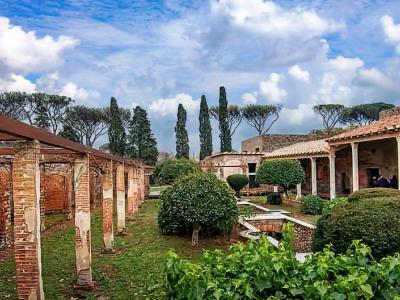
The House (Praedia) of Julia Felix is a sizable property, originally a private home, named after its previous owner. After a significant earthquake in 62 AD, which preceded the eruption of Vesuvius in 79 AD that ultimately devastated the city, the owner had part of the building transformed into rental housing while retaining another portion for public use.
This location comprises both indoor and outdoor spaces centered around atria – courtyards where the main rooms open, alongside enclosed gardens and a private water source. Various areas of the property allowed for both indoor and outdoor seating, adorned with frescoes depicting scenes of leisure and gardens.
The grandeur of the architecture and the high-quality decorations suggest that the building was intended for wealthy and prestigious residents. The walls remain nearly entirely covered in frescoes. The tablinum, which faces the large garden to the east, must have been particularly impressive, boasting Fourth-Style frescoes with green plants on a black background, panels depicting villas, sanctuaries, and flying figures, and a frieze of still-life panels.
Among the most extravagant features of the property were the summer dining area and baths, catering primarily to respectable citizens. Given that most public baths in Pompeii were closed for repairs after the earthquake of 62 AD, it's likely that these baths saw frequent use.
The dining room exuded elegance and warmth, reminiscent of the elite villas in the countryside or on the coast, overlooking gardens with small pools and waterfalls. The expansive rear garden contained fruit trees within large squares, bordered by low wooden fences.
The remains of the House were unearthed during archaeological excavations in 1755.
This location comprises both indoor and outdoor spaces centered around atria – courtyards where the main rooms open, alongside enclosed gardens and a private water source. Various areas of the property allowed for both indoor and outdoor seating, adorned with frescoes depicting scenes of leisure and gardens.
The grandeur of the architecture and the high-quality decorations suggest that the building was intended for wealthy and prestigious residents. The walls remain nearly entirely covered in frescoes. The tablinum, which faces the large garden to the east, must have been particularly impressive, boasting Fourth-Style frescoes with green plants on a black background, panels depicting villas, sanctuaries, and flying figures, and a frieze of still-life panels.
Among the most extravagant features of the property were the summer dining area and baths, catering primarily to respectable citizens. Given that most public baths in Pompeii were closed for repairs after the earthquake of 62 AD, it's likely that these baths saw frequent use.
The dining room exuded elegance and warmth, reminiscent of the elite villas in the countryside or on the coast, overlooking gardens with small pools and waterfalls. The expansive rear garden contained fruit trees within large squares, bordered by low wooden fences.
The remains of the House were unearthed during archaeological excavations in 1755.
10) House of the Venus in Shell
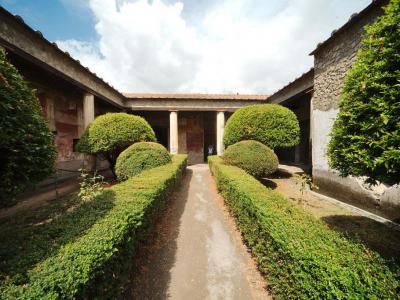
The House of the Venus Marina is a domus horne – a dwelling designed for a single family. It is typical of the more conventional dwellings found in Pompei, alongside the larger, more heavily decorated villas owned by the wealthy. More compact and understated than the other notable houses found in Pompei, it is still centred around an atrium and peristyle. This suggests that these features were present in all Roman architecture, and not reserved for the wealthy alone.
The house has earned its name from the spectacular fresco found on the rear wall of the peristyle. It depicts Venus, the Goddess of Love, in an aquatic scene. Reclining on an oyster shell, she is pictured wearing jewellery and a shawl, and has golden curled hair. On either side of Venus, Cupid and a Nereid on a dolphin are pictured. This depiction of Venus, as an aquatic creature, has been recreated in numerous artworks, and is perhaps the image most commonly associated with the Roman goddess, who was widely worshipped in Pompei. Described as the ‘protectress of Pompei’ in inscriptions found elsewhere in the city, it is perhaps ironic that, while much of Pompei was destroyed, her likeness has survived almost entirely intact.
The house has earned its name from the spectacular fresco found on the rear wall of the peristyle. It depicts Venus, the Goddess of Love, in an aquatic scene. Reclining on an oyster shell, she is pictured wearing jewellery and a shawl, and has golden curled hair. On either side of Venus, Cupid and a Nereid on a dolphin are pictured. This depiction of Venus, as an aquatic creature, has been recreated in numerous artworks, and is perhaps the image most commonly associated with the Roman goddess, who was widely worshipped in Pompei. Described as the ‘protectress of Pompei’ in inscriptions found elsewhere in the city, it is perhaps ironic that, while much of Pompei was destroyed, her likeness has survived almost entirely intact.
