Custom Walk in Annapolis, Maryland by sgastrich_b97eb7 created on 2026-03-09
Guide Location: USA » Annapolis
Guide Type: Custom Walk
# of Sights: 6
Tour Duration: 1 Hour(s)
Travel Distance: 2.2 Km or 1.4 Miles
Share Key: BYP9Z
Guide Type: Custom Walk
# of Sights: 6
Tour Duration: 1 Hour(s)
Travel Distance: 2.2 Km or 1.4 Miles
Share Key: BYP9Z
How It Works
Please retrieve this walk in the GPSmyCity app. Once done, the app will guide you from one tour stop to the next as if you had a personal tour guide. If you created the walk on this website or come to the page via a link, please follow the instructions below to retrieve the walk in the app.
Retrieve This Walk in App
Step 1. Download the app "GPSmyCity: Walks in 1K+ Cities" on Apple App Store or Google Play Store.



Step 2. In the GPSmyCity app, download(or launch) the guide "Annapolis Map and Walking Tours".
Step 3. Tap the menu button located at upper right corner of the "Walks" screen and select "Retrieve custom walk". Enter the share key: BYP9Z
1) Maryland State House (must see)
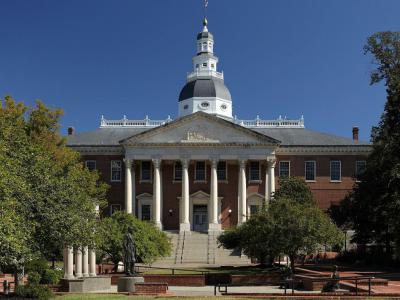
The Maryland State House in Annapolis houses the Maryland General Assembly and offices of the Governor and Lieutenant Governor. It is the oldest state capitol in continuous legislative use, dating back to 1772. The two-story brick structure, in the middle of State Circle, was designed by Joseph Horatio Anderson, a noted architect of the time, in the popular Georgian style of that period.
A small portico juts out from the center of the building and is topped by a pediment; two high arched windows frame the entrance. The dome of the statehouse is depicted on the Maryland state quarter, and has the distinction of being topped by the largest wooden dome in the United States constructed without nails.
The current building, which was designated a National Historic Landmark in 1960, is the third statehouse on its site. Currently, the building is administered by the State House Trust, which was established in 1969.
A small portico juts out from the center of the building and is topped by a pediment; two high arched windows frame the entrance. The dome of the statehouse is depicted on the Maryland state quarter, and has the distinction of being topped by the largest wooden dome in the United States constructed without nails.
The current building, which was designated a National Historic Landmark in 1960, is the third statehouse on its site. Currently, the building is administered by the State House Trust, which was established in 1969.
Sight description based on Wikipedia.
2) William Paca House and Garden (must see)
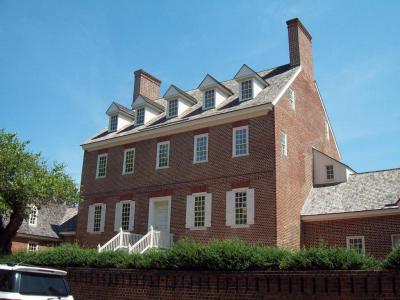
The William Paca House (once known as Carvel Hall) is an 18th-century landmark comprising a five-part Georgian-style mansion and the terraced pleasure garden, both built between 1763 and 1765 to the design by William Paca, a patriot leader who was one of Maryland’s four Signers of the Declaration of Independence in 1776 and the state’s third Governor, serving from 1782 to 1785.
The brickwork structure comprises a central two-and-a-half-story block on an elevated platform, flanked by symmetrical one-and-a-half-story end pavilions, connected to the central structure by one-and-a-half-story hyphens. The building's beautiful interior boasts original woodwork remaining in the central hall, stair hall and the west parlor, including the stair's original Chinese Chippendale balustrade and other decorations relevant to the Georgian Era style. The two-acre (8,100 m2) walled garden, which includes a two-story summer house, represents precise geometric parterres of three-season blooming flowers.
The Paca family resided in the mansion along with their servants and slaves until 1780. After William Paca sold the house, it continued as a single-family home until 1801, upon which it served mainly as a rental property for much of the 19th century. National tennis champion William Larned bought the property in 1901 and converted it into a hotel, with a large addition attached to the back and extending over most of the old garden. For much of the 20th century, Carvel Hall was Annapolis’s finest hotel.
Concerned that developers might eventually tear down the historic edifice, Historic Annapolis and the State of Maryland bought the Paca mansion and the rest of the Carvel Hall site in 1965. Beginning the same year and over the next decade, a team of experts had painstakingly restored the house and the garden to their original 18th-century splendor using details drawn from historic artwork and archaeological excavations.
Today, this picturesque retreat from the bustle of the city, replete with period furnishings and paintings, reveals the inner workings of an upper-class household in colonial and revolutionary Annapolis. In 1971, the mansion was declared a National Historic Landmark.
Both, the house and the garden are open for guided tours Monday to Saturday, from 10 am to 5 pm, and Sundays, from 10 am to 5 pm (last tour at 3.30 pm).
The brickwork structure comprises a central two-and-a-half-story block on an elevated platform, flanked by symmetrical one-and-a-half-story end pavilions, connected to the central structure by one-and-a-half-story hyphens. The building's beautiful interior boasts original woodwork remaining in the central hall, stair hall and the west parlor, including the stair's original Chinese Chippendale balustrade and other decorations relevant to the Georgian Era style. The two-acre (8,100 m2) walled garden, which includes a two-story summer house, represents precise geometric parterres of three-season blooming flowers.
The Paca family resided in the mansion along with their servants and slaves until 1780. After William Paca sold the house, it continued as a single-family home until 1801, upon which it served mainly as a rental property for much of the 19th century. National tennis champion William Larned bought the property in 1901 and converted it into a hotel, with a large addition attached to the back and extending over most of the old garden. For much of the 20th century, Carvel Hall was Annapolis’s finest hotel.
Concerned that developers might eventually tear down the historic edifice, Historic Annapolis and the State of Maryland bought the Paca mansion and the rest of the Carvel Hall site in 1965. Beginning the same year and over the next decade, a team of experts had painstakingly restored the house and the garden to their original 18th-century splendor using details drawn from historic artwork and archaeological excavations.
Today, this picturesque retreat from the bustle of the city, replete with period furnishings and paintings, reveals the inner workings of an upper-class household in colonial and revolutionary Annapolis. In 1971, the mansion was declared a National Historic Landmark.
Both, the house and the garden are open for guided tours Monday to Saturday, from 10 am to 5 pm, and Sundays, from 10 am to 5 pm (last tour at 3.30 pm).
Sight description based on Wikipedia.
3) Annapolis Park Historic District (must see)
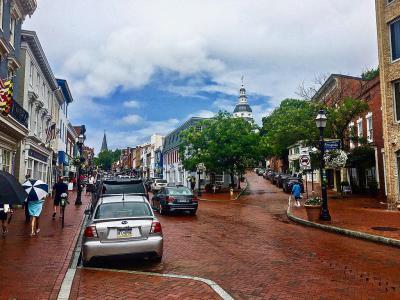
The Annapolis Park Historic District was listed on the National Register of Historic Places in 2006. Annapolis Park contains 354 houses situated along a series of curved streets. The houses are ranch houses, primarily with brick exteriors, and all constructed in 1953-57. A thriving community theater scene, including two venues, is based in the historic district.
Sight description based on Wikipedia.
4) Ego Alley (must see)
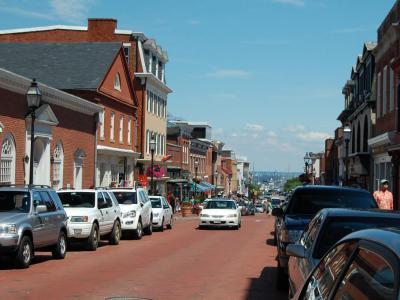
Ego Alley (Annapolis City Dock) is not an alley in the traditional sense of the word; rather than a walkway, it represents a small, narrow waterway that leads to the heart of Annapolis and spills out into Spa Creek. The name "ego alley" derives from the endless queue of expensive yachts parading through this dead-end canal, usually only to see and be seen, on evenings and weekends. Considering this is where all the boats must turn around, it is a great place to see them. Sometimes it can be quite fun too, since not all skippers are skillful enough to operate their vessels in such tight and crowded conditions. Other than ship-watching, this scenic marina also makes for an interesting place to meander, shop, and dine.
On one side, it has the Marriott Waterfront Hotel, complete with their famous "Pusser's Restaurant and Bar", whose outdoor tables are literally inches away from the water and provide an ideal vantage point. Close-by, on the same side, is a yacht club, a marine store, and then a concrete half wall that allows people to have a seat and take in the scenery. On the opposite side of Ego Alley, there are boat slips and several water taxi stands. The wall continues here as well, but the many docking boats often block the view. At the end of the canal is the dinghy dock where the visiting seafaring folks, who are either moored or anchored out in the harbor, take their smaller vessels into town for provisions, sightseeing, etc.
During winter holiday season, albeit cold, is yet another good time to take a stroll down here, since many of the boats are decked out in Christmas lights. There are just as many benches here as well, with many people enjoying their ice cream or some other edible delight from one of the local shops. You can regularly see Naval Academy midshipmen here in uniform on the weekend, coming down to relax and with visiting friends. Also on weekends, you can expect to hear various free musical performances from locals, such as the band Little Bird.
On one side, it has the Marriott Waterfront Hotel, complete with their famous "Pusser's Restaurant and Bar", whose outdoor tables are literally inches away from the water and provide an ideal vantage point. Close-by, on the same side, is a yacht club, a marine store, and then a concrete half wall that allows people to have a seat and take in the scenery. On the opposite side of Ego Alley, there are boat slips and several water taxi stands. The wall continues here as well, but the many docking boats often block the view. At the end of the canal is the dinghy dock where the visiting seafaring folks, who are either moored or anchored out in the harbor, take their smaller vessels into town for provisions, sightseeing, etc.
During winter holiday season, albeit cold, is yet another good time to take a stroll down here, since many of the boats are decked out in Christmas lights. There are just as many benches here as well, with many people enjoying their ice cream or some other edible delight from one of the local shops. You can regularly see Naval Academy midshipmen here in uniform on the weekend, coming down to relax and with visiting friends. Also on weekends, you can expect to hear various free musical performances from locals, such as the band Little Bird.
5) Kunta Kinte - Alex Haley Memorial (must see)
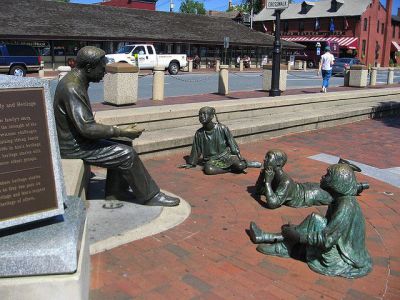
Located at the head of the Annapolis harbor, beside the City Dock, the Kunta Kinte-Alex Haley Memorial is the only memorial in the United States commemorating the actual name and place of landing of an enslaved African in the New World. The monument was inspired by Alex Haley’s 1976 Pulitzer Prize-winning novel, “Roots: The Saga of an American Family”, which tells the story of his ancestor, Kunta Kinte, an 18th-century African boy from the Gambian town of Jufferee, who was sold into slavery and transported in chains to the United States. The memorial marks the very spot where Kunta Kinte set foot on American soil, and is dedicated to all of African Americans' ancestors whose names are lost forever in the oceans of time.
The memorial comprises three distinct areas: the Alex Haley sculpture group, the Compass Rose, and the Story Wall. The former depicts Haley himself, reading from a book on his lap to three children of different races sitting in front of him. The nearby Compass Rose is made of granite and measures 14 feet in diameter; it includes a bronze inlaid compass and the world map oriented to true North, with Annapolis at its center. The third piece, lining the retaining sea wall on Compromise Street, is the Story Wall. It represents a series of ten markers topped with bronze plaques, each displaying a quote from Alex Haley’s book. Each quote is accompanied by text and unique graphics to explain its meaning.
The “A Luta Continua” (Portuguese: “the struggle continues”) slogan refers to the 23 years of challenges that took to erect this memorial, from 1979, when Alex Haley’s best selling story prompted discussions of its placing, to June 12, 2002, when the final phase of the Kunta Kinte-Alex Haley Memorial was dedicated. In 1981, the first commemorative plaque installed on the site was stolen within just 48 hours, allegedly by the Ku Klux Klan! The news of the theft made international headlines, but the plaque was never recovered. Two months later, citizens of Annapolis had raised funds and replaced it.
Today, the memorial is seen by almost 1,000,000 visitors a year. Sadly, Alex Haley himself did not live to see it completed.
The memorial comprises three distinct areas: the Alex Haley sculpture group, the Compass Rose, and the Story Wall. The former depicts Haley himself, reading from a book on his lap to three children of different races sitting in front of him. The nearby Compass Rose is made of granite and measures 14 feet in diameter; it includes a bronze inlaid compass and the world map oriented to true North, with Annapolis at its center. The third piece, lining the retaining sea wall on Compromise Street, is the Story Wall. It represents a series of ten markers topped with bronze plaques, each displaying a quote from Alex Haley’s book. Each quote is accompanied by text and unique graphics to explain its meaning.
The “A Luta Continua” (Portuguese: “the struggle continues”) slogan refers to the 23 years of challenges that took to erect this memorial, from 1979, when Alex Haley’s best selling story prompted discussions of its placing, to June 12, 2002, when the final phase of the Kunta Kinte-Alex Haley Memorial was dedicated. In 1981, the first commemorative plaque installed on the site was stolen within just 48 hours, allegedly by the Ku Klux Klan! The news of the theft made international headlines, but the plaque was never recovered. Two months later, citizens of Annapolis had raised funds and replaced it.
Today, the memorial is seen by almost 1,000,000 visitors a year. Sadly, Alex Haley himself did not live to see it completed.
6) Banneker-Douglass Museum (must see)
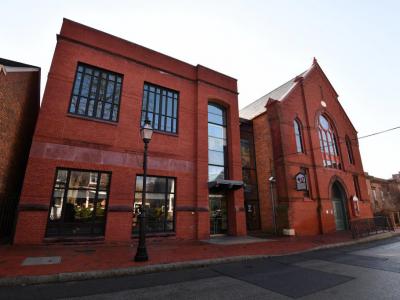
The Banneker-Douglass Museum is dedicated to preserving Maryland's African American heritage, and is named for the famous free African American astronomer and mathematician, Benjamin Banneker, and the leader of the Abolitionism movement, Frederick Douglass. Fittingly, it is housed in the former Mount Moriah African Methodist Episcopal Church, the historic two-and-a-half-story, gable-front brick building constructed in 1875, which initially served as the meeting hall for the First African Methodist Episcopal Church, originally formed in the 1790s. In 1896, the building was remodeled.
Eventually, the property was leased to the Maryland Commission on African-American History and Culture, becoming the state's official museum for African-American history and culture. In 1984, after the museum had opened, a two-and-a-half-story addition was added.
Today, the Banneker-Douglass Museum serves to document, interpret and promote African American history and culture, particularly in Maryland. Pursuant to this agenda, the museum displays contributions of famous African American Maryland residents, such as Kunta Kinte, Benjamin Banneker, James Pennington, Frederick Douglass, Harriet Tubman, Matthew Henson and Thurgood Marshall.
It also runs exhibitions depicting black life in Maryland, African and African American art, and covering the issues of slavery and change in the education system of the U.S. The museum regularly organizes workshops, lectures, performances and educational programs on a yearly basis.
The facility also serves as the state's official repository of African American material culture, and has its own library and archives. The Banneker-Douglass Museum's Gothic Revival-style building has been listed on the National Register of Historic Places since 1973 and is within the boundaries of the Colonial Annapolis Historic District.
Eventually, the property was leased to the Maryland Commission on African-American History and Culture, becoming the state's official museum for African-American history and culture. In 1984, after the museum had opened, a two-and-a-half-story addition was added.
Today, the Banneker-Douglass Museum serves to document, interpret and promote African American history and culture, particularly in Maryland. Pursuant to this agenda, the museum displays contributions of famous African American Maryland residents, such as Kunta Kinte, Benjamin Banneker, James Pennington, Frederick Douglass, Harriet Tubman, Matthew Henson and Thurgood Marshall.
It also runs exhibitions depicting black life in Maryland, African and African American art, and covering the issues of slavery and change in the education system of the U.S. The museum regularly organizes workshops, lectures, performances and educational programs on a yearly basis.
The facility also serves as the state's official repository of African American material culture, and has its own library and archives. The Banneker-Douglass Museum's Gothic Revival-style building has been listed on the National Register of Historic Places since 1973 and is within the boundaries of the Colonial Annapolis Historic District.
Sight description based on Wikipedia.
