Custom Walk in Bordeaux, France by igristaya_58876a created on 2026-03-15
Guide Location: France » Bordeaux
Guide Type: Custom Walk
# of Sights: 6
Tour Duration: 2 Hour(s)
Travel Distance: 3.4 Km or 2.1 Miles
Share Key: SGQTR
Guide Type: Custom Walk
# of Sights: 6
Tour Duration: 2 Hour(s)
Travel Distance: 3.4 Km or 2.1 Miles
Share Key: SGQTR
How It Works
Please retrieve this walk in the GPSmyCity app. Once done, the app will guide you from one tour stop to the next as if you had a personal tour guide. If you created the walk on this website or come to the page via a link, please follow the instructions below to retrieve the walk in the app.
Retrieve This Walk in App
Step 1. Download the app "GPSmyCity: Walks in 1K+ Cities" on Apple App Store or Google Play Store.



Step 2. In the GPSmyCity app, download(or launch) the guide "Bordeaux Map and Walking Tours".
Step 3. Tap the menu button located at upper right corner of the "Walks" screen and select "Retrieve custom walk". Enter the share key: SGQTR
1) Bordeaux Grand Theatre (must see)
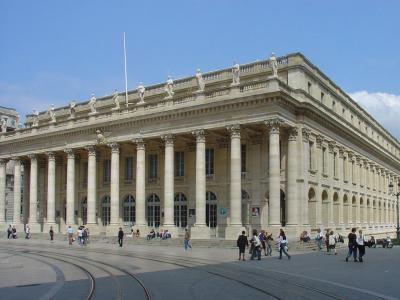
The Grand Théâtre de Bordeaux is located on the grand Comedy Square, adjacent to Esprit des Lois Street, in the city’s cultured Grands Hommes quarter. Inaugurated in 1780, it was designed by renowned French architect, Victor Louis, who won the commission after earning the Grand Prix de Rome, a scholarship scheme for gifted young artists and architects. The young architect went on to design the famous Theatre-Français in Paris.
Victor Louis’ vision for the Grand Théâtre in Bordeaux was certainly ambitious – conceived as a Temple of the Arts, it has a wide portico entrance, complimenting the building’s Neoclassical design. The entrance features 12 colossal Corinthian-style columns, each topped with a statue, representing the nine Muses and three Goddesses – Juno, Venus and Minerva.
The theater's interior is arguably equal to its spectacular exterior. Its vast auditorium is painted in blue, white and gold – the traditional colors of French royalty. Superbly preserved, it is one of the last remaining wooden framed theaters in Europe. Once a temporary seat for the French Parliament, it is now home to two of the city’s most esteemed theatrical groups – the National Opera and National Ballet of Bordeaux.
Why You Should Visit:
The architecture from outside is great but inside the gold gilding and ornate decoration everywhere you look is amazing.
The pre- and post-restoration rooms on view are light and airy, and the guided tour is hugely informative.
Tip:
Check ahead to see if there are any concerts you can attend and book ahead of time.
Victor Louis’ vision for the Grand Théâtre in Bordeaux was certainly ambitious – conceived as a Temple of the Arts, it has a wide portico entrance, complimenting the building’s Neoclassical design. The entrance features 12 colossal Corinthian-style columns, each topped with a statue, representing the nine Muses and three Goddesses – Juno, Venus and Minerva.
The theater's interior is arguably equal to its spectacular exterior. Its vast auditorium is painted in blue, white and gold – the traditional colors of French royalty. Superbly preserved, it is one of the last remaining wooden framed theaters in Europe. Once a temporary seat for the French Parliament, it is now home to two of the city’s most esteemed theatrical groups – the National Opera and National Ballet of Bordeaux.
Why You Should Visit:
The architecture from outside is great but inside the gold gilding and ornate decoration everywhere you look is amazing.
The pre- and post-restoration rooms on view are light and airy, and the guided tour is hugely informative.
Tip:
Check ahead to see if there are any concerts you can attend and book ahead of time.
2) Cathedrale Saint-Andre (Cathedral of St. Andrew) (must see)
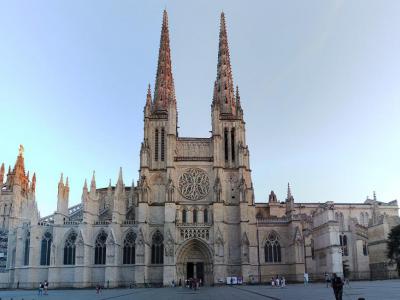
The Cathedral of Saint Andrew is a symbol of Bordeaux's rich history and architectural grandeur. Situated on Pey-Berland Square, this Gothic masterpiece has been a central figure in the city's spiritual and cultural life for centuries.
Construction of the cathedral began in 1096 under the auspices of Pope Urban II, with the majority of the structure completed during the 14th and 15th centuries. Notably, the cathedral's Royal Gate, dating to the early 13th century, exemplifies the intricate design characteristic of French Gothic architecture. The cathedral's two towers, soaring to 81 meters, dominate the Bordeaux skyline, offering panoramic views of the city and the Garonne River.
Throughout its history, the cathedral has witnessed significant events, including the 1137 marriage of Eleanor of Aquitaine to King Louis VII of France. This union, though short-lived, had profound implications for European history. Additionally, in 1615, the cathedral hosted the wedding of Anne of Austria and Louis XIII, further cementing its status as a site of royal significance.
The interior of the cathedral is equally impressive, with a nave measuring 124 meters in length and 29 meters in height. Visitors can admire the intricate stained glass windows, which, despite suffering damage during the French Revolution, still retain their historical charm. The grand organ, a masterpiece of French craftsmanship, adds to the cathedral's acoustic allure.
Adjacent to the cathedral stands the Pey-Berland Tower, a separate bell tower constructed between 1440 and 1500. This tower, named after Archbishop Pey Berland, offers visitors the opportunity to ascend its 233 steps for a breathtaking view of Bordeaux.
If you're drawn by its architectural beauty, historical significance, or spiritual ambiance, you’ll love the place. The Cathedral of Saint Andrew offers a profound experience that encapsulates the essence of Bordeaux.
Construction of the cathedral began in 1096 under the auspices of Pope Urban II, with the majority of the structure completed during the 14th and 15th centuries. Notably, the cathedral's Royal Gate, dating to the early 13th century, exemplifies the intricate design characteristic of French Gothic architecture. The cathedral's two towers, soaring to 81 meters, dominate the Bordeaux skyline, offering panoramic views of the city and the Garonne River.
Throughout its history, the cathedral has witnessed significant events, including the 1137 marriage of Eleanor of Aquitaine to King Louis VII of France. This union, though short-lived, had profound implications for European history. Additionally, in 1615, the cathedral hosted the wedding of Anne of Austria and Louis XIII, further cementing its status as a site of royal significance.
The interior of the cathedral is equally impressive, with a nave measuring 124 meters in length and 29 meters in height. Visitors can admire the intricate stained glass windows, which, despite suffering damage during the French Revolution, still retain their historical charm. The grand organ, a masterpiece of French craftsmanship, adds to the cathedral's acoustic allure.
Adjacent to the cathedral stands the Pey-Berland Tower, a separate bell tower constructed between 1440 and 1500. This tower, named after Archbishop Pey Berland, offers visitors the opportunity to ascend its 233 steps for a breathtaking view of Bordeaux.
If you're drawn by its architectural beauty, historical significance, or spiritual ambiance, you’ll love the place. The Cathedral of Saint Andrew offers a profound experience that encapsulates the essence of Bordeaux.
3) Grosse Cloche (Big Bell) (must see)
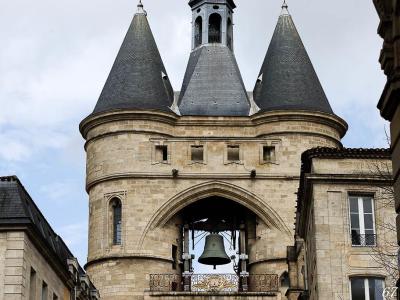
The Big Bell stands proudly in the heart of Bordeaux as a symbol of the city’s rich medieval heritage. This iconic belfry-one of the oldest in France-was originally part of the Saint-Éloi gate, a key entrance to the city during the 13th century. Over time, it evolved into both a belfry and a town hall, serving as a civic and defensive monument.
The structure is a harmonious blend of Gothic and Renaissance architecture, featuring two octagonal towers connected by a central archway. Above the arch, the city's coat of arms is prominently displayed, symbolizing Bordeaux's enduring legacy. The bell itself, cast in 1775 and weighing 7,800 kilograms, is a striking feature. It rings six times a year, including on major public holidays and the first Sunday of each month at noon.
Visitors to the Big Bell can explore its rich history through guided tours, which offer insights into its architectural significance and the role it played in Bordeaux's past. Climbing the narrow, winding staircase rewards visitors with panoramic views of the city, providing a unique perspective of Bordeaux's landscape.
For those interested in the city's history, architecture, and culture, La Grosse Cloche is a must-see landmark that encapsulates the spirit of Bordeaux. Its enduring presence serves as a reminder of the city's resilience and its ability to preserve its heritage while embracing the future.
The surrounding streets add to the charm, lined with cafés, boutique shops, and picturesque corners perfect for photography. A morning visit captures the soft light on the stone façade, while afternoons allow for people-watching and soaking in the lively atmosphere of Bordeaux’s historic heart.
The structure is a harmonious blend of Gothic and Renaissance architecture, featuring two octagonal towers connected by a central archway. Above the arch, the city's coat of arms is prominently displayed, symbolizing Bordeaux's enduring legacy. The bell itself, cast in 1775 and weighing 7,800 kilograms, is a striking feature. It rings six times a year, including on major public holidays and the first Sunday of each month at noon.
Visitors to the Big Bell can explore its rich history through guided tours, which offer insights into its architectural significance and the role it played in Bordeaux's past. Climbing the narrow, winding staircase rewards visitors with panoramic views of the city, providing a unique perspective of Bordeaux's landscape.
For those interested in the city's history, architecture, and culture, La Grosse Cloche is a must-see landmark that encapsulates the spirit of Bordeaux. Its enduring presence serves as a reminder of the city's resilience and its ability to preserve its heritage while embracing the future.
The surrounding streets add to the charm, lined with cafés, boutique shops, and picturesque corners perfect for photography. A morning visit captures the soft light on the stone façade, while afternoons allow for people-watching and soaking in the lively atmosphere of Bordeaux’s historic heart.
4) Place de la Bourse (Stock Exchange Square) (must see)
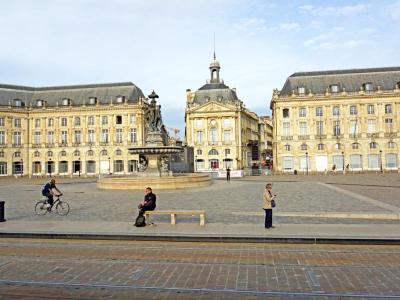
Stock Exchange Square is one of those squares that seems to have been designed to impress you the second you arrive – and it mostly succeeds. Perched on the edge of the Garonne River, it forms a perfect frame: symmetrical façades, elegant façades, arcades, and a harmony of classical French design from the 18th century. It was conceived by Jacques Gabriel (who designed Versailles Palace in Paris) and later carried forward by his son Ange-Jacques Gabriel; construction spanned from the early 1730s until mid-century.
Originally called Royal Square, it has worn several names over time: Liberty Square during the Revolution, Imperial Square under Napoleon, and finally Stock Exchange Square. Each name reflects a changing political atmosphere, but the architecture kept its poise.
At its heart sits the Fountain of the Three Graces, installed in 1869. This striking monument replaces earlier symbols: first an equestrian statue of King Louis XV, later another statue during Napoleon’s reign, all swept away by revolution and reform. The Three Graces represent beauty, joy, and abundance. The fountain blends marble and bronze in a graceful celebration of myth and art.
Do you know? In front of this ensemble lies the Water Mirror – by the river. It’s a shallow reflecting pool (just a few centimeters of water over granite) that mirrors the stately buildings, making for magical photos at dusk or dawn. It was added in the early 2000s as part of a riverside renovation, and it has become one of Bordeaux’s most beloved visual signatures.
Flanking the square are the Stock Exchange Palace (now home to the Chamber of Commerce and Industry) on one side, and the National Museum of Customs, on the other. The entire ensemble is part of Bordeaux’s UNESCO heritage, an example of how 18th-century urbanism can still feel alive, not fossilized.
A visit here gives you more than pretty façades and photo ops: it’s an opportunity to step into the layers of Bordeaux’s past – monarchy, revolution, commerce – all reflected in stone, water, and myth.
Originally called Royal Square, it has worn several names over time: Liberty Square during the Revolution, Imperial Square under Napoleon, and finally Stock Exchange Square. Each name reflects a changing political atmosphere, but the architecture kept its poise.
At its heart sits the Fountain of the Three Graces, installed in 1869. This striking monument replaces earlier symbols: first an equestrian statue of King Louis XV, later another statue during Napoleon’s reign, all swept away by revolution and reform. The Three Graces represent beauty, joy, and abundance. The fountain blends marble and bronze in a graceful celebration of myth and art.
Do you know? In front of this ensemble lies the Water Mirror – by the river. It’s a shallow reflecting pool (just a few centimeters of water over granite) that mirrors the stately buildings, making for magical photos at dusk or dawn. It was added in the early 2000s as part of a riverside renovation, and it has become one of Bordeaux’s most beloved visual signatures.
Flanking the square are the Stock Exchange Palace (now home to the Chamber of Commerce and Industry) on one side, and the National Museum of Customs, on the other. The entire ensemble is part of Bordeaux’s UNESCO heritage, an example of how 18th-century urbanism can still feel alive, not fossilized.
A visit here gives you more than pretty façades and photo ops: it’s an opportunity to step into the layers of Bordeaux’s past – monarchy, revolution, commerce – all reflected in stone, water, and myth.
5) Miroir d'Eau (Water Mirror) (must see)
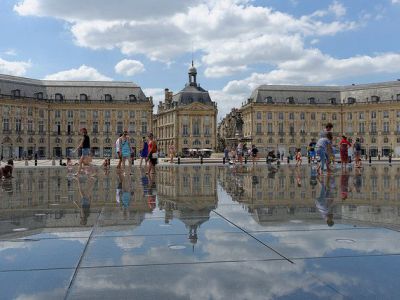
Just across from the majestic Stock Exchange Palace lies one of Bordeaux’s most playful and poetic features: the Water Mirror. Far from being a static monument, it’s a living canvas of water, light and reflection that invites you to step in (quite literally).
Created in 2006 during the quayside revitalization project, this reflecting pool covers about 3,450 square meters and is made of smooth granite slabs over which a thin 2 cm layer of water flows. The design was conceived by landscape artist Michel Corajoud, with engineering and architectural input from Jean-Max Llorca and Pierre Gangnet.
Beneath the apparent simplicity lies a technical marvel: an underground reservoir of 800 cubic meters and a network of pumps and channels that constantly cycle water and power mist effects through nearly 900 injectors.
Throughout the day, the Water Mirror cycles in phases: it fills, displays a perfect mirror surface reflecting the classical façades and sky, then drains briefly, followed by a soft mist rising from the slabs. The mist can reach up to 2 meters high, creating an ephemeral veil over the square.
Locals and visitors alike flock here: children dash through the shallow water, couples stroll hand in hand, and photographers line up to frame the mirror image of the city.
Because the Water Mirror operates only from spring through fall (typically April to October), in winter months the slabs lie dry but still carry an austere beauty.
Plan a slightly longer stop here – both for visual delight and the fun of interaction. The shifting reflection, the sudden burst of mist, and the laughter of children – it’s a moment in Bordeaux that feels alive, even when the water is still.
Created in 2006 during the quayside revitalization project, this reflecting pool covers about 3,450 square meters and is made of smooth granite slabs over which a thin 2 cm layer of water flows. The design was conceived by landscape artist Michel Corajoud, with engineering and architectural input from Jean-Max Llorca and Pierre Gangnet.
Beneath the apparent simplicity lies a technical marvel: an underground reservoir of 800 cubic meters and a network of pumps and channels that constantly cycle water and power mist effects through nearly 900 injectors.
Throughout the day, the Water Mirror cycles in phases: it fills, displays a perfect mirror surface reflecting the classical façades and sky, then drains briefly, followed by a soft mist rising from the slabs. The mist can reach up to 2 meters high, creating an ephemeral veil over the square.
Locals and visitors alike flock here: children dash through the shallow water, couples stroll hand in hand, and photographers line up to frame the mirror image of the city.
Because the Water Mirror operates only from spring through fall (typically April to October), in winter months the slabs lie dry but still carry an austere beauty.
Plan a slightly longer stop here – both for visual delight and the fun of interaction. The shifting reflection, the sudden burst of mist, and the laughter of children – it’s a moment in Bordeaux that feels alive, even when the water is still.
6) Monument to the Girondins (must see)
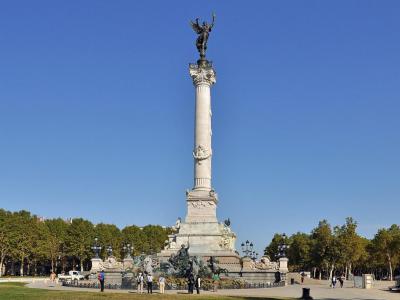
The Monument to the Girondins stands proudly in Bordeaux's Quinconces Square, a tribute to the Girondin deputies who met their untimely end during the French Revolution's Reign of Terror. Constructed between 1894 and 1902, this monument is a harmonious blend of art and history, featuring a 54-meter-high column crowned by a statue of Liberty breaking free from her chains. At its base, an elaborate fountain showcases allegorical figures representing various virtues and elements of French society.
The central column is flanked by two basins adorned with dynamic bronze sculptures, including sea horses and cherubs, symbolizing the tumultuous period of the Revolution. The statue of Liberty atop the column signifies the triumph of freedom over oppression.
During World War II, the monument suffered damage, with its statues removed by the occupying forces. However, these were later recovered and restored, returning to their rightful place in 1983. Today, the Monument to the Girondins stands as a poignant reminder of the sacrifices made for liberty and the enduring spirit of the Girondins.
Did you know? The bronze horses at the base of the Monument are so lifelike that locals joke they might gallop off at any moment. Each sculpture took years to perfect, with artists meticulously capturing muscles, movement, and the wild energy of the horses, creating a sense of motion frozen in time.
The central column is flanked by two basins adorned with dynamic bronze sculptures, including sea horses and cherubs, symbolizing the tumultuous period of the Revolution. The statue of Liberty atop the column signifies the triumph of freedom over oppression.
During World War II, the monument suffered damage, with its statues removed by the occupying forces. However, these were later recovered and restored, returning to their rightful place in 1983. Today, the Monument to the Girondins stands as a poignant reminder of the sacrifices made for liberty and the enduring spirit of the Girondins.
Did you know? The bronze horses at the base of the Monument are so lifelike that locals joke they might gallop off at any moment. Each sculpture took years to perfect, with artists meticulously capturing muscles, movement, and the wild energy of the horses, creating a sense of motion frozen in time.
