Custom Walk in Catania, Italy by gmarkasyan_ab43d created on 2026-03-18
Guide Location: Italy » Catania
Guide Type: Custom Walk
# of Sights: 7
Tour Duration: 1 Hour(s)
Travel Distance: 2.6 Km or 1.6 Miles
Share Key: UGK3D
Guide Type: Custom Walk
# of Sights: 7
Tour Duration: 1 Hour(s)
Travel Distance: 2.6 Km or 1.6 Miles
Share Key: UGK3D
How It Works
Please retrieve this walk in the GPSmyCity app. Once done, the app will guide you from one tour stop to the next as if you had a personal tour guide. If you created the walk on this website or come to the page via a link, please follow the instructions below to retrieve the walk in the app.
Retrieve This Walk in App
Step 1. Download the app "GPSmyCity: Walks in 1K+ Cities" on Apple App Store or Google Play Store.



Step 2. In the GPSmyCity app, download(or launch) the guide "Catania Map and Walking Tours".
Step 3. Tap the menu button located at upper right corner of the "Walks" screen and select "Retrieve custom walk". Enter the share key: UGK3D
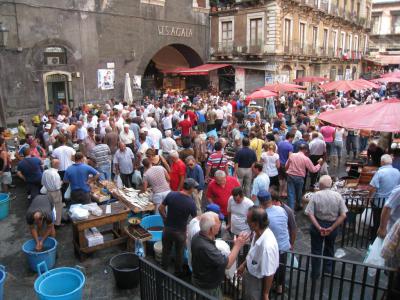
1) At 'Piscaria (Catania Fish Market) (must see)
Catania Fish Market has operated continuously since the early 19th century and remains inseparable from the rhythms of the sea. Part of the market unfolds beneath the Tunnel of Charles V, a 16th-century stone passage dug under the Palace of the Seminary of the Clerics and the former defensive walls built during the reign of Emperor Charles V. The vaulted tunnel amplifies sound and smell alike: vendors’ shouted prices echo against lava-stone walls, while the scent of saltwater and fresh fish lingers in the air.
From early morning, stalls spill into surrounding streets, piled high with seafood from the Ionian Sea: swordfish, tuna, sea bass, shrimp, anchovies, clams, mussels, and sea urchins, some of it still moving as it is cleaned and cut on the spot. Vendors compete for attention with loud shouted calls in a lively contest for attention, while water is constantly thrown across the pavement to keep the fish fresh.
In recent years, the Fish Market has also become a place where visitors can actively take part in Catania’s food culture. Travelers often wander through the stalls to watch fishmongers skillfully clean swordfish or open sea urchins, sometimes offering a quick taste of the bright orange roe. Small counters nearby prepare seafood on the spot, frying anchovies, calamari, or shrimp and serving them in paper cones for an easy snack while walking through the market. Some vendors also shuck oysters or slice raw fish for simple tastings. Arriving early in the morning gives visitors the best chance to see the market at full energy, when the stalls are busiest and the day’s catch is still being sorted and sold.
From early morning, stalls spill into surrounding streets, piled high with seafood from the Ionian Sea: swordfish, tuna, sea bass, shrimp, anchovies, clams, mussels, and sea urchins, some of it still moving as it is cleaned and cut on the spot. Vendors compete for attention with loud shouted calls in a lively contest for attention, while water is constantly thrown across the pavement to keep the fish fresh.
In recent years, the Fish Market has also become a place where visitors can actively take part in Catania’s food culture. Travelers often wander through the stalls to watch fishmongers skillfully clean swordfish or open sea urchins, sometimes offering a quick taste of the bright orange roe. Small counters nearby prepare seafood on the spot, frying anchovies, calamari, or shrimp and serving them in paper cones for an easy snack while walking through the market. Some vendors also shuck oysters or slice raw fish for simple tastings. Arriving early in the morning gives visitors the best chance to see the market at full energy, when the stalls are busiest and the day’s catch is still being sorted and sold.
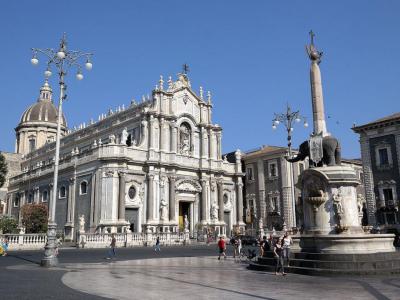
2) Piazza Duomo (Cathedral Square) (must see)
Cathedral Square is a civic and symbolic space where the city’s past and everyday rhythm come together in a single open setting. Rebuilt after the devastating earthquake of 1693, the square is a showcase of Sicilian Baroque, shaped largely in the 18th century as part of Catania’s comprehensive rebuilding plan. Its layout is defined by symmetry, broad sightlines, and a strong sense of order, framed by elegant façades and paved in pale stone that reflects the Mediterranean light.
At the center of the square stands the Elephant Fountain, Catania’s most recognizable symbol. Carved from dark lava stone in the 18th century, the elephant, known locally as Liotru, supports an ancient Egyptian obelisk whose hieroglyphs predate the city itself and echoes the city’s long relationship with Mount Etna.
On the north side of Cathedral Square rises the Elephants’ Palace, which serves as Catania’s City Hall. Built in the 18th century after the earthquake, the palace takes its name from the Elephant Fountain and continues to function as the seat of municipal government, reinforcing the square’s civic role. On the south side, stands the Palace of the Clerics, originally built to house members of the cathedral clergy and today forming part of the architectural frame of the square.
Together with the nearby Cathedral of Saint Agatha, these buildings form a cohesive architectural ensemble that reinforces both the civic and religious importance of this place. Cathedral Square is also a place of constant movement. Cafés line the edges of the square, while the nearby Fish Market fills the surrounding streets with sound, color, and activity.
At the center of the square stands the Elephant Fountain, Catania’s most recognizable symbol. Carved from dark lava stone in the 18th century, the elephant, known locally as Liotru, supports an ancient Egyptian obelisk whose hieroglyphs predate the city itself and echoes the city’s long relationship with Mount Etna.
On the north side of Cathedral Square rises the Elephants’ Palace, which serves as Catania’s City Hall. Built in the 18th century after the earthquake, the palace takes its name from the Elephant Fountain and continues to function as the seat of municipal government, reinforcing the square’s civic role. On the south side, stands the Palace of the Clerics, originally built to house members of the cathedral clergy and today forming part of the architectural frame of the square.
Together with the nearby Cathedral of Saint Agatha, these buildings form a cohesive architectural ensemble that reinforces both the civic and religious importance of this place. Cathedral Square is also a place of constant movement. Cafés line the edges of the square, while the nearby Fish Market fills the surrounding streets with sound, color, and activity.
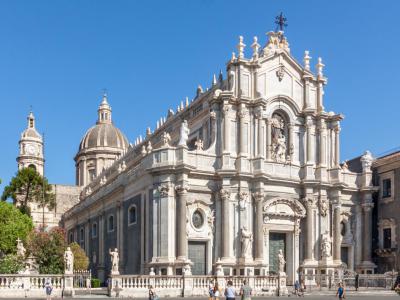
3) Cathedral of Catania (must see)
Catania Cathedral, officially the Cathedral of Saint Agatha, stands as both the city’s main religious landmark and a witness to centuries of upheaval. The site has been sacred since the Norman period, when the first cathedral was completed in the 11th century. Repeated earthquakes and eruptions from Mount Etna caused extensive damage, most dramatically in 1169 and in the catastrophic earthquake of 1693. Rather than erasing its past, each reconstruction added another layer.
The present building is a refined example of Sicilian Baroque, shaped largely in the early 18th century. The façade, designed by Giovanni Battista Vaccarini after 1693, rises in three tiers articulated by columns and niches, with pale limestone set against darker volcanic stone. The broad parvis is edged by a white stone balustrade and lined with Carrara marble statues of saints. The central wooden door is carved with panels illustrating episodes from the life of Saint Agatha. The dome was completed in the early 19th century and the bell tower rebuilt following earlier collapses.
Inside, the cathedral follows a Latin cross plan with three naves. The austere rhythm of columns leads toward an apse that dates back to the 12th century, preserving traces of the medieval structure. Several chapels punctuate the interior, including the Chapel of the Holy Crucifix in the north transept. The cathedral also houses, close to the right transept, the tomb of Vincenzo Bellini, Catania’s most celebrated composer, as well as the burial places of King Frederick III of Sicily, John of Randazzo, and Constance of Aragon.
Saint Agatha herself remains central to the cathedral’s meaning. According to tradition, she was a young noblewoman who refused the advances of the Roman prefect Quintianus and was martyred in the 3rd century. Local belief holds that she continues to protect Catania from enemies, injustice, and even Mount Etna. This faith is captured in the letters carved into the façade: N.O.P.A.Q.V.I.E., an acronym of a Latin phrase affirming that Agatha avenges wrongs committed against her land.
The present building is a refined example of Sicilian Baroque, shaped largely in the early 18th century. The façade, designed by Giovanni Battista Vaccarini after 1693, rises in three tiers articulated by columns and niches, with pale limestone set against darker volcanic stone. The broad parvis is edged by a white stone balustrade and lined with Carrara marble statues of saints. The central wooden door is carved with panels illustrating episodes from the life of Saint Agatha. The dome was completed in the early 19th century and the bell tower rebuilt following earlier collapses.
Inside, the cathedral follows a Latin cross plan with three naves. The austere rhythm of columns leads toward an apse that dates back to the 12th century, preserving traces of the medieval structure. Several chapels punctuate the interior, including the Chapel of the Holy Crucifix in the north transept. The cathedral also houses, close to the right transept, the tomb of Vincenzo Bellini, Catania’s most celebrated composer, as well as the burial places of King Frederick III of Sicily, John of Randazzo, and Constance of Aragon.
Saint Agatha herself remains central to the cathedral’s meaning. According to tradition, she was a young noblewoman who refused the advances of the Roman prefect Quintianus and was martyred in the 3rd century. Local belief holds that she continues to protect Catania from enemies, injustice, and even Mount Etna. This faith is captured in the letters carved into the façade: N.O.P.A.Q.V.I.E., an acronym of a Latin phrase affirming that Agatha avenges wrongs committed against her land.
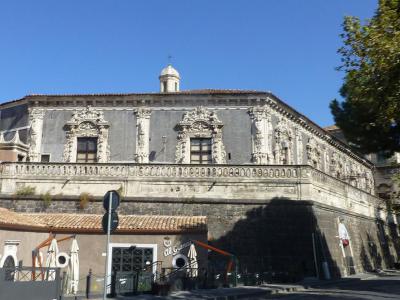
4) Palazzo Biscari (Biscari Palace) (must see)
Biscari Palace is an aristocratic residences of Baroque and Rococo design. Conceived after the devastating earthquake of 1693, the palace was commissioned by Ignazio Paternò Castello, 3rd Prince of Biscari, with construction beginning in 1702 and continuing through much of the 18th century. Completed in 1763 by the fifth Prince of Biscari, its inauguration was marked by lavish celebrations that reflected the family’s status and Catania’s renewed confidence during the reconstruction era.
The palace’s most amazing exterior façade faces Cardinale Dusmet Street, where richly carved balconies curve outward on stone brackets. When this façade was built, it rose directly above the 16th-century city walls, overlooking the sea at their base. The visitor entrance is marked by a stone portal adorned with cartouches and the Biscari coat of arms, opening into a spacious courtyard with an outdoor staircase that prepares visitors for the decorative richness inside.
The interior reveals a fully developed Rococo style. Frescoes, mirrors, and elaborate stucco work animate the grand rooms, culminating in the octagonal ballroom, the palace’s most celebrated space. Decorated by Matteo Desiderato and Sebastiano Lo Monaco, the ballroom is notable for its illusionistic effects and fluid lines. A distinctive spiral staircase shaped like a sea shell leads to a balcony beneath the dome, originally intended to hold an orchestra and now regarded as one of the palace’s most elegant architectural details.
Beyond the ballroom, the palace unfolds through a sequence of named rooms, each reflecting a specific function or theme. The Fief Room displays large paintings of the Biscari family’s feudal lands, while the Princess Apartment, created for the wife of Ignazio V, is paved with salvaged Roman marble. This reuse of ancient material reflects the interests of Ignazio V, a renowned archaeologist whose collections form the basis of the palace museum. Today, although parts of Biscari Palace remain privately inhabited, sections are open for visits and cultural events.
The palace’s most amazing exterior façade faces Cardinale Dusmet Street, where richly carved balconies curve outward on stone brackets. When this façade was built, it rose directly above the 16th-century city walls, overlooking the sea at their base. The visitor entrance is marked by a stone portal adorned with cartouches and the Biscari coat of arms, opening into a spacious courtyard with an outdoor staircase that prepares visitors for the decorative richness inside.
The interior reveals a fully developed Rococo style. Frescoes, mirrors, and elaborate stucco work animate the grand rooms, culminating in the octagonal ballroom, the palace’s most celebrated space. Decorated by Matteo Desiderato and Sebastiano Lo Monaco, the ballroom is notable for its illusionistic effects and fluid lines. A distinctive spiral staircase shaped like a sea shell leads to a balcony beneath the dome, originally intended to hold an orchestra and now regarded as one of the palace’s most elegant architectural details.
Beyond the ballroom, the palace unfolds through a sequence of named rooms, each reflecting a specific function or theme. The Fief Room displays large paintings of the Biscari family’s feudal lands, while the Princess Apartment, created for the wife of Ignazio V, is paved with salvaged Roman marble. This reuse of ancient material reflects the interests of Ignazio V, a renowned archaeologist whose collections form the basis of the palace museum. Today, although parts of Biscari Palace remain privately inhabited, sections are open for visits and cultural events.
5) Roman Theater of Catania (must see)
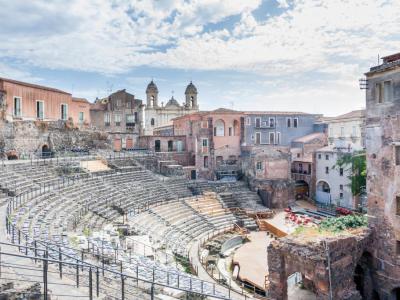
Although the visible structure dates mainly to the 2nd century AD, the Roman Theater was built directly over an earlier Greek theater. Together with the adjacent Odeon, the complex formed the city’s principal venue for performance and public gatherings. Constructed primarily from lava stone and limestone, the seating rises northward, uphill, while spectators would have looked south toward the stage, orchestra, and the sea beyond.
The elliptical structure measured roughly 330 feet in diameter and could accommodate around 7,000 spectators across twenty-one seating rows, accessed through corridors built beneath the cavea. The smaller Odeon, with a capacity of about 1,500, was reserved for music and poetry competitions and is among the best-preserved examples of its kind in Sicily.
One of the theater’s most impressive features is the Amenano River flowing directly underneath the structure. Buried by the 1669 eruption of Mount Etna, the river still runs below the orchestra, which is why parts of the lower theater are often partially flooded with clear freshwater. After the 5th century AD, the complex fell out of use, and much of its marble seating and columns were stripped during the Middle Ages. Reused in major buildings such as Catania Cathedral, recycled theater columns can still be seen in the apse.
Excavations began in the 18th century under Ignazio Paternò Castello, Prince of Biscari, and continued into the 19th century, but it was only in 1959 that modern houses encroaching on the site were removed, fully exposing the theater and Odeon. Two of those former residences on the north side of the theater, Pandolfo House and Liberti House, remain integrated into the complex today, serving as entrance spaces and small museums displaying statues, marble fragments, and architectural elements found on site.
The elliptical structure measured roughly 330 feet in diameter and could accommodate around 7,000 spectators across twenty-one seating rows, accessed through corridors built beneath the cavea. The smaller Odeon, with a capacity of about 1,500, was reserved for music and poetry competitions and is among the best-preserved examples of its kind in Sicily.
One of the theater’s most impressive features is the Amenano River flowing directly underneath the structure. Buried by the 1669 eruption of Mount Etna, the river still runs below the orchestra, which is why parts of the lower theater are often partially flooded with clear freshwater. After the 5th century AD, the complex fell out of use, and much of its marble seating and columns were stripped during the Middle Ages. Reused in major buildings such as Catania Cathedral, recycled theater columns can still be seen in the apse.
Excavations began in the 18th century under Ignazio Paternò Castello, Prince of Biscari, and continued into the 19th century, but it was only in 1959 that modern houses encroaching on the site were removed, fully exposing the theater and Odeon. Two of those former residences on the north side of the theater, Pandolfo House and Liberti House, remain integrated into the complex today, serving as entrance spaces and small museums displaying statues, marble fragments, and architectural elements found on site.
6) Monastery of St. Nicholas Arena (must see)
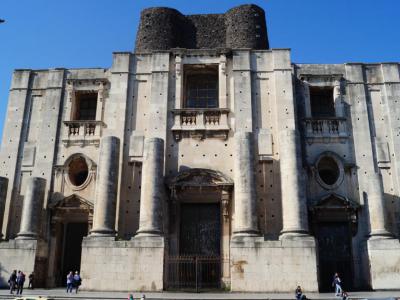
The Monastery of Saint Nicholas Arena is one of the largest Benedictine monasteries in Europe. Founded in 1558, it was established by Benedictine monks whose wealth and noble origins earned the monastery the reputation of being a true “palace for monks”. The name “Arena” does not refer to a Roman amphitheater, but to the red volcanic sand characteristic of the area on the slopes of Mount Etna where the order first settled before moving into the city.
The monastery’s survival through natural disaster is central to its story. During the 1669 eruption of Mount Etna, lava flows reached the complex but did not destroy it; the monks constructed a massive stone bulwark that successfully diverted the lava. The eruption instead raised the ground level around the monastery and reshaped the surrounding landscape. It was the catastrophic earthquake of 1693, not the lava, that flattened much of the structure. Reconstruction began in 1702, with the new monastery built directly over what remained of the earlier complex.
Much of the monastery’s distinctive late-Baroque character, especially the ornate window frames and exuberant southern façade, was shaped by Antonino Amato and Francesco Battaglia. The complex expanded with new cloisters, including the rebuilt Marble Cloister and the newly added Eastern Cloister, complemented by long corridors, staircases, and even a hanging garden. Subterranean spaces preserve visible traces of the 1669 lava flow pressed directly against the monastery walls.
Beside the monastery stands the vast Church of San Nicolò l’Arena, the largest church in Sicily, whose unfinished façade and columns reflect financial strain and political upheaval during the 19th century. Today, as part of the University of Catania and a UNESCO World Heritage Site, the monastery stands as a world-class example of adaptive reuse.
The monastery’s survival through natural disaster is central to its story. During the 1669 eruption of Mount Etna, lava flows reached the complex but did not destroy it; the monks constructed a massive stone bulwark that successfully diverted the lava. The eruption instead raised the ground level around the monastery and reshaped the surrounding landscape. It was the catastrophic earthquake of 1693, not the lava, that flattened much of the structure. Reconstruction began in 1702, with the new monastery built directly over what remained of the earlier complex.
Much of the monastery’s distinctive late-Baroque character, especially the ornate window frames and exuberant southern façade, was shaped by Antonino Amato and Francesco Battaglia. The complex expanded with new cloisters, including the rebuilt Marble Cloister and the newly added Eastern Cloister, complemented by long corridors, staircases, and even a hanging garden. Subterranean spaces preserve visible traces of the 1669 lava flow pressed directly against the monastery walls.
Beside the monastery stands the vast Church of San Nicolò l’Arena, the largest church in Sicily, whose unfinished façade and columns reflect financial strain and political upheaval during the 19th century. Today, as part of the University of Catania and a UNESCO World Heritage Site, the monastery stands as a world-class example of adaptive reuse.
7) Giardino Bellini (Bellini Garden) (must see)
Bellini Garden is the most popular garden in which to go for a walk among locals. It is dedicated to the famous Italian composer born in Catania, V. Bellini.
Before the construction of a public garden, the area was occupied by the garden maze or labyrinth owned by the Ignazio Paternò Castello, prince of Biscari. In 1854, the Municipality of Catania bought the area of the maze, and in 1864 started to adapt the area into a public garden.
Starting from 1875, the municipality acquired several further areas surrounding the maze, and two years later the work to unify these areas was undertaken. The Bellini Garden was inaugurated in 1883.
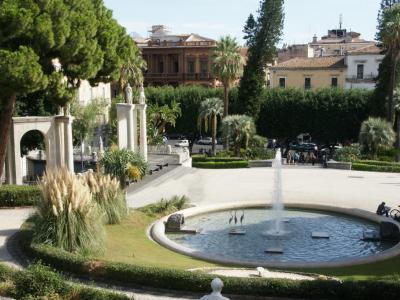
Inside, the villa is equipped with numerous architectural features such as ponds, fountains, statues and busts of many distinguished people from Catania.
Before the construction of a public garden, the area was occupied by the garden maze or labyrinth owned by the Ignazio Paternò Castello, prince of Biscari. In 1854, the Municipality of Catania bought the area of the maze, and in 1864 started to adapt the area into a public garden.
Starting from 1875, the municipality acquired several further areas surrounding the maze, and two years later the work to unify these areas was undertaken. The Bellini Garden was inaugurated in 1883.
Inside, the villa is equipped with numerous architectural features such as ponds, fountains, statues and busts of many distinguished people from Catania.
