Custom Walk in Hanoi, Vietnam by steveback9962 created on 2026-04-03
Guide Location: Vietnam » Hanoi
Guide Type: Custom Walk
# of Sights: 9
Tour Duration: 2 Hour(s)
Travel Distance: 2.9 Km or 1.8 Miles
Share Key: DN2VZ
Guide Type: Custom Walk
# of Sights: 9
Tour Duration: 2 Hour(s)
Travel Distance: 2.9 Km or 1.8 Miles
Share Key: DN2VZ
How It Works
Please retrieve this walk in the GPSmyCity app. Once done, the app will guide you from one tour stop to the next as if you had a personal tour guide. If you created the walk on this website or come to the page via a link, please follow the instructions below to retrieve the walk in the app.
Retrieve This Walk in App
Step 1. Download the app "GPSmyCity: Walks in 1K+ Cities" on Apple App Store or Google Play Store.



Step 2. In the GPSmyCity app, download(or launch) the guide "Hanoi Map and Walking Tours".
Step 3. Tap the menu button located at upper right corner of the "Walks" screen and select "Retrieve custom walk". Enter the share key: DN2VZ
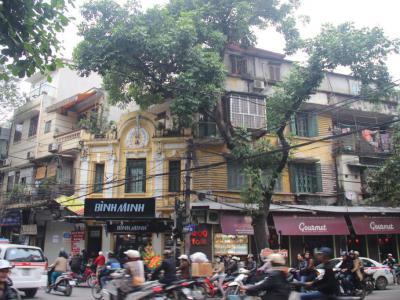
1) Hang Bong Street (must see)
Hàng Bông (French: Rue du Coton) is an ancient street running for about 932 meters from the crossroad Hàng Bông - Hàng Gai - Hàng Trong - Hàng Hom to the former city gate Cửa Nam (South Gate). Once populated by cotton dealers and makers of clothes and winter blankets (hence the name), today's Hàng Bông is one of the busiest shopping streets in Hanoi, lined with art galleries, silk and clothing shops.
Formerly this street consisted of various sections, each with its own name, such as Hang Hai (aka Hang Bong Hai), Hang Manh (packed with shops selling comedy shoes, hats, and paper worship items), Hang Bong Dem (inhabited by sellers of cotton balls, cotton- and other blankets), Hang Bong Banyan Tree Cua Quyen (home to a small temple worshiping Co Quyen, with a banyan tree nearby), Hang Bong Lo (where all kinds of fish were sold), Hang Bong Tho Nhuom (back in the early 20th century this was home to the dyers of silk fabrics), and Hang Bong Alley (known during the French colonial era as Rue Lhonde).
Also, during the French period, Old Hang Bong Street was a home to many print houses, bookstores, and journalists. Notorious for many traffic accidents involving trams (prior to 1991), Hang Bong Street, since the turn of the 21st century, has been gradually associated with luxurious fashion, largely surpassing the rival destinations of Hang Dao, Luong Van Can and Tran Nhan Tong streets. Today, this street also accommodates the fancy Silk Path hotel where once used to be the music tea rooms, popular haunt for artists and other creative folk.
At night, Hang Bong Street is a popular gathering spot for youngsters and students, in large part due to the cheap fried and grilled spring rolls sold on the corner of Hang Bong junction and Tam Thuong alley. At the end of the street, on the right-hand (even-numbered) side is a pastry shop very famous with backpackers. On festive occasions, this street is also teeming with sellers of flags and T-shirts.
Formerly this street consisted of various sections, each with its own name, such as Hang Hai (aka Hang Bong Hai), Hang Manh (packed with shops selling comedy shoes, hats, and paper worship items), Hang Bong Dem (inhabited by sellers of cotton balls, cotton- and other blankets), Hang Bong Banyan Tree Cua Quyen (home to a small temple worshiping Co Quyen, with a banyan tree nearby), Hang Bong Lo (where all kinds of fish were sold), Hang Bong Tho Nhuom (back in the early 20th century this was home to the dyers of silk fabrics), and Hang Bong Alley (known during the French colonial era as Rue Lhonde).
Also, during the French period, Old Hang Bong Street was a home to many print houses, bookstores, and journalists. Notorious for many traffic accidents involving trams (prior to 1991), Hang Bong Street, since the turn of the 21st century, has been gradually associated with luxurious fashion, largely surpassing the rival destinations of Hang Dao, Luong Van Can and Tran Nhan Tong streets. Today, this street also accommodates the fancy Silk Path hotel where once used to be the music tea rooms, popular haunt for artists and other creative folk.
At night, Hang Bong Street is a popular gathering spot for youngsters and students, in large part due to the cheap fried and grilled spring rolls sold on the corner of Hang Bong junction and Tam Thuong alley. At the end of the street, on the right-hand (even-numbered) side is a pastry shop very famous with backpackers. On festive occasions, this street is also teeming with sellers of flags and T-shirts.
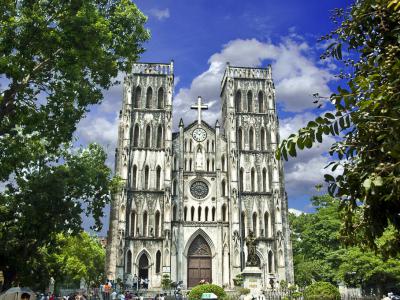
2) St. Joseph Cathedral
Saint Joseph's Cathedral in Hanoi serves as the seat of the Roman Catholic Archdiocese of Hanoi. Constructed in 1886 during French colonial rule, it is the oldest church in the city. Locally known as the "Big Church," it is situated on Nha Chung Street, close to the Ho Hoan Kiem, also known as the Lake of the Returned Sword.
The cathedral's location has a significant historical backdrop, as it was built on the site of the demolished Bao Thien Pagoda, a 12th-century temple constructed by the Ly Dynasty and formerly a vital place of worship for the local populace. This decision by the French to replace the pagoda highlighted their influence and architectural ambitions in Hanoi during their colonial tenure.
Saint Joseph's Cathedral was consecrated on Christmas Day, 1886, and features a neo-Gothic architectural style, mirroring the iconic Notre Dame Cathedral in Paris. This style is evident in its facade, characterized by twin towers flanked by impressive stained glass windows. These windows allow light to filter through in a myriad of colors, creating a visually captivating effect.
In front of the cathedral stands the Regina Pacis (Queen of Peace) statue of the Virgin Mary, adding to its spiritual and architectural significance. Inside, the cathedral is renowned for its beautiful interiors, which visitors can admire through a side door entry.
Mass is conducted twice daily at Saint Joseph's Cathedral, with increased attendance on Sundays and holidays, reflecting its central role in the religious life of the community. The cathedral remains a popular destination for both worshippers and tourists, offering a glimpse into the spiritual and colonial history of Hanoi.
The cathedral's location has a significant historical backdrop, as it was built on the site of the demolished Bao Thien Pagoda, a 12th-century temple constructed by the Ly Dynasty and formerly a vital place of worship for the local populace. This decision by the French to replace the pagoda highlighted their influence and architectural ambitions in Hanoi during their colonial tenure.
Saint Joseph's Cathedral was consecrated on Christmas Day, 1886, and features a neo-Gothic architectural style, mirroring the iconic Notre Dame Cathedral in Paris. This style is evident in its facade, characterized by twin towers flanked by impressive stained glass windows. These windows allow light to filter through in a myriad of colors, creating a visually captivating effect.
In front of the cathedral stands the Regina Pacis (Queen of Peace) statue of the Virgin Mary, adding to its spiritual and architectural significance. Inside, the cathedral is renowned for its beautiful interiors, which visitors can admire through a side door entry.
Mass is conducted twice daily at Saint Joseph's Cathedral, with increased attendance on Sundays and holidays, reflecting its central role in the religious life of the community. The cathedral remains a popular destination for both worshippers and tourists, offering a glimpse into the spiritual and colonial history of Hanoi.
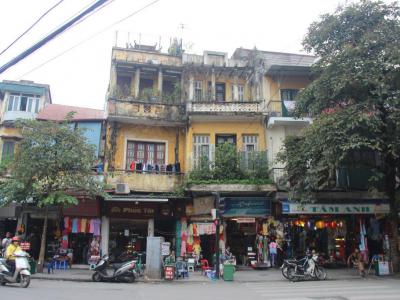
3) Hàng Gai (Silk Street)
Set on the edge of Hanoi’s Old Quarter, near Hoan Kiem Lake, Hang Gai or Silk Street is one of the most bustling commercial destinations in the capital, specialized in silk. The entirety of this 300 meter-long street is lined with more than a hundred stores trading in silk or related products and services. The vast majority of the local fashion boutiques and tailor shops have been in business for decades, offering ready-to-wear and made-to-measure garments.
Back in the times of the Le Dynasty (1428-1789), Hang Gai (literally “Hemp Street”) was the middle section of the road that linked the Nhi Ha river shore to the Southern Gate of Thang Long imperial citadel, and was the place were ropes and hammocks were sold. The word “Gai” in Vietnamese means hemp that was used in making of the hammocks. Similarly, during the French colonial era, Hang Gai was known as Rue de Chanvre (chanvre is the French for hemp, too).
Generally renowned for its quality, the area has a number of firm favourites among the clientele, such as the Khai Silk and Tan My Design shops whose craftsmen are perfect if you’re too pressed for time to get a tailor-made outfit during your stay in Hanoi. They can make you a suit within 24 hours, though it’s best to allow more time for a second fitting to make sure that it fits perfectly.
Most stores in Hang Gai Street accept cards and it pays to go to a better quality store and avoid street vendors to ensure the best buy. As with most retailers throughout Vietnam, bargaining is also welcome – you can start at 50% off the asking price and pay no more than 70%.
Aside from boutiques and tailor shops, Hang Gai Street also hosts a number of souvenir outlets selling notebooks, lamps and postcards, as well as prominent art galleries such as Thang Long Art Gallery and Green Palm Gallery.
Back in the times of the Le Dynasty (1428-1789), Hang Gai (literally “Hemp Street”) was the middle section of the road that linked the Nhi Ha river shore to the Southern Gate of Thang Long imperial citadel, and was the place were ropes and hammocks were sold. The word “Gai” in Vietnamese means hemp that was used in making of the hammocks. Similarly, during the French colonial era, Hang Gai was known as Rue de Chanvre (chanvre is the French for hemp, too).
Generally renowned for its quality, the area has a number of firm favourites among the clientele, such as the Khai Silk and Tan My Design shops whose craftsmen are perfect if you’re too pressed for time to get a tailor-made outfit during your stay in Hanoi. They can make you a suit within 24 hours, though it’s best to allow more time for a second fitting to make sure that it fits perfectly.
Most stores in Hang Gai Street accept cards and it pays to go to a better quality store and avoid street vendors to ensure the best buy. As with most retailers throughout Vietnam, bargaining is also welcome – you can start at 50% off the asking price and pay no more than 70%.
Aside from boutiques and tailor shops, Hang Gai Street also hosts a number of souvenir outlets selling notebooks, lamps and postcards, as well as prominent art galleries such as Thang Long Art Gallery and Green Palm Gallery.
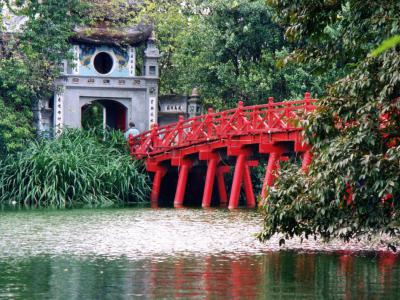
4) Ngoc Son Temple
The Ncog Son temple stands on an island of the Hoan Kiem Lake. There was a temple at the location from the 14th century. The present structure was built in the 18th century. A three passage gate called the Tam Quan stands at one end of a red wooden bridge called The Huc (Rising Sun bridge). The Huc connects the Island with the mainland.
The Ncog Son temple is dedicated to many heroes. The main altar is dedicated to the hero Tran Hung Dao, who defeated and army of 300,000 invaders from the Chinese Yuan dynasty. Other altars are dedicated to La To, the patron saint of physicians, the scholar Van Xuong and Nguyen Van Sieu, a Confucian scholar who voluntarily restored the temple and its surroundings in 1864.
Nguyen Van Sieu added the Thap But, a 30 foot stone obelisk with a tip that resembles a paintbrush found to the left of the gates and Dai Nghien, a hollowed rock in the shape of a peach called the writing pad to the temple complex.
The temple has a pavilion in front of the altars and many souvenir shops for tourists. Elderly Vietnamese gather at the courtyard of the temple to play danh co tuong or Chinese Chess.
The Ncog Son temple is dedicated to many heroes. The main altar is dedicated to the hero Tran Hung Dao, who defeated and army of 300,000 invaders from the Chinese Yuan dynasty. Other altars are dedicated to La To, the patron saint of physicians, the scholar Van Xuong and Nguyen Van Sieu, a Confucian scholar who voluntarily restored the temple and its surroundings in 1864.
Nguyen Van Sieu added the Thap But, a 30 foot stone obelisk with a tip that resembles a paintbrush found to the left of the gates and Dai Nghien, a hollowed rock in the shape of a peach called the writing pad to the temple complex.
The temple has a pavilion in front of the altars and many souvenir shops for tourists. Elderly Vietnamese gather at the courtyard of the temple to play danh co tuong or Chinese Chess.
5) Hoàn Kiếm Lake (must see)
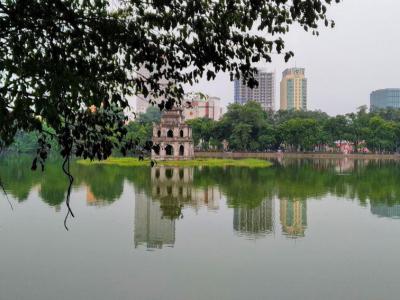
Hoàn Kiếm Lake holds a storied place at the heart of Hanoi. Also known as Sword Lake, this 12-hectare freshwater lake is a central feature of the city's public and historical life. Located in Hanoi's historical center, the lake is not only a major scenic spot but also a focal point for the city's public life, surrounded by vibrant streets and bustling local markets.
Originally named Green Water Lake (Hồ Lục Thủy) for its distinctive watercolor, the lake's present name, which means "Lake of the Returned Sword," is derived from a legendary event. The tale recounts that Emperor Lê Lợi, after defeating Ming China, was approached by a Golden Turtle God (Kim Qui) while boating on the lake. The turtle god requested the return of a magical sword, Heaven's Will, given to Lợi by the Dragon King (Long Vương) to aid in his battle against the Chinese. Acknowledging that his mission was accomplished, Lợi returned the sword to the turtle. This pivotal event led to the renaming of the lake to commemorate the sword's return.
The Turtle Tower (Tháp Rùa), situated on a small island near the center of the lake, is a prominent landmark associated with this legend. It stands as a silent reminder of the lake's mythological past. The lake was once home to the large soft-shell turtle species Rafetus leloi, named in honor of the emperor. Although the last known specimen was found deceased in 2016, the species remains emblematic of the lake's rich biodiversity.
To the north, the Jade Islet is connected to the lake's shore by the striking vermilion-red Thê Húc Bridge, which means "Perch of the Morning Sunlight". Atop the islet sits the Temple of the Jade Mountain (Ngoc Son), erected in the 18th century. This temple honors notable historical figures such as Tran Hung Dao, a military leader known for his victories over Mongol invaders; Van Xuong, a revered scholar; and Nguyen Van Sieu, a renowned writer who refurbished the temple in 1864, lending it its current appearance.
Today, Hoàn Kiếm Lake remains a vital part of Hanoi’s cultural fabric, attracting visitors with its serene beauty and rich history, encapsulating a blend of natural charm and cultural significance.
Originally named Green Water Lake (Hồ Lục Thủy) for its distinctive watercolor, the lake's present name, which means "Lake of the Returned Sword," is derived from a legendary event. The tale recounts that Emperor Lê Lợi, after defeating Ming China, was approached by a Golden Turtle God (Kim Qui) while boating on the lake. The turtle god requested the return of a magical sword, Heaven's Will, given to Lợi by the Dragon King (Long Vương) to aid in his battle against the Chinese. Acknowledging that his mission was accomplished, Lợi returned the sword to the turtle. This pivotal event led to the renaming of the lake to commemorate the sword's return.
The Turtle Tower (Tháp Rùa), situated on a small island near the center of the lake, is a prominent landmark associated with this legend. It stands as a silent reminder of the lake's mythological past. The lake was once home to the large soft-shell turtle species Rafetus leloi, named in honor of the emperor. Although the last known specimen was found deceased in 2016, the species remains emblematic of the lake's rich biodiversity.
To the north, the Jade Islet is connected to the lake's shore by the striking vermilion-red Thê Húc Bridge, which means "Perch of the Morning Sunlight". Atop the islet sits the Temple of the Jade Mountain (Ngoc Son), erected in the 18th century. This temple honors notable historical figures such as Tran Hung Dao, a military leader known for his victories over Mongol invaders; Van Xuong, a revered scholar; and Nguyen Van Sieu, a renowned writer who refurbished the temple in 1864, lending it its current appearance.
Today, Hoàn Kiếm Lake remains a vital part of Hanoi’s cultural fabric, attracting visitors with its serene beauty and rich history, encapsulating a blend of natural charm and cultural significance.
6) Martyrs' Monument
The Martyrs' Monument in Hanoi stands as a powerful tribute to those who sacrificed their lives for the nation's independence. Prominently located near Ba Dinh Square, this monument is easily accessible from various parts of the city, either by taxi or the numerous bus routes leading to Le Hong Phong Road.
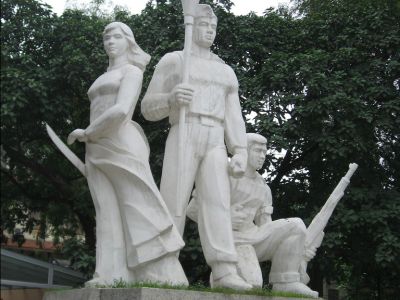
Crafted from pristine white marble, the monument features three figures: two men and one woman, each depicted with symbolic items-a torch, a gun, and a sword, respectively. These elements are not only representative of the struggle but also signify the inclusive nature of the fight for freedom, where individuals of all genders participated equally. The figures are sculpted with expressive detail, their faces etched with determination and courage, vividly conveying the resolve of the Vietnamese people during their quest for independence.
The Martyrs' Monument is not just a visual spectacle but also a site of deep historical importance. It encourages reflection on the profound sacrifices made by the Vietnamese people. Visiting the monument provides an opportunity to honor those who fought bravely and to better understand the turbulent history of Vietnam's path to independence. This splendid structure is a poignant reminder of the heroic efforts undertaken across genders, inspiring feelings of patriotism and reverence among its viewers.
Crafted from pristine white marble, the monument features three figures: two men and one woman, each depicted with symbolic items-a torch, a gun, and a sword, respectively. These elements are not only representative of the struggle but also signify the inclusive nature of the fight for freedom, where individuals of all genders participated equally. The figures are sculpted with expressive detail, their faces etched with determination and courage, vividly conveying the resolve of the Vietnamese people during their quest for independence.
The Martyrs' Monument is not just a visual spectacle but also a site of deep historical importance. It encourages reflection on the profound sacrifices made by the Vietnamese people. Visiting the monument provides an opportunity to honor those who fought bravely and to better understand the turbulent history of Vietnam's path to independence. This splendid structure is a poignant reminder of the heroic efforts undertaken across genders, inspiring feelings of patriotism and reverence among its viewers.
7) Statue of Ly Thai To
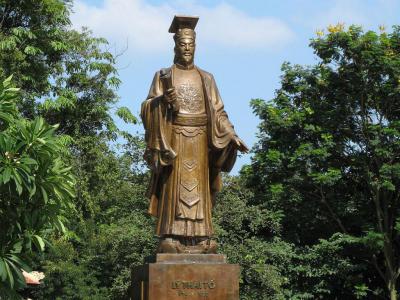
The Ly Thai To statue is a large bronze sculpture of Emperor Ly Thai To, founder of the Ly dynasty of Vietnam. He also founded the city of Thang Long in 1010 which later became the city of Hanoi.
In February 2003, the Hanoi department of Culture and Information held a design contest for a statue of Ly Thai To. Sculptor Vi Thi Hoa of the Vietnamese Fine Arts Association won the contest that consisted of 29 other entries. The statue was made in August 2004 and erected in October 2004. It is the largest bronze sculpture in Vietnam. The statue weighs 12 tons and is atop a 20 ton pedestal. It stands 10.10 meters high. The right hand of Ly Thai To holds the Chieu Doi Do or the decree of the relocation of the capital city to Thang Long, and the left hand points to the location where the construction began. The statue was erected to celebrate the 50th anniversary of the liberation of Hanoi. It is venerated by the local people with flowers and incense.
The statue of Ly Thai To is located in Indira Gandhi Park, named after the slain Indian prime minister who was a supporter and friend of Vietnam. The park is popular with the locals for strolls and for practicing dance and games.
In February 2003, the Hanoi department of Culture and Information held a design contest for a statue of Ly Thai To. Sculptor Vi Thi Hoa of the Vietnamese Fine Arts Association won the contest that consisted of 29 other entries. The statue was made in August 2004 and erected in October 2004. It is the largest bronze sculpture in Vietnam. The statue weighs 12 tons and is atop a 20 ton pedestal. It stands 10.10 meters high. The right hand of Ly Thai To holds the Chieu Doi Do or the decree of the relocation of the capital city to Thang Long, and the left hand points to the location where the construction began. The statue was erected to celebrate the 50th anniversary of the liberation of Hanoi. It is venerated by the local people with flowers and incense.
The statue of Ly Thai To is located in Indira Gandhi Park, named after the slain Indian prime minister who was a supporter and friend of Vietnam. The park is popular with the locals for strolls and for practicing dance and games.
8) Trang Tien Plaza
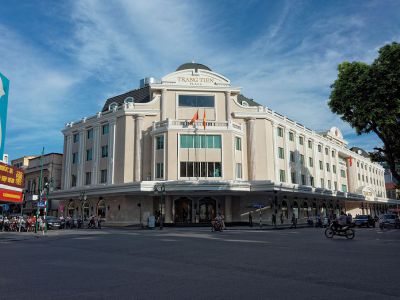
Trang Tien Plaza is a major shopping center located in the Hoan Kiem district of Hanoi. It occupies the former site of the Hanoi General Department Store, near the Hanoi Post Office, and has a view of Hoan Kiem Lake. Trang Tien Plaza is not just one of the city's biggest and most upscale malls, but it's also a key landmark. The building, which showcases sophisticated French architectural design, reflects the refined culture of Vietnam's capital. It features over 215,000 square feet of space, which includes offices, retail stores, and various dining and cafe options.
The origins of this esteemed shopping destination trace back to 1953, when the French government sold what was known as Maison Godard to international businesses, renaming it Grands Magasins Reunis. By 1959, it was renamed again to the General Department Store of Hanoi City, selling items such as textiles, clothes, bicycles, and their parts. In 1993, the Vietnamese government acquired it, but the state-run business closed on September 29, 1995.
Construction of the new complex began on April 30, 2000, commemorating the 25th anniversary of South Vietnam's liberation, and was completed in 18 months by another state enterprise. This led to the opening of the modern Trang Tien Plaza, which provides a wide range of products, from everyday items to luxury goods. By 2005, thanks to substantial investments from IMEX PAN Pacific Group, it became the nation’s premier luxury shopping destination.
Today, Trang Tien Plaza hosts over 200 global brands including Rolex, Burberry, and Zegna. The first floor features top-tier brands like Louis Vuitton and Cartier, while the second floor offers labels such as Versace and Dior. The third floor focuses on jewelry and beauty products, the fourth floor caters to men's and women’s fashion and accessories, and the fifth floor includes a cinema and restaurant. The sixth floor is dedicated to home goods and children's products.
The origins of this esteemed shopping destination trace back to 1953, when the French government sold what was known as Maison Godard to international businesses, renaming it Grands Magasins Reunis. By 1959, it was renamed again to the General Department Store of Hanoi City, selling items such as textiles, clothes, bicycles, and their parts. In 1993, the Vietnamese government acquired it, but the state-run business closed on September 29, 1995.
Construction of the new complex began on April 30, 2000, commemorating the 25th anniversary of South Vietnam's liberation, and was completed in 18 months by another state enterprise. This led to the opening of the modern Trang Tien Plaza, which provides a wide range of products, from everyday items to luxury goods. By 2005, thanks to substantial investments from IMEX PAN Pacific Group, it became the nation’s premier luxury shopping destination.
Today, Trang Tien Plaza hosts over 200 global brands including Rolex, Burberry, and Zegna. The first floor features top-tier brands like Louis Vuitton and Cartier, while the second floor offers labels such as Versace and Dior. The third floor focuses on jewelry and beauty products, the fourth floor caters to men's and women’s fashion and accessories, and the fifth floor includes a cinema and restaurant. The sixth floor is dedicated to home goods and children's products.
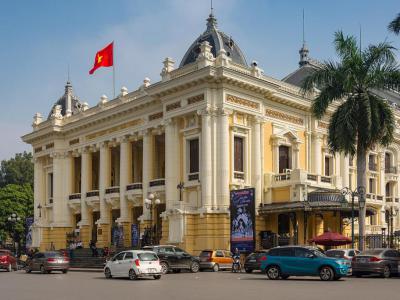
9) Hanoi Opera House
The Hanoi opera house was built in 1911 by the French colonial rulers to resemble the old opera house in Paris. On August the 16th 1945, the Viet Minh declared that it had taken over the city from the balcony of the building.
The Hanoi opera house was built over a drained pond in 1911. Architects Harley and Broyer were the designers, and the construction was supervised by M. Travary and M. Savelon. The structure combines Greek, Beaux Arts and Gothic styles like the Palais Garnier, the old opera house in Paris. This is the largest theater in Vietnam. It consists of a large stage, a 24 x 24 meter main audience room and several balconies in the middle floor. There are 18 makeup rooms, 2 rooms for voice training, a library and a meeting room backstage. In 1997, the opera house underwent major restoration under the supervision of French Vietnamese architects, Ho Thieu Thri and Hoang Phuc Sinh. The theater was equipped with state of the art acoustic and other equipment suitable for modern audiences.
Visitors can view all types of performances at the Hanoi opera house including folk music performances, western music concerts and Vietnamese operetta and drama. Visitors are not allowed in unless they are part of the audience at a performance. The steps leading to the building are a popular place for tourists to get their photographs taken.
The Hanoi opera house was built over a drained pond in 1911. Architects Harley and Broyer were the designers, and the construction was supervised by M. Travary and M. Savelon. The structure combines Greek, Beaux Arts and Gothic styles like the Palais Garnier, the old opera house in Paris. This is the largest theater in Vietnam. It consists of a large stage, a 24 x 24 meter main audience room and several balconies in the middle floor. There are 18 makeup rooms, 2 rooms for voice training, a library and a meeting room backstage. In 1997, the opera house underwent major restoration under the supervision of French Vietnamese architects, Ho Thieu Thri and Hoang Phuc Sinh. The theater was equipped with state of the art acoustic and other equipment suitable for modern audiences.
Visitors can view all types of performances at the Hanoi opera house including folk music performances, western music concerts and Vietnamese operetta and drama. Visitors are not allowed in unless they are part of the audience at a performance. The steps leading to the building are a popular place for tourists to get their photographs taken.
