Custom Walk in Seville, Spain by zhasebi2278 created on 2026-03-21
Guide Location: Spain » Seville
Guide Type: Custom Walk
# of Sights: 16
Tour Duration: 3 Hour(s)
Travel Distance: 6.4 Km or 4 Miles
Share Key: VQMST
Guide Type: Custom Walk
# of Sights: 16
Tour Duration: 3 Hour(s)
Travel Distance: 6.4 Km or 4 Miles
Share Key: VQMST
How It Works
Please retrieve this walk in the GPSmyCity app. Once done, the app will guide you from one tour stop to the next as if you had a personal tour guide. If you created the walk on this website or come to the page via a link, please follow the instructions below to retrieve the walk in the app.
Retrieve This Walk in App
Step 1. Download the app "GPSmyCity: Walks in 1K+ Cities" on Apple App Store or Google Play Store.



Step 2. In the GPSmyCity app, download(or launch) the guide "Seville Map and Walking Tours".
Step 3. Tap the menu button located at upper right corner of the "Walks" screen and select "Retrieve custom walk". Enter the share key: VQMST
1) Casa de Pilatos (Pilate's House) (must see)
In October 1520, the nobleman Don Fadrique Enriques de Rivera returned from a journey to the Holy Land. Inspired by his experiences in Jerusalem, he initiated in Seville the Holy Way of the Cross. The Holy Way traced the path of Christ from Pilate's praetorian to the hill of Calvary. In this case Calvary was a pillar in a field outside the city walls.
The house of Don Fadrique was still under construction when he inaugurated the Via Crucis and it became known as "Pilate's House." People thought of the house as a copy of Pilate's house. Pontius Pilate is best known for being the official who presided over the trial of Jesus and later ordered his crucifixion. Rooms of the house have names associated with the Passion of Christ. There is "Hall of Praetorian", and "Chapel of Flagellations."
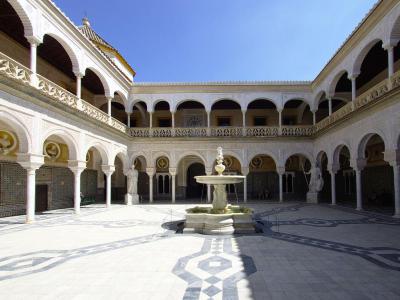
The house is decorated with rare azulejo tiles and surrounded with well maintained gardens. The front gate is of marble in the renaissance style. Beyond the front gate is a courtyard with a fountain and the busts of Spanish kings, 24 in all. There are also a number of busts of Roman emperors. Beyond the emperors and kings are more gardens.
The interiors of the house are decorated with azulejo tiles and ceilings of Mudejar honeycomb design. In a room of the left wing of the tower is a ceiling fresco painted by the Spanish painter Francisco Pacheco. The theme of the frescoe is the apotheosis of Hercules. Hercules is celebrated as the founder of Seville and Cadiz. The house is open year round.
Why You Should Visit:
To see Andalusian design, without the crowds at the Royal Alcázar. The tile work, ceilings, wood, plaster carvings, and colorful gardens are very much worthwhile.
Tip:
Don't miss the cute ceramics shop just outside the Casa; it's an especially good one with some traditional and some original items... better than the regular souvenir shop.
The house of Don Fadrique was still under construction when he inaugurated the Via Crucis and it became known as "Pilate's House." People thought of the house as a copy of Pilate's house. Pontius Pilate is best known for being the official who presided over the trial of Jesus and later ordered his crucifixion. Rooms of the house have names associated with the Passion of Christ. There is "Hall of Praetorian", and "Chapel of Flagellations."
The house is decorated with rare azulejo tiles and surrounded with well maintained gardens. The front gate is of marble in the renaissance style. Beyond the front gate is a courtyard with a fountain and the busts of Spanish kings, 24 in all. There are also a number of busts of Roman emperors. Beyond the emperors and kings are more gardens.
The interiors of the house are decorated with azulejo tiles and ceilings of Mudejar honeycomb design. In a room of the left wing of the tower is a ceiling fresco painted by the Spanish painter Francisco Pacheco. The theme of the frescoe is the apotheosis of Hercules. Hercules is celebrated as the founder of Seville and Cadiz. The house is open year round.
Why You Should Visit:
To see Andalusian design, without the crowds at the Royal Alcázar. The tile work, ceilings, wood, plaster carvings, and colorful gardens are very much worthwhile.
Tip:
Don't miss the cute ceramics shop just outside the Casa; it's an especially good one with some traditional and some original items... better than the regular souvenir shop.
2) Palacio de las Duenas (Palace of Duenas) (must see)
Palace of the Dukes belongs to the House of Alba. It was built in the 15th century in the renaissance style but with Gothic and Moorish accents. The palace has a strong architectural and artistic heritage. Several famous poets and artists were born here and it has become a national monument, a "Asset of Cultural Interest."
The Duke of Alba has been open to tourists since 2016. The palace name is from the monastery of Santa Maria de las Duenas which was home to nuns and servants of Saint Ferdinand and Alfonso X The Wise. The monastery was peripheral to the palace. It was demolished in 1866.
The palace was at one time the residence of Lord Holland, a great fan of Spanish literature. He is the author of a memoir on Lope de Vega and Guillen de Castro. The palace became the property of the house of Alba with the marriage of the 5th Marchioness of Villanueva del Rio with the 4th Duke of Alba.
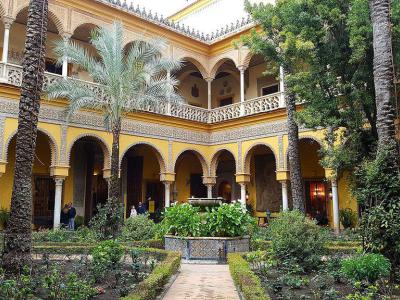
The palace style is a mixture of Gothic, Moorish and Renaissance. There used to be eleven patios. Only one patio remains, surrounded by a gallery. In the interior there is a staircase under a vaulted roof and a ceiling of alfarje gold. The main attractions are Italian and Spanish paintings, antiques, ceramics, sculptures, tapestries and mosaics.
The Duke of Alba has been open to tourists since 2016. The palace name is from the monastery of Santa Maria de las Duenas which was home to nuns and servants of Saint Ferdinand and Alfonso X The Wise. The monastery was peripheral to the palace. It was demolished in 1866.
The palace was at one time the residence of Lord Holland, a great fan of Spanish literature. He is the author of a memoir on Lope de Vega and Guillen de Castro. The palace became the property of the house of Alba with the marriage of the 5th Marchioness of Villanueva del Rio with the 4th Duke of Alba.
The palace style is a mixture of Gothic, Moorish and Renaissance. There used to be eleven patios. Only one patio remains, surrounded by a gallery. In the interior there is a staircase under a vaulted roof and a ceiling of alfarje gold. The main attractions are Italian and Spanish paintings, antiques, ceramics, sculptures, tapestries and mosaics.
3) Setas de Sevilla (Metropol Parasol) (must see)
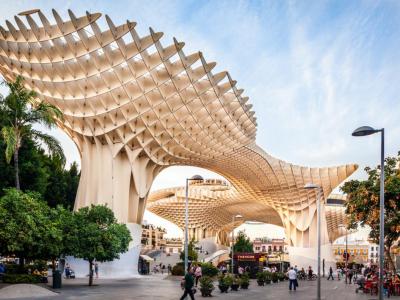
Metropol Parasol is a wooden structure erected in La Plaza de Encarnacion. It has 113,000 square feet of area and 85 feet in height. It is the largest of its kind in the world. People call it "The Mushrooms" because it looks like mushrooms. It is formed by six parasols in the form of mushrooms.
The design of the mushrooms was inspired by the vaults of the Cathedral of Seville and the ficus trees in the Plaza de Cristo de Burgos. There are four levels. Level zero (underground) is home to the Antiquarium. The Antiquarium is a museum displaying Roman and Moorish remains and artifacts discovered while the Parasols were being built.
The next level is Level One. Level One is the street-level open air public plaza and market. Level One is shaded by the wooden parasols above. Levels Two and Three are panoramic terraces and a restaurant. The Parasol project was not created without controversy. There are cost problems, people disliked the appearance, and there are safety concerns.
Since the 19th century there was a market in the plaza, within a "dedicated" building. Following plans for urban renewal, the building was pulled down in part in 1948. The market remained until 1973 before the remainder of the building was removed. The land stayed fallow until 1990 when the city had finally decided on an underground parking lot.
Then the unexpected happened. The diggers discovered ruins and remains dating to the Roman and Moorish eras. All work was stopped and archeology took over. After an expenditure of more than 14 million Euros, the project went into deep freeze. At last, in 2004 the city tried to resume development and opened a competition for bids.
The winner of the competition was destined to change the profile of Seville forever. The winner was German architect Jurgen Mayer who designed six mushroom shapes as parasols to shelter the public area below. The mushrooms were constructed entirely of imported Finnish wood known for its straightness.
The honey-comb structure provides shade for the shops and market below. Admission is free for residents of the city. For others tickets to the top of the parasol cost a few euros. This includes a free drink. The best time to go is at sunset. The view from the top is magical.
The design of the mushrooms was inspired by the vaults of the Cathedral of Seville and the ficus trees in the Plaza de Cristo de Burgos. There are four levels. Level zero (underground) is home to the Antiquarium. The Antiquarium is a museum displaying Roman and Moorish remains and artifacts discovered while the Parasols were being built.
The next level is Level One. Level One is the street-level open air public plaza and market. Level One is shaded by the wooden parasols above. Levels Two and Three are panoramic terraces and a restaurant. The Parasol project was not created without controversy. There are cost problems, people disliked the appearance, and there are safety concerns.
Since the 19th century there was a market in the plaza, within a "dedicated" building. Following plans for urban renewal, the building was pulled down in part in 1948. The market remained until 1973 before the remainder of the building was removed. The land stayed fallow until 1990 when the city had finally decided on an underground parking lot.
Then the unexpected happened. The diggers discovered ruins and remains dating to the Roman and Moorish eras. All work was stopped and archeology took over. After an expenditure of more than 14 million Euros, the project went into deep freeze. At last, in 2004 the city tried to resume development and opened a competition for bids.
The winner of the competition was destined to change the profile of Seville forever. The winner was German architect Jurgen Mayer who designed six mushroom shapes as parasols to shelter the public area below. The mushrooms were constructed entirely of imported Finnish wood known for its straightness.
The honey-comb structure provides shade for the shops and market below. Admission is free for residents of the city. For others tickets to the top of the parasol cost a few euros. This includes a free drink. The best time to go is at sunset. The view from the top is magical.

4) Palacio de Lebrija
Recognized as one of the most precious heritage sites of Andalusia, the Palace of the Countess of Lebrija has been turned into a museum since 1999. Dating to the 16th century and remodeled between the 18th and 20th centuries, the palace is characterised by its collection of art, including Roman mosaics and other antiquities as well as Asian art, paintings by European masters and European decorative arts.
The interior of the palace is decorated in a palette of architectural styles, with elements such as Moorish arches, Plateresque decoration, tilework retrieved from ruined convent, a coffered ceiling from a 16th-century palace and a Renaissance frieze, while its façade and layout reflect the typical Andalusian style.
Visitors may explore the ground floor at will. There are also guided tours (English/Spanish) of the upper floor throughout the day. The richly appointed rooms on this floor have been left as the family lived in them; they include sitting rooms, a private chapel, dining room and library, all of which contain a multitude of ornaments and major works of art.
Why You Should Visit:
The Countess filled her homes with a shocking array of archaeological finds!
If you don't speak Spanish, you might not be able to understand what everything is because the signs are only in Spanish.
However, the more spectacular items in the collection – namely the impressive Roman mosaics – require no labels to understand.
The building itself is also a sight worth seeing on its own, although it's very easy to become lost among the meandering rooms.
Tip:
If you do visit, make sure you do both floors, as you need to do the upstairs tour to really understand the place.
The interior of the palace is decorated in a palette of architectural styles, with elements such as Moorish arches, Plateresque decoration, tilework retrieved from ruined convent, a coffered ceiling from a 16th-century palace and a Renaissance frieze, while its façade and layout reflect the typical Andalusian style.
Visitors may explore the ground floor at will. There are also guided tours (English/Spanish) of the upper floor throughout the day. The richly appointed rooms on this floor have been left as the family lived in them; they include sitting rooms, a private chapel, dining room and library, all of which contain a multitude of ornaments and major works of art.
Why You Should Visit:
The Countess filled her homes with a shocking array of archaeological finds!
If you don't speak Spanish, you might not be able to understand what everything is because the signs are only in Spanish.
However, the more spectacular items in the collection – namely the impressive Roman mosaics – require no labels to understand.
The building itself is also a sight worth seeing on its own, although it's very easy to become lost among the meandering rooms.
Tip:
If you do visit, make sure you do both floors, as you need to do the upstairs tour to really understand the place.
5) Iglesia Colegial del Salvador (Church of the Divine Savior) (must see)
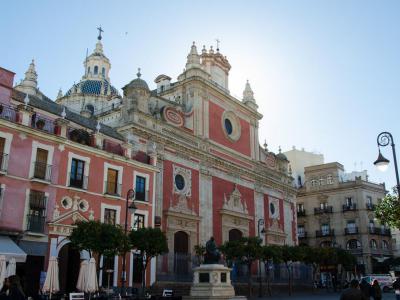
Located in the Plaza del Salvador in Seville, the Church of the Divine Savior is the largest church in the city after the Cathedral. The church was built over the remains Ibn Adabba, the Great Mosque, and an early Christian chapel. It fell into disrepair over the centuries between 1340 and 2008 when it was fully restored to its former glory.
The church is baroque. The facade however, has a mannerist influence. Mannerist architecture developed after the end of the renaissance style and the first signs of the Baroque, about 1610. The building is rectangular and it has three naves. The vaults are a barrel type. Pillars with columns support the vaults. The drum is octagonal.
The main altarpiece was by Cayetano de Acosta in Baroque style. The immaculate Mary appears over the tabernacle. In the center is the Transfiguration of Jesus, surrounded by Archangels. In the central nave the columns have a tracery of eucharistic symbols. There are lions and castles. The church is about the moment Jesus reveals his divinity.
Tip:
Purchase the "combined" ticket here and you'll be able to skip the long line at the Cathedral and Giralda.
The church is baroque. The facade however, has a mannerist influence. Mannerist architecture developed after the end of the renaissance style and the first signs of the Baroque, about 1610. The building is rectangular and it has three naves. The vaults are a barrel type. Pillars with columns support the vaults. The drum is octagonal.
The main altarpiece was by Cayetano de Acosta in Baroque style. The immaculate Mary appears over the tabernacle. In the center is the Transfiguration of Jesus, surrounded by Archangels. In the central nave the columns have a tracery of eucharistic symbols. There are lions and castles. The church is about the moment Jesus reveals his divinity.
Tip:
Purchase the "combined" ticket here and you'll be able to skip the long line at the Cathedral and Giralda.
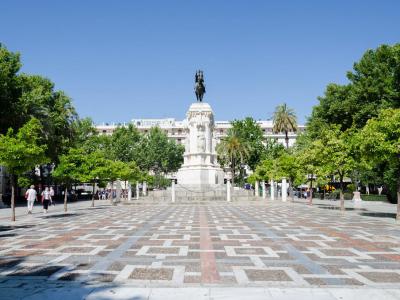
6) Plaza Nueva (The New Square)
Plaza Nueva (New Square), located in Seville's heart, is home to the city's municipal building. This square, now a central public area, originally belonged to the San Fernando convent from 1270 to 1840. It was later repurposed by the city authorities into a plaza, completed in 1856.
Initially, this site was part of the Guadalquivir River until the 11th century. Remarkable historical discoveries, including a 10th-century ship and a 6th-century Byzantine anchor, were unearthed here in 1981 during the Seville Metro construction. By the 11th century, the area transformed into a cemetery and orchards.
The Plaza Nueva's space was once occupied by the Convento Casa Grande de San Francisco from 1270 to 1840. This convent, with its extensive gardens, stretched beyond today's plaza boundaries, reaching up to the current Calle Zaragoza. The 19th-century Napoleonic invasion severely damaged the convent, culminating in a fire in 1810. In 1840, the government acquired and demolished the remaining structures, paving the way for the plaza.
Central to Plaza Nueva is a statue of Fernando III, who seized Seville in 1248 and was canonized in 1671. The plaza's design initially contemplated various monuments, including tributes to Murillo and Isabella II, but ultimately, in 1920, it was resolved to honor Fernando III. The monument, a collaboration between architect Juan Talavera y Heredia and sculptor Joaquín Bilbao, was unveiled in August 1924.
Initially, this site was part of the Guadalquivir River until the 11th century. Remarkable historical discoveries, including a 10th-century ship and a 6th-century Byzantine anchor, were unearthed here in 1981 during the Seville Metro construction. By the 11th century, the area transformed into a cemetery and orchards.
The Plaza Nueva's space was once occupied by the Convento Casa Grande de San Francisco from 1270 to 1840. This convent, with its extensive gardens, stretched beyond today's plaza boundaries, reaching up to the current Calle Zaragoza. The 19th-century Napoleonic invasion severely damaged the convent, culminating in a fire in 1810. In 1840, the government acquired and demolished the remaining structures, paving the way for the plaza.
Central to Plaza Nueva is a statue of Fernando III, who seized Seville in 1248 and was canonized in 1671. The plaza's design initially contemplated various monuments, including tributes to Murillo and Isabella II, but ultimately, in 1920, it was resolved to honor Fernando III. The monument, a collaboration between architect Juan Talavera y Heredia and sculptor Joaquín Bilbao, was unveiled in August 1924.

7) Plaza de toros de la Maestranza (Maestranza Bullring) (must see)
The Maestranza Bullring is one of Seville’s most famous landmarks and one of the oldest and most prestigious bullrings in Spain. Construction began in 1749 under the patronage of the Royal Cavalry Brotherhood of Seville, an aristocratic institution originally devoted to military training and horsemanship. Unlike many bullrings built later in the 19th century, the Maestranza developed gradually over decades, which explains its distinctive slightly oval shape rather than a perfect circle. The elegant Baroque-style entrance gate and the bright white and yellow exterior walls have become instantly recognizable symbols of Seville.
The arena can seat roughly 12,000 spectators and is considered one of the most demanding venues in the bullfighting world. Its long history, distinctive layout, and highly knowledgeable audience give it a reputation as a particularly challenging arena for matadors. In Seville, bullfights held during the April Fair represent the highlight of the city’s bullfighting calendar. The regular season usually runs from March or April—depending on the dates of Holy Week—until late September. Each year, the Real Maestranza commissions an artist to design the official poster announcing the upcoming season at the Royal Bullring.
Today the Maestranza is also one of the city’s most visited tourist attractions. Even for visitors who do not attend a bullfight, the site offers insight into a long-standing Andalusian tradition. Guided tours allow access to areas normally hidden from the public, including the chapel where matadors pray before entering the arena, the royal box, and the bullfighters’ gate through which the toreros make their entrance.
The complex also houses the Bullfighting Museum, which displays historic costumes, paintings, posters, and memorabilia tracing the evolution of bullfighting in Seville.
The arena can seat roughly 12,000 spectators and is considered one of the most demanding venues in the bullfighting world. Its long history, distinctive layout, and highly knowledgeable audience give it a reputation as a particularly challenging arena for matadors. In Seville, bullfights held during the April Fair represent the highlight of the city’s bullfighting calendar. The regular season usually runs from March or April—depending on the dates of Holy Week—until late September. Each year, the Real Maestranza commissions an artist to design the official poster announcing the upcoming season at the Royal Bullring.
Today the Maestranza is also one of the city’s most visited tourist attractions. Even for visitors who do not attend a bullfight, the site offers insight into a long-standing Andalusian tradition. Guided tours allow access to areas normally hidden from the public, including the chapel where matadors pray before entering the arena, the royal box, and the bullfighters’ gate through which the toreros make their entrance.
The complex also houses the Bullfighting Museum, which displays historic costumes, paintings, posters, and memorabilia tracing the evolution of bullfighting in Seville.
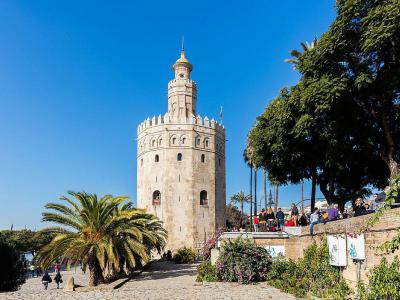
8) Torre del Oro (Gold Tower)
The Gold Tower, situated in Seville, is a twelve-sided military watchtower constructed by the Almohad dynasty to control access to Seville via the Guadalquivir river. It was built in the early 13th century and had a role as a prison during the Middle Ages. Its name originates from the radiant golden reflection it cast on the river, attributed to its construction materials, which consisted of a blend of mortar, lime, and compacted hay.
This tower is divided into three levels, with the third and uppermost level being circular in shape, added in 1769. Nearby, there is a smaller octagonal tower known as the Silver Tower, believed to have been built during the same era.
In recent centuries, the Gold Tower faced a threat when the adjacent road needed expansion. However, due to strong opposition from the local population, the idea of demolishing the tower was abandoned. In 1868, there was an attempt to sell it as scrap, but this proposal was also vehemently rejected by the city's residents. Today, the tower has been restored and serves as a naval museum, housing engravings, letters, models, instruments, and historical documents. The museum provides insights into the naval history of Seville and the significance of its river.
This tower is divided into three levels, with the third and uppermost level being circular in shape, added in 1769. Nearby, there is a smaller octagonal tower known as the Silver Tower, believed to have been built during the same era.
In recent centuries, the Gold Tower faced a threat when the adjacent road needed expansion. However, due to strong opposition from the local population, the idea of demolishing the tower was abandoned. In 1868, there was an attempt to sell it as scrap, but this proposal was also vehemently rejected by the city's residents. Today, the tower has been restored and serves as a naval museum, housing engravings, letters, models, instruments, and historical documents. The museum provides insights into the naval history of Seville and the significance of its river.
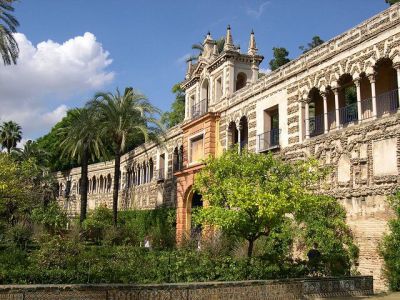
9) Real Alcazar de Sevilla (Royal Palace of Seville) (must see)
In the year 712, Seville was conquered by the Umayyad Caliphate. Then began 700 years of Arab rule in Andalusia. In 913 Abd al-Rahman III built a fort over a Visigothic church.
This construction was expanded in the 11th century by an addition called "Al Mubarak", The Blessed. Seville became the capital of Al-Andalus and there followed a period of demolishing and rebuilding until twelve palaces had been built one over the other. In 1366 Pedro I built Mudejar Palace. Ferdinand and Isabella made the top floor the royal residence.
Styles followed one another over the years until no hint remained of the original design. They refashioned with Islamic, Gothic, Romanesque and Renaissance influences. Then came Baroque, with Islamic overtones. Did we mention tiles? Majolica and arista? Ceramic tiles, Seville had more than anyone. More cigars and more tiles.
La Puerta de Leon (Lion Gate) is the main gate to the palace. It is named for the tile inlay above the entrance depicting a lion holding a cross and a banner in Latin which could be translated as "ready for anything". With all the architectural changes to the palace since 913, the scroll is true wit.
Visit the gardens. All the old Andalusian palaces had gardens which featured fruit trees, vegetables and flowers. They not only provided food but also visual and esthetic pleasure. Water was plentiful in fountains and ponds. In the 16th century the old Muslim wall was turned into a loggia to admire the view of the palace gardens.
Must see items in the palace are the patios and rooms. Some of the names are intriguing. Courtyard of the Dolls, Bedroom of the Moorish Kings, Justice Room, Prince's Room, Courtyard of the Maidens, and there are at least thirteen gardens.
This construction was expanded in the 11th century by an addition called "Al Mubarak", The Blessed. Seville became the capital of Al-Andalus and there followed a period of demolishing and rebuilding until twelve palaces had been built one over the other. In 1366 Pedro I built Mudejar Palace. Ferdinand and Isabella made the top floor the royal residence.
Styles followed one another over the years until no hint remained of the original design. They refashioned with Islamic, Gothic, Romanesque and Renaissance influences. Then came Baroque, with Islamic overtones. Did we mention tiles? Majolica and arista? Ceramic tiles, Seville had more than anyone. More cigars and more tiles.
La Puerta de Leon (Lion Gate) is the main gate to the palace. It is named for the tile inlay above the entrance depicting a lion holding a cross and a banner in Latin which could be translated as "ready for anything". With all the architectural changes to the palace since 913, the scroll is true wit.
Visit the gardens. All the old Andalusian palaces had gardens which featured fruit trees, vegetables and flowers. They not only provided food but also visual and esthetic pleasure. Water was plentiful in fountains and ponds. In the 16th century the old Muslim wall was turned into a loggia to admire the view of the palace gardens.
Must see items in the palace are the patios and rooms. Some of the names are intriguing. Courtyard of the Dolls, Bedroom of the Moorish Kings, Justice Room, Prince's Room, Courtyard of the Maidens, and there are at least thirteen gardens.
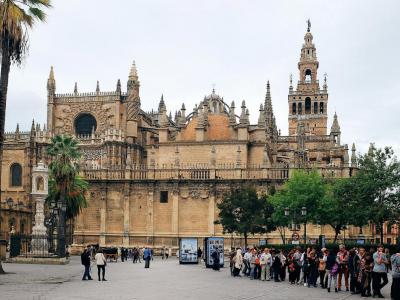
10) Seville Cathedral & Giralda Tower (must see)
The Seville Cathedral is standing on the Great Mosque. In 1248 the city was conquered by Ferdinand III. The Cathedral replaced the Mosque in the 14th century but not the minaret. The minaret is called the Giralda Tower for the weather vane at its peak. The minaret has no stairs, only ramps so the sultan could ride his horse to the top and enjoy the view.
The cathedral is accessed through the Plaza Virgen de los Reyes. It has five naves. The main nave is 118 feet high. The floor measures 380 feet long and 249 feet wide. The transept rises to 131 feet. Seville Cathedral is also known as the Cathedral of Saint Mary of the Sea. It is listed as one of UNESCO World Heritage sites since 1987.
It is told that when the church plan was presented to the church elders, they said "Let us build a church so beautiful and so grand that those who see it finished will think we are mad." Christopher Columbus and his son are buried here. When Hagia Sofia became a mosque the Cathedral of Seville became the tallest cathedral known.
The Giralda Tower was built using local bricks and scrap marble left from Umayyad construction. It was made to resemble the minaret of the Koutoubia Mosque of Marrakesh, Morocco. The tower 342 feet high and it is still one of the most memorable symbols of old Seville.
Why you should visit:
Ride the ramp up the minaret like the sultan of old and admire the city.
Tip:
Come early or go online to book the rooftop tour! You can also climb up the Giralda Tower (free on Mondays) to get an eagle's eye view of Sevilla. Don't miss the tomb of Columbus right off the altar, and consider buying the combined ticket with Divino Salvador Church, which is a marvel by itself.
The cathedral is accessed through the Plaza Virgen de los Reyes. It has five naves. The main nave is 118 feet high. The floor measures 380 feet long and 249 feet wide. The transept rises to 131 feet. Seville Cathedral is also known as the Cathedral of Saint Mary of the Sea. It is listed as one of UNESCO World Heritage sites since 1987.
It is told that when the church plan was presented to the church elders, they said "Let us build a church so beautiful and so grand that those who see it finished will think we are mad." Christopher Columbus and his son are buried here. When Hagia Sofia became a mosque the Cathedral of Seville became the tallest cathedral known.
The Giralda Tower was built using local bricks and scrap marble left from Umayyad construction. It was made to resemble the minaret of the Koutoubia Mosque of Marrakesh, Morocco. The tower 342 feet high and it is still one of the most memorable symbols of old Seville.
Why you should visit:
Ride the ramp up the minaret like the sultan of old and admire the city.
Tip:
Come early or go online to book the rooftop tour! You can also climb up the Giralda Tower (free on Mondays) to get an eagle's eye view of Sevilla. Don't miss the tomb of Columbus right off the altar, and consider buying the combined ticket with Divino Salvador Church, which is a marvel by itself.
11) Convento de la Encarnación (Convent of the Incarnation)
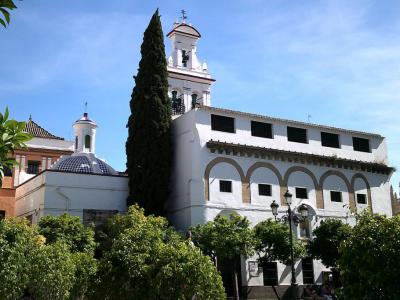
The Convent of the Incarnation (Convento de la Encarnación) is situated in the heart of Seville, right in the city center, across from the Cathedral and the Archbishop's Palace. It's nestled in the Santa Cruz neighborhood and is commonly known as the Convento de Santa Marta because it occupies the grounds of the old Hospital de Santa Marta. This convent is affiliated with the Order of Hermits of Saint Augustine, which was established in 1244.
The church itself features a single nave with ribbed vaults supported by four corbels. The presbytery has a square layout and is capped by a dome, which used to be a Moorish chapel. In the 19th century, additional rooms were added to the convent when the Augustinian community settled there.
Visitors are welcome to explore the church, but the rest of the convent is not open to the public. Adjacent to the church, you can purchase a notable item known as "Recortes de la Sagrada Forma." These are delicate, round white wafers that symbolize the Body of Christ in the Eucharist, though they are not consecrated.
The church itself features a single nave with ribbed vaults supported by four corbels. The presbytery has a square layout and is capped by a dome, which used to be a Moorish chapel. In the 19th century, additional rooms were added to the convent when the Augustinian community settled there.
Visitors are welcome to explore the church, but the rest of the convent is not open to the public. Adjacent to the church, you can purchase a notable item known as "Recortes de la Sagrada Forma." These are delicate, round white wafers that symbolize the Body of Christ in the Eucharist, though they are not consecrated.
12) Palacio Arzobispal (Archbishop's Palace)
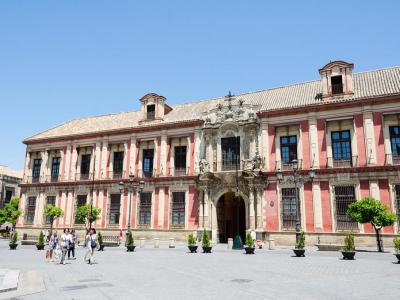
The Archbishop’s Palace stands beside Seville Cathedral in Square of the Virgin of the Kings, forming part of one of the city’s most historic spaces. The building has served for centuries as the residence of Seville’s bishops and archbishops, as well as an administrative centre of the archdiocese.
The origins of the palace date back to the period following the Christian reconquest of Seville in 1248, when church authorities established their headquarters near the newly consecrated cathedral. The complex expanded over the following centuries and underwent several reconstructions, particularly during the 16th and 17th centuries when Seville flourished as Spain’s principal trading port with the Americas. The building visible today largely reflects 18th-century Spanish Baroque renovations. Its richly decorated red façade and ornate entrance portal make it one of the most colourful historic buildings in the city. In recognition of its cultural importance, the palace was declared a National Monument in 1969.
Inside, the palace preserves an important artistic heritage. Its halls, staircases, and courtyards display paintings and sculptures from the Seville Baroque period, forming one of the city’s most notable collections of religious art—surpassed only by those of the Museum of Fine Arts and Seville Cathedral. Works by painters such as Francisco de Zurbarán, Bartolomé Esteban Murillo, and Francisco Pacheco are displayed alongside pieces from Italian and Dutch Baroque schools.
After many years of restricted access, visitors can now explore parts of the palace, though all visits must be guided. Standing outside in the square, tourists can also admire the striking contrast between the palace’s vibrant Baroque façade and the massive Gothic walls of the nearby cathedral.
The origins of the palace date back to the period following the Christian reconquest of Seville in 1248, when church authorities established their headquarters near the newly consecrated cathedral. The complex expanded over the following centuries and underwent several reconstructions, particularly during the 16th and 17th centuries when Seville flourished as Spain’s principal trading port with the Americas. The building visible today largely reflects 18th-century Spanish Baroque renovations. Its richly decorated red façade and ornate entrance portal make it one of the most colourful historic buildings in the city. In recognition of its cultural importance, the palace was declared a National Monument in 1969.
Inside, the palace preserves an important artistic heritage. Its halls, staircases, and courtyards display paintings and sculptures from the Seville Baroque period, forming one of the city’s most notable collections of religious art—surpassed only by those of the Museum of Fine Arts and Seville Cathedral. Works by painters such as Francisco de Zurbarán, Bartolomé Esteban Murillo, and Francisco Pacheco are displayed alongside pieces from Italian and Dutch Baroque schools.
After many years of restricted access, visitors can now explore parts of the palace, though all visits must be guided. Standing outside in the square, tourists can also admire the striking contrast between the palace’s vibrant Baroque façade and the massive Gothic walls of the nearby cathedral.
13) Iglesia de Santa Cruz (Church of the Holy Cross)
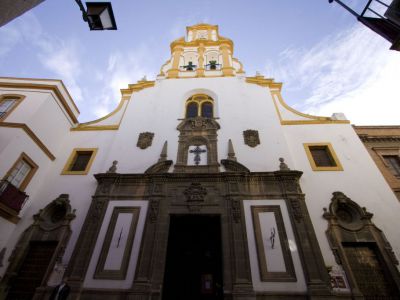
The Church of the Holy Cross stands on Mateos Gago Street, just a short walk from the cathedral in the historic Holy Cross Neighborhood. While it bears the name of the district's central square, it is not actually located within it; rather, it occupies the site of the former Convent of the Holy Spirit. The church is deeply connected to the history of the area, which once formed the Jewish quarter of medieval Seville. Today, it serves as the headquarters of the Brotherhood of the Holy Cross, a prominent religious confraternity.
Construction of the building began in 1655 and was completed in 1672 to serve the Minor Clerics, only becoming the parish church of the Holy Cross in the 19th century after the original church in the nearby square was demolished. The main chapel, designed by architect José Tirado, was added in 1728. The interior features three naves and a magnificent altarpiece from 1735. Neoclassical refinements continued into the late 18th century, including the installation of 46 choir stalls made of mahogany and pine in 1800, salvaged from the Convent of Saint Augustine.
After centuries of appearing unfinished and plain, it was enhanced with a Neo-Baroque façade between 1926 and 1929 by architect Juan Talavera y Heredia, giving the building its current decorative character.
While the church itself sits on a bustling street, Holy Cross Square remains a peaceful retreat nearby. Shaded by orange trees and centered around a famous 17th-century wrought-iron cross, the square marks the site where the original church once stood and where the painter Bartolomé Esteban Murillo is buried.
Construction of the building began in 1655 and was completed in 1672 to serve the Minor Clerics, only becoming the parish church of the Holy Cross in the 19th century after the original church in the nearby square was demolished. The main chapel, designed by architect José Tirado, was added in 1728. The interior features three naves and a magnificent altarpiece from 1735. Neoclassical refinements continued into the late 18th century, including the installation of 46 choir stalls made of mahogany and pine in 1800, salvaged from the Convent of Saint Augustine.
After centuries of appearing unfinished and plain, it was enhanced with a Neo-Baroque façade between 1926 and 1929 by architect Juan Talavera y Heredia, giving the building its current decorative character.
While the church itself sits on a bustling street, Holy Cross Square remains a peaceful retreat nearby. Shaded by orange trees and centered around a famous 17th-century wrought-iron cross, the square marks the site where the original church once stood and where the painter Bartolomé Esteban Murillo is buried.
14) Jardines de los Reales Alcazares (Royal Palace Gardens) (must see)
The gardens of the Royal Palace of Seville are the grandest late- medieval gardens anywhere in Europe and possibly, the world. After 1248, the year of the Christian Reconquista of Andalusia, the craftsmen and artisans of Seville developed the style known as Mudejar. "Mudejar" means "allowed to stay." The Moorish styles remained.
During the 16th century Seville was the richest city in Spain. The designers of Charles V focused on Renaissance styles when creating follies and gardens. The old garden spaces remained but the pavilions, gazebos and labyrinths were another matter. The alcazar gardens of Peter I enclosed pools, fountains, and niches of glazed tiles.
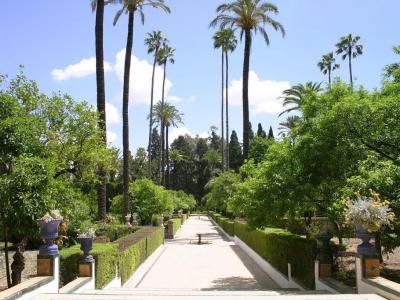
The plantings of the gardens include palms, cypress, myrtle, berries, magnolia and citrus trees. When the orange trees drop their oranges, the air is filled with the scent of jasmine and oranges. The Alcazar gardens are a cluster of mazes, pools and intimate paths, palm trees and fountains. It is almost too much sweetness to bear.
During the 16th century Seville was the richest city in Spain. The designers of Charles V focused on Renaissance styles when creating follies and gardens. The old garden spaces remained but the pavilions, gazebos and labyrinths were another matter. The alcazar gardens of Peter I enclosed pools, fountains, and niches of glazed tiles.
The plantings of the gardens include palms, cypress, myrtle, berries, magnolia and citrus trees. When the orange trees drop their oranges, the air is filled with the scent of jasmine and oranges. The Alcazar gardens are a cluster of mazes, pools and intimate paths, palm trees and fountains. It is almost too much sweetness to bear.
15) Plaza de Espana (Spain Square) (must see)
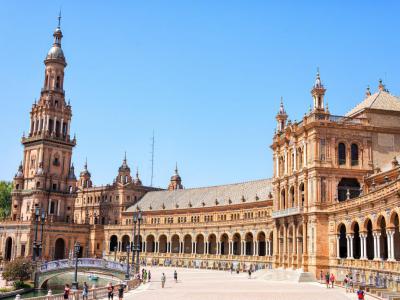
Some say Seville was founded by Hercules. Hercules could not be reached for verification. Waves of Carthaginians, Romans, Goths, Vandals, and Moors have seen Seville since Hercules. None of them have seen the Spain Square.
The square is situated at the edge of Maria Louisa Park, Seville's largest green area. In 1914 Anibal Gonzales, architect, began work in preparation for the Ibero-American Exposition of 1929. Using the styles of Art Deco and Spanish Renaissance Revival, Spanish Baroque Revival and Neo-Mudejar, Anibal created the Spain Square.
The square is embraced by a semi-circle of exotic buildings and towers bordering a moat. The moat encloses a vast open space. In the center of the space is the Vicente Traver fountain. The buildings are reached by four bridges that stretch over the moat. Take a boat ride in the moat and view the square around you. It's like floating in a dream.
The four bridges represent Castile, Leon, Aragon, and Navarre, the four ancient kingdoms of Spain. Around the edges of the square are 52 niches or alcoves. Each is a tiny pavilion of colorful azulejo tiles, depicting a province of Spain. Each alcove has shelves used as a lending library, offering books on the provinces.
The Ibero-American Exposition was meant to show a reconciliation between Spain and her former American colonies and territories. There was a great need to build a modern state and reestablish economic and cultural ties to the New World. The square holds this vision of a glorious past and a promising future, embracing it in the heart of Spain.
Why you should visit:
To experience the soul and grandeur of this city.
The square is situated at the edge of Maria Louisa Park, Seville's largest green area. In 1914 Anibal Gonzales, architect, began work in preparation for the Ibero-American Exposition of 1929. Using the styles of Art Deco and Spanish Renaissance Revival, Spanish Baroque Revival and Neo-Mudejar, Anibal created the Spain Square.
The square is embraced by a semi-circle of exotic buildings and towers bordering a moat. The moat encloses a vast open space. In the center of the space is the Vicente Traver fountain. The buildings are reached by four bridges that stretch over the moat. Take a boat ride in the moat and view the square around you. It's like floating in a dream.
The four bridges represent Castile, Leon, Aragon, and Navarre, the four ancient kingdoms of Spain. Around the edges of the square are 52 niches or alcoves. Each is a tiny pavilion of colorful azulejo tiles, depicting a province of Spain. Each alcove has shelves used as a lending library, offering books on the provinces.
The Ibero-American Exposition was meant to show a reconciliation between Spain and her former American colonies and territories. There was a great need to build a modern state and reestablish economic and cultural ties to the New World. The square holds this vision of a glorious past and a promising future, embracing it in the heart of Spain.
Why you should visit:
To experience the soul and grandeur of this city.
16) Parque de María Luisa (María Luisa Park) (must see)
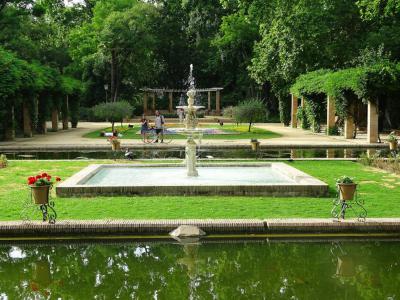
You shouldn't miss a visit to María Luisa Park before leaving Seville. It's a stunning location that stretches along the Guadalquivir River and serves as the city's main green space. Most of the park used to be the gardens of the Palace of San Telmo. In 1893, Infanta Luisa Fernanda, Duchess of Montpensier, generously donated these grounds to the city of Seville to create a public park. The gardens, as we see them today, were redesigned by Jean-Claude Nicolas Forestier, starting in 1911. Subsequently, the park played a crucial role in the Ibero-American Exposition of 1929, contributing to its impressive architectural setting.
To prepare for the exhibition, the entire southern part of the city underwent redevelopment, transforming into an expansive area filled with gardens and grand boulevards. At its heart lies the Parque de María Luisa, designed in a "Moorish paradise style" and featuring a half-mile of tiled fountains, pavilions, walls, ponds, benches, and exedras. You'll find abundant plantings of palms, orange trees, Mediterranean pines, and carefully designed flower beds, some of which are hidden by vines.
María Luisa Park also serves as a botanical garden, showcasing a wide variety of plant species, both native and exotic, with informative panels to educate visitors. The park is home to numerous bird species, particularly doves (so much so that a part of Plaza de América is known as "Parque de las Palomas" or Dove Park). Additionally, you'll spot green parrots living in the park's center, as well as ducks and swans in the fountains and lakes.
Why You Should Visit:
The historic buildings, sculptures, and water features make this a unique work of garden landscaping and leafy beauty. There is always something new to explore or do!
At various points, you can join different experiences, such as feeding the birds (Plaza de America), riding a bike (including family cycles), or entertaining yourself taking photos of the incomparable Plaza de España.
Tip:
Make sure you visit during the "golden hour" when the light is the most beautiful in Sevilla (in July it would be around 8-9pm)!
To prepare for the exhibition, the entire southern part of the city underwent redevelopment, transforming into an expansive area filled with gardens and grand boulevards. At its heart lies the Parque de María Luisa, designed in a "Moorish paradise style" and featuring a half-mile of tiled fountains, pavilions, walls, ponds, benches, and exedras. You'll find abundant plantings of palms, orange trees, Mediterranean pines, and carefully designed flower beds, some of which are hidden by vines.
María Luisa Park also serves as a botanical garden, showcasing a wide variety of plant species, both native and exotic, with informative panels to educate visitors. The park is home to numerous bird species, particularly doves (so much so that a part of Plaza de América is known as "Parque de las Palomas" or Dove Park). Additionally, you'll spot green parrots living in the park's center, as well as ducks and swans in the fountains and lakes.
Why You Should Visit:
The historic buildings, sculptures, and water features make this a unique work of garden landscaping and leafy beauty. There is always something new to explore or do!
At various points, you can join different experiences, such as feeding the birds (Plaza de America), riding a bike (including family cycles), or entertaining yourself taking photos of the incomparable Plaza de España.
Tip:
Make sure you visit during the "golden hour" when the light is the most beautiful in Sevilla (in July it would be around 8-9pm)!
