Custom Walk in Santorini, Greece by castello_edna25_c85b88 created on 2026-04-18
Guide Location: Greece » Santorini
Guide Type: Custom Walk
# of Sights: 8
Tour Duration: 7 Hour(s)
Travel Distance: 20.3 Km or 12.6 Miles
Share Key: 4PVY4
Guide Type: Custom Walk
# of Sights: 8
Tour Duration: 7 Hour(s)
Travel Distance: 20.3 Km or 12.6 Miles
Share Key: 4PVY4
How It Works
Please retrieve this walk in the GPSmyCity app. Once done, the app will guide you from one tour stop to the next as if you had a personal tour guide. If you created the walk on this website or come to the page via a link, please follow the instructions below to retrieve the walk in the app.
Retrieve This Walk in App
Step 1. Download the app "GPSmyCity: Walks in 1K+ Cities" on Apple App Store or Google Play Store.



Step 2. In the GPSmyCity app, download(or launch) the guide "Santorini Map and Walking Tours".
Step 3. Tap the menu button located at upper right corner of the "Walks" screen and select "Retrieve custom walk". Enter the share key: 4PVY4
1) 25 Martiou Street
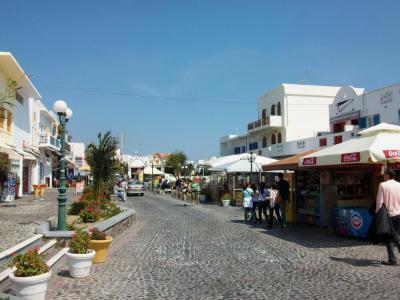
25 Martiou Street is one of the main commercial arteries of Fira, functioning as a central corridor for both daily services and visitor activity. It intersects with Theotokopoulou Square, the town’s principal civic and transport hub, where banks, pharmacies, and the bus and taxi terminals are located. This connection makes the street an essential link between public transport and the surrounding commercial and residential areas.
Running inland rather than along the caldera, the street connects the central square with the upper parts of town and forms part of the natural route toward Firostefani and Imerovigli settlements. Lined with jewelry shops, clothing boutiques, bakeries, travel agencies, and souvenir stores, it supports a broad mix of local needs and tourism-related commerce.
Although often described as a walking street, 25 Martiou is not fully pedestrianized year-round. It is a paved road that allows vehicle access, but car traffic is typically restricted during the summer months to manage heavy pedestrian flow. As a result, it functions in practice as one of Fira’s main walking routes, particularly for visitors moving between the transport hub and the town center.
Architecturally, the street reflects the functional side of Cycladic urban life. Whitewashed facades and commercial shopfronts define its appearance, rather than continuous scenic viewpoints. While blue domes are a widely recognized symbol of Santorini, they are less characteristic here, appearing more often on nearby churches and along the caldera edge. Instead, 25 Martiou Street offers a grounded view of contemporary island life, where commerce, movement, and routine intersect at the heart of Fira.
Running inland rather than along the caldera, the street connects the central square with the upper parts of town and forms part of the natural route toward Firostefani and Imerovigli settlements. Lined with jewelry shops, clothing boutiques, bakeries, travel agencies, and souvenir stores, it supports a broad mix of local needs and tourism-related commerce.
Although often described as a walking street, 25 Martiou is not fully pedestrianized year-round. It is a paved road that allows vehicle access, but car traffic is typically restricted during the summer months to manage heavy pedestrian flow. As a result, it functions in practice as one of Fira’s main walking routes, particularly for visitors moving between the transport hub and the town center.
Architecturally, the street reflects the functional side of Cycladic urban life. Whitewashed facades and commercial shopfronts define its appearance, rather than continuous scenic viewpoints. While blue domes are a widely recognized symbol of Santorini, they are less characteristic here, appearing more often on nearby churches and along the caldera edge. Instead, 25 Martiou Street offers a grounded view of contemporary island life, where commerce, movement, and routine intersect at the heart of Fira.
2) Panagia Theoskepasti Chapel
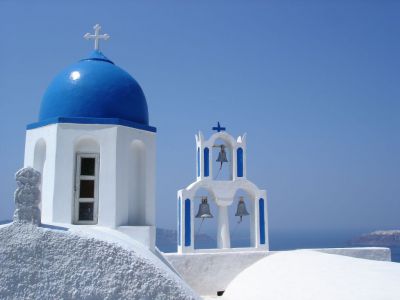
One of Santorini's symbols, the Chapel of Panagia Theoskepasti, is located near the port of Andres, on Skaros Rock, a rocky peninsula that projects into the sea. It was fashioned by multiple volcanoes that changed the shape of the island from circular to crescent. In addition, many other islands were also formed from these volcanoes. The rock was also the site of a castle until an earthquake destroyed the building in the 19th century.
The white building with a blue dome housing the church is open during the day until 4pm, free for anyone to visit. Moreover, the village of Imerovigli has some of the best views of Santorini because of its high vantage point. Visitors can reach the church via the nearby walking trail that begins at Imerovigli and runs through the cape that connects Skaros to the village. The trail ends at the Chapel of Theoskepasti. There is also a stunning underwater caldera that is worth the wait. Once you have visited the church, make sure to see the Hidden Room. The cave sits to the right of the trail and is one of the few elements that remain from the original castle structure.
Tip:
Weekend morning chanting begins at 7am and is broadcasted via loudspeakers to the entire district for hours.
The white building with a blue dome housing the church is open during the day until 4pm, free for anyone to visit. Moreover, the village of Imerovigli has some of the best views of Santorini because of its high vantage point. Visitors can reach the church via the nearby walking trail that begins at Imerovigli and runs through the cape that connects Skaros to the village. The trail ends at the Chapel of Theoskepasti. There is also a stunning underwater caldera that is worth the wait. Once you have visited the church, make sure to see the Hidden Room. The cave sits to the right of the trail and is one of the few elements that remain from the original castle structure.
Tip:
Weekend morning chanting begins at 7am and is broadcasted via loudspeakers to the entire district for hours.
3) Agios Nikolaos Monastery
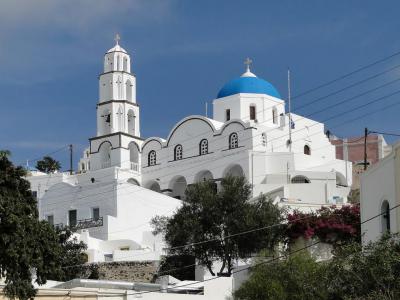
Located in the stunning and blue waters of the Aegean Sea is the Agios Nikolaos Monastery. This female convent is located between the villages of Firostefani and Imerovogli in Santorini. It is dedicated to saints Agios Panteleimon, Agios Nikolaos, and Zoodochos Pigi, and was established by the Gizi family in 1651. Prior to its current use, it was a private family chapel.
The design of the nunnery reflects the clean and simple lines of Cycladic style, while the interior of the edifice features beautiful 17th century artwork and spectacular golden icons. Two museums, folklore and ecclesiastical, are also located on the property.
Each year on August 15th, locals come here to celebrate the religious festival the Feast of the Assumption of the Virgin Mary. After church services, locals and visitors celebrate the holiday with food, song, and dance. Visitors will enjoy viewing the handmade textiles that the nuns make, using hand looms.
The design of the nunnery reflects the clean and simple lines of Cycladic style, while the interior of the edifice features beautiful 17th century artwork and spectacular golden icons. Two museums, folklore and ecclesiastical, are also located on the property.
Each year on August 15th, locals come here to celebrate the religious festival the Feast of the Assumption of the Virgin Mary. After church services, locals and visitors celebrate the holiday with food, song, and dance. Visitors will enjoy viewing the handmade textiles that the nuns make, using hand looms.
4) Firostefani Central Square
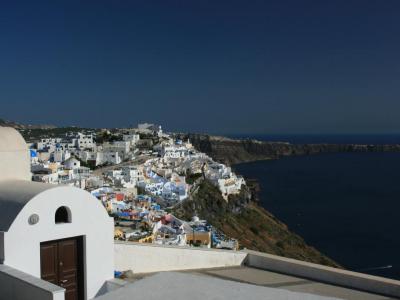
Firostefani Central Square in Santorini offers a quaint and charming spot in the picturesque neighborhood of Firostefani, just a short distance from the bustling town of Fira. Although it might not resemble a typical town square, this small area serves as a delightful gathering spot right next to the main road, making it an excellent stop for both locals and visitors.
This central square is surrounded by the quintessential white-washed buildings adorned with vibrant bougainvillea, reflecting the traditional Greek architectural style that Santorini is famous for. Its prime location on the edge of the caldera provides visitors with breathtaking panoramic views of the volcanic landscape and the deep blue Aegean Sea, making it a perfect vantage point for enjoying the island's natural beauty.
The area around Firostefani Central Square is brimming with a variety of eateries, including local cafés and restaurants that offer delicious local cuisine and a great selection of wines and other beverages. It's an ideal spot for those looking to grab a quick bite or enjoy a leisurely meal while soaking in the scenic views.
Tourists can also explore the narrow, cobbled streets lined with boutique shops, local tavernas, and charming cafes, adding to the square's laid-back ambiance. The square often hosts local events and festivals, providing a glimpse into the authentic culture of the island.
Firostefani Central Square's proximity to notable attractions, such as the Old Port of Fira and Skala, as well as cultural landmarks like the Agios Gerasimos Church and the Archaeological Museum of Thera, makes it a convenient and appealing destination for those seeking both relaxation and cultural exploration on the beautiful island of Santorini.
This central square is surrounded by the quintessential white-washed buildings adorned with vibrant bougainvillea, reflecting the traditional Greek architectural style that Santorini is famous for. Its prime location on the edge of the caldera provides visitors with breathtaking panoramic views of the volcanic landscape and the deep blue Aegean Sea, making it a perfect vantage point for enjoying the island's natural beauty.
The area around Firostefani Central Square is brimming with a variety of eateries, including local cafés and restaurants that offer delicious local cuisine and a great selection of wines and other beverages. It's an ideal spot for those looking to grab a quick bite or enjoy a leisurely meal while soaking in the scenic views.
Tourists can also explore the narrow, cobbled streets lined with boutique shops, local tavernas, and charming cafes, adding to the square's laid-back ambiance. The square often hosts local events and festivals, providing a glimpse into the authentic culture of the island.
Firostefani Central Square's proximity to notable attractions, such as the Old Port of Fira and Skala, as well as cultural landmarks like the Agios Gerasimos Church and the Archaeological Museum of Thera, makes it a convenient and appealing destination for those seeking both relaxation and cultural exploration on the beautiful island of Santorini.
5) Three Bells of Fira (must see)
The Three Bells of Fira, officially known as the Catholic Church of the Dormition, belongs to the Greek Catholic Church and falls under the jurisdiction of the Catholic Diocese of Santorini, following the Byzantine liturgical tradition while remaining in communion with Rome.
The site has a long and layered history. In the 17th century, two small cave churches were carved into the cliff face here. As the settlement expanded and the terrain shifted, these early structures were lost. An infirmary was later built on the site and subsequently occupied by Jesuits, before the property was transferred to the Catholic authorities. The present-day church was constructed in 1757, forming the core of the structure seen today.
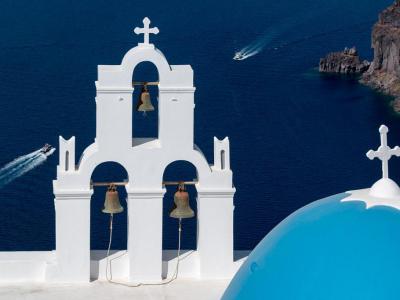
The church suffered serious damage during the 1956 Amorgos earthquake. Extensive restoration followed, giving the building its current appearance. Architecturally modest in scale, its visual impact comes from its setting and composition: whitewashed walls, a vivid blue dome, and a freestanding bell tower crowned with three bells. The bell tower, positioned slightly apart from the church itself, overlooks the caldera and the Nea Kameni volcanic islet.
The church is dedicated to the Dormition of the Virgin Mary, celebrated on 15 August, which remains its principal feast day. On this occasion, religious services and observances are held in keeping with Byzantine Catholic tradition.
Today, the Three Bells of Fira functions both as an active place of worship and as one of the island’s most photographed viewpoints. Its best-known view is from the clifftop viewpoint and parking area above the church, from where the dome and bell tower are seen framed against the sea and sky.
The site has a long and layered history. In the 17th century, two small cave churches were carved into the cliff face here. As the settlement expanded and the terrain shifted, these early structures were lost. An infirmary was later built on the site and subsequently occupied by Jesuits, before the property was transferred to the Catholic authorities. The present-day church was constructed in 1757, forming the core of the structure seen today.
The church suffered serious damage during the 1956 Amorgos earthquake. Extensive restoration followed, giving the building its current appearance. Architecturally modest in scale, its visual impact comes from its setting and composition: whitewashed walls, a vivid blue dome, and a freestanding bell tower crowned with three bells. The bell tower, positioned slightly apart from the church itself, overlooks the caldera and the Nea Kameni volcanic islet.
The church is dedicated to the Dormition of the Virgin Mary, celebrated on 15 August, which remains its principal feast day. On this occasion, religious services and observances are held in keeping with Byzantine Catholic tradition.
Today, the Three Bells of Fira functions both as an active place of worship and as one of the island’s most photographed viewpoints. Its best-known view is from the clifftop viewpoint and parking area above the church, from where the dome and bell tower are seen framed against the sea and sky.
6) St. John the Baptist Cathedral (must see)
The Catholic Cathedral of Saint John the Baptist stands out as the principal Roman Catholic church on the island. Originally established in the 17th century during the period of Venetian influence, it reflects the Catholic presence fostered by Western religious orders, including the Jesuits. Like many buildings on Santorini, it was repeatedly affected by seismic activity. The structure seen today dates from a reconstruction completed in 1975, carried out in a restrained, Baroque-inspired style.
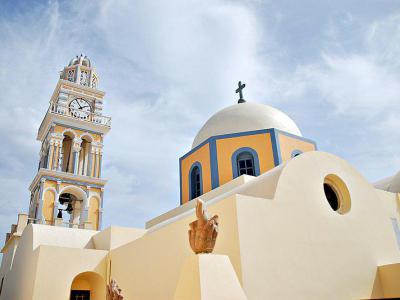
Approaching the cathedral, notice the peach-colored facade, which immediately distinguishes it from the island’s predominantly whitewashed Orthodox churches. The clock tower and bell tower, rising just to one side, serve as an easy visual marker from nearby streets.
As you step inside, pause near the entrance. To one side, you’ll find the confessional, a feature typical of Catholic churches but rarely encountered elsewhere on the island. Moving forward into the nave, your eye is naturally drawn toward the main altar, positioned beneath the dome and arranged according to Western liturgical tradition rather than behind an iconostasis.
Lift your gaze upward to the central chandelier, suspended below the dome. Its placement reinforces the height of the space and acts as the visual center of the interior. Above the altar, a large religious painting forms the focal point of the sanctuary, framed by soft blue, cream, and warm-toned surfaces that emphasize light and balance over heavy ornamentation. Along the side walls, look for a series of framed devotional paintings and portraits of saints, arranged in a clear, orderly sequence.
The cathedral remains an active place of worship, serving both local parishioners and visitors. Sunday Mass is regularly held, often attended by an international congregation, with parts of the service occasionally offered in multiple languages depending on those present. Visitors are expected to dress modestly and maintain a respectful atmosphere, especially during services.
Outside, the surrounding streets form part of Fira’s compact commercial center, with small shops, cafes, and casual eateries unfolding just beyond the church-an everyday setting that contrasts with the quiet, ordered interior you have just explored.
Approaching the cathedral, notice the peach-colored facade, which immediately distinguishes it from the island’s predominantly whitewashed Orthodox churches. The clock tower and bell tower, rising just to one side, serve as an easy visual marker from nearby streets.
As you step inside, pause near the entrance. To one side, you’ll find the confessional, a feature typical of Catholic churches but rarely encountered elsewhere on the island. Moving forward into the nave, your eye is naturally drawn toward the main altar, positioned beneath the dome and arranged according to Western liturgical tradition rather than behind an iconostasis.
Lift your gaze upward to the central chandelier, suspended below the dome. Its placement reinforces the height of the space and acts as the visual center of the interior. Above the altar, a large religious painting forms the focal point of the sanctuary, framed by soft blue, cream, and warm-toned surfaces that emphasize light and balance over heavy ornamentation. Along the side walls, look for a series of framed devotional paintings and portraits of saints, arranged in a clear, orderly sequence.
The cathedral remains an active place of worship, serving both local parishioners and visitors. Sunday Mass is regularly held, often attended by an international congregation, with parts of the service occasionally offered in multiple languages depending on those present. Visitors are expected to dress modestly and maintain a respectful atmosphere, especially during services.
Outside, the surrounding streets form part of Fira’s compact commercial center, with small shops, cafes, and casual eateries unfolding just beyond the church-an everyday setting that contrasts with the quiet, ordered interior you have just explored.
7) Orthodox Metropolitan Cathedral
The Orthodox Metropolitan Cathedral of Thera, also known as the Cathedral of Ypapanti, is the island’s principal Orthodox church. An earlier cathedral occupied this site in the 19th century, but the structure you see today was rebuilt after the devastating earthquake of 1956, which destroyed much of Fira. The reconstruction combined traditional Orthodox forms with mid-20th-century building techniques.
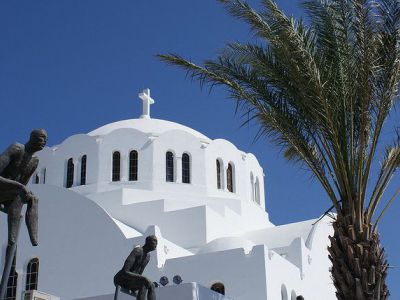
From the outside, focus first on the arched arcades that frame the facade. Above them rises the central dome, while the bell tower, set slightly apart, adds vertical emphasis to the composition. Together, these elements create a layered silhouette that is visible from several points along the caldera.
Now step inside and pause near the entrance. Greek Orthodox churches rely on iconography, wall paintings, and carefully structured use of light, rather than stained glass. As your eyes adjust, look toward the upper walls and ceiling, where frescoes by the local artist Christoforos Asimis unfold. His work reflects modern Orthodox painting while remaining firmly rooted in traditional themes and iconographic order.
Move your gaze upward toward the central chandelier, which hangs beneath the dome. Nearby, notice the mosaics added in 1975. The cathedral remains an active place of worship, and visitors are welcome outside of services. Modest dress is required, with shoulders and knees covered, and a respectful atmosphere is expected, especially during religious observances.
From the outside, focus first on the arched arcades that frame the facade. Above them rises the central dome, while the bell tower, set slightly apart, adds vertical emphasis to the composition. Together, these elements create a layered silhouette that is visible from several points along the caldera.
Now step inside and pause near the entrance. Greek Orthodox churches rely on iconography, wall paintings, and carefully structured use of light, rather than stained glass. As your eyes adjust, look toward the upper walls and ceiling, where frescoes by the local artist Christoforos Asimis unfold. His work reflects modern Orthodox painting while remaining firmly rooted in traditional themes and iconographic order.
Move your gaze upward toward the central chandelier, which hangs beneath the dome. Nearby, notice the mosaics added in 1975. The cathedral remains an active place of worship, and visitors are welcome outside of services. Modest dress is required, with shoulders and knees covered, and a respectful atmosphere is expected, especially during religious observances.
8) Akrotiri Lighthouse
The Akrotiri Lighthouse, located on the southwestern tip of Santorini, is one of the island's most beautiful and historically significant landmarks. Built in 1892 by a French trading company, it is one of the oldest lighthouses in Greece. Initially powered by petrol fuel and manually operated, the lighthouse transitioned to electricity in 1893. Although it ceased operation during World War II, it was recommissioned by the Greek Navy in 1945 and remains operational today.
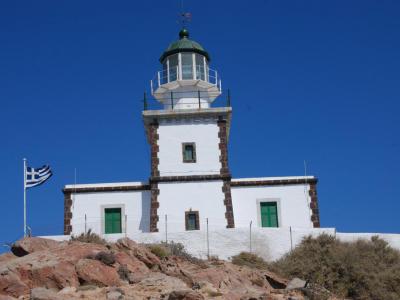
Perched atop a high cliff, the lighthouse stands 10 meters tall, above a whitewashed building that once housed the warden. The structure emits a bright white light every 10 seconds, continuing its vital role in ensuring the safety of maritime traffic. The surrounding village of Akrotiri is a tranquil spot, located 5 kilometers from the village center and a 26-minute drive from Fira Town, Santorini’s bustling hub.
The lighthouse is renowned for its stunning sunset views, where visitors can watch the sun dip into the Aegean Sea, creating a breathtaking romantic atmosphere. The site offers panoramic vistas of the sea, the impressive Santorini volcano, and the caldera cliffs dotted with picturesque villages.
A visit to the Akrotiri Lighthouse is often complemented by exploring the nearby Excavations of Akrotiri and the distinctive Red Beach, known for its unique color. The combination of historical significance, natural beauty, and captivating sunset views makes the Akrotiri Lighthouse a must-visit destination on the island of Santorini.
Perched atop a high cliff, the lighthouse stands 10 meters tall, above a whitewashed building that once housed the warden. The structure emits a bright white light every 10 seconds, continuing its vital role in ensuring the safety of maritime traffic. The surrounding village of Akrotiri is a tranquil spot, located 5 kilometers from the village center and a 26-minute drive from Fira Town, Santorini’s bustling hub.
The lighthouse is renowned for its stunning sunset views, where visitors can watch the sun dip into the Aegean Sea, creating a breathtaking romantic atmosphere. The site offers panoramic vistas of the sea, the impressive Santorini volcano, and the caldera cliffs dotted with picturesque villages.
A visit to the Akrotiri Lighthouse is often complemented by exploring the nearby Excavations of Akrotiri and the distinctive Red Beach, known for its unique color. The combination of historical significance, natural beauty, and captivating sunset views makes the Akrotiri Lighthouse a must-visit destination on the island of Santorini.
