Custom Walk in Oslo, Norway by johnfuller301_f2c37 created on 2026-04-25
Guide Location: Norway » Oslo
Guide Type: Custom Walk
# of Sights: 11
Tour Duration: 3 Hour(s)
Travel Distance: 4.9 Km or 3 Miles
Share Key: 79DQC
Guide Type: Custom Walk
# of Sights: 11
Tour Duration: 3 Hour(s)
Travel Distance: 4.9 Km or 3 Miles
Share Key: 79DQC
How It Works
Please retrieve this walk in the GPSmyCity app. Once done, the app will guide you from one tour stop to the next as if you had a personal tour guide. If you created the walk on this website or come to the page via a link, please follow the instructions below to retrieve the walk in the app.
Retrieve This Walk in App
Step 1. Download the app "GPSmyCity: Walks in 1K+ Cities" on Apple App Store or Google Play Store.



Step 2. In the GPSmyCity app, download(or launch) the guide "Oslo Map and Walking Tours".
Step 3. Tap the menu button located at upper right corner of the "Walks" screen and select "Retrieve custom walk". Enter the share key: 79DQC
1) Honnorbrygga Cruise Port
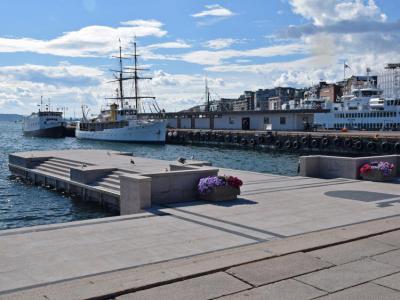
Oslo Cruise Port serves as a vital gateway for cruise passengers eager to explore the cultural richness and natural beauty of Norway. Nestled at the end of the breathtaking Oslofjord, the cruise terminal offers travelers a spectacular introduction to the country's stunning landscapes even before they set foot on shore.
Upon arrival at Oslo Cruise Port, passengers typically dock at one of the four piers located on the Akershus Fortress side. The cruise terminal building at Akershus offers essential facilities such as a coffee shop, tourist information, currency exchange, Wi-Fi, souvenir shops, and taxis, ensuring passengers have everything they need for a comfortable and convenient visit. Additionally, the close proximity of the terminal piers to the city center allows travelers easy access to Oslo's main attractions, whether by foot, public transport, or guided excursions.
Oslo Cruise Port's strategic location makes it effortless for passengers to explore the city's vibrant culture, historic landmarks, and scenic waterfront promenades. Within a short walking distance from the port, visitors can immerse themselves in Oslo's bustling city center or opt for a leisurely stroll along the picturesque Harbour Promenade, which offers captivating views of the surrounding area. With an array of public transportation options available, including sightseeing buses and trams, exploring Oslo's attractions from the cruise port is convenient and hassle-free, allowing passengers to make the most of their time ashore.
Upon arrival at Oslo Cruise Port, passengers typically dock at one of the four piers located on the Akershus Fortress side. The cruise terminal building at Akershus offers essential facilities such as a coffee shop, tourist information, currency exchange, Wi-Fi, souvenir shops, and taxis, ensuring passengers have everything they need for a comfortable and convenient visit. Additionally, the close proximity of the terminal piers to the city center allows travelers easy access to Oslo's main attractions, whether by foot, public transport, or guided excursions.
Oslo Cruise Port's strategic location makes it effortless for passengers to explore the city's vibrant culture, historic landmarks, and scenic waterfront promenades. Within a short walking distance from the port, visitors can immerse themselves in Oslo's bustling city center or opt for a leisurely stroll along the picturesque Harbour Promenade, which offers captivating views of the surrounding area. With an array of public transportation options available, including sightseeing buses and trams, exploring Oslo's attractions from the cruise port is convenient and hassle-free, allowing passengers to make the most of their time ashore.
2) Pipervika
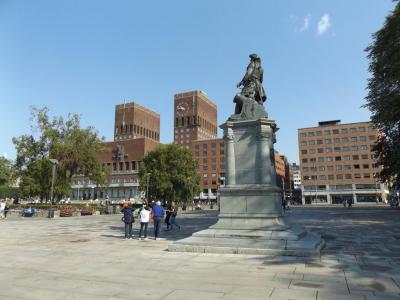
Pipervika stands as a well-liked district within Oslo, forming a connecting link between Aker Brygge and Akershus Fortress. Apart from the age-old structures and the captivating vista of the bay, one also has the opportunity to embark on a ferry journey to the Bygdøy peninsula, encompassing a round-trip duration of approximately 20 minutes. In the present day, the term Pipervika predominantly designates the bay situated between the fortress and Aker Brygge, a location formerly referred to as Piperviksbukta. This locale is an integral part of the Fjord City urban rejuvenation initiative.
The initial part of the name is believed to harken back to the pipers (flutists) of the brigade music who were stationed in the vicinity. The latter segment represents the definitive form of 'bay' or 'inlet'. However, the bay's Norse denomination was Gyljandi, stemming from the verb 'gylja' which means 'howl' or 'shout' – likely alluding to the blustery conditions in the bay. The appellation Pipervika, meaning 'the piping bay', could hence be perceived as a form of translation from Norse to Danish that occurred during the 17th century. (In Scandinavian languages, the term 'pipe' is often utilized to depict the sound of forceful winds.)
The initial part of the name is believed to harken back to the pipers (flutists) of the brigade music who were stationed in the vicinity. The latter segment represents the definitive form of 'bay' or 'inlet'. However, the bay's Norse denomination was Gyljandi, stemming from the verb 'gylja' which means 'howl' or 'shout' – likely alluding to the blustery conditions in the bay. The appellation Pipervika, meaning 'the piping bay', could hence be perceived as a form of translation from Norse to Danish that occurred during the 17th century. (In Scandinavian languages, the term 'pipe' is often utilized to depict the sound of forceful winds.)
3) Christiania Torv
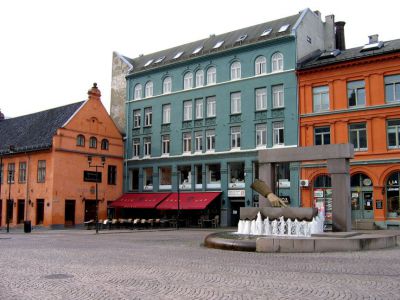
Christiania Square (Christiania Torv) stands as a captivating hub within the historic city, showcasing its architectural charm. Positioned 300 meters to the east of the Town Hall square, it has a rich history woven into its fabric.
Following a major fire in 1624 near Akershus Fortress, King Christian IV ordered a new fortification, the counterscarp, on the ruins. This led to new quarters in the east, forming a city named Christiania after the king. The central square, initially called Kvadraturen for its shape, was renamed in 1958 to honor the previous name of the Norwegian capital.
From 1639 to 1641, the square expanded by removing corner buildings, transforming its shape into a rectangle. The Old Town Hall (Gamle Rådhus) was built during this time. It served as the city's council location until 1733. Over the years, ownership changed multiple times. On March 1, 1983, the Old Town Hall opened to the public, housing the Theatre Museum from 1997.
Next to the Old Town Hall is Rådmannsgården, Kristiania's oldest building, established in 1626. Originally for councillor Loritz Hansen, it later housed different owners. In 1824, it held the University and Deutschman Library. It became a garrison hospital in 1852 and the municipality's headquarters in 1897. In 1937, it was taken over by the Oslo Art Society.
A single-story yellow building holds the local chapter of the Norwegian Association of Artists' exhibition hall. In the square's center stands the famous "Glove" fountain, known as Hansken. At the square's northern corner, there's Brasserie Hansken, a modern structure housing a restaurant and the Glove Pub.
Following a major fire in 1624 near Akershus Fortress, King Christian IV ordered a new fortification, the counterscarp, on the ruins. This led to new quarters in the east, forming a city named Christiania after the king. The central square, initially called Kvadraturen for its shape, was renamed in 1958 to honor the previous name of the Norwegian capital.
From 1639 to 1641, the square expanded by removing corner buildings, transforming its shape into a rectangle. The Old Town Hall (Gamle Rådhus) was built during this time. It served as the city's council location until 1733. Over the years, ownership changed multiple times. On March 1, 1983, the Old Town Hall opened to the public, housing the Theatre Museum from 1997.
Next to the Old Town Hall is Rådmannsgården, Kristiania's oldest building, established in 1626. Originally for councillor Loritz Hansen, it later housed different owners. In 1824, it held the University and Deutschman Library. It became a garrison hospital in 1852 and the municipality's headquarters in 1897. In 1937, it was taken over by the Oslo Art Society.
A single-story yellow building holds the local chapter of the Norwegian Association of Artists' exhibition hall. In the square's center stands the famous "Glove" fountain, known as Hansken. At the square's northern corner, there's Brasserie Hansken, a modern structure housing a restaurant and the Glove Pub.
4) Gamle Raadhus
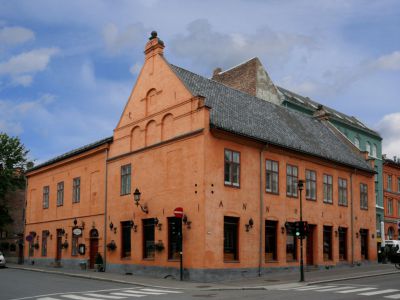
Gamle Rådhus (The Old Town Hall) in Oslo, boasts a rich and extensive history. As one of the most ancient structures in Norway's capital, it was initially erected in 1641 as Christiania's inaugural town hall during the period when the city was referred to as Christiania. King Christian IV provided financial backing for the town hall's construction.
For nearly a century, from 1641 to 1733, the building functioned as the municipal center of Christiania. Its prominent position next to Akershus Fortress contributed to its significance. Subsequently, the building underwent a series of transformations. It served as a fire station, a temporary church, a private residence, Norway's Supreme Court, the city's main assembly hall, a correctional facility, the gathering place for Freemasons, a museum, and presently, a restaurant.
In 1925, the restaurant was relocated to the primary level of the main edifice, preserving much of its original furnishings. However, a fire ravaged the building in 1996. Yet, the City of Oslo, the owner, took swift action to restore and recreate the structure.
Today, the Old Town Hall continues its role as a restaurant, offering a splendid setting for various occasions such as receptions, concerts, performances, and conferences on the ground floor. The original basement, once a holding area, has been preserved and repurposed as a wine cellar and event space capable of accommodating up to 20 guests. Additionally, a beer garden and outdoor dining area grace the backyard from May through September.
The restaurant's lavish menu is centered around traditional Norwegian cuisine, highlighting local ingredients. Delicacies such as lutefisk, diverse seafood, and succulent reindeer meat feature prominently, showcasing the rich culinary heritage of Norway.
For nearly a century, from 1641 to 1733, the building functioned as the municipal center of Christiania. Its prominent position next to Akershus Fortress contributed to its significance. Subsequently, the building underwent a series of transformations. It served as a fire station, a temporary church, a private residence, Norway's Supreme Court, the city's main assembly hall, a correctional facility, the gathering place for Freemasons, a museum, and presently, a restaurant.
In 1925, the restaurant was relocated to the primary level of the main edifice, preserving much of its original furnishings. However, a fire ravaged the building in 1996. Yet, the City of Oslo, the owner, took swift action to restore and recreate the structure.
Today, the Old Town Hall continues its role as a restaurant, offering a splendid setting for various occasions such as receptions, concerts, performances, and conferences on the ground floor. The original basement, once a holding area, has been preserved and repurposed as a wine cellar and event space capable of accommodating up to 20 guests. Additionally, a beer garden and outdoor dining area grace the backyard from May through September.
The restaurant's lavish menu is centered around traditional Norwegian cuisine, highlighting local ingredients. Delicacies such as lutefisk, diverse seafood, and succulent reindeer meat feature prominently, showcasing the rich culinary heritage of Norway.
5) Steen & Strøm
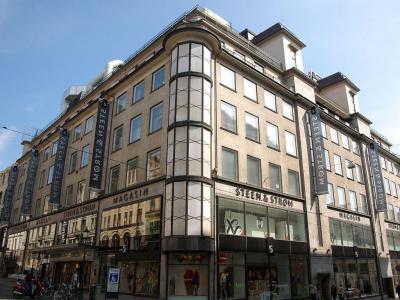
Situated in the heart of Oslo's city center, Steen & Strøm stands as a sprawling department store housing an array of renowned and alluring brands within its premises. Spanning across six expansive floors, the store offers a wealth of fashion and lifestyle products that span the spectrum from timeless classics to the forefront of trends.
Steen & Strøm boasts an impressive lineup of brands, including Sandro, Maje, Filippa K, Gucci, Hugo Boss, Fredrik & Louisa, Juicy Couture, Polo Ralph Lauren, and Tiger of Sweden. Additionally, the store features multi-brand establishments like Collage The Shop, adding to the diverse shopping experience.
Descending to the basement, visitors will discover a vibrant food court showcasing enticing lunch options and specialty food boutiques such as Lakrids liquorice, Eat Thai, Whats Soup, Summerbird, Los Tacos, SOT Burger, and Jonathan Sushi.
Tracing its origins back to 1797, Steen & Strøm's history is deeply rooted, with Samuel Strøm inaugurating a store at the intersection of Prinsensgate and Kongensgate. The department store underwent its most recent upgrade in 2021, and it proudly holds a place within the Promenaden Fashion District, Oslo's novel enclave for upscale retail therapy.
Steen & Strøm boasts an impressive lineup of brands, including Sandro, Maje, Filippa K, Gucci, Hugo Boss, Fredrik & Louisa, Juicy Couture, Polo Ralph Lauren, and Tiger of Sweden. Additionally, the store features multi-brand establishments like Collage The Shop, adding to the diverse shopping experience.
Descending to the basement, visitors will discover a vibrant food court showcasing enticing lunch options and specialty food boutiques such as Lakrids liquorice, Eat Thai, Whats Soup, Summerbird, Los Tacos, SOT Burger, and Jonathan Sushi.
Tracing its origins back to 1797, Steen & Strøm's history is deeply rooted, with Samuel Strøm inaugurating a store at the intersection of Prinsensgate and Kongensgate. The department store underwent its most recent upgrade in 2021, and it proudly holds a place within the Promenaden Fashion District, Oslo's novel enclave for upscale retail therapy.
6) Stortorvet
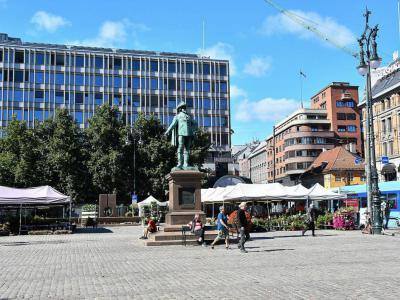
Stortorvet, or ‘Grand Plaza’, is a major public place for socializing, trade, and traffic in Oslo. It has been the city's central square since 1736 when it replaced in this capacity Christiania Torv. Originally developed around Oslo Cathedral, which was constructed in 1697, the square became functional after its foundation was filled in with earth from the city ramparts and later, by city garbage.
Over time, it evolved into a vital marketplace, particularly known for its winter market, which dates back to Oslo's early history. Initially held in the Old Town, the market had moved between various locations before settling at Stortorvet in 1735. By the late 19th century, it was so prominent that local schools and university halted their classes and lectures, and the Supreme Court even paused its proceedings during market days.
The square is surrounded by several historical buildings such as Koppgården, at Number 2, built in 1879-80 for wine merchant Hermann Alexander Kopp, and Sandakergården, at Number 5, named so for the men's outfitter that once occupied premises on the ground floor. Other notable structures include the Swan Pharmacy (Svaneapoteket), established in 1628 and operational in its current location since 1896, and a more modern Christiania Bank building, at Number 7, completed in 1971.
Stortorvet also features three significant artworks, namely: the bronze statue of King Christian IV sculpted by Carl Ludvig Jacobsen, unveiled in 1880; the "Animal Fountain" by Skule Vaksvik, featuring hens and a rooster depicted in bronze, created in 1955; and the "Water in Stone" installation of red granite, made by Anne-Marie Backer Mohr and Bjart Mohr in 1985.
Over time, it evolved into a vital marketplace, particularly known for its winter market, which dates back to Oslo's early history. Initially held in the Old Town, the market had moved between various locations before settling at Stortorvet in 1735. By the late 19th century, it was so prominent that local schools and university halted their classes and lectures, and the Supreme Court even paused its proceedings during market days.
The square is surrounded by several historical buildings such as Koppgården, at Number 2, built in 1879-80 for wine merchant Hermann Alexander Kopp, and Sandakergården, at Number 5, named so for the men's outfitter that once occupied premises on the ground floor. Other notable structures include the Swan Pharmacy (Svaneapoteket), established in 1628 and operational in its current location since 1896, and a more modern Christiania Bank building, at Number 7, completed in 1971.
Stortorvet also features three significant artworks, namely: the bronze statue of King Christian IV sculpted by Carl Ludvig Jacobsen, unveiled in 1880; the "Animal Fountain" by Skule Vaksvik, featuring hens and a rooster depicted in bronze, created in 1955; and the "Water in Stone" installation of red granite, made by Anne-Marie Backer Mohr and Bjart Mohr in 1985.
7) GlasMagasinet
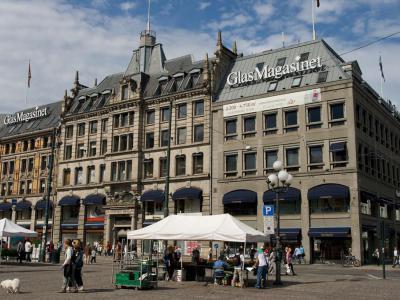
GlasMagasinet stands as one of Norway's most historic and prestigious department stores. Positioned in proximity to Stortorvet and Karl Johans Gate, its location is conveniently accessible. Housing over 50 diverse departments, encompassing everything from Scandinavian crystal to the latest fashion trends, a visit becomes a must.
For a considerable duration, GlasMagasinet has held a distinct focus on curated design and home goods. Among its establishments are Illum Bolighus, Magnor Brandstore, Bellas House, Heimen Husfliden, and Kicks Flagship Store. Notably, the selection spans from apparel for all ages, cosmetics, photographic equipment, and flowers, to even hosting the sole Elkjøp City electronics store in central Oslo.
The ambiance seamlessly merges elegance and style with a blend of modernity and tradition. The facility's four floors offer convenient navigation, while intermittent cafes and restaurants further elevate the already delightful shopping experience.
For a considerable duration, GlasMagasinet has held a distinct focus on curated design and home goods. Among its establishments are Illum Bolighus, Magnor Brandstore, Bellas House, Heimen Husfliden, and Kicks Flagship Store. Notably, the selection spans from apparel for all ages, cosmetics, photographic equipment, and flowers, to even hosting the sole Elkjøp City electronics store in central Oslo.
The ambiance seamlessly merges elegance and style with a blend of modernity and tradition. The facility's four floors offer convenient navigation, while intermittent cafes and restaurants further elevate the already delightful shopping experience.
8) Karl Johans Gate (must see)
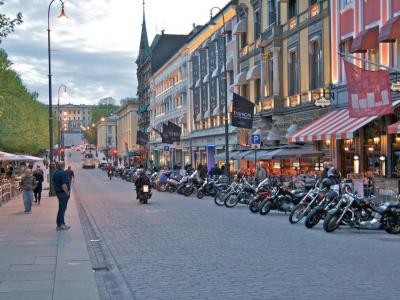
Karl Johans Gate, or simply "Karl Johan" (as the locals colloquially refer to it), is named after King Karl III Johan and is considered the main street in Oslo. Popular with tourists, it gets particularly vibrant on Norway's Constitution Day, May 17, with parades and royal appearances. Street performers, including jugglers and musicians, add to the lively atmosphere from May to October, making it a cultural hub in the city.
Karl Johans Gate stretches 1,415 meters from Oslo Central Station to the Royal Palace. A section between the station and the Storting building is fully pedestrian. Lining the street are a number of landmarks such as the Oslo Cathedral, the Bazaars, the Fire Brigade, the National Theater, the Hotel Continental, and the University of Oslo.
Palace Park (Slottsparken) at the east end of Karl Johans Gate is home to the Royal Palace (Slottet). Originally built for King Karl III Johan, the palace continues to function as a residence for the present King of Norway, Harald V.
The street is made up of two distinct sections with unique histories. The eastern section, between Egertorget to Jernbanetorget squares, was originally part of King Christian IV's old city, near the ramparts. It wasn't fully developed until the 1690s when the Oslo Cathedral was built. The western section was developed in the late 1830s, as part of an urban expansion. Designed as a parade route, it was named Karl Johans Gate in 1852 after King Karl Johan’s death. The distinctively wide western and narrow eastern sections were merged in 1860.
In 2005, to mark the centenary of the dissolution of the Union between Sweden and Norway, the western part of Karl Johans Gate was narrowed and the pavements extended, aligning with the midpoint of the Royal Palace’s facade. New lampposts (modeled after 1920s designs) were installed, and the street was repaved with large stones. Also, to honor the 100th anniversary of Henrik Ibsen’s death in 2006, quotes from his works were embedded in the pavement between Frederiks Gate and the Grand Hotel, replicating the famous writer's daily route from the 1890s.
Karl Johans Gate stretches 1,415 meters from Oslo Central Station to the Royal Palace. A section between the station and the Storting building is fully pedestrian. Lining the street are a number of landmarks such as the Oslo Cathedral, the Bazaars, the Fire Brigade, the National Theater, the Hotel Continental, and the University of Oslo.
Palace Park (Slottsparken) at the east end of Karl Johans Gate is home to the Royal Palace (Slottet). Originally built for King Karl III Johan, the palace continues to function as a residence for the present King of Norway, Harald V.
The street is made up of two distinct sections with unique histories. The eastern section, between Egertorget to Jernbanetorget squares, was originally part of King Christian IV's old city, near the ramparts. It wasn't fully developed until the 1690s when the Oslo Cathedral was built. The western section was developed in the late 1830s, as part of an urban expansion. Designed as a parade route, it was named Karl Johans Gate in 1852 after King Karl Johan’s death. The distinctively wide western and narrow eastern sections were merged in 1860.
In 2005, to mark the centenary of the dissolution of the Union between Sweden and Norway, the western part of Karl Johans Gate was narrowed and the pavements extended, aligning with the midpoint of the Royal Palace’s facade. New lampposts (modeled after 1920s designs) were installed, and the street was repaved with large stones. Also, to honor the 100th anniversary of Henrik Ibsen’s death in 2006, quotes from his works were embedded in the pavement between Frederiks Gate and the Grand Hotel, replicating the famous writer's daily route from the 1890s.
9) Royal Palace (must see)
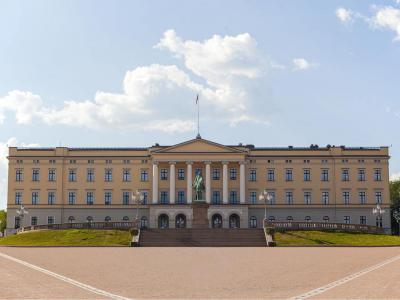
The Royal Palace (Slottet) in Oslo was constructed in the first half of the 19th century as the residence for King Karl III Johan of Norway. Originally from France, the king (also known as Karl XIV Johan of Sweden) reigned over Norway and Sweden from 1818 to 1844. Today, the palace serves as the official residence of the Norwegian monarch (whereas the Crown Prince resides at the Skaugum estate in Asker, west of Oslo).
Situated at the end of Karl Johans Gate, the palace is surrounded by Palace Park (Slottsparken) and is fronted by Palace Square (Slottsplassen). Before its completion, Norwegian royalty resided in Paléet, a grand townhouse in Christiania (now Oslo). The construction of the Royal Palace began in 1824 and lasted for nearly 25 years, based on the designs by Danish-born architect Hans Linstow.
Despite adopting a simpler three-story neo-classical design, the palace remained unfinished when King Karl passed away in 1844. His son and successor, Oscar I, and his wife, Queen Josephine, became its first residents five years later.
The Royal Palace Chapel, consecrated in 1844, is used for religious services and various events of the Norwegian royal family, such as baptisms and confirmations.
Following the dissolution of the Union with Sweden in 1905, the palace became the permanent royal residence of Norway’s new monarch, King Haakon VII. Significant renovations were undertaken during the reign of King Harald V to address structural issues and modernize the building. Public access to the palace began in 2002, and the daily changing of the guard has since become a popular attraction for visitors.
Moreover, in 2017, the former palace stables were renovated and converted into a versatile art venue called The Queen Sonja Art Stable (Dronning Sonja KunstStall). Open to the public, this building serves as an art gallery, museum, and concert hall.
Guided tours of the palace, predominantly in Norwegian, are offered throughout the afternoon during the summer months. However, English-language tours are also available daily at 12 pm, 2 pm, 2:20 pm, and 4 pm. Tickets for these guided tours can be purchased online starting from the 1st of March each year.
Tip:
Changing of the royal guards is at 1:30 pm daily. You can always politely approach one of the guard soldiers and take a nice photo or have a chat with them :)
The garden is peaceful and freely accessible – you can have a picnic there and quietly enjoy nature.
Situated at the end of Karl Johans Gate, the palace is surrounded by Palace Park (Slottsparken) and is fronted by Palace Square (Slottsplassen). Before its completion, Norwegian royalty resided in Paléet, a grand townhouse in Christiania (now Oslo). The construction of the Royal Palace began in 1824 and lasted for nearly 25 years, based on the designs by Danish-born architect Hans Linstow.
Despite adopting a simpler three-story neo-classical design, the palace remained unfinished when King Karl passed away in 1844. His son and successor, Oscar I, and his wife, Queen Josephine, became its first residents five years later.
The Royal Palace Chapel, consecrated in 1844, is used for religious services and various events of the Norwegian royal family, such as baptisms and confirmations.
Following the dissolution of the Union with Sweden in 1905, the palace became the permanent royal residence of Norway’s new monarch, King Haakon VII. Significant renovations were undertaken during the reign of King Harald V to address structural issues and modernize the building. Public access to the palace began in 2002, and the daily changing of the guard has since become a popular attraction for visitors.
Moreover, in 2017, the former palace stables were renovated and converted into a versatile art venue called The Queen Sonja Art Stable (Dronning Sonja KunstStall). Open to the public, this building serves as an art gallery, museum, and concert hall.
Guided tours of the palace, predominantly in Norwegian, are offered throughout the afternoon during the summer months. However, English-language tours are also available daily at 12 pm, 2 pm, 2:20 pm, and 4 pm. Tickets for these guided tours can be purchased online starting from the 1st of March each year.
Tip:
Changing of the royal guards is at 1:30 pm daily. You can always politely approach one of the guard soldiers and take a nice photo or have a chat with them :)
The garden is peaceful and freely accessible – you can have a picnic there and quietly enjoy nature.
10) Theatercaféen
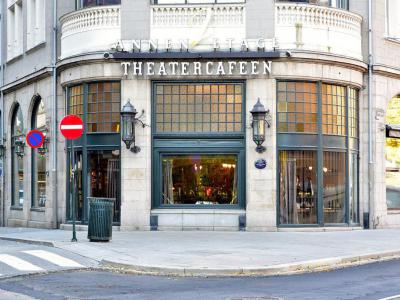
Established in 1900, Theatercafeen has stood as one of Oslo's cherished culinary and social hubs, exuding a lively and dynamic ambiance. Originally under the ownership of Foss Brewery (Foss Bryggeri), the restaurant and hotel were acquired by Caroline Boman Hansen (1860–1956) and Christian Boman Hansen (1868–1915) in 1909. Currently, Elisabeth C. Brochmann represents the fourth generation at the helm.
In 1949, Theatercaféen was modernized but lost some of its unique atmosphere. In 1971, it was renovated back to its original Art Nouveau style by architect Hans Gabriel Finne. Elements from the original fixtures and vintage photos were used to restore its authentic character. Inspiration came from Paris, Copenhagen, and Stockholm. The floor, made of 100,000 linoleum segments, showcases craftsmanship. The restaurant was refurbished again in 2010 with a new bar and a private chamber.
The ascent of Theatercaféen as a focal point for prominent figures within Norway's artistic and cultural sphere was swift. Among its patrons were Sigurd Bødker, Sven Elvestad, and Herman Wildenvey, alongside thespians from the National Theatre. Commencing in 1924, the practice of creating and displaying portraits of these illustrious guests adorned the restaurant's walls. This tradition has endured, culminating in an ensemble of 81 portraits, encompassing authors, actors, painters, photographers, musicians, and composers-each having graced the establishment's halls, either in the past or the present.
In 1949, Theatercaféen was modernized but lost some of its unique atmosphere. In 1971, it was renovated back to its original Art Nouveau style by architect Hans Gabriel Finne. Elements from the original fixtures and vintage photos were used to restore its authentic character. Inspiration came from Paris, Copenhagen, and Stockholm. The floor, made of 100,000 linoleum segments, showcases craftsmanship. The restaurant was refurbished again in 2010 with a new bar and a private chamber.
The ascent of Theatercaféen as a focal point for prominent figures within Norway's artistic and cultural sphere was swift. Among its patrons were Sigurd Bødker, Sven Elvestad, and Herman Wildenvey, alongside thespians from the National Theatre. Commencing in 1924, the practice of creating and displaying portraits of these illustrious guests adorned the restaurant's walls. This tradition has endured, culminating in an ensemble of 81 portraits, encompassing authors, actors, painters, photographers, musicians, and composers-each having graced the establishment's halls, either in the past or the present.
11) Oslo City Hall (must see)
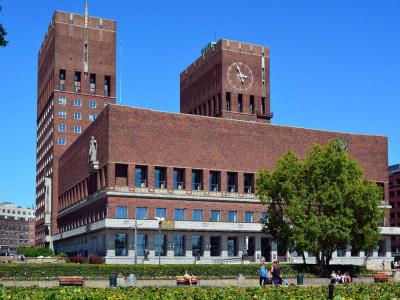
Oslo City Hall (Oslo rådhus) is a mainstay of civic life in the Norwegian capital. Designed by architects Arnstein Arneberg and Magnus Poulsson, its construction took place between 1931 and 1950, with a pause during World War II. The red-brick structure features two towers – 63 and 66 meters tall. The eastern tower houses a carillon with 49 bells that chime every hour.
Historically, Oslo had different city halls, including one reportedly housing a public wine cellar. The Old City Hall (Gamle rådhus) was built near Akershus Fortress in 1641. As the city expanded, the need for a larger facility became evident by the 1800s. The idea for the current City Hall emerged in 1906 but was delayed for financial reasons.
When the building was officially opened in 1950, its brick style looked (at least to some) a bit outdated compared to the modern steel-and-glass architecture of the time. Influenced by functionalism, the design included two oblong, industrial-style office towers. The overall appearance combined modern forms and styling from the medieval era, including statues mounted on the walls and an ornate astronomical clock on the north face.
The artistic decorations, selected through contests in 1937, feature contributions from eight painters and 17 sculptors. The main hall features wall paintings by Henrik Sørensen and Alf Rolfsen, depicting Norway’s history. The City Council Hall is semi-circular, adorned with oak and tapestries, including one showing Saint Hallvard (the patron saint of Oslo) and the seven virtues, meant to inspire ethical governance.
Each year, on December 10th, the Nobel Peace Prize ceremony takes place at the Oslo City Hall, attended by the Norwegian royal family and prime minister. Barack Obama was among the first to be honored in the banqueting hall here after the ceremony was moved from the University of Oslo’s main building.
The City Hall is open to the general public. Apart from its decorated halls, visitors can enjoy a wonderful view of the harbor from the main balcony.
Tip:
Make sure to read the English captions under the wood carvings as you walk up to the City Hall.
Free guided tours in English (lasting approximately one hour) are also available, during which the guides explain the murals & artworks and their symbolism, as well as the functioning of the municipal government, in an entertaining way. Something not to be missed!
Historically, Oslo had different city halls, including one reportedly housing a public wine cellar. The Old City Hall (Gamle rådhus) was built near Akershus Fortress in 1641. As the city expanded, the need for a larger facility became evident by the 1800s. The idea for the current City Hall emerged in 1906 but was delayed for financial reasons.
When the building was officially opened in 1950, its brick style looked (at least to some) a bit outdated compared to the modern steel-and-glass architecture of the time. Influenced by functionalism, the design included two oblong, industrial-style office towers. The overall appearance combined modern forms and styling from the medieval era, including statues mounted on the walls and an ornate astronomical clock on the north face.
The artistic decorations, selected through contests in 1937, feature contributions from eight painters and 17 sculptors. The main hall features wall paintings by Henrik Sørensen and Alf Rolfsen, depicting Norway’s history. The City Council Hall is semi-circular, adorned with oak and tapestries, including one showing Saint Hallvard (the patron saint of Oslo) and the seven virtues, meant to inspire ethical governance.
Each year, on December 10th, the Nobel Peace Prize ceremony takes place at the Oslo City Hall, attended by the Norwegian royal family and prime minister. Barack Obama was among the first to be honored in the banqueting hall here after the ceremony was moved from the University of Oslo’s main building.
The City Hall is open to the general public. Apart from its decorated halls, visitors can enjoy a wonderful view of the harbor from the main balcony.
Tip:
Make sure to read the English captions under the wood carvings as you walk up to the City Hall.
Free guided tours in English (lasting approximately one hour) are also available, during which the guides explain the murals & artworks and their symbolism, as well as the functioning of the municipal government, in an entertaining way. Something not to be missed!
