Custom Walk in Cartagena, Colombia by kce7476_85b7ed created on 2026-05-02
Guide Location: Colombia » Cartagena
Guide Type: Custom Walk
# of Sights: 12
Tour Duration: 2 Hour(s)
Travel Distance: 2.9 Km or 1.8 Miles
Share Key: WVJMA
Guide Type: Custom Walk
# of Sights: 12
Tour Duration: 2 Hour(s)
Travel Distance: 2.9 Km or 1.8 Miles
Share Key: WVJMA
How It Works
Please retrieve this walk in the GPSmyCity app. Once done, the app will guide you from one tour stop to the next as if you had a personal tour guide. If you created the walk on this website or come to the page via a link, please follow the instructions below to retrieve the walk in the app.
Retrieve This Walk in App
Step 1. Download the app "GPSmyCity: Walks in 1K+ Cities" on Apple App Store or Google Play Store.



Step 2. In the GPSmyCity app, download(or launch) the guide "Cartagena Map and Walking Tours".
Step 3. Tap the menu button located at upper right corner of the "Walks" screen and select "Retrieve custom walk". Enter the share key: WVJMA
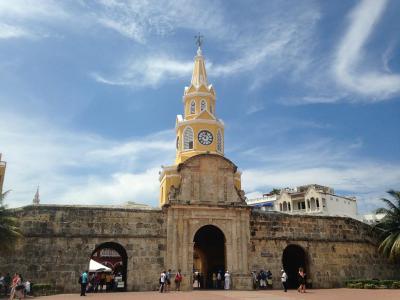
1) Torre del Reloj (Clock Tower) (must see)
The main entrance to the historic walled city of Cartagena is famously known as the Clock Tower (Torre del Reloj). This significant landmark, built into the city wall, features a trio of open archways that offer a gateway into the Old City. A stunning clock tower crowns the central arch. With Baroque architecture, this beautiful eight-sided tower is painted golden-yellow with white trim.
Construction of this gateway took place between 1601 and 1631. Initially, only the central archway existed as a portal to the city. It was known as the Mouth of the Bridge (Boca del Puente). The other two housed an armory and a chapel. The clock tower was added later, during the early 18th century.
The Clock Tower is located next to Cars Square (Plaza de Los Coches) just inside the city walls. This triangular-shaped city square has a dark past as the place that once held Cartagena's slave market. This past also included public gallows in the center of the town square. On the plaza, directly across from the clock tower, you'll find the well-liked Cartagena sweets market known as Sweets Portal (Portal de Los Dulces).
The clock tower gate also serves as a connection from the city to the nearby Getsemani neighborhood just outside the walls. Getsemani is now a hip neighborhood filled with graffiti art and brightly painted buildings. Don't miss the two statues of Pegasus located on a nearby road that leads to the outside of the clock tower.
Construction of this gateway took place between 1601 and 1631. Initially, only the central archway existed as a portal to the city. It was known as the Mouth of the Bridge (Boca del Puente). The other two housed an armory and a chapel. The clock tower was added later, during the early 18th century.
The Clock Tower is located next to Cars Square (Plaza de Los Coches) just inside the city walls. This triangular-shaped city square has a dark past as the place that once held Cartagena's slave market. This past also included public gallows in the center of the town square. On the plaza, directly across from the clock tower, you'll find the well-liked Cartagena sweets market known as Sweets Portal (Portal de Los Dulces).
The clock tower gate also serves as a connection from the city to the nearby Getsemani neighborhood just outside the walls. Getsemani is now a hip neighborhood filled with graffiti art and brightly painted buildings. Don't miss the two statues of Pegasus located on a nearby road that leads to the outside of the clock tower.
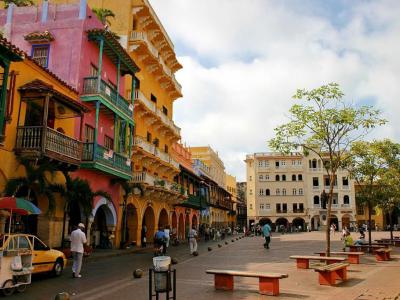
2) Plaza de los Coches (Square of the Carriages)
Square of the Carriages (Plaza de los Coches) is a historic square located in the heart of the walled city of Cartagena. This vibrant place is one of the city's most popular tourist destinations, known for its lively atmosphere, charming colonial architecture, and rich cultural history.
The square, originally known as Slave Square (Plaza del Esclavo), was where African slaves were bought and sold during the colonial period. In the early 19th century, the square was renamed Square of the Carriages as it became a popular spot for carriages to pick up and drop off passengers.
The square is bordered by several impressive colonial-era buildings, including the 18th-century Clock Tower and the Governor's Palace, which now houses the Museum of History of Cartagena. The architecture of these buildings reflects the city's rich cultural heritage and adds to the charm of the square.
Today, Square of the Carriages is a bustling hub of activity where visitors can find street vendors selling souvenirs, local food and drinks, and musicians playing traditional Colombian music. The area is also surrounded by shops, restaurants, and cafes.
The square was a hub of social and cultural activity during the colonial era. It hosted bullfights, theatrical performances, and religious processions, which attracted people from all over the city.
The statue located in the Square of the Carriages depicts Pedro de Heredia, the Spanish conquistador who founded the city of Cartagena in 1533. The statue was erected in 1937 to commemorate the 400th anniversary of the city's founding. It stands at the center of the square and is a popular spot for tourists to take photos.
The square, originally known as Slave Square (Plaza del Esclavo), was where African slaves were bought and sold during the colonial period. In the early 19th century, the square was renamed Square of the Carriages as it became a popular spot for carriages to pick up and drop off passengers.
The square is bordered by several impressive colonial-era buildings, including the 18th-century Clock Tower and the Governor's Palace, which now houses the Museum of History of Cartagena. The architecture of these buildings reflects the city's rich cultural heritage and adds to the charm of the square.
Today, Square of the Carriages is a bustling hub of activity where visitors can find street vendors selling souvenirs, local food and drinks, and musicians playing traditional Colombian music. The area is also surrounded by shops, restaurants, and cafes.
The square was a hub of social and cultural activity during the colonial era. It hosted bullfights, theatrical performances, and religious processions, which attracted people from all over the city.
The statue located in the Square of the Carriages depicts Pedro de Heredia, the Spanish conquistador who founded the city of Cartagena in 1533. The statue was erected in 1937 to commemorate the 400th anniversary of the city's founding. It stands at the center of the square and is a popular spot for tourists to take photos.
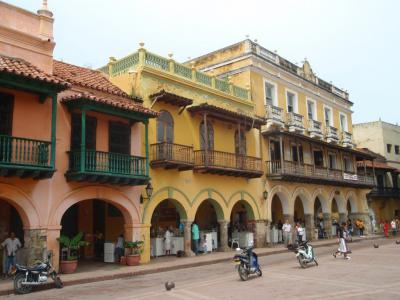
3) Portal de Los Dulces (Sweets Portal)
In the triangular-shaped Cars Square (Plaza de Los Coches), you'll find a candy market called Sweets Portal (Portal de Los Dulces). This site was named years ago for the sweet pastries sold there by street hagglers. You will find this lively market in the arcaded walkways of a row of old houses. The lovely Spanish colonial architecture of these brightly painted structures, with their charming balconies and tile roofs, is worth checking out.
At this outdoor market, you will find dozens of confectionary stands with vendors selling homemade candies and pastries. Jars filled with a variety of sweet treats are on display. You'll have fun shopping for delicious Caribbean delicacies with an emphasis on coconut sweets. Try the popular Cubanitos, rolled candy wrapped in colored paper.
Enjoy the colorful display of treats and the wonderful aroma of sweets in the air as you stroll through this inviting marketplace. There are also some interesting shops and restaurants around this colonial square. Don't miss Cartagena's landmark clock tower, directly across from the Sweets Portal.
At this outdoor market, you will find dozens of confectionary stands with vendors selling homemade candies and pastries. Jars filled with a variety of sweet treats are on display. You'll have fun shopping for delicious Caribbean delicacies with an emphasis on coconut sweets. Try the popular Cubanitos, rolled candy wrapped in colored paper.
Enjoy the colorful display of treats and the wonderful aroma of sweets in the air as you stroll through this inviting marketplace. There are also some interesting shops and restaurants around this colonial square. Don't miss Cartagena's landmark clock tower, directly across from the Sweets Portal.
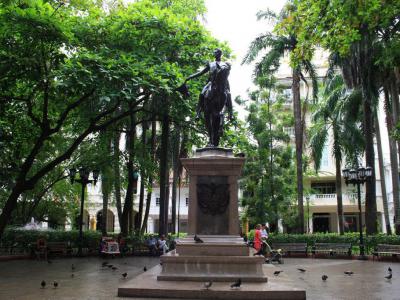
4) Plaza de Bolivar (Bolivar Square)
In the heart of the old walled city of Cartagena, you'll find Bolivar Square (Plaza de Bolivar). Inside this lovely square is a park full of lush greenery, shady trees, fountains, and plenty of benches that are perfect for relaxing on a sunny day. With its central location, it is considered the main square of the city.
In the center of the square is an equestrian statue of Simon Bolivar, the first president of Colombia, who was famously known as "The Liberator." The bronze statue rests on a granite pedestal and has had a prominent place in the square since 1896. It was created by Venezuelan artist and sculptor Eloy Palacios.
Around Bolivar Square are some lovely historic buildings stylized with features that include arcaded walkways, balconies, and tiled roofs. At one corner, you'll find the impressive Cartagena Cathedral. You will also find several intriguing museums around this square and nearby. Museums include the Palace of the Inquisition, the Zenu Gold Museum, and the Emerald Museum inside Caribe Jewelry.
Bolivar Square offers a shady tropical oasis in the center of Cartagena. You won't want to miss an exploration of this charming historical place.
In the center of the square is an equestrian statue of Simon Bolivar, the first president of Colombia, who was famously known as "The Liberator." The bronze statue rests on a granite pedestal and has had a prominent place in the square since 1896. It was created by Venezuelan artist and sculptor Eloy Palacios.
Around Bolivar Square are some lovely historic buildings stylized with features that include arcaded walkways, balconies, and tiled roofs. At one corner, you'll find the impressive Cartagena Cathedral. You will also find several intriguing museums around this square and nearby. Museums include the Palace of the Inquisition, the Zenu Gold Museum, and the Emerald Museum inside Caribe Jewelry.
Bolivar Square offers a shady tropical oasis in the center of Cartagena. You won't want to miss an exploration of this charming historical place.
5) Palacio de La Inquisicion (Palace of the Inquisition)
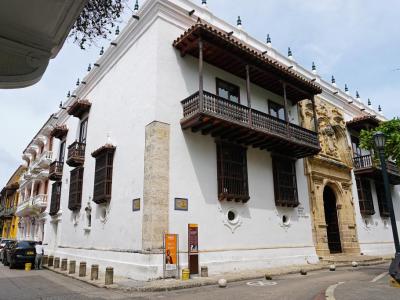
The former seat of the once mighty (and fearsome) Holy Office of the Inquisition in Cartagena, overlooking Parque de Bolívar, is an 18th-century architectural landmark, part of Colombia's cultural heritage. Established by the decree of Philip III of Spain, the Inquisition Palace took more than a century to build, from 1610 to 1770.
Between 1580 and 1640, the crowns of Portugal and Spain were held by the same monarch, and thus many Portuguese merchants were active in Spanish overseas colonies. At that time, Cartagena was a center of commerce and a transit point between the Caribbean and Spanish settlements in western South America. It became the third city in the Spanish empire to have a tribunal of the Holy Office of the Inquisition.
The necessity to have it was prompted by suspicion that some of the merchants – of Portuguese descent, mainly – were crypto-Jews (i.e. secret practitioners of Judaism passing as Christians). The Palace was used by the Inquisition to try Jews and other non-Catholics; some 800 individuals, believed to be guilty of crimes such as black magic, were publicly executed here.
As of 1953, the property has been in the hands of the Historical Museum of Cartagena. Among the many historical artifacts exhibited here now (such as coins, maps, weapons, furniture, church bells, and paintings), there is also torture equipment previously used on victims within these walls during the Inquisition time. Notably, some of these items were removed from display in 2015, ahead of the visit of Pope Francis, and then partially returned.
Cited as one of Cartagena's "best examples of late colonial, civil architecture", the Palace also contains elements from the Baroque era. Its wooden framework is reinforced with double-story limestones used in the construction. The white brick facade is contrasted by stone gateways. Inside, the rooms are also clad in masonry.
Between 1580 and 1640, the crowns of Portugal and Spain were held by the same monarch, and thus many Portuguese merchants were active in Spanish overseas colonies. At that time, Cartagena was a center of commerce and a transit point between the Caribbean and Spanish settlements in western South America. It became the third city in the Spanish empire to have a tribunal of the Holy Office of the Inquisition.
The necessity to have it was prompted by suspicion that some of the merchants – of Portuguese descent, mainly – were crypto-Jews (i.e. secret practitioners of Judaism passing as Christians). The Palace was used by the Inquisition to try Jews and other non-Catholics; some 800 individuals, believed to be guilty of crimes such as black magic, were publicly executed here.
As of 1953, the property has been in the hands of the Historical Museum of Cartagena. Among the many historical artifacts exhibited here now (such as coins, maps, weapons, furniture, church bells, and paintings), there is also torture equipment previously used on victims within these walls during the Inquisition time. Notably, some of these items were removed from display in 2015, ahead of the visit of Pope Francis, and then partially returned.
Cited as one of Cartagena's "best examples of late colonial, civil architecture", the Palace also contains elements from the Baroque era. Its wooden framework is reinforced with double-story limestones used in the construction. The white brick facade is contrasted by stone gateways. Inside, the rooms are also clad in masonry.
6) Catedral de Santa Catalina de Alejandria (Cartagena Cathedral)
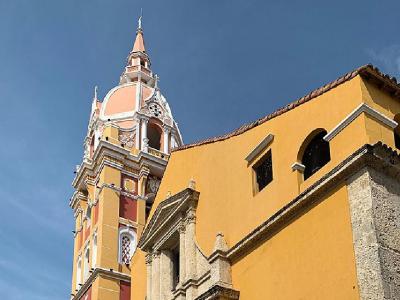
Sitting on the corner of the lively Bolivar Square in Cartagena is the magnificent church of Spanish Renaissance style, brightly painted in lemon-yellow with a white trim. The bell tower and dome rising over the rooftops of the Old City make it really hard to miss this architectural landmark.
The temple, officially known as the Metropolitan Cathedral Basilica of Santa Catalina of Alexandria, is the episcopal see of the Archbishop of Cartagena de Indias (one of the oldest episcopal sees in the Americas), and it is dedicated to the Christian martyr, Santa Catalina (aka Saint Catherine) of Alexandria.
The cathedral was built between 1577 and 1612, replacing a modest church of wood and reeds on this site. In 1586, while still under construction, the building suffered severe damage which seriously delayed its completion when Cartagena came under attack by the English privateer (pirate) Francis Drake. Armed with a fleet of up to 23 warships and more than 3,000 men, Drake captured the city and looted it for six weeks, threatening to destroy the cathedral, unless a juicy ransom was paid.
The first warning shot that he fired on the structure struck one of the columns, knocking it down and taking two more with it. The four arches supported by the columns and part of the roof also collapsed as a result. Finally, the Cartagenians agreed to pay “El Draque” 110,000 silver ducats to stop the destruction.
The original structure of the cathedral has been preserved to this day almost unchanged. Designed by master builder Simón González, it was modeled on basilicas in Andalusia, Spain and the Canary Islands. Later, in 1908, the tower and the dome of the cathedral were refurbished, but the balconies, the main portal, and the cornices are original from the colonial era.
The interior includes three naves divided by columned archways. The gilded high altar is large and exquisite, featuring small statuary and ornate gold decorations. High up on the side walls, there are nicely carved wooden reliefs depicting religious scenes. Also noteworthy is the gorgeous marble flooring of checkered tiles in shades of black and white.
Outside, in Plaza de la Proclamación (Proclamation Square), you can see a bronze statue of Pope John Paul II, a monument to the papal visit in 1986.
The temple, officially known as the Metropolitan Cathedral Basilica of Santa Catalina of Alexandria, is the episcopal see of the Archbishop of Cartagena de Indias (one of the oldest episcopal sees in the Americas), and it is dedicated to the Christian martyr, Santa Catalina (aka Saint Catherine) of Alexandria.
The cathedral was built between 1577 and 1612, replacing a modest church of wood and reeds on this site. In 1586, while still under construction, the building suffered severe damage which seriously delayed its completion when Cartagena came under attack by the English privateer (pirate) Francis Drake. Armed with a fleet of up to 23 warships and more than 3,000 men, Drake captured the city and looted it for six weeks, threatening to destroy the cathedral, unless a juicy ransom was paid.
The first warning shot that he fired on the structure struck one of the columns, knocking it down and taking two more with it. The four arches supported by the columns and part of the roof also collapsed as a result. Finally, the Cartagenians agreed to pay “El Draque” 110,000 silver ducats to stop the destruction.
The original structure of the cathedral has been preserved to this day almost unchanged. Designed by master builder Simón González, it was modeled on basilicas in Andalusia, Spain and the Canary Islands. Later, in 1908, the tower and the dome of the cathedral were refurbished, but the balconies, the main portal, and the cornices are original from the colonial era.
The interior includes three naves divided by columned archways. The gilded high altar is large and exquisite, featuring small statuary and ornate gold decorations. High up on the side walls, there are nicely carved wooden reliefs depicting religious scenes. Also noteworthy is the gorgeous marble flooring of checkered tiles in shades of black and white.
Outside, in Plaza de la Proclamación (Proclamation Square), you can see a bronze statue of Pope John Paul II, a monument to the papal visit in 1986.
7) Plaza de Santo Domingo (Santo Domingo Square) (must see)
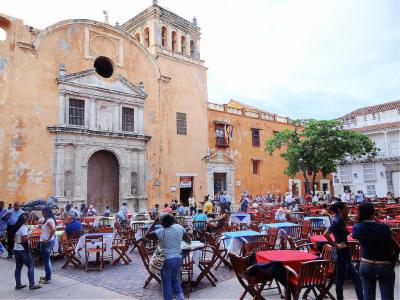
Plaza de Santo Domingo (Santo Domingo Square) is a vibrant square in the Old City of Cartagena. It was named after the beautiful church and convent Santo Domingo Church (also known as Santo Domingo Convent), which stands on one of its corners. The orange-yellow facade of the church and its massive arched entryway is striking. Check out the twisted bell tower on top.
With a gruesome past, this square was used during the Spanish Inquisition as a place for executions. The buildings surrounding Santo Domino Square boast Spanish Colonial architecture featuring balconies and red tile roofs. Around the square are shops, street vendors, lively restaurants, and plenty of outdoor tables for dining and relaxing.
Don't miss the famous "La Gorda Gertrudis" (Fat Gertrudis), a statue of a naked Rubenesque woman done in bronze. The sculpture was created by renowned artist Fernando Botero and stands in front of the church. It is a popular spot for taking photographs. The narrow nearby alleyways that branch off Santo Domingo Square are just ripe for exploration!
With a gruesome past, this square was used during the Spanish Inquisition as a place for executions. The buildings surrounding Santo Domino Square boast Spanish Colonial architecture featuring balconies and red tile roofs. Around the square are shops, street vendors, lively restaurants, and plenty of outdoor tables for dining and relaxing.
Don't miss the famous "La Gorda Gertrudis" (Fat Gertrudis), a statue of a naked Rubenesque woman done in bronze. The sculpture was created by renowned artist Fernando Botero and stands in front of the church. It is a popular spot for taking photographs. The narrow nearby alleyways that branch off Santo Domingo Square are just ripe for exploration!
8) La Gorda Gertrudis
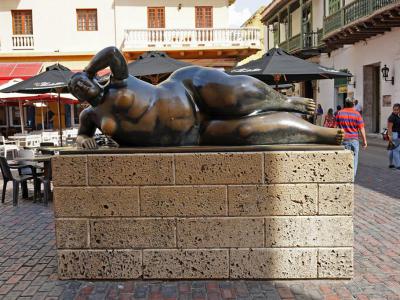
Near the front of a church in one corner of Santo Domingo Square is an eye-catching bronze statue of a voluptuous nude woman. You can't miss this stunning sculpture when you walk through this bustling Cartagena square. La Gorda translates to "the fat girl" in Spanish. Prominently placed on a pedestal, this well-loved reclining fat lady marks a favorite spot for visitors to take photos.
The statue is a creation of Fernando Botero, a world-renowned Colombian painter, and sculptor. He is well-known for his portrayal of rotund or chubby people and animals in his artwork. Botero's creative works are viewable in prominent locations around the world. His trademark style of art is famously known as "Boterismo."
In the year 2000, this extraordinary sculpture was gifted to the city of Cartagena by Botero. "Reclining Figure 92" was the sculpture's original title before receiving its more commonly known name, "La Gorda Gertrudis." Famous local legends surround this statue; the most generally known is that touching La Gorda's breast will make you lucky in love!
The statue is a creation of Fernando Botero, a world-renowned Colombian painter, and sculptor. He is well-known for his portrayal of rotund or chubby people and animals in his artwork. Botero's creative works are viewable in prominent locations around the world. His trademark style of art is famously known as "Boterismo."
In the year 2000, this extraordinary sculpture was gifted to the city of Cartagena by Botero. "Reclining Figure 92" was the sculpture's original title before receiving its more commonly known name, "La Gorda Gertrudis." Famous local legends surround this statue; the most generally known is that touching La Gorda's breast will make you lucky in love!
9) Baluarte de Santo Domingo (Bastion of Santo Domingo)
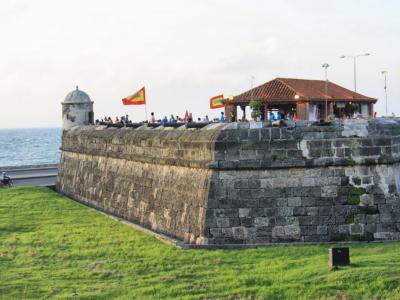
The Bastion of Santo Domingo (Baluarte de Santo Domingo) is a fortification, the origin of the Cartagena city walls constructed to protect the town against attacks. Soon after explorer Francis Drake pillaged Cartagena in 1586, plans were made to create a bastion to secure access to the city.
There are several things to see during your exploration of this large fortification. The stonework and masonry walls are well preserved. On the top of the bastion are rows of iron cannons resting along the parapet. At the front corner of the triangular-shaped structure is a small stone turret used as a watch tower.
This structure is located right next to the harbor and offers breathtaking panoramic views of the city skyline and the Caribbean Sea. Cafe del Mar, a lively restaurant and bar with plenty of outdoor tables, has a central location on top of the bastion. It's a fun spot to stop and take in the magnificent views, enjoy a drink, listen to music, and watch the sunset.
There are several things to see during your exploration of this large fortification. The stonework and masonry walls are well preserved. On the top of the bastion are rows of iron cannons resting along the parapet. At the front corner of the triangular-shaped structure is a small stone turret used as a watch tower.
This structure is located right next to the harbor and offers breathtaking panoramic views of the city skyline and the Caribbean Sea. Cafe del Mar, a lively restaurant and bar with plenty of outdoor tables, has a central location on top of the bastion. It's a fun spot to stop and take in the magnificent views, enjoy a drink, listen to music, and watch the sunset.
10) Las Bovedas (The Vaults)
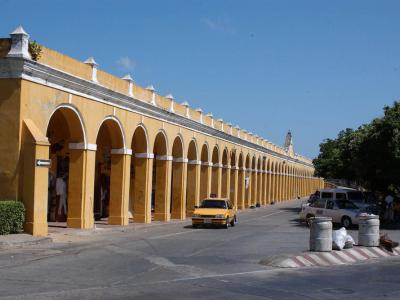
Exploring the Old City of Cartagena one cannot miss the immense arcade of columns and arches of bright golden color, located between the forts of Santa Clara and Santa Catalina. Known as Las Bóvedas (The Vaults), this building is indeed massive. Its walls – 15 meters thick(!) – were originally intended to protect a military storehouse.
The 23 bombproof arcades were built between 1789 and 1795 to a design by Antonio de Arebalo, a military engineer who worked on all fortifications in Cartagena. The 47 porticos were added in 1798. For a while, the vaults were used by the Spanish Crown as a garrison, the same purpose later used by republican forces. During the civil wars in the 19th century, the vaults were utilized as prison cells; at high tide, the unfortunate inmates had to stand up to their knees in seawater.
Nowadays, the building has become a lively marketplace, with the dungeon cells accommodating boutiques and other businesses. Inside the numbered vaults shops are selling a vast array of souvenirs: handcrafted items, paintings, colorful clothing, jewelry, and more. Together with the breathtaking view of the Caribbean Sea, this makes Las Bóvedas a popular tourist destination, appealing to those who love to stroll along the arcaded walkway whilst exploring traditional Colombian merchandise in this historic landmark.
The 23 bombproof arcades were built between 1789 and 1795 to a design by Antonio de Arebalo, a military engineer who worked on all fortifications in Cartagena. The 47 porticos were added in 1798. For a while, the vaults were used by the Spanish Crown as a garrison, the same purpose later used by republican forces. During the civil wars in the 19th century, the vaults were utilized as prison cells; at high tide, the unfortunate inmates had to stand up to their knees in seawater.
Nowadays, the building has become a lively marketplace, with the dungeon cells accommodating boutiques and other businesses. Inside the numbered vaults shops are selling a vast array of souvenirs: handcrafted items, paintings, colorful clothing, jewelry, and more. Together with the breathtaking view of the Caribbean Sea, this makes Las Bóvedas a popular tourist destination, appealing to those who love to stroll along the arcaded walkway whilst exploring traditional Colombian merchandise in this historic landmark.
11) Murallas de Cartagena (Cartagena City Walls) (must see)
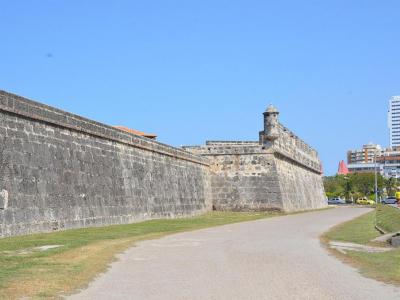
The walls around the Old City of Cartagena were built as protection against enemy attacks and pirate raids. The city walls reached completion in 1796 after nearly two centuries of construction. The wall is thick and well-constructed. Today, the walls represent one of the best-preserved fortifications in South America.
Walking along the Murallas de Cartagena (Cartagena City Walls) is a fun way to explore the walled site and offers fabulous views of the city and the glistening Caribbean Sea. The walls surround the historic Old Cartagena and stretch for 11 kilometers (just under seven miles). In spots along the wall, you'll find watch towers, old iron cannons, and lookout points.
A popular place to watch the sunset is from the Bastion of Santo Domingo, a fortification that marks the origin of the efforts to secure the city. Cafe del Mar is a restaurant with a central spot at the top of the bastion along the city walls. Relaxing on the walls and enjoying a drink is a great way to end a day exploring Cartagena.
Walking along the Murallas de Cartagena (Cartagena City Walls) is a fun way to explore the walled site and offers fabulous views of the city and the glistening Caribbean Sea. The walls surround the historic Old Cartagena and stretch for 11 kilometers (just under seven miles). In spots along the wall, you'll find watch towers, old iron cannons, and lookout points.
A popular place to watch the sunset is from the Bastion of Santo Domingo, a fortification that marks the origin of the efforts to secure the city. Cafe del Mar is a restaurant with a central spot at the top of the bastion along the city walls. Relaxing on the walls and enjoying a drink is a great way to end a day exploring Cartagena.
12) Plaza San Diego (San Diego Square)
San Diego Square is a charming and picturesque square surrounded by colonial-era buildings and is considered one of the most beautiful and peaceful squares in Cartagena.
The square is named after the San Diego Convent, a historic landmark on one side of the San Diego Square. The convent was built in the 16th century and served as a place of worship and refuge for the Spanish colonizers during attacks from pirates and other invaders. The architecture of the San Diego Convent is a beautiful blend of colonial and Baroque styles, with elegant arches, frescoes, and ornate carvings adorning the walls and ceilings. The convent also features a stunning courtyard, surrounded by galleries with arches and columns. It is now home to the University of Fine Arts and Sciences of Bolívar.
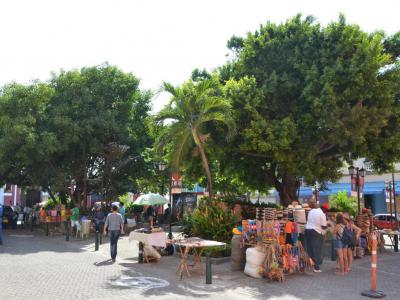
The square is a popular destination for locals and tourists alike, who come to enjoy its peaceful atmosphere and beautiful surroundings. Visitors can sit on the benches in the shade of the palm trees, sip on a refreshing drink from one of the nearby cafes, or admire the historic architecture and colonial charm of the square.
The surrounding buildings, many of which have been restored and converted into boutique hotels, restaurants, and shops, add to the charm of the square. Visitors can enjoy a meal or a drink at one of the outdoor cafes, browse local handicrafts at the street vendors' stalls, or take in the sights and sounds of the lively surroundings.
The square is named after the San Diego Convent, a historic landmark on one side of the San Diego Square. The convent was built in the 16th century and served as a place of worship and refuge for the Spanish colonizers during attacks from pirates and other invaders. The architecture of the San Diego Convent is a beautiful blend of colonial and Baroque styles, with elegant arches, frescoes, and ornate carvings adorning the walls and ceilings. The convent also features a stunning courtyard, surrounded by galleries with arches and columns. It is now home to the University of Fine Arts and Sciences of Bolívar.
The square is a popular destination for locals and tourists alike, who come to enjoy its peaceful atmosphere and beautiful surroundings. Visitors can sit on the benches in the shade of the palm trees, sip on a refreshing drink from one of the nearby cafes, or admire the historic architecture and colonial charm of the square.
The surrounding buildings, many of which have been restored and converted into boutique hotels, restaurants, and shops, add to the charm of the square. Visitors can enjoy a meal or a drink at one of the outdoor cafes, browse local handicrafts at the street vendors' stalls, or take in the sights and sounds of the lively surroundings.
