Custom Walk in Venice, Italy by lampert_melissa_aa96e6 created on 2026-05-11
Guide Location: Italy » Venice
Guide Type: Custom Walk
# of Sights: 5
Tour Duration: 2 Hour(s)
Travel Distance: 5.9 Km or 3.7 Miles
Share Key: FARMM
Guide Type: Custom Walk
# of Sights: 5
Tour Duration: 2 Hour(s)
Travel Distance: 5.9 Km or 3.7 Miles
Share Key: FARMM
How It Works
Please retrieve this walk in the GPSmyCity app. Once done, the app will guide you from one tour stop to the next as if you had a personal tour guide. If you created the walk on this website or come to the page via a link, please follow the instructions below to retrieve the walk in the app.
Retrieve This Walk in App
Step 1. Download the app "GPSmyCity: Walks in 1K+ Cities" on Apple App Store or Google Play Store.



Step 2. In the GPSmyCity app, download(or launch) the guide "Venice Map and Walking Tours".
Step 3. Tap the menu button located at upper right corner of the "Walks" screen and select "Retrieve custom walk". Enter the share key: FARMM
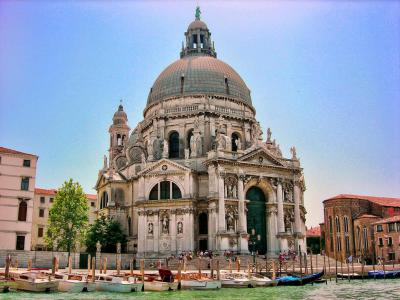
1) Basilica di Santa Maria della Salute (Basilica of Our Lady of Good Health) (must see)
San Marco may dominate postcards by reputation, but when it comes to Venice’s most recognizable outline, the real scene-stealer is the Basilica of Our Lady of Good Health. Known locally as La Salute, this sweeping white church commands the entrance to the Grand Canal with a dome that feels less like a roof and more like a statement. It stands as the clearest expression of Venetian Baroque ambition-bold, theatrical, and impossible to ignore...
Its origins are tied to crisis rather than confidence. In the early 1630s, a devastating plague swept through Venice, killing nearly a third of the city’s population. In response, the Venetian Republic made a vow: if deliverance came, a church would rise in honor of Our Lady of Good Health. The promise held, and construction followed.
Designed by Baldassare Longhena, then just in his early thirties, the project would define his career. Built on more than 100,000 wooden piles driven into the lagoon floor, La Salute took around fifty years to complete. Longhena devoted most of his life to it and lived just long enough to see the final result in 1681.
Once finished, the basilica's dome quickly became part of Venice’s visual identity. Painters took note. Canaletto and Francesco Guardi returned to it again and again, while artists visiting from abroad-Turner, Monet, and John Singer Sargent among them-used it as a focal point for light, reflection, and atmosphere. The silhouette you see today is not just architecture; it is centuries of artistic attention layered onto stone.
Inside, the basilica continues to surprise. The sacristy doubles as a compact art gallery, featuring works by Titian and Tintoretto. Ceiling paintings such as David and Goliath, Cain and Abel, and Abraham and Isaac unfold overhead, while The Marriage Feast of Cana anchors the space with dramatic intensity. At the high altar, a sculptural group by Josse de Corte delivers pure Baroque theater: the Virgin and Child banish the plague itself, imagined as a defeated old woman retreating from Venice.
Entry to the church is free during opening hours, though the sacristy requires a ticket. From the balcony, views spill back onto the square, and on certain days, a short organ recital follows the service-an unexpected reward for those who linger. Check the schedule in advance, and plan ahead.
Cafés are scarce nearby, so bringing a drink isn’t a bad idea. La Salute rewards patience, timing, and a willingness to look up...
Its origins are tied to crisis rather than confidence. In the early 1630s, a devastating plague swept through Venice, killing nearly a third of the city’s population. In response, the Venetian Republic made a vow: if deliverance came, a church would rise in honor of Our Lady of Good Health. The promise held, and construction followed.
Designed by Baldassare Longhena, then just in his early thirties, the project would define his career. Built on more than 100,000 wooden piles driven into the lagoon floor, La Salute took around fifty years to complete. Longhena devoted most of his life to it and lived just long enough to see the final result in 1681.
Once finished, the basilica's dome quickly became part of Venice’s visual identity. Painters took note. Canaletto and Francesco Guardi returned to it again and again, while artists visiting from abroad-Turner, Monet, and John Singer Sargent among them-used it as a focal point for light, reflection, and atmosphere. The silhouette you see today is not just architecture; it is centuries of artistic attention layered onto stone.
Inside, the basilica continues to surprise. The sacristy doubles as a compact art gallery, featuring works by Titian and Tintoretto. Ceiling paintings such as David and Goliath, Cain and Abel, and Abraham and Isaac unfold overhead, while The Marriage Feast of Cana anchors the space with dramatic intensity. At the high altar, a sculptural group by Josse de Corte delivers pure Baroque theater: the Virgin and Child banish the plague itself, imagined as a defeated old woman retreating from Venice.
Entry to the church is free during opening hours, though the sacristy requires a ticket. From the balcony, views spill back onto the square, and on certain days, a short organ recital follows the service-an unexpected reward for those who linger. Check the schedule in advance, and plan ahead.
Cafés are scarce nearby, so bringing a drink isn’t a bad idea. La Salute rewards patience, timing, and a willingness to look up...
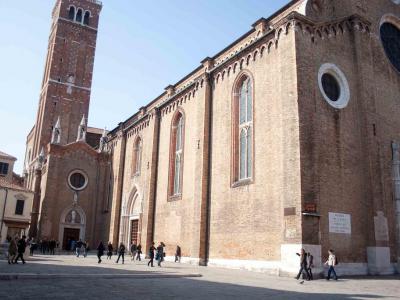
2) Basilica di Santa Maria Gloriosa dei Frari (Basilica of Glorious St. Mary of the Friars) (must see)
The Friars' Basilica, usually shortened by locals to just the “Frari,” sits a little away from the main tourist flow-and that already tells you something about Venice. The city’s second most important church, after St. Mark’s Basilica, is not on the main stage, but quietly holding its ground in a lived-in neighborhood. It doesn’t shout for attention, and it’s rarely swarmed. That restraint is misleading, because once inside, the Frari delivers one of the strongest artistic punches in the city.
The church was founded by the Franciscans in the late 13th century, and size was clearly not a concern. This is one of the largest churches in Venice, crowned by a brick bell tower that rises higher than all but St. Mark’s. Architecturally, it remains one of the few Venetian churches to keep a Gothic look-simple, sober, and almost blunt on the outside. A kind of vast brick container... What’s inside, however, is anything but restrained.
Indeed, the Frari is one of the best places in Venice to understand why Titian mattered. His Assumption of the Virgin dominates the high altar, and it still feels radical: dramatic movement, bold color, and a vertical energy that pulls your eyes upward. Nearby hangs the Madonna di Ca’ Pesaro, another break from tradition, with the Virgin shifted off center, and the composition tilted in a way that once caused raised eyebrows. Add works by Bellini and Vivarini, and you start to see how Venetian painting evolved within these walls.
And art here is not limited to just paintings, either. Donatello’s wooden Saint John the Baptist stands with unsettling intensity. A finely carved 15th-century choir fills the space with quiet craftsmanship. Then there are the tombs-many of them extravagant, some deliberately unsettling. On one side of the nave lies Titian himself, who died of plague in 1576 and was granted a church burial when others were not. Opposite, the marble pyramid mausoleum of sculptor Antonio Canova contrasts sharply with the theatrical monument to Doge Giovanni Pesaro, held up by massive sculpted figures and filled with symbols of decay and power.
If you want to catch the details, a small guide or leaflet helps. And yes-make sure to cover your shoulders here, because even masterpieces have dress codes...
The church was founded by the Franciscans in the late 13th century, and size was clearly not a concern. This is one of the largest churches in Venice, crowned by a brick bell tower that rises higher than all but St. Mark’s. Architecturally, it remains one of the few Venetian churches to keep a Gothic look-simple, sober, and almost blunt on the outside. A kind of vast brick container... What’s inside, however, is anything but restrained.
Indeed, the Frari is one of the best places in Venice to understand why Titian mattered. His Assumption of the Virgin dominates the high altar, and it still feels radical: dramatic movement, bold color, and a vertical energy that pulls your eyes upward. Nearby hangs the Madonna di Ca’ Pesaro, another break from tradition, with the Virgin shifted off center, and the composition tilted in a way that once caused raised eyebrows. Add works by Bellini and Vivarini, and you start to see how Venetian painting evolved within these walls.
And art here is not limited to just paintings, either. Donatello’s wooden Saint John the Baptist stands with unsettling intensity. A finely carved 15th-century choir fills the space with quiet craftsmanship. Then there are the tombs-many of them extravagant, some deliberately unsettling. On one side of the nave lies Titian himself, who died of plague in 1576 and was granted a church burial when others were not. Opposite, the marble pyramid mausoleum of sculptor Antonio Canova contrasts sharply with the theatrical monument to Doge Giovanni Pesaro, held up by massive sculpted figures and filled with symbols of decay and power.
If you want to catch the details, a small guide or leaflet helps. And yes-make sure to cover your shoulders here, because even masterpieces have dress codes...
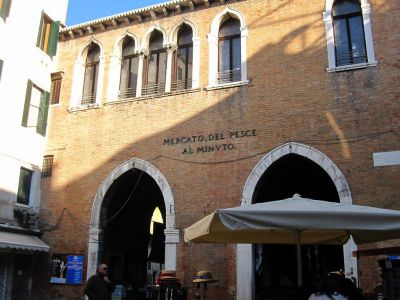
3) Mercatino Antiquariato Campo San Maurizio (Antiques Market)
Set your pace to unhurried, because the market in San Maurizio Square does not reward rushing. This is one of Venice’s longest-running open-air antique markets, and it feels perfectly at home in its setting. The square itself is compact but layered, framed by Gothic palaces like Bellavite, Molin, and Zaguri, with the neoclassical façade of the Church of San Maurizio presiding calmly over the scene. It’s the kind of square that seems to have been waiting centuries for tables of old objects to appear.
The market has been operating for decades, and it shows-in a good way. This isn’t a place for novelty souvenirs or fast selling. Collectors, seasoned dealers, locals, and quietly curious visitors all move at roughly the same tempo. The atmosphere is measured and conversational, closer to a scholarly exchange than a sales pitch. Most stalls are run by experienced dealers from Venice and northern Italy, people who prefer explaining an object’s history to haggling aggressively over its price.
What you won’t find here are oversized wardrobes or dramatic furniture pieces. What you will find are the things that fit in the hands and invite closer inspection: old books, prints, engravings, maps, postcards, clocks, devotional items, silverware, jewelry, Murano glass, and small, carefully chosen curiosities from roughly the 18th to early 20th centuries. The conversations drift naturally toward materials, techniques, and provenance, with bargaining kept polite, informed, and refreshingly low-key.
The real charm of the Mercatino lies in how seamlessly it blends into the square. Nautical motifs, travel documents, and printed ephemera quietly echo Venice’s maritime and diplomatic past, without ever spelling it out. Held on selected weekends in April, June, September, October, and December, this market offers a tactile, grounded way to connect with the city’s layered history-one object, one conversation, and one unhurried glance at a time...
The market has been operating for decades, and it shows-in a good way. This isn’t a place for novelty souvenirs or fast selling. Collectors, seasoned dealers, locals, and quietly curious visitors all move at roughly the same tempo. The atmosphere is measured and conversational, closer to a scholarly exchange than a sales pitch. Most stalls are run by experienced dealers from Venice and northern Italy, people who prefer explaining an object’s history to haggling aggressively over its price.
What you won’t find here are oversized wardrobes or dramatic furniture pieces. What you will find are the things that fit in the hands and invite closer inspection: old books, prints, engravings, maps, postcards, clocks, devotional items, silverware, jewelry, Murano glass, and small, carefully chosen curiosities from roughly the 18th to early 20th centuries. The conversations drift naturally toward materials, techniques, and provenance, with bargaining kept polite, informed, and refreshingly low-key.
The real charm of the Mercatino lies in how seamlessly it blends into the square. Nautical motifs, travel documents, and printed ephemera quietly echo Venice’s maritime and diplomatic past, without ever spelling it out. Held on selected weekends in April, June, September, October, and December, this market offers a tactile, grounded way to connect with the city’s layered history-one object, one conversation, and one unhurried glance at a time...
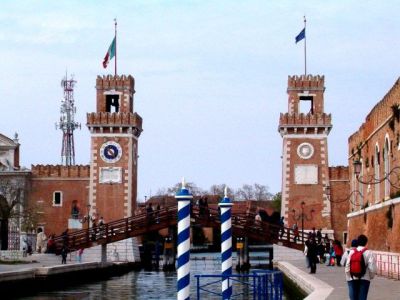
4) Arsenale di Venezia (Venetian Arsenal)
Venice owes much of its existence to a formidable fleet of ships that controlled the Eastern Mediterranean and the islands of Crete and Cyprus, which were constructed in the Arsenal ("Arsenale"), the world's first large-scale shipyard. Operating for an impressive seven centuries and occupying 15% of the city's landmass, the Arsenal employed over 2,000 workers at its peak.
Today, the Arsenal serves as a naval base for the Italian Navy and also serves as an exhibition space during the Venice Biennale. The best vantage point to admire the grandeur of the complex is from the wooden bridge at the end of the Fondamenta dell'Arsenale embankment. Guarded by four colossal stone lions, the imposing twin-tower entrance stands as a testament to the site's immense significance to the city. While plans are underway to transform the Arsenal into a cultural center, most of the area remains off-limits to the public and is only accessible during special exhibitions. However, a portion that can be visited can be reached from either of the two vaporetto stops, Celestia or Bacini Arsenale.
Why You Should Visit:
This site is truly awe-inspiring, with its remarkably preserved fortifications. The expansive area offers a more spacious and tranquil atmosphere, while still being surrounded by numerous bars and restaurants. The view from the bridge is simply stunning, presenting several picture-perfect spots for capturing memorable photos.
Tips:
A rare opportunity to explore the Arsenal is granted to the public during the Venice Biennale, held from June to November in odd-numbered years, when the space is transformed into an installation art venue. Otherwise, be sure to visit the Ships Pavilion or the Naval Museum ("Museo Storico Navale") on the opposite side of the channel to marvel at some fascinating historical boats.
Today, the Arsenal serves as a naval base for the Italian Navy and also serves as an exhibition space during the Venice Biennale. The best vantage point to admire the grandeur of the complex is from the wooden bridge at the end of the Fondamenta dell'Arsenale embankment. Guarded by four colossal stone lions, the imposing twin-tower entrance stands as a testament to the site's immense significance to the city. While plans are underway to transform the Arsenal into a cultural center, most of the area remains off-limits to the public and is only accessible during special exhibitions. However, a portion that can be visited can be reached from either of the two vaporetto stops, Celestia or Bacini Arsenale.
Why You Should Visit:
This site is truly awe-inspiring, with its remarkably preserved fortifications. The expansive area offers a more spacious and tranquil atmosphere, while still being surrounded by numerous bars and restaurants. The view from the bridge is simply stunning, presenting several picture-perfect spots for capturing memorable photos.
Tips:
A rare opportunity to explore the Arsenal is granted to the public during the Venice Biennale, held from June to November in odd-numbered years, when the space is transformed into an installation art venue. Otherwise, be sure to visit the Ships Pavilion or the Naval Museum ("Museo Storico Navale") on the opposite side of the channel to marvel at some fascinating historical boats.

5) Giardini della Biennale (Biennale Gardens)
The inception of the Biennale Gardens dates back to the early 19th century when Napoleon Bonaparte orchestrated the reclamation of a marshy area in the eastern part of the city, transforming it into a public park. Today, outside of the bustling exhibition months, the gardens lie in a state of slumber, offering a serene respite.
These gardens house permanent pavilions representing various countries, showcasing the works of esteemed architects. Among these architectural marvels, the Austrian pavilion, a creation of Josef Hoffmann from the 1930s, stands tall, while the Finnish pavilion, designed by Alvar Aalto in the 1950s, exudes its own unique charm. The Netherlands pavilion, crafted by Gerrit Thomas Rietveld during the same era, adds to the eclectic mix, and the Venezuelan pavilion, completed in 1954, bears the mark of Carlo Scarpa. Dominating the landscape is the grand structure that once housed the Italian pavilion, now known as the Palace of Exhibitions ("Palazzo delle Esposizioni"), serving as a venue for international exhibitions. Preserving the legacy of the Biennale, the Greenhouse ("Serra dei Giardini"), standing alongside the Garibaldi Gardens, remains the oldest surviving building, having evolved into a delightful blend of a garden center and café.
For those unenthused by art but seeking solace in nature's embrace, the Biennale Gardens offer a rare opportunity in Venice to indulge in leisurely strolls amidst lush greenery. Moreover, feline enthusiasts will find themselves captivated by the enchanting presence of cats that roam the vast expanse.
These gardens house permanent pavilions representing various countries, showcasing the works of esteemed architects. Among these architectural marvels, the Austrian pavilion, a creation of Josef Hoffmann from the 1930s, stands tall, while the Finnish pavilion, designed by Alvar Aalto in the 1950s, exudes its own unique charm. The Netherlands pavilion, crafted by Gerrit Thomas Rietveld during the same era, adds to the eclectic mix, and the Venezuelan pavilion, completed in 1954, bears the mark of Carlo Scarpa. Dominating the landscape is the grand structure that once housed the Italian pavilion, now known as the Palace of Exhibitions ("Palazzo delle Esposizioni"), serving as a venue for international exhibitions. Preserving the legacy of the Biennale, the Greenhouse ("Serra dei Giardini"), standing alongside the Garibaldi Gardens, remains the oldest surviving building, having evolved into a delightful blend of a garden center and café.
For those unenthused by art but seeking solace in nature's embrace, the Biennale Gardens offer a rare opportunity in Venice to indulge in leisurely strolls amidst lush greenery. Moreover, feline enthusiasts will find themselves captivated by the enchanting presence of cats that roam the vast expanse.
