Custom Walk in Ohrid, North Macedonia by dinafreebird1_244c2f created on 2026-05-13
Guide Location: North Macedonia » Ohrid
Guide Type: Custom Walk
# of Sights: 7
Tour Duration: 2 Hour(s)
Travel Distance: 3.1 Km or 1.9 Miles
Share Key: HUM7W
Guide Type: Custom Walk
# of Sights: 7
Tour Duration: 2 Hour(s)
Travel Distance: 3.1 Km or 1.9 Miles
Share Key: HUM7W
How It Works
Please retrieve this walk in the GPSmyCity app. Once done, the app will guide you from one tour stop to the next as if you had a personal tour guide. If you created the walk on this website or come to the page via a link, please follow the instructions below to retrieve the walk in the app.
Retrieve This Walk in App
Step 1. Download the app "GPSmyCity: Walks in 1K+ Cities" on Apple App Store or Google Play Store.



Step 2. In the GPSmyCity app, download(or launch) the guide "Ohrid Map and Walking Tours".
Step 3. Tap the menu button located at upper right corner of the "Walks" screen and select "Retrieve custom walk". Enter the share key: HUM7W
1) Ohrid Main Square
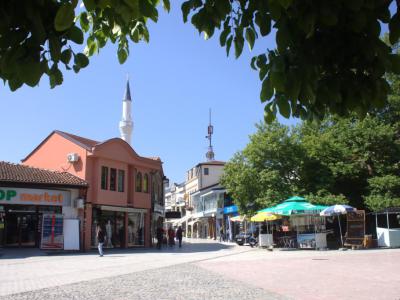
Ohrid Main Square is known as Krusevska Republika Square. It is not named for Nikita Kruschev, former leader of the Soviet Union. It is named instead in memory of the short-lived uprising against Ottoman rule in the town of Krusevo, Macedonia in 1903. There are several such squares in Macedonia. The Ohrid Main Square is one of them.
The Main Square opens up at the northern end of the Old Bazaar that reaches up from the waterfront. This is the touchstone of Ohrid. There are well tailored flower gardens, and walking spaces paved with marble.
Here is the home of the fabled Chinar tree, said to be 1,000 years old. Minarets and church steeples loom nearby.
The vibes in the square are friendly. Inviting shops and cafes line the edges. There are many comfortable vantage points from which to observe fascinating Ohrid.
The Main Square opens up at the northern end of the Old Bazaar that reaches up from the waterfront. This is the touchstone of Ohrid. There are well tailored flower gardens, and walking spaces paved with marble.
Here is the home of the fabled Chinar tree, said to be 1,000 years old. Minarets and church steeples loom nearby.
The vibes in the square are friendly. Inviting shops and cafes line the edges. There are many comfortable vantage points from which to observe fascinating Ohrid.
2) Church of St. Sophia (must see)
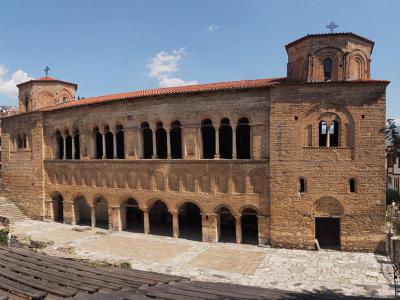
The Cathedral of Saint Sophia was built in Ohrid in the 9th century by Boris II. It was rebuilt in the 11th century and provided with a domed basilica by Archbishop Leo of Ohrid. A Great Feast mural adorns the nave.
In the recess of the apse the Virgin Enthroned holds her son in a protective mandorla. Christ prepares bread and wine below. On the walls behind the altar platform (the "bema") is a sequence of scenes from the lives of Abraham, Saint Basil the Great and Saint John Chrysostum. Above the alcove where sacerdotales are kept are scenes of martyrdoms.
The church was dedicated to Holy Wisdom ("Hagia Sofia"). It was built on the foundation of an early Christian basilica of the 5th century. In the 15th century the church was converted to a mosque. The precious frescoes were white-washed. During their regime, the Ottomans caused a lot of damage to the church.
After the Balkan Wars of 1912, Saint Sophia was returned to her role as an Orthodox Church and a conservation project was initiated. The frescoes were cleaned and rejuvenated and the church once again expressed the Byzantine world of the 11th century.
Every year the one-month Ohrid Summer Festival is opened by an operatic concert at Saint Sophia's. The first concert was in August, 1961. Inside the church, Macedonian opera star Ana Lipsha Tofovic and pianist Ladislav Peridic gave a bravura performance. It was a first for Ohrid and a first for the church.
In the recess of the apse the Virgin Enthroned holds her son in a protective mandorla. Christ prepares bread and wine below. On the walls behind the altar platform (the "bema") is a sequence of scenes from the lives of Abraham, Saint Basil the Great and Saint John Chrysostum. Above the alcove where sacerdotales are kept are scenes of martyrdoms.
The church was dedicated to Holy Wisdom ("Hagia Sofia"). It was built on the foundation of an early Christian basilica of the 5th century. In the 15th century the church was converted to a mosque. The precious frescoes were white-washed. During their regime, the Ottomans caused a lot of damage to the church.
After the Balkan Wars of 1912, Saint Sophia was returned to her role as an Orthodox Church and a conservation project was initiated. The frescoes were cleaned and rejuvenated and the church once again expressed the Byzantine world of the 11th century.
Every year the one-month Ohrid Summer Festival is opened by an operatic concert at Saint Sophia's. The first concert was in August, 1961. Inside the church, Macedonian opera star Ana Lipsha Tofovic and pianist Ladislav Peridic gave a bravura performance. It was a first for Ohrid and a first for the church.
3) Church of St. John at Kaneo (must see)
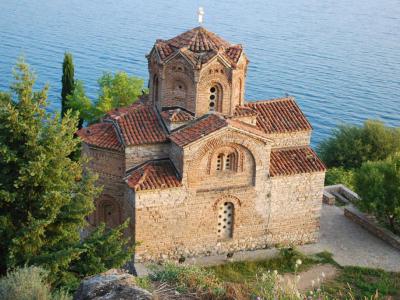
The Church of Saint John the Theologian sits on a cliff overlooking Kaneo Beach and Lake Ohrid. It is really next door to the Plaosnik Archeological Site and Saint Clement's Church. The John referred to is John of Patmos, credited to be the writer of Revelations. According to some historians, he may also have been John the Apostle.
It is not known precisely when the church was built. Certain documents indicate construction was perhaps in the 13th century, well before the rise of the Ottoman Empire which eventually engulfed Macedonia.
The church is laid out in a cruciform plan on a rectangular base. Unfortunately, the architect is not yet known. The church has a single dome. The roof cornice is unusual. It is neither flat nor undulating in the normal manner. It forms angled tympanums between a doorway lintel and the arch above. This is customary in the central Balkans.
Frescoes dating from the 1200s are intact in the dome apse. The naos niche contains bits from the Passion of Christ. The altar space holds scenes of the liturgy and the Worship of the Lamb. There are portraits of Saints Clement of Ohrid, Erasmus of Lychnidos and Constantine Cabasilas, Ohrid Archbishop in the 1260s.
Christ Pancrator is featured in a fresco in the church dome. The Church of Saint John is a pleasant walk from the fortress of Tsar Samoil downhill through the pine forest. The views of Lake Ohrid and the old town are sweeping and dramatic. For weary, hungry hikers there is no dearth of friendly restaurants at the water's edge.
It is not known precisely when the church was built. Certain documents indicate construction was perhaps in the 13th century, well before the rise of the Ottoman Empire which eventually engulfed Macedonia.
The church is laid out in a cruciform plan on a rectangular base. Unfortunately, the architect is not yet known. The church has a single dome. The roof cornice is unusual. It is neither flat nor undulating in the normal manner. It forms angled tympanums between a doorway lintel and the arch above. This is customary in the central Balkans.
Frescoes dating from the 1200s are intact in the dome apse. The naos niche contains bits from the Passion of Christ. The altar space holds scenes of the liturgy and the Worship of the Lamb. There are portraits of Saints Clement of Ohrid, Erasmus of Lychnidos and Constantine Cabasilas, Ohrid Archbishop in the 1260s.
Christ Pancrator is featured in a fresco in the church dome. The Church of Saint John is a pleasant walk from the fortress of Tsar Samoil downhill through the pine forest. The views of Lake Ohrid and the old town are sweeping and dramatic. For weary, hungry hikers there is no dearth of friendly restaurants at the water's edge.
4) King Samoil Fortress (must see)
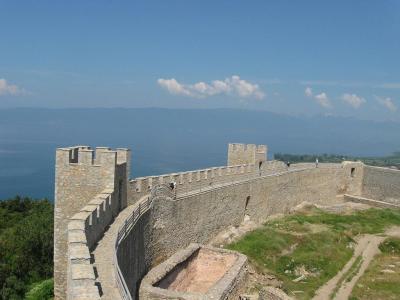
Ohrid fortress, popularly known as Tsar Samoil Fortress, is a restored medieval stronghold that occupies the top of Ohrid hill. The hill rises 328 feet above the waters of Lake Ohrid, giving the fort a commanding view over the lake, the city and surrounding countryside. The ramparts extend for two miles, varying in height from ten to 53 feet.
The fortress was built upon the ruins of an earlier fort built in the 4th century BC by none other than Philip II, King of Macedonia and father of Alexander the Great. King Samoil built his medieval style fortress on the remains of Philip's creation in the late 10th century AD.
Ohrid, known in ancient times as "Lychnidos", has been ruled by Romans, Byzantines, Slavs and Ottomans. They destroyed and rebuilt the fortress in turn several times. The fortress has served as a defensive asset and also as a residence. The citadel center is divided by a wall into two parts. The Emperor lived in one and soldiers in the other.
The wall surrounding this space has a row of towers. The main entrance is flanked by two semicircular keep-like defensive towers. The remaining part of the fort is wrapped by a defensive wall around a residential area for courtiers' families. In this second area is an ancient cemetery, the ruins of a donjon and a cistern.
Until the arrival of the Ottomans in 1395, the city was completely enclosed within the walls. Only the Upper and Lower Gates provided access to the town. After the Turkish involvement the town expanded beyond the walls. Christians were kept in the walled up hill section. The Ottoman quarter was outside on lower, more open ground.
In the year 2000 conservation and restoration efforts were started on the fort. The walls and towers of the citadel were repaired and preserved. From the archeological complex of Plaosnik there is a wooded path to the citadel. Admission is free.
The fortress was built upon the ruins of an earlier fort built in the 4th century BC by none other than Philip II, King of Macedonia and father of Alexander the Great. King Samoil built his medieval style fortress on the remains of Philip's creation in the late 10th century AD.
Ohrid, known in ancient times as "Lychnidos", has been ruled by Romans, Byzantines, Slavs and Ottomans. They destroyed and rebuilt the fortress in turn several times. The fortress has served as a defensive asset and also as a residence. The citadel center is divided by a wall into two parts. The Emperor lived in one and soldiers in the other.
The wall surrounding this space has a row of towers. The main entrance is flanked by two semicircular keep-like defensive towers. The remaining part of the fort is wrapped by a defensive wall around a residential area for courtiers' families. In this second area is an ancient cemetery, the ruins of a donjon and a cistern.
Until the arrival of the Ottomans in 1395, the city was completely enclosed within the walls. Only the Upper and Lower Gates provided access to the town. After the Turkish involvement the town expanded beyond the walls. Christians were kept in the walled up hill section. The Ottoman quarter was outside on lower, more open ground.
In the year 2000 conservation and restoration efforts were started on the fort. The walls and towers of the citadel were repaired and preserved. From the archeological complex of Plaosnik there is a wooded path to the citadel. Admission is free.
5) Ancient Theatre of Ohrid (must see)
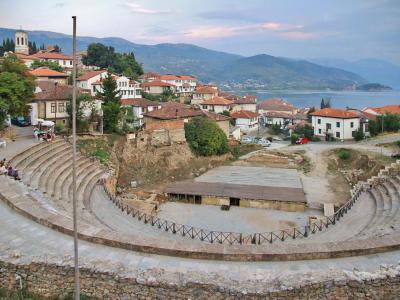
The Ancient Theatre of Ohrid is a remarkable Hellenistic-period relic, dating back to 200 BC. It holds the distinction of being the only theater of its type in the country, contrasting with the Roman-era theaters found in Scupi, Stobi, and Heraklea Lynkestis. Originally designed to host a considerable audience, only the lower section of the theater survives today, making it difficult to ascertain its full capacity.
Strategically nestled between two hills, the theater's location is ideal, providing natural wind protection which enhances its acoustics, a feature crucial for the live performances it was built to host. During the Roman era, the theater’s purpose expanded to include gladiator fights and it also served as a venue for executing Christians, which led to its growing unpopularity among the local populace. This disfavor ultimately resulted in the theater being buried by the locals following the fall of the Roman Empire, an act which inadvertently preserved much of its structure.
The theater remained hidden until the 1980s when it was accidentally uncovered during construction activities in the area. Discoveries of large stone blocks engraved with depictions of the Greek god Dionysus and the muses suggested the presence of a significant Greek cultural site, leading to its excavation.
Revived in the late 1980s, the Ancient Theatre of Ohrid has been reintegrated into cultural life, hosting a variety of public performances including plays, concerts, operas, and ballet. It has also become a prestigious venue within the Ohrid Summer Festival, attracting international performances from renowned groups and artists like the Bolshoi and José Carreras. This historical site not only serves as a testament to the architectural and cultural achievements of ancient times but also as a vibrant center of contemporary cultural expression.
Strategically nestled between two hills, the theater's location is ideal, providing natural wind protection which enhances its acoustics, a feature crucial for the live performances it was built to host. During the Roman era, the theater’s purpose expanded to include gladiator fights and it also served as a venue for executing Christians, which led to its growing unpopularity among the local populace. This disfavor ultimately resulted in the theater being buried by the locals following the fall of the Roman Empire, an act which inadvertently preserved much of its structure.
The theater remained hidden until the 1980s when it was accidentally uncovered during construction activities in the area. Discoveries of large stone blocks engraved with depictions of the Greek god Dionysus and the muses suggested the presence of a significant Greek cultural site, leading to its excavation.
Revived in the late 1980s, the Ancient Theatre of Ohrid has been reintegrated into cultural life, hosting a variety of public performances including plays, concerts, operas, and ballet. It has also become a prestigious venue within the Ohrid Summer Festival, attracting international performances from renowned groups and artists like the Bolshoi and José Carreras. This historical site not only serves as a testament to the architectural and cultural achievements of ancient times but also as a vibrant center of contemporary cultural expression.
6) Old Bazaar Street
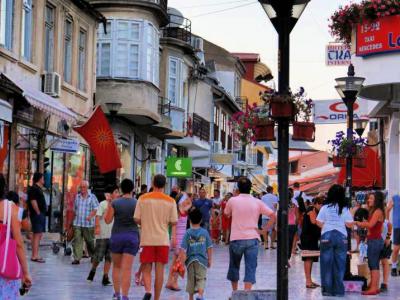
The Old Bazaar ain't what it used to be. Or perhaps it never was a world-class market place. Ohrid has always been a religious and cultural center more then anything else. It shines not as a center for trade. So the bazaar is simple. It is just one street extending up from the waterfront to the Main Square of town, not a great distance.
The bazaar extends from the Square downhill to the waterfront or it reaches the square from the shore of Lake Ohrid, whichever way one chooses. It is a walk, no cars. The street is variously paved with cobblestones in the narrow parts or with marble slates in the wider parts. In olden times, the street was covered with grape vines for shade.
Starting from the Main Square, one passes through the food market (formerly an animal market). The few original stores of the bazaar are made of stone. The Ohrid market provides a very different experience than that of Greek or Serbian markets. The open market is not noisy. The merchants sell their foods with a calm not found elsewhere.
After the food market is the Turkish bazaar. Here are kebabs, baklava, Turkish delights, and other foods in the Ottoman legacy. Shoemakers, barbers, leather shops, pearl makers and various other crafts may satisfy the pleasant needs of everyday.
The bazaar extends from the Square downhill to the waterfront or it reaches the square from the shore of Lake Ohrid, whichever way one chooses. It is a walk, no cars. The street is variously paved with cobblestones in the narrow parts or with marble slates in the wider parts. In olden times, the street was covered with grape vines for shade.
Starting from the Main Square, one passes through the food market (formerly an animal market). The few original stores of the bazaar are made of stone. The Ohrid market provides a very different experience than that of Greek or Serbian markets. The open market is not noisy. The merchants sell their foods with a calm not found elsewhere.
After the food market is the Turkish bazaar. Here are kebabs, baklava, Turkish delights, and other foods in the Ottoman legacy. Shoemakers, barbers, leather shops, pearl makers and various other crafts may satisfy the pleasant needs of everyday.
7) Ali Pasha Mosque
Within the Old Bazaar of Ohrid the Ali Pasha Mosque lies. It is nearly on the Main Square, close to the 1,000-year old Chinar tree. The fountain in the square sprays and gushes. Many, many years have gone by. The history of the mosque is shorter than that of the tree, but it is long.
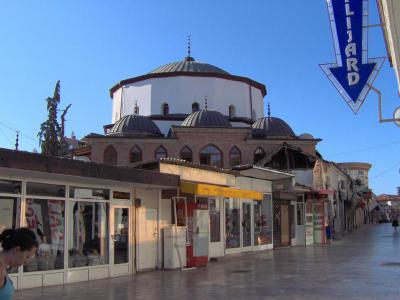
The Mosque was built in 1573 by Sulejman Pasha. It was intended as a place of worship and as a secondary school. A reliquary of the bygone rule of the Ottomans, the Mosque is one of the first mosques to be built in Macedonia.
The mosque is constructed of stone and fired brick. There were two minarets. One located on the south side of the mosque was demolished in 1912. The mosque was built with a central dome and an entrance hall covered with three domes. There is a tall minaret on the side. At times, the Square reverberates to the Adzan call to prayer.
Included within the mosque compound are a Turkish bath and a mausoleum. Renovations and restorations have been carried out in recent years by the Turkish Directorate General of Foundations.
The Mosque was built in 1573 by Sulejman Pasha. It was intended as a place of worship and as a secondary school. A reliquary of the bygone rule of the Ottomans, the Mosque is one of the first mosques to be built in Macedonia.
The mosque is constructed of stone and fired brick. There were two minarets. One located on the south side of the mosque was demolished in 1912. The mosque was built with a central dome and an entrance hall covered with three domes. There is a tall minaret on the side. At times, the Square reverberates to the Adzan call to prayer.
Included within the mosque compound are a Turkish bath and a mausoleum. Renovations and restorations have been carried out in recent years by the Turkish Directorate General of Foundations.
