Custom Walk in Manchester, England by leonsmit_private_6b6cf created on 2026-05-14
Guide Location: England » Manchester
Guide Type: Custom Walk
# of Sights: 15
Tour Duration: 3 Hour(s)
Travel Distance: 4.8 Km or 3 Miles
Share Key: SHXU8
Guide Type: Custom Walk
# of Sights: 15
Tour Duration: 3 Hour(s)
Travel Distance: 4.8 Km or 3 Miles
Share Key: SHXU8
How It Works
Please retrieve this walk in the GPSmyCity app. Once done, the app will guide you from one tour stop to the next as if you had a personal tour guide. If you created the walk on this website or come to the page via a link, please follow the instructions below to retrieve the walk in the app.
Retrieve This Walk in App
Step 1. Download the app "GPSmyCity: Walks in 1K+ Cities" on Apple App Store or Google Play Store.



Step 2. In the GPSmyCity app, download(or launch) the guide "Manchester Map and Walking Tours".
Step 3. Tap the menu button located at upper right corner of the "Walks" screen and select "Retrieve custom walk". Enter the share key: SHXU8
1) Chinatown
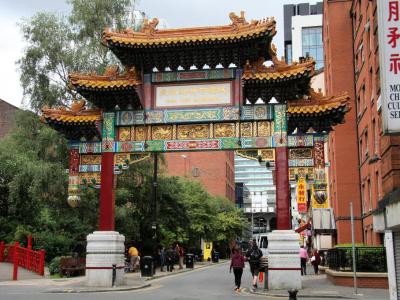
Manchester’s Chinatown is a compact district shaped by migration from the mid-twentieth century onward, developing into one of the largest Chinese communities in Europe. The area combines restaurants, bakeries, supermarkets, and cultural associations arranged along a network of short streets. Its character reflects layers of influence from mainland China, Hong Kong, and Southeast Asia, expressed through signage, food traditions, and community events.
The most recognisable feature is the ornate paifang arch at the heart of the district. Built in the 1980s, it was assembled from materials crafted in China and decorated with carved dragons, guardian lions, and bright lacquered surfaces. The arch marks the symbolic entrance to the neighbourhood and serves as a focal point during celebrations. Its placement reflects the community’s effort to establish a visible cultural landmark within the wider city.
Shops and eateries cluster around the streets leading from the arch. Menus often combine Cantonese, Sichuan, regional northern dishes, and contemporary fusion options, showing the diverse backgrounds of the families who established the area. Supermarkets stock imported ingredients, herbal products, and festival goods, many arranged in narrow aisles that echo older trading patterns.
Window displays frequently change with the lunar calendar, highlighting food traditions and seasonal themes. During events such as Lunar New Year, the district becomes a gathering place for lion dances, music, and street stalls.
The most recognisable feature is the ornate paifang arch at the heart of the district. Built in the 1980s, it was assembled from materials crafted in China and decorated with carved dragons, guardian lions, and bright lacquered surfaces. The arch marks the symbolic entrance to the neighbourhood and serves as a focal point during celebrations. Its placement reflects the community’s effort to establish a visible cultural landmark within the wider city.
Shops and eateries cluster around the streets leading from the arch. Menus often combine Cantonese, Sichuan, regional northern dishes, and contemporary fusion options, showing the diverse backgrounds of the families who established the area. Supermarkets stock imported ingredients, herbal products, and festival goods, many arranged in narrow aisles that echo older trading patterns.
Window displays frequently change with the lunar calendar, highlighting food traditions and seasonal themes. During events such as Lunar New Year, the district becomes a gathering place for lion dances, music, and street stalls.
2) Former National Westminster Bank
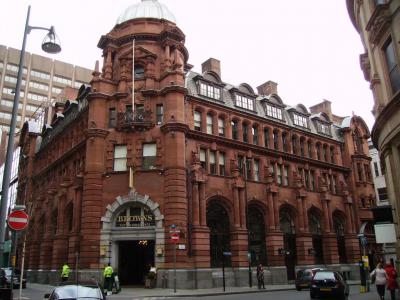
The former National Westminster Bank building in Spring Gardens, Manchester, stands as a prominent example of Edwardian architectural elegance. Constructed in 1902, originally for Parr's Bank, this structure was designed by Charles Heathcote. It reflects a bold Edwardian Baroque style and has been recognized for its architectural significance as a Grade II* listed building since January 4, 1972.
The building's exterior is crafted from red sandstone and is distinguished by a corner tower topped with a cupola. It features Doric columns that support ornamental brackets rather than structural elements and hooded gables that add to its grandeur. One of the most striking features of the bank is its vast plate glass windows, designed to flood the banking hall with light. These windows include large round-headed panes filling the width of each bay, with molded heads, scrolled keystones, and plate-glass glazing adorned with enriched bronze 'ferramenta'. The design incorporates a horizontal mid-panel, bottom panels with stained glass, and arched upper lights with margin panes.
Internally, the bank's foyer is richly decorated with mahogany paneling, and the main banking hall is lined with walls of green marble, making it one of the most opulent interiors of its time not only in Manchester but also comparable to those in London. The original stained glass and intricate Art Nouveau ironwork on the exterior further enhance its aesthetic and historical value.
As of February 2024, this historical building has taken on a new life as a Browns brasserie and bar, continuing its legacy while serving a modern function in the heart of Manchester.
The building's exterior is crafted from red sandstone and is distinguished by a corner tower topped with a cupola. It features Doric columns that support ornamental brackets rather than structural elements and hooded gables that add to its grandeur. One of the most striking features of the bank is its vast plate glass windows, designed to flood the banking hall with light. These windows include large round-headed panes filling the width of each bay, with molded heads, scrolled keystones, and plate-glass glazing adorned with enriched bronze 'ferramenta'. The design incorporates a horizontal mid-panel, bottom panels with stained glass, and arched upper lights with margin panes.
Internally, the bank's foyer is richly decorated with mahogany paneling, and the main banking hall is lined with walls of green marble, making it one of the most opulent interiors of its time not only in Manchester but also comparable to those in London. The original stained glass and intricate Art Nouveau ironwork on the exterior further enhance its aesthetic and historical value.
As of February 2024, this historical building has taken on a new life as a Browns brasserie and bar, continuing its legacy while serving a modern function in the heart of Manchester.
3) Piccadilly Gardens
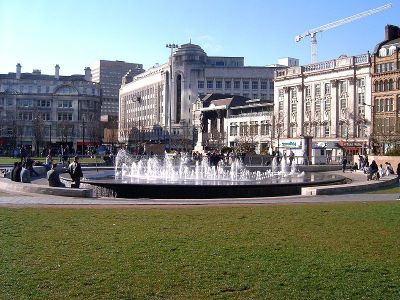
Piccadilly Gardens is an open public space shaped by several phases of redesign during the twentieth and early twenty-first centuries. What was once part of a former infirmary site evolved into a central meeting point with a mix of green areas, paved paths, and transport links. Its layout reflects changing ideas about public squares-combining open lawns with routes that support steady pedestrian movement.
The gardens include a broad lawn bordered by trees, with paths that cut across at practical angles rather than decorative ones. These routes follow the natural flow of foot traffic between nearby transport hubs, shops, and cultural venues. Seating areas are arranged along the edges, giving clear views across the open centre. The mixture of grass, stone, and water features shows an attempt to balance green space with durable surfaces suited for heavy daily use.
At one side stands a long concrete wall installed during a major redevelopment at the beginning of the century. Its straight lines and pale surface contrast with the softer elements of the gardens. Nearby fountains form a grid of low water jets set directly into the pavement. Their shallow design creates a changing soundscape and a gathering point, especially in warmer months.
Events and temporary installations often appear in the open sections, turning the space into a flexible site for public activity.
The gardens include a broad lawn bordered by trees, with paths that cut across at practical angles rather than decorative ones. These routes follow the natural flow of foot traffic between nearby transport hubs, shops, and cultural venues. Seating areas are arranged along the edges, giving clear views across the open centre. The mixture of grass, stone, and water features shows an attempt to balance green space with durable surfaces suited for heavy daily use.
At one side stands a long concrete wall installed during a major redevelopment at the beginning of the century. Its straight lines and pale surface contrast with the softer elements of the gardens. Nearby fountains form a grid of low water jets set directly into the pavement. Their shallow design creates a changing soundscape and a gathering point, especially in warmer months.
Events and temporary installations often appear in the open sections, turning the space into a flexible site for public activity.
4) 50 Newton Street
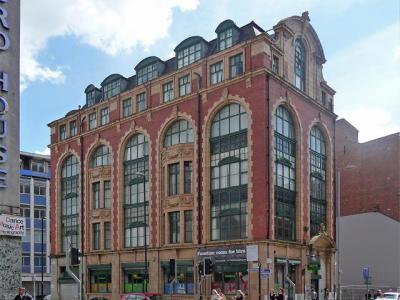
50 Newton Street is a historic Grade II listed building situated in Manchester, specifically located in the vibrant Northern Quarter. This former warehouse, built between 1906 and 1908, replaced a hat factory that was destroyed by fire in 1906. The building was designed by Charles Clegg & Son, who infused the structure with distinctive flair and panache. Characterized by its "Free Baroque" architectural style, it has been acknowledged by English Heritage for its unique design elements that stand out in the urban landscape.
As we look ahead to 2024, there are significant developments planned for 50 Newton Street. The building is set to undergo a comprehensive renovation led by Sean Boyd of Boyd & Company Capital Investments Limited. This restoration aims to preserve the historical essence of the building while adapting it to contemporary uses, ensuring that it continues to be a vital part of Manchester’s architectural heritage.
As we look ahead to 2024, there are significant developments planned for 50 Newton Street. The building is set to undergo a comprehensive renovation led by Sean Boyd of Boyd & Company Capital Investments Limited. This restoration aims to preserve the historical essence of the building while adapting it to contemporary uses, ensuring that it continues to be a vital part of Manchester’s architectural heritage.
5) London Road Fire Station
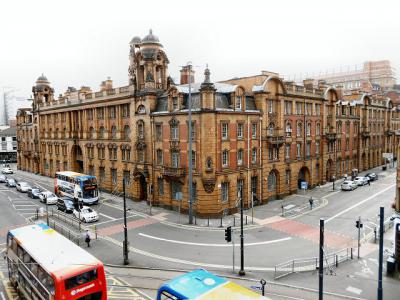
London Road Fire Station in Manchester is a notable example of Edwardian Baroque architecture. Designed by Woodhouse, Willoughby, and Langham, the fire station opened in 1906 and features red brick and terracotta construction. The building complex, situated at a prime location bordered by London Road, Whitworth Street, Minshull Street South, and Fairfield Street, has been a Grade II* listed building since 1974.
Originally built by J. Gerrard and Sons of Swinton, London Road Fire Station was more than just a fire station; it included a police station, an ambulance station, a bank, a coroner's court, and a gas-meter testing station. The station served as a comprehensive civic facility housing not only firemen and their families but also providing essential services to the community. Initially equipped with horse-drawn fire appliances, the station transitioned to motorized vehicles shortly after its opening.
During its operational years, the fire station was significant in the community, especially during World War II when it was visited by royalty in 1942 to honor the brigade's efforts. Post-war, it evolved into a training center and became notable in 1952 as the first center equipped to record emergency calls. The building also served as the headquarters for the Manchester Fire Brigade until 1974, after which the Greater Manchester Fire Service took over, leading to its eventual closure in 1986.
After closing, the building fell into a period of decline and was largely unused, prompting its placement on English Heritage's Buildings at Risk Register in 2001. A significant turning point came in 2010 when Manchester City Council issued a compulsory purchase order to Britannia Hotels, which had left the building derelict for nearly 30 years. The building was finally sold to Allied London in 2015, and in 2018, redevelopment work began to transform the site into a mixed-use facility focusing on leisure and hotel amenities, aiming to restore its historic grandeur and utility.
Originally built by J. Gerrard and Sons of Swinton, London Road Fire Station was more than just a fire station; it included a police station, an ambulance station, a bank, a coroner's court, and a gas-meter testing station. The station served as a comprehensive civic facility housing not only firemen and their families but also providing essential services to the community. Initially equipped with horse-drawn fire appliances, the station transitioned to motorized vehicles shortly after its opening.
During its operational years, the fire station was significant in the community, especially during World War II when it was visited by royalty in 1942 to honor the brigade's efforts. Post-war, it evolved into a training center and became notable in 1952 as the first center equipped to record emergency calls. The building also served as the headquarters for the Manchester Fire Brigade until 1974, after which the Greater Manchester Fire Service took over, leading to its eventual closure in 1986.
After closing, the building fell into a period of decline and was largely unused, prompting its placement on English Heritage's Buildings at Risk Register in 2001. A significant turning point came in 2010 when Manchester City Council issued a compulsory purchase order to Britannia Hotels, which had left the building derelict for nearly 30 years. The building was finally sold to Allied London in 2015, and in 2018, redevelopment work began to transform the site into a mixed-use facility focusing on leisure and hotel amenities, aiming to restore its historic grandeur and utility.
6) Asia House
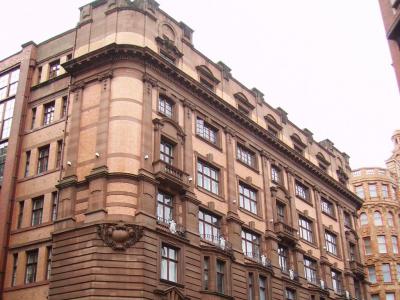
Asia House on Princess Street in Manchester stands as a notable historical building from the early 20th century. Constructed between 1906 and 1909, it exemplifies Edwardian Baroque architecture and has been recognized as a Grade II* listed building since October 3, 1974. Originally a packing and shipping warehouse designed for the Refuge Assurance Company, it served multiple shipping merchants, such as the Oxford Packing Company, and housed 36 shipping merchants by 1910.
The building was designed by I.R.E. Birkett, according to architectural historian Nikolaus Pevsner in his book The Buildings of England. However, English Heritage attributes the design to Harry S. Fairhurst. Asia House is particularly noted for its lavish interiors, including an "exceptionally rich" entrance hall and stairwell adorned with veined marble, green and cream faience, Art Nouveau stained glass, and tree motifs.
The structure of Asia House is built on a trapezoidal plan and consists of two linked blocks, each rising six stories high plus an attic above a double basement. Its facade is constructed with pink-brown sandstone, brick, and marble. The side and rear elevations feature glazed white brick and common brick, respectively. Originally, the warehouse had loading bays situated between the blocks, connected to packing rooms in the basement via shafts. These areas facilitated the movement of goods, which were then dispatched after being packed into bales using hydraulic presses powered by Manchester's hydraulic power system. The building was illuminated by gas.
Reflecting changes in urban utilization, Asia House was converted into residential units in 2003, with its basement repurposed as a car park. It has been home to notable residents, including Noel Gallagher, the famed singer-songwriter from the band Oasis. Asia House remains a prime example of Manchester's rich industrial heritage and its adaptation to modern urban living.
The building was designed by I.R.E. Birkett, according to architectural historian Nikolaus Pevsner in his book The Buildings of England. However, English Heritage attributes the design to Harry S. Fairhurst. Asia House is particularly noted for its lavish interiors, including an "exceptionally rich" entrance hall and stairwell adorned with veined marble, green and cream faience, Art Nouveau stained glass, and tree motifs.
The structure of Asia House is built on a trapezoidal plan and consists of two linked blocks, each rising six stories high plus an attic above a double basement. Its facade is constructed with pink-brown sandstone, brick, and marble. The side and rear elevations feature glazed white brick and common brick, respectively. Originally, the warehouse had loading bays situated between the blocks, connected to packing rooms in the basement via shafts. These areas facilitated the movement of goods, which were then dispatched after being packed into bales using hydraulic presses powered by Manchester's hydraulic power system. The building was illuminated by gas.
Reflecting changes in urban utilization, Asia House was converted into residential units in 2003, with its basement repurposed as a car park. It has been home to notable residents, including Noel Gallagher, the famed singer-songwriter from the band Oasis. Asia House remains a prime example of Manchester's rich industrial heritage and its adaptation to modern urban living.
7) Canada House
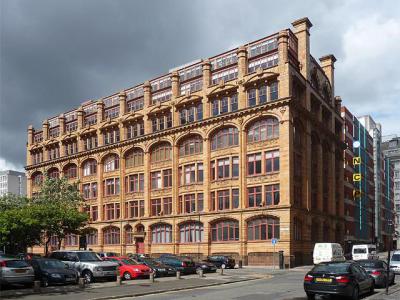
Canada House is a significant historical and architectural landmark in Manchester. Constructed in 1908-09 by W.G. Higginbottom, it was initially built for J.S. Booth and Company, a prominent textile firm, as part of a cluster of buildings known as Princes Buildings (A, B, C, and D). The building is situated on Chepstow Street and is recognized as a Grade II listed structure, highlighting its importance in architectural and cultural heritage.
Historically, the area where Canada House stands was undeveloped fields until the early 19th century. The construction of the nearby Rochdale Canal in 1804 catalyzed urban expansion towards this part of Manchester, transforming it into an industrial quarter specializing in iron, glass, and marble works. This development also included slum dwellings for workers and other warehouses, among them Canada House.
Architecturally, Canada House is designed in the Art Nouveau style, retaining many of its original features which contribute to its distinct character. The building comprises six floors and a basement, designed for multifunctional use. The western side of the building features elaborate and flexible office spaces, while the eastern side, facing a canal spur, was originally used for cloth processing.
In recent years, Canada House has been refurbished by Kinrise, who transformed it into a modern office space while respecting its architectural heritage. The building now hosts 24 resident businesses, including several in the digital and creative industries, and operates at full capacity. It has been equipped with new amenities such as the Clink Café, screening and meeting rooms, and co-working spaces.
Strategically located near important cultural and educational institutions like the Central Library and Archive, Greater Manchester Central Convention Centre, Manchester University, and Manchester Metropolitan University, Canada House remains a vibrant part of Manchester’s cultural and entertainment district. Its proximity to significant venues like the Palace Theatre, Bridgewater Hall, Manchester HOME, and Manchester Art Gallery, along with numerous historic pubs, underscores its standing as a central and lively spot in the city.
Historically, the area where Canada House stands was undeveloped fields until the early 19th century. The construction of the nearby Rochdale Canal in 1804 catalyzed urban expansion towards this part of Manchester, transforming it into an industrial quarter specializing in iron, glass, and marble works. This development also included slum dwellings for workers and other warehouses, among them Canada House.
Architecturally, Canada House is designed in the Art Nouveau style, retaining many of its original features which contribute to its distinct character. The building comprises six floors and a basement, designed for multifunctional use. The western side of the building features elaborate and flexible office spaces, while the eastern side, facing a canal spur, was originally used for cloth processing.
In recent years, Canada House has been refurbished by Kinrise, who transformed it into a modern office space while respecting its architectural heritage. The building now hosts 24 resident businesses, including several in the digital and creative industries, and operates at full capacity. It has been equipped with new amenities such as the Clink Café, screening and meeting rooms, and co-working spaces.
Strategically located near important cultural and educational institutions like the Central Library and Archive, Greater Manchester Central Convention Centre, Manchester University, and Manchester Metropolitan University, Canada House remains a vibrant part of Manchester’s cultural and entertainment district. Its proximity to significant venues like the Palace Theatre, Bridgewater Hall, Manchester HOME, and Manchester Art Gallery, along with numerous historic pubs, underscores its standing as a central and lively spot in the city.
8) Manchester Central Library
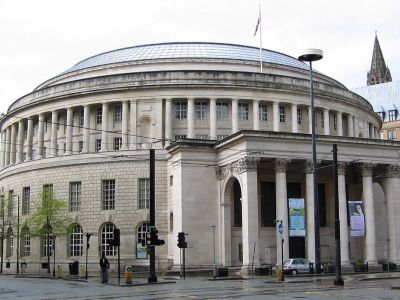
Manchester Central Library, located in Manchester, serves as the main hub for the city's library and information service. This iconic building, facing Saint Peter's Square, is a testament to the architectural vision of E. Vincent Harris. Constructed between 1930 and 1934, the design of the library draws inspiration from the Pantheon in Rome, featuring a rotunda and a domed structure. Its classical influence was well received at its opening, with one critic lauding it as a convincing argument for the "perennial applicability of the Classical canon."
The building itself is listed as grade II*, denoting it as particularly significant and more than merely of local interest. The architecture includes a two-story portico with Corinthian columns, fronting a round structure surrounded by a Tuscan colonnade. This colonnade is crowned with a band of unrelieved Portland stone, and despite the appearance of a domed roof from street level, the actual dome is concealed within, visible only from the Great Hall inside.
The interior of the library is equally majestic, with the Great Hall being a focal point on the first floor. This vast reading room is topped by the hidden dome and features original furniture designed by Harris. Inscriptions from the Book of Proverbs adorn the dome's rim, adding a literary grace to the structural elegance. The library holds the distinction of being the second-largest public lending library in Britain, following only the Library of Birmingham.
Previously, beneath the Great Hall, the library housed four floors of steel book stacks that provided 35 miles of shelving and held over one million books, accessible only to staff and controlled to preserve delicate materials. After extensive renovations from 2010 to 2014, which included the modernization and refurbishment of these spaces, many of these books have been moved to publicly accessible areas, excluding rare and fragile items.
The collections at Manchester Central Library are notable, comprising over 30 incunabula and numerous first and early editions of significant works, making it a treasure trove for both casual readers and academic researchers alike. The library reopened on March 22, 2014, after its transformative refurbishment, continuing its legacy as a cornerstone of cultural and literary life in Manchester.
The building itself is listed as grade II*, denoting it as particularly significant and more than merely of local interest. The architecture includes a two-story portico with Corinthian columns, fronting a round structure surrounded by a Tuscan colonnade. This colonnade is crowned with a band of unrelieved Portland stone, and despite the appearance of a domed roof from street level, the actual dome is concealed within, visible only from the Great Hall inside.
The interior of the library is equally majestic, with the Great Hall being a focal point on the first floor. This vast reading room is topped by the hidden dome and features original furniture designed by Harris. Inscriptions from the Book of Proverbs adorn the dome's rim, adding a literary grace to the structural elegance. The library holds the distinction of being the second-largest public lending library in Britain, following only the Library of Birmingham.
Previously, beneath the Great Hall, the library housed four floors of steel book stacks that provided 35 miles of shelving and held over one million books, accessible only to staff and controlled to preserve delicate materials. After extensive renovations from 2010 to 2014, which included the modernization and refurbishment of these spaces, many of these books have been moved to publicly accessible areas, excluding rare and fragile items.
The collections at Manchester Central Library are notable, comprising over 30 incunabula and numerous first and early editions of significant works, making it a treasure trove for both casual readers and academic researchers alike. The library reopened on March 22, 2014, after its transformative refurbishment, continuing its legacy as a cornerstone of cultural and literary life in Manchester.
9) Free Trade Hall
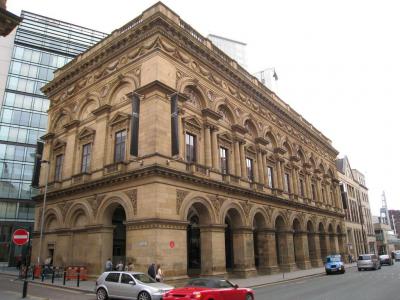
The Free Trade Hall is located on Peter Street, close to the Manchester Opera House in Manchester City Centre. It was built on Saint Peter’s Fields in 1856. The fields are famous in Mancunian folklore as the site of the Peterloo Massacre. In 1819, the fields were the site for a mass political demonstration, which was ended by brutal military invention, resulting in fifteen deaths. The massacre was a watershed for the city of Manchester, which grew into a more prosperous and democratic settlement in the following fifty years.
A large public concert hall, the Free Trade Hall was built to commemorate the repealing of the Corn Laws in 1846, which opened up the United Kingdom to free trade. Despite damage during the Blitz and declining audiences in recent years, the hall was Manchester’s premier classical concert venue until the opening of Bridgewater Hall in 1996. The hall has also hosted famous rock artists, including Bob Dylan and the Sex Pistols, whilst a young Winston Churchill gave a speech at the hall in 1904.
The Grade II listed building, designed in the Italian cinquecento style, now houses a hotel. The ground floor and stairwells still display artifacts from the hall’s heyday, including the coats of arms of Lancashire towns which fought the Corn Laws 150 years ago.
A large public concert hall, the Free Trade Hall was built to commemorate the repealing of the Corn Laws in 1846, which opened up the United Kingdom to free trade. Despite damage during the Blitz and declining audiences in recent years, the hall was Manchester’s premier classical concert venue until the opening of Bridgewater Hall in 1996. The hall has also hosted famous rock artists, including Bob Dylan and the Sex Pistols, whilst a young Winston Churchill gave a speech at the hall in 1904.
The Grade II listed building, designed in the Italian cinquecento style, now houses a hotel. The ground floor and stairwells still display artifacts from the hall’s heyday, including the coats of arms of Lancashire towns which fought the Corn Laws 150 years ago.
10) Statue of Prince Albert
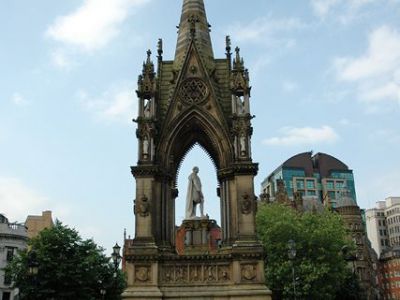
The memorial to Prince Albert is the largest and most distinctive of the many statues and monuments that stand in Manchester's Albert Square. A green square of open space facing Manchester Town Hall, the public gardens hold statues of locally and nationally significant figures, and a fountain built to celebrate Queen Victoria's diamond jubilee. Prince Albert, Victoria’s husband was a popular member of the royal family, held in particularly high regard for his anti-slavery campaigning. The Queen famously mourned the death of her husband until her death some forty years later, in 1901. The surrounding square, amongst countless other places and buildings in the UK, also bears his name.
The statue depicts the former Prince Consort in military regalia, designed by Matthew Noble, and was erected in 1867. Victoria herself approved the statue of her late husband, Prince Albert, who died of typhoid fever at just 42 years of age. The statue is surrounded by an unusual, ornate stone archway, known as a ciborium. The surround was conceived by architect Thomas Worthington, possibly inspired by the similarly ornate Walter Scott monument in Edinburgh. The carved figures on the arch represent the four arts, the four continents of the world, the four agricultural seasons and the four sciences – mathematics, astronomy, chemistry and mechanics.
The statue depicts the former Prince Consort in military regalia, designed by Matthew Noble, and was erected in 1867. Victoria herself approved the statue of her late husband, Prince Albert, who died of typhoid fever at just 42 years of age. The statue is surrounded by an unusual, ornate stone archway, known as a ciborium. The surround was conceived by architect Thomas Worthington, possibly inspired by the similarly ornate Walter Scott monument in Edinburgh. The carved figures on the arch represent the four arts, the four continents of the world, the four agricultural seasons and the four sciences – mathematics, astronomy, chemistry and mechanics.
11) Manchester Town Hall (must see)
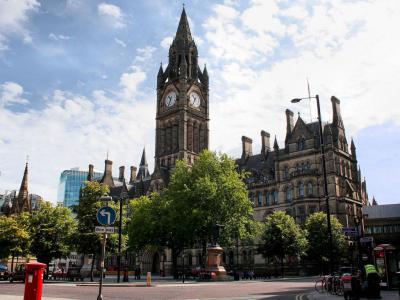
Manchester Town Hall is a nineteenth-century civic building designed by Alfred Waterhouse and completed in 1887. Built in a Neo-Gothic style, it reflects the confidence and ambition of Manchester during the height of the industrial era, using sandstone, pointed arches, and dramatic vertical lines to express civic identity and authority. Although the building is temporarily closed to the public, its surroundings still offer several points of interest that help tell the story of the city’s past.
As you stand at the front main entrance, notice the statue of the Roman Governor Agricola. He is credited with founding the original Roman fort of Mamucium, from which Manchester developed. The statue acts as a symbolic reminder of the city’s long history, linking its ancient origins with the powerful civic presence of the nineteenth-century town hall behind it. The placement of Agricola at the entrance emphasises continuity between early settlement and later urban growth.
Now turn your attention to Albert Square, the large open space in front of the building. The square is framed by historic architecture and features monuments and statues that celebrate key figures from Manchester’s political and cultural life. As you walk across the square, look at the central Albert Memorial, with its canopy-like Gothic design that echoes the architectural forms of the town hall itself. The open layout of the square allows the façade of the building to dominate the view, creating an impressive civic setting where public events, gatherings, and everyday city life unfold.
Outside, the building’s clock tower rises above the surrounding square. Reaching 280 feet (85 m), it houses a massive clock bell known as Great Abel, named after the mayor who officiated at the building’s opening. Its height and narrow proportions emphasise vertical lines, while the carved details around the windows reveal a blend of decorative and functional elements typical of Victorian civic architecture.
The exterior stone has weathered over time, giving the surface a textured appearance that contrasts with the sharper carving around the entrances. Even from a distance, the tower and façade show how the building expressed the ambitions of a rapidly expanding industrial city through its scale, materials, and public presence.
As you stand at the front main entrance, notice the statue of the Roman Governor Agricola. He is credited with founding the original Roman fort of Mamucium, from which Manchester developed. The statue acts as a symbolic reminder of the city’s long history, linking its ancient origins with the powerful civic presence of the nineteenth-century town hall behind it. The placement of Agricola at the entrance emphasises continuity between early settlement and later urban growth.
Now turn your attention to Albert Square, the large open space in front of the building. The square is framed by historic architecture and features monuments and statues that celebrate key figures from Manchester’s political and cultural life. As you walk across the square, look at the central Albert Memorial, with its canopy-like Gothic design that echoes the architectural forms of the town hall itself. The open layout of the square allows the façade of the building to dominate the view, creating an impressive civic setting where public events, gatherings, and everyday city life unfold.
Outside, the building’s clock tower rises above the surrounding square. Reaching 280 feet (85 m), it houses a massive clock bell known as Great Abel, named after the mayor who officiated at the building’s opening. Its height and narrow proportions emphasise vertical lines, while the carved details around the windows reveal a blend of decorative and functional elements typical of Victorian civic architecture.
The exterior stone has weathered over time, giving the surface a textured appearance that contrasts with the sharper carving around the entrances. Even from a distance, the tower and façade show how the building expressed the ambitions of a rapidly expanding industrial city through its scale, materials, and public presence.
12) The Triangle
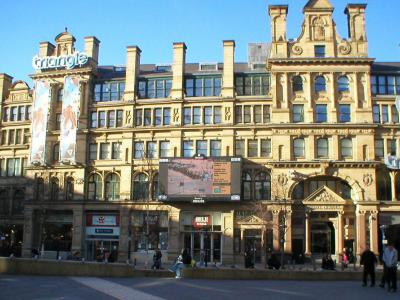
The Triangle Shopping Centre is housed in an Edwardian building on Exchange Square, in Manchester’s regenerated Millennium Quarter. There has been a commercial centre standing on this spot since 1837, when the first trading floor opened. The triangular building that contains the shopping centre was built in 1897, and opened its doors as a Corn Exchange in 1903. Like the nearby Royal Exchange, the building was a thriving centre for the trading of goods in Depression era England, and contributed to Manchester’s growth as the industrial and commercial centre of the region. After World War 2, the building fell into disuse, before becoming a bohemian flea market in the 1970s.
The building became well known for its alternative stores selling clothes and jewellery, as well as a range of cafes. Bomb damage from the IRA blast in 1996 led to extensive regeneration, and caused a great number of these shops and stalls to be relocated. Now refitted with a modern interior inside the listed Edwardian frontage, the building is home to a number of designer outlets. Famous brands like Adidas, Muji, O’Neill and Jigsaw have stores within the centre, and it is also home to local radio station Galaxy Manchester.
The building became well known for its alternative stores selling clothes and jewellery, as well as a range of cafes. Bomb damage from the IRA blast in 1996 led to extensive regeneration, and caused a great number of these shops and stalls to be relocated. Now refitted with a modern interior inside the listed Edwardian frontage, the building is home to a number of designer outlets. Famous brands like Adidas, Muji, O’Neill and Jigsaw have stores within the centre, and it is also home to local radio station Galaxy Manchester.
13) Manchester Cathedral (must see)
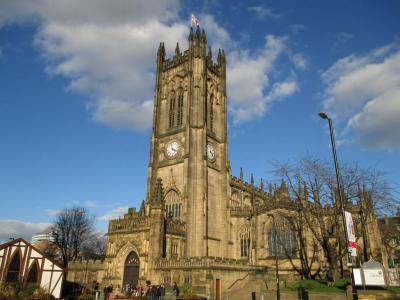
Manchester Cathedral developed gradually over many centuries, with much of its present form dating from the fifteenth century. Built largely in a late medieval English style, it first served as a collegiate church before becoming a cathedral in the nineteenth century. The building is characterised by its broad nave, extensive timber structure, and finely worked furnishings that reflect both religious ceremony and civic prestige.
Although the cathedral suffered damage during the Second World War, careful restoration preserved its historic layout while introducing thoughtfully designed modern elements that sit alongside the medieval fabric of the building.
As you enter the nave, walk straight ahead toward the choir screen and continue into the quire, where you will find the medieval quire stalls and misericords, the most celebrated artistic feature of the interior. Look to either side to see the tall wooden stall fronts and layered canopy work, whose delicate tracery and moulding reveal the craftsmanship of the fifteenth century. Now look beneath the folding seats to discover the misericords. These small but expressive carvings depict animals, foliage, moral tales, and humorous scenes drawn from everyday medieval life. Their sharp lines and lively figures offer a rare insight into the imagination, values, and storytelling traditions of the period.
Return to the nave and pause in the central aisle. When you look upward, the hammerbeam roof becomes the dominant feature of the space. The great timber beams project outward across the width of the nave, creating a bold structural rhythm while also supporting carved angels and decorative bosses. This roof is one of the most impressive surviving elements of the medieval church and gives the interior much of its warmth and character, contrasting with the pale stone of the walls and arcades below.
From here, continue along the side aisles toward the chapels to encounter the cathedral’s modern stained-glass windows, installed during the post-war reconstruction. The most striking of these is the Fire Window, whose vivid colours and abstract forms introduce a strong visual contrast to the surrounding medieval architecture.
Although the cathedral suffered damage during the Second World War, careful restoration preserved its historic layout while introducing thoughtfully designed modern elements that sit alongside the medieval fabric of the building.
As you enter the nave, walk straight ahead toward the choir screen and continue into the quire, where you will find the medieval quire stalls and misericords, the most celebrated artistic feature of the interior. Look to either side to see the tall wooden stall fronts and layered canopy work, whose delicate tracery and moulding reveal the craftsmanship of the fifteenth century. Now look beneath the folding seats to discover the misericords. These small but expressive carvings depict animals, foliage, moral tales, and humorous scenes drawn from everyday medieval life. Their sharp lines and lively figures offer a rare insight into the imagination, values, and storytelling traditions of the period.
Return to the nave and pause in the central aisle. When you look upward, the hammerbeam roof becomes the dominant feature of the space. The great timber beams project outward across the width of the nave, creating a bold structural rhythm while also supporting carved angels and decorative bosses. This roof is one of the most impressive surviving elements of the medieval church and gives the interior much of its warmth and character, contrasting with the pale stone of the walls and arcades below.
From here, continue along the side aisles toward the chapels to encounter the cathedral’s modern stained-glass windows, installed during the post-war reconstruction. The most striking of these is the Fire Window, whose vivid colours and abstract forms introduce a strong visual contrast to the surrounding medieval architecture.
14) Manchester Castle
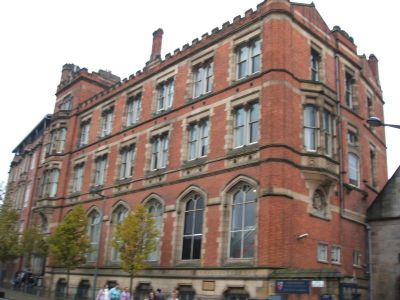
Manchester Castle once stood on a spot just north of Manchester Cathedral, adjacent to the River Irwell. The castle no longer stands, having been replaced in the medieval era by Chetham’s School of Music, which remains in this spot. This medieval building may carry original features of the former castle, and is available to hire as a venue for weddings and conferences. Manchester Castle has been referenced in manuscripts dating from 1184, and was described as a fairly unremarkable fortified timber manor house. Three rings of ditches have been found close to the site, suggesting a network of moats may have once surrounded the castle.
The site of Manchester Castle gives an indication of the reason for Manchester’s enduring success as a settlement, from Roman times to the present day. Military historians have identified the local geography, where several rivers cross paths at the feet of the Pennine hills, as one of the strongest areas of land in England to defend. This may well be the reason for the castle’s location, at the confluence of two rivers next to the medieval township of Manchester. England’s largest city, London, possesses similar geography, which made the site easy to defend from invasion in the medieval era.
The site of Manchester Castle gives an indication of the reason for Manchester’s enduring success as a settlement, from Roman times to the present day. Military historians have identified the local geography, where several rivers cross paths at the feet of the Pennine hills, as one of the strongest areas of land in England to defend. This may well be the reason for the castle’s location, at the confluence of two rivers next to the medieval township of Manchester. England’s largest city, London, possesses similar geography, which made the site easy to defend from invasion in the medieval era.
15) Chetham's Library (must see)
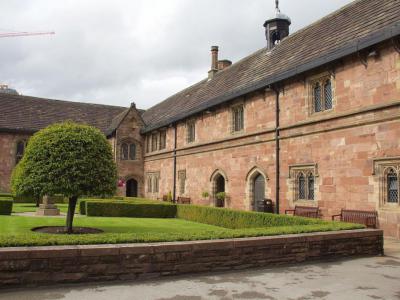
Chetham's Library, established in 1653 as part of Chetham's Hospital along with Chetham's School of Music, stands as the oldest public reference library in the United Kingdom. It was founded by Humphrey Chetham to provide education for deserving children and to offer a scholarly resource. Since its inception, the library has remained active, functioning as an independent charity. It welcomes visitors without charge from Monday to Friday, though appointments are necessary. Tours can be arranged through the library's website.
The library boasts a vast collection of over 100,000 printed volumes, with 60,000 predating 1851. These encompass works from the 16th and 17th centuries, periodicals, local history materials, and assorted ephemera. Chetham's Library has earned recognition as an Accredited Museum by the Arts Council England and its entire collection is designated as nationally and internationally significant under the Arts Council England scheme.
Among its treasures are portraits of notable figures such as William Whitaker, the Reverend John Radcliffe, Robert Thyer, the Reverend Francis Robert Raines, and Elizabeth Leigh. Noteworthy among its fine art pieces is an Allegory with Putti and Satyrs, attributed to the 16th-century Netherlandish artist Vincent Sellaer.
A notable segment of the library's holdings pertains to Belle Vue Zoo and Gardens, a prominent entertainment venue and zoological center in Manchester from the 1830s to the 1980s. This collection includes numerous posters, programs, photographs, and business documents of the owner, John Jennison. Much of this material has been digitized and made accessible online through grants obtained by the library, notably a £45,000 grant in 2014.
The library boasts a vast collection of over 100,000 printed volumes, with 60,000 predating 1851. These encompass works from the 16th and 17th centuries, periodicals, local history materials, and assorted ephemera. Chetham's Library has earned recognition as an Accredited Museum by the Arts Council England and its entire collection is designated as nationally and internationally significant under the Arts Council England scheme.
Among its treasures are portraits of notable figures such as William Whitaker, the Reverend John Radcliffe, Robert Thyer, the Reverend Francis Robert Raines, and Elizabeth Leigh. Noteworthy among its fine art pieces is an Allegory with Putti and Satyrs, attributed to the 16th-century Netherlandish artist Vincent Sellaer.
A notable segment of the library's holdings pertains to Belle Vue Zoo and Gardens, a prominent entertainment venue and zoological center in Manchester from the 1830s to the 1980s. This collection includes numerous posters, programs, photographs, and business documents of the owner, John Jennison. Much of this material has been digitized and made accessible online through grants obtained by the library, notably a £45,000 grant in 2014.
