Custom Walk in Bratislava, Slovakia by i_gillan_348af8 created on 2026-05-17
Guide Location: Slovakia » Bratislava
Guide Type: Custom Walk
# of Sights: 5
Tour Duration: 2 Hour(s)
Travel Distance: 3.6 Km or 2.2 Miles
Share Key: H678B
Guide Type: Custom Walk
# of Sights: 5
Tour Duration: 2 Hour(s)
Travel Distance: 3.6 Km or 2.2 Miles
Share Key: H678B
How It Works
Please retrieve this walk in the GPSmyCity app. Once done, the app will guide you from one tour stop to the next as if you had a personal tour guide. If you created the walk on this website or come to the page via a link, please follow the instructions below to retrieve the walk in the app.
Retrieve This Walk in App
Step 1. Download the app "GPSmyCity: Walks in 1K+ Cities" on Apple App Store or Google Play Store.



Step 2. In the GPSmyCity app, download(or launch) the guide "Bratislava Map and Walking Tours".
Step 3. Tap the menu button located at upper right corner of the "Walks" screen and select "Retrieve custom walk". Enter the share key: H678B
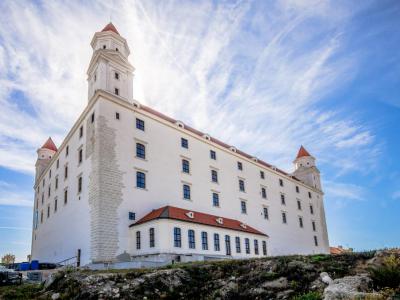
1) Bratislava Castle (must see)
The imposing Bratislava Castle is the most conspicuous landmark in the town of Bratislava. It stands on an isolated rocky hill above the town, and had been built and rebuilt continuously throughout the 9th-18th centuries.
The site of the castle has been of strategic importance for most of the area's history. It is located roughly in the center of Europe. Still, more importantly, it is along the route between the Carpathians and the Alps at a convenient crossing point of the river Danube.
The hill and surrounding area have hosted settlements since before the early Iron Age. Evidence suggests that the first settlements here started around 3,500 BC. In those early centuries, the hill was used as an acropolis for the surrounding town.
Archeological evidence shows a history of Celt and Roman occupation through 500 AD. The current structure was begun in the 10th century but worked lagged over the years. As the need for defense increased for the Kingdom of Hungary, the castle was added on to.
The Kingdom was abolished in 1781, and the castle was more or less dismantled and abandoned. The structures were used as a seminary and military barracks for some time during the 19th century. By the middle part of the 20th century, the castle was in ruins.
A massive restoration effort was begun in 1957 and completed in 1968. The 1968 Federation Law, which formed the Czech Socialist Republic and the Slovak Socialist Republic, was signed in the castle. Many years later, the constitution of now independent Slovakia was also signed in the castle's Knights Hall.
The castle is beautifully restored and houses exhibitions from the Slovak National Museum. Even if you choose not to visit the museum and interior rooms, walking around the castle grounds and enjoying the views of the city and the Danube is not to be missed.
The site of the castle has been of strategic importance for most of the area's history. It is located roughly in the center of Europe. Still, more importantly, it is along the route between the Carpathians and the Alps at a convenient crossing point of the river Danube.
The hill and surrounding area have hosted settlements since before the early Iron Age. Evidence suggests that the first settlements here started around 3,500 BC. In those early centuries, the hill was used as an acropolis for the surrounding town.
Archeological evidence shows a history of Celt and Roman occupation through 500 AD. The current structure was begun in the 10th century but worked lagged over the years. As the need for defense increased for the Kingdom of Hungary, the castle was added on to.
The Kingdom was abolished in 1781, and the castle was more or less dismantled and abandoned. The structures were used as a seminary and military barracks for some time during the 19th century. By the middle part of the 20th century, the castle was in ruins.
A massive restoration effort was begun in 1957 and completed in 1968. The 1968 Federation Law, which formed the Czech Socialist Republic and the Slovak Socialist Republic, was signed in the castle. Many years later, the constitution of now independent Slovakia was also signed in the castle's Knights Hall.
The castle is beautifully restored and houses exhibitions from the Slovak National Museum. Even if you choose not to visit the museum and interior rooms, walking around the castle grounds and enjoying the views of the city and the Danube is not to be missed.
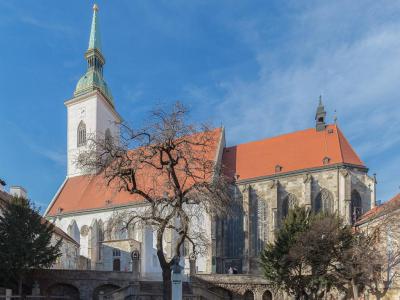
2) St. Martin's Cathedral (must see)
In the town's early history, worshipping was done at the Bratislava Castle. But in the early 13th century, the King of Hungary requested that the pope allow him to relocate the church. So, as the town grew, the construction of a Gothic cathedral began in 1311.
It wasn't completed until 1452 due to financial difficulties and the Hussite Wars. Additions were made in the 18th and 19th centuries, including the Baroque Chapel of Saint John the Merciful.
The present appearance of the building has been steady since 1877 when significant restoration efforts were completed after earthquakes, fires, and war had damaged the cathedral.
The cathedral is most famous as the coronation church for the Kingdom of Hungary from 1563 onward. Eleven kings and queens and eight of their consorts were coronated in the building.
In recognition of this honor, the cathedral tower is topped with a replica of the Crown of Saint Stephen. This replica of the Holy Crown of Hungary weighs 330 pounds (150 kilograms) and is gold-plated.
The cathedral was built over a cemetery and lay atop an unknown amount of catacombs and crypts. The building is designated a national cultural monument, but it is, unfortunately, decaying due to vibrations from the traffic passing on the Novy Most bridge.
It wasn't completed until 1452 due to financial difficulties and the Hussite Wars. Additions were made in the 18th and 19th centuries, including the Baroque Chapel of Saint John the Merciful.
The present appearance of the building has been steady since 1877 when significant restoration efforts were completed after earthquakes, fires, and war had damaged the cathedral.
The cathedral is most famous as the coronation church for the Kingdom of Hungary from 1563 onward. Eleven kings and queens and eight of their consorts were coronated in the building.
In recognition of this honor, the cathedral tower is topped with a replica of the Crown of Saint Stephen. This replica of the Holy Crown of Hungary weighs 330 pounds (150 kilograms) and is gold-plated.
The cathedral was built over a cemetery and lay atop an unknown amount of catacombs and crypts. The building is designated a national cultural monument, but it is, unfortunately, decaying due to vibrations from the traffic passing on the Novy Most bridge.
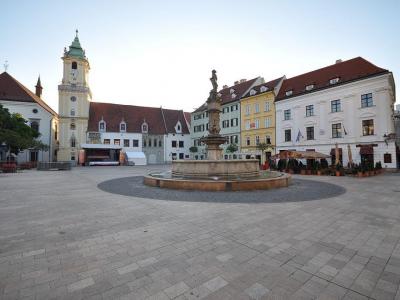
3) Hlavne Namestie (Main Square) (must see)
The central point in old town Bratislava, the Main Square, has been the hub of the town for centuries. It is surrounded by landmarks, including Kutscherfeldov Palace, Pawera House, Ungerov Dom, and the Maximillian Fountain. Additionally, tons of restaurants, cafes, and bars in the area keep it bustling.
During the winter months, the Main Square is home to Bratislava's Christmas fair. The entire area is decorated, and vendors set up stalls throughout the square. You'll find souvenirs, boiled wine, beer, and many different Slovak foods.
Over the years, the square has changed names several times. During World War II, it was named to honor Hilter. From 1948 to 1989, it was named for the day Bratislava was liberated by the Red Army - 4 April Square.
The square is home to the Old Town Hall building and several other landmark buildings. Old Town Hall was built in 1599 and is the oldest in the country. Today, it houses a museum all about the town's history.
The Japanese and French Embassy are also located here.
During the winter months, the Main Square is home to Bratislava's Christmas fair. The entire area is decorated, and vendors set up stalls throughout the square. You'll find souvenirs, boiled wine, beer, and many different Slovak foods.
Over the years, the square has changed names several times. During World War II, it was named to honor Hilter. From 1948 to 1989, it was named for the day Bratislava was liberated by the Red Army - 4 April Square.
The square is home to the Old Town Hall building and several other landmark buildings. Old Town Hall was built in 1599 and is the oldest in the country. Today, it houses a museum all about the town's history.
The Japanese and French Embassy are also located here.
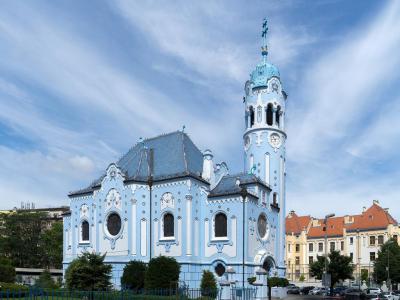
4) Blue Church (must see)
The Hungarian Secessionist Catholic Church, known as the Church of Saint Elisabeth or the Blue Church, is located in Old Town Bratislava. The construction was consecrated to Elisabeth of Hungary, who was a princess and, later, became a Roman Catholic saint. She was widowed young and surrendered her wealth for a life devoted to the poor and indigent. After her death at the age of 24, many miracles of healing were accredited to her. She was canonized by Pope Gregory IX in 1235.
Built in 1908, the structure was designed by Odon Lechner, a recognized Hungarian architect. He was known to embellish his constructions with Zsolnay tile patterns. Zsolnay tiles were manufactured by a Hungarian company known for its intricate porcelain, tiles, stoneware and pottery. The tiles on the church’s roof were generated using the pyrogranite process, which involves firing ceramic under exceptionally high temperatures, producing resilient materials which are resistant to acid and frost. The structure has attained its name because of the blue color of the mosaics, which decorate its roof and walls.
The building features a cylindrical tower and bell dome common to the Hungarian Art Nouveau and the Romanesque movement in art and architecture. The single nave church contains vaulted ceilings along with hints of barrel vaults. Romanesque double pillars encompass the entrances and the windows.
Built in 1908, the structure was designed by Odon Lechner, a recognized Hungarian architect. He was known to embellish his constructions with Zsolnay tile patterns. Zsolnay tiles were manufactured by a Hungarian company known for its intricate porcelain, tiles, stoneware and pottery. The tiles on the church’s roof were generated using the pyrogranite process, which involves firing ceramic under exceptionally high temperatures, producing resilient materials which are resistant to acid and frost. The structure has attained its name because of the blue color of the mosaics, which decorate its roof and walls.
The building features a cylindrical tower and bell dome common to the Hungarian Art Nouveau and the Romanesque movement in art and architecture. The single nave church contains vaulted ceilings along with hints of barrel vaults. Romanesque double pillars encompass the entrances and the windows.
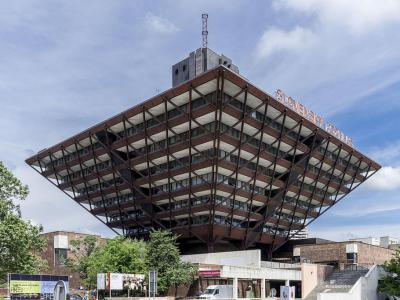
5) Slovak Radio Building
The Slovak Radio Building in Bratislava is an architectural icon known for its distinctive upside-down pyramid shape, earning it the local nickname "Radio Diamant." Designed by architects Štefan Svetko, Štefan Ďurkovič, and Barnabáš Kissling, the building was completed in 1983 after beginning construction in 1967. Standing at 80 meters tall, it features a 522-seat concert hall equipped with a large concert organ. The building first tested broadcasting in 1984 and commenced regular broadcasting on March 27, 1985, serving as the headquarters for Radio and Television of Slovakia (RTVS).
Constructed during a period when socialist realism was the mandated architectural style in Czechoslovakia, the Slovak Radio Building represents a break from the norm. The architects were allowed some freedom to innovate, which led them to diverge from the typical high-rise designs of the time that featured a low block topped by a tall office tower. Instead, their design emphasized expressiveness and uniqueness, with Štefan Svetko famously describing the building as a "temple of word and music."
This building was among the first major constructions in Slovakia to use a steel frame rather than the then-standard prefabricated concrete panels. This choice, while novel, introduced challenges due to the limited local experience with steel construction at the time.
Originally selected through a design competition in 1963 that was won by Miloš Chorvát, the investor ultimately chose the second-place design by Svetko, Ďurkovič, and Kissling. The building's location, which was peripheral at the time of its conception, is now considered part of the broader center of Bratislava, marking it as a significant landmark within the city's architectural landscape.
Constructed during a period when socialist realism was the mandated architectural style in Czechoslovakia, the Slovak Radio Building represents a break from the norm. The architects were allowed some freedom to innovate, which led them to diverge from the typical high-rise designs of the time that featured a low block topped by a tall office tower. Instead, their design emphasized expressiveness and uniqueness, with Štefan Svetko famously describing the building as a "temple of word and music."
This building was among the first major constructions in Slovakia to use a steel frame rather than the then-standard prefabricated concrete panels. This choice, while novel, introduced challenges due to the limited local experience with steel construction at the time.
Originally selected through a design competition in 1963 that was won by Miloš Chorvát, the investor ultimately chose the second-place design by Svetko, Ďurkovič, and Kissling. The building's location, which was peripheral at the time of its conception, is now considered part of the broader center of Bratislava, marking it as a significant landmark within the city's architectural landscape.
