Custom Walk in Bristol, England by jhucker1_4999c2 created on 2026-06-24
Guide Location: England » Bristol
Guide Type: Custom Walk
# of Sights: 9
Tour Duration: 5 Hour(s)
Travel Distance: 12.2 Km or 7.6 Miles
Share Key: XLRUN
Guide Type: Custom Walk
# of Sights: 9
Tour Duration: 5 Hour(s)
Travel Distance: 12.2 Km or 7.6 Miles
Share Key: XLRUN
How It Works
Please retrieve this walk in the GPSmyCity app. Once done, the app will guide you from one tour stop to the next as if you had a personal tour guide. If you created the walk on this website or come to the page via a link, please follow the instructions below to retrieve the walk in the app.
Retrieve This Walk in App
Step 1. Download the app "GPSmyCity: Walks in 1K+ Cities" on Apple App Store or Google Play Store.



Step 2. In the GPSmyCity app, download(or launch) the guide "Bristol Map and Walking Tours".
Step 3. Tap the menu button located at upper right corner of the "Walks" screen and select "Retrieve custom walk". Enter the share key: XLRUN
1) Temple Meads Train Station
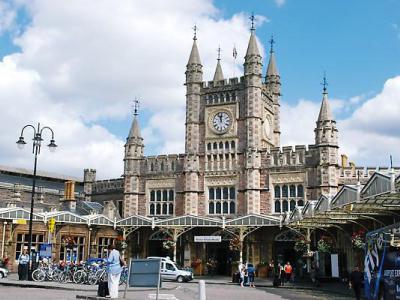
Temple Meads Train Station, located in Bristol, holds a significant place in railway history as the oldest and largest railway station in the city. It has served as a crucial transport hub, connecting various parts of Bristol and its surrounding districts. With its extensive bus services and even a ferry to the city center, Temple Meads plays a vital role in facilitating public transportation in the area. While Bristol Parkway is another major station in the city, Temple Meads boasts a rich heritage that sets it apart.
Temple Meads, opened in 1840, was the western terminus of the Great Western Railway, connecting Bristol and London. Designed by English civil engineer Isambard Kingdom Brunel, it later served other railway companies. Expansion occurred in the 1870s under Francis Fox and in the 1930s under Percy Emerson Culverhouse.
The station encompasses thirteen platforms, numbered from 1 to 15. However, passenger trains are primarily limited to eight tracks. The platform numbering system is distinct, with odd numbers at the east end and even numbers at the west end. Notably, Platform 2 serves as a bay platform at the west end but is not utilized for passenger trains. Additionally, there is no Platform 14 at Temple Meads.
As the oldest and largest railway station in Bristol, Temple Meads stands as a testament to the city's rich railway heritage. Its grand architecture, historical significance, and vital role in public transportation make it an iconic landmark in Bristol and an essential part of the city's identity.
Temple Meads, opened in 1840, was the western terminus of the Great Western Railway, connecting Bristol and London. Designed by English civil engineer Isambard Kingdom Brunel, it later served other railway companies. Expansion occurred in the 1870s under Francis Fox and in the 1930s under Percy Emerson Culverhouse.
The station encompasses thirteen platforms, numbered from 1 to 15. However, passenger trains are primarily limited to eight tracks. The platform numbering system is distinct, with odd numbers at the east end and even numbers at the west end. Notably, Platform 2 serves as a bay platform at the west end but is not utilized for passenger trains. Additionally, there is no Platform 14 at Temple Meads.
As the oldest and largest railway station in Bristol, Temple Meads stands as a testament to the city's rich railway heritage. Its grand architecture, historical significance, and vital role in public transportation make it an iconic landmark in Bristol and an essential part of the city's identity.
2) Girl with a Pierced Eardrum
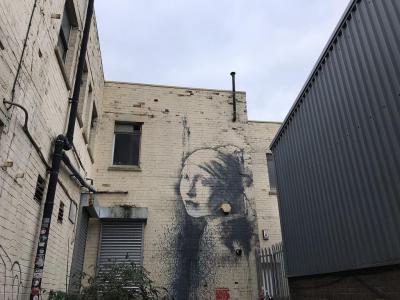
If you’re wandering along Bristol’s Harbourside and spot a classic gone rogue, you’ve found Banksy’s Girl with a Pierced Eardrum. Painted in October 2014 on the side of a Hanover Place building-handily located between the clock tower and a burger van-it takes the Dutch master’s Girl with a Pearl Earring and swaps the jewel for… a security alarm. It’s Banksy doing what he does best: blending fine art references with a sly jab at modern surveillance culture, all in sharp-edged stencil form.
Its arrival was perfectly timed, appearing just after breathless headlines claimed the artist had been arrested and unmasked. Within a day, someone treated it to a splash of black paint-street art’s version of a handshake. Far from spoiling it, the drips arguably gave the piece another layer of texture.
True to Bristol’s habit of letting its art evolve with the times, the girl gained a blue surgical mask in 2020, a low-key nod to the pandemic years. Like much of the city’s street art, it wears its history in layers: paint, politics, and passing moments.
Part of the fun is that it’s exactly where it was painted-no gallery glass, no neat labels-just a building wall by the docks, framed by old warehouses, cafés, and other murals. Whether you’re a Banksy devotee or just someone with a coffee in hand, it’s worth the short detour to see how a single security alarm, in the right hands, can upstage an Old Master.
Its arrival was perfectly timed, appearing just after breathless headlines claimed the artist had been arrested and unmasked. Within a day, someone treated it to a splash of black paint-street art’s version of a handshake. Far from spoiling it, the drips arguably gave the piece another layer of texture.
True to Bristol’s habit of letting its art evolve with the times, the girl gained a blue surgical mask in 2020, a low-key nod to the pandemic years. Like much of the city’s street art, it wears its history in layers: paint, politics, and passing moments.
Part of the fun is that it’s exactly where it was painted-no gallery glass, no neat labels-just a building wall by the docks, framed by old warehouses, cafés, and other murals. Whether you’re a Banksy devotee or just someone with a coffee in hand, it’s worth the short detour to see how a single security alarm, in the right hands, can upstage an Old Master.
3) Bristol Harbourside (must see)
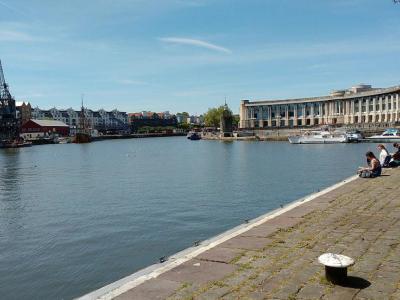
Bristol Harbourside didn’t always deal in flat whites, gallery openings, and paddleboard rentals. For centuries, this was the city’s commercial heart-a dockland buzzing with ships hauling West Country goods out and exotic cargo in. Then, in the late 20th century, the big ships moved downstream to Avonmouth, and the old docks were left high and dry-perfect for reinvention. Now, 19th-century cranes and warehouses share the space with glass-fronted apartments, theatres, and museums, living proof that Bristol can turn its hand from industry to artistry without missing a beat.
There’s no shortage of ways to fill your day here. Take to the water by rowing, paddleboarding, or hitching a ride on a harbour cruise. Stick to dry land and you can cycle the harbourside paths or wander between museums, galleries, and Banksy sightings-the Arnolfini Art Center caters to the contemporary crowd, while M Shed Museum tells Bristol’s story in dockside detail. For a deeper dive into maritime history, step aboard Brunel’s SS Great Britain and see how Victorian engineering took on the Atlantic.
The food scene is as international as the cargo once unloaded here-think Caribbean roti, Middle Eastern mezze, or a solid British pie, all within a few steps of each other. And when the light fades, the waterside opts for a softer glow, as the harbour lights flicker in the ripples.
Just a short walk from Bristol Cathedral, Queen Square, or the Old City, the Harbourside works as a full day out or a leisurely detour. Stick around long enough and you’ll hear buskers, seagulls, and laughter all competing for the same bit of airspace.
There’s no shortage of ways to fill your day here. Take to the water by rowing, paddleboarding, or hitching a ride on a harbour cruise. Stick to dry land and you can cycle the harbourside paths or wander between museums, galleries, and Banksy sightings-the Arnolfini Art Center caters to the contemporary crowd, while M Shed Museum tells Bristol’s story in dockside detail. For a deeper dive into maritime history, step aboard Brunel’s SS Great Britain and see how Victorian engineering took on the Atlantic.
The food scene is as international as the cargo once unloaded here-think Caribbean roti, Middle Eastern mezze, or a solid British pie, all within a few steps of each other. And when the light fades, the waterside opts for a softer glow, as the harbour lights flicker in the ripples.
Just a short walk from Bristol Cathedral, Queen Square, or the Old City, the Harbourside works as a full day out or a leisurely detour. Stick around long enough and you’ll hear buskers, seagulls, and laughter all competing for the same bit of airspace.
4) Banksy - Well Hung Lover
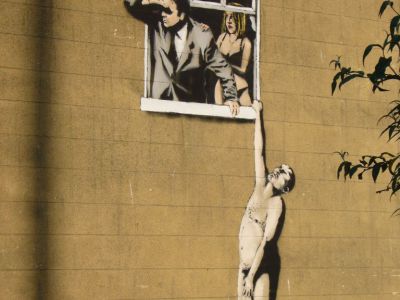
On the wall of a former sexual health clinic, five metres above Frogmore Street, a naked man hangs by one arm from a windowsill, his free hand strategically placed. Above him, a suited figure leans out, scanning the street for the lover he can’t see. Beside him, a woman in lingerie rests her hand on his shoulder, a picture of guilty calm. The scene is Banksy at full voltage – sly, economical, and loaded with visual innuendo.
The mural appeared in 2006, after three days behind tarpaulin-wrapped scaffolding. When the cover came off, Bristol found itself staring at a home-grown scandal in spray paint. The Council had been on a mission to scrub graffiti from the city, but this one hit a nerve. The building’s owner at the time – a member of Massive Attack music group – had commissioned it, and when the Council later bought the property, they put it to the people. Ninety-seven percent voted to let it stay.
That vote made Well Hung Lover the first street piece in the UK to receive official blessing after the fact. The clinic moved on, the mural stayed put, and its survival became part of Bristol’s civic identity – cheeky, defiant. Even paintball vandals couldn’t take that away; they just added another layer to the story.
The mural appeared in 2006, after three days behind tarpaulin-wrapped scaffolding. When the cover came off, Bristol found itself staring at a home-grown scandal in spray paint. The Council had been on a mission to scrub graffiti from the city, but this one hit a nerve. The building’s owner at the time – a member of Massive Attack music group – had commissioned it, and when the Council later bought the property, they put it to the people. Ninety-seven percent voted to let it stay.
That vote made Well Hung Lover the first street piece in the UK to receive official blessing after the fact. The clinic moved on, the mural stayed put, and its survival became part of Bristol’s civic identity – cheeky, defiant. Even paintball vandals couldn’t take that away; they just added another layer to the story.
5) Bristol City Museum & Art Gallery (must see)
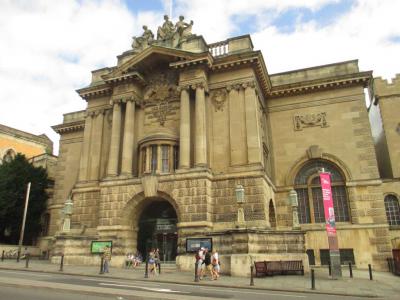
The Bristol City Museum & Art Gallery has been holding court in its ornate Edwardian Baroque home since 1905, all carved stone, sweeping staircases, and a sense of civic grandeur that feels worlds away from the city’s gritty industrial past. Built as a temple to learning and culture, it remains free to enter-meaning you can wander past Egyptian mummies, Assyrian reliefs, taxidermy, glittering ceramics, and paintings by the likes of the Pre-Raphaelites, which were a group of painters founded in 1848. The collections pull you through centuries and continents, pausing for a good dose of Bristol’s own story, from maritime exploits to the less-than-glorious sides of global trade.
And then there’s Banksy. The museum is home to his Paint Pot Angel, a classical figure with a splash of pink rebellion across its head, scandalizing the sculpture hall. Back in 2009, Banksy staged his infamous “Banksy vs. Bristol Museum” takeover here-an all-out, tongue-in-cheek hijacking that saw the galleries filled with irreverent surprises, and the queues stretching halfway across the city. The show may have packed up long ago, but its echoes still rattle through the building.
Today, the museum continues to shuffle the old with the new, giving you a straight path from ancient tombs to contemporary provocation-no time machine required.
And then there’s Banksy. The museum is home to his Paint Pot Angel, a classical figure with a splash of pink rebellion across its head, scandalizing the sculpture hall. Back in 2009, Banksy staged his infamous “Banksy vs. Bristol Museum” takeover here-an all-out, tongue-in-cheek hijacking that saw the galleries filled with irreverent surprises, and the queues stretching halfway across the city. The show may have packed up long ago, but its echoes still rattle through the building.
Today, the museum continues to shuffle the old with the new, giving you a straight path from ancient tombs to contemporary provocation-no time machine required.
6) Queen Ziggy
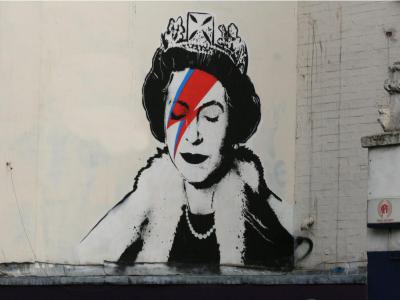
Picture it-Bristol, 2012. The bunting’s barely hung for the Diamond Jubilee when, overnight, a certain wall on Upper Maudlin Street acquires a new sovereign. Not the sort you’ll find on coins, but a monochrome Queen Elizabeth II, crown polished, pearls gleaming… and a bolt of red and blue lightning slicing across her face. It’s a clear nod to Bowie’s Ziggy Stardust-royalty meets glam rock, all in one sideways glance. Locals dubbed her “Queen Ziggy,” and while Banksy never stepped forward to claim parentage, the timing, wit, and Bristol postcode all pointed in his direction.
The spot itself has a past-it’s no stranger to Banksy’s handiwork-and it sits right by the Grand Appeal charity, fundraising lifeline for the Children’s Hospital next door. The mural’s arrival sparked a flurry of interpretations. Was it a love letter to the Queen, a pop-culture mash-up, or a cheeky riff on power and celebrity? Maybe all three. After all, Bowie and the monarchy have each ruled their own kingdoms-just not usually on the same wall.
For the wandering visitor, Queen Ziggy isn’t background scenery-it’s an unmissable flash of personality in the city’s visual conversation. That lightning bolt, cutting through the grey, has a way of pulling you up short, reminding you that Bristol’s walls don’t just host art-they throw opinions, jokes, and sly winks into the street. Here, tradition doesn’t gather dust; it gets remixed with a soundtrack, a splash of colour, and the sort of irreverence that refuses to fade.
The spot itself has a past-it’s no stranger to Banksy’s handiwork-and it sits right by the Grand Appeal charity, fundraising lifeline for the Children’s Hospital next door. The mural’s arrival sparked a flurry of interpretations. Was it a love letter to the Queen, a pop-culture mash-up, or a cheeky riff on power and celebrity? Maybe all three. After all, Bowie and the monarchy have each ruled their own kingdoms-just not usually on the same wall.
For the wandering visitor, Queen Ziggy isn’t background scenery-it’s an unmissable flash of personality in the city’s visual conversation. That lightning bolt, cutting through the grey, has a way of pulling you up short, reminding you that Bristol’s walls don’t just host art-they throw opinions, jokes, and sly winks into the street. Here, tradition doesn’t gather dust; it gets remixed with a soundtrack, a splash of colour, and the sort of irreverence that refuses to fade.
7) The Mild Mild West
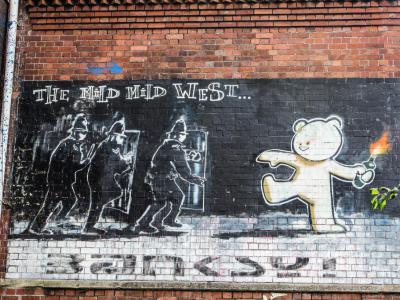
Back in the late ’90s, Stokes Croft was already Bristol’s unofficial laboratory for bold ideas, loud nights, and walls that spoke their mind. Then one day in 1999, a new voice appeared-painted in broad daylight by Banksy-where a solicitor’s office wall became the stage for The Mild Mild West. A teddy bear, all fluff and mischief, is caught mid-throw with a Molotov cocktail aimed at three riot police. It’s playful at a glance, but rooted in a sharp protest against the police crackdowns on the city’s unlicensed raves, particularly a notorious clash on Winterstoke Road.
The title winks at Bristol’s easy-going reputation while hinting at the heat under the surface. Locals embraced it almost instantly, seeing a reflection of Stokes Croft’s personality: friendly and open, but ready to stand its ground when pushed. Its spot at a busy junction makes it impossible to miss, ensuring its message still rolls through the daily life of the city.
Around it, cafés hum, independent shops keep the “Do It Yourself” spirit alive, and other walls carry their own loud, colourful opinions.
Stand here for a moment and you’ll catch more than just a snapshot of street art-you’ll hear the long-running conversation between Bristol’s creative soul and the forces that try to tame it. And judging by that teddy’s aim, the debate isn’t over yet.
The title winks at Bristol’s easy-going reputation while hinting at the heat under the surface. Locals embraced it almost instantly, seeing a reflection of Stokes Croft’s personality: friendly and open, but ready to stand its ground when pushed. Its spot at a busy junction makes it impossible to miss, ensuring its message still rolls through the daily life of the city.
Around it, cafés hum, independent shops keep the “Do It Yourself” spirit alive, and other walls carry their own loud, colourful opinions.
Stand here for a moment and you’ll catch more than just a snapshot of street art-you’ll hear the long-running conversation between Bristol’s creative soul and the forces that try to tame it. And judging by that teddy’s aim, the debate isn’t over yet.
8) Rose on a Mousetrap
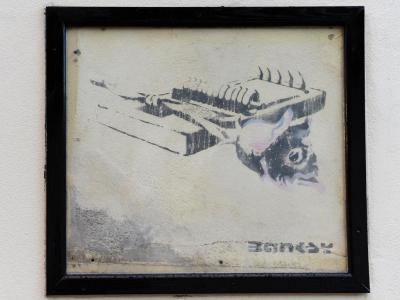
In Bristol’s Cotham district, down the quiet stretch of Thomas Street North, there’s a Banksy that doesn't try too hard. Rose on a Mousetrap, painted in the early 2000s, pairs a delicate bloom with a steel-jawed trap, an image that can be read as love caught in a snare, beauty under siege, or simply a dark little joke in floral form. It’s a rare example of Banksy going for subtle over spectacle, drawing you in with its quiet sting rather than a billboard-sized blast of politics.
When it first appeared, the locals didn’t just admire it-they mobilised. About twenty neighbours pooled funds to buy glass and a frame, turning this modest mural into Bristol’s only framed Banksy. The protective casing wasn’t just about preserving paint; it was a statement of ownership and affection. Here was a piece they weren’t going to let be scrawled over, chipped away, or whisked off to auction.
For visitors, finding Rose on a Mousetrap isn’t like stumbling across Banksy’s high-profile pieces in Stokes Croft or the city centre. It sits in a residential patch, far from the footfall of tourists chasing guidebook hotspots. That makes seeing it feel a bit like being let in on a secret, the kind of thing a local might point out on the way to the corner shop. Its survival-thanks to that communal act of preservation-says as much about Bristol’s relationship with its street art as the image itself. Here, even the quietest works get to grow old in peace, frame and all.
When it first appeared, the locals didn’t just admire it-they mobilised. About twenty neighbours pooled funds to buy glass and a frame, turning this modest mural into Bristol’s only framed Banksy. The protective casing wasn’t just about preserving paint; it was a statement of ownership and affection. Here was a piece they weren’t going to let be scrawled over, chipped away, or whisked off to auction.
For visitors, finding Rose on a Mousetrap isn’t like stumbling across Banksy’s high-profile pieces in Stokes Croft or the city centre. It sits in a residential patch, far from the footfall of tourists chasing guidebook hotspots. That makes seeing it feel a bit like being let in on a secret, the kind of thing a local might point out on the way to the corner shop. Its survival-thanks to that communal act of preservation-says as much about Bristol’s relationship with its street art as the image itself. Here, even the quietest works get to grow old in peace, frame and all.
9) Cat and Dog
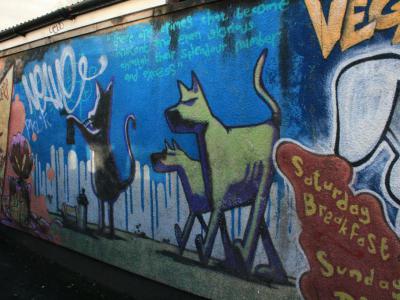
If you wander into Bristol’s Easton neighbourhood and spot a feline loitering with an aerosol can, you’ve just found Cat and Dog-an early Banksy that predates the sharp-edged stencils he’s now known for. Painted at the junction of Robertson Road and Foster Street during his days with the DryBreadZ Crew (DBZ for short), it’s pure late-90s street energy: freehand, unpolished, and buzzing with the city’s then-growing graffiti scene.
The scene pairs a spray-can-wielding cat with two watchful dogs-equal parts bodyguards and bouncers-creating a standoff that teeters between playfulness and threat. Adding bite to the image is a quote scrawled beside it: “There are crimes that become innocent or even glorious through their splendour, number, and excess.” It’s the kind of lofty line that makes you wonder if the cat’s about to redecorate the wall or start a small revolution.
What makes Cat and Dog worth the detour isn’t just its design-it’s the glimpse it offers into Banksy’s creative adolescence. Here’s the artist before the bulletproof glass and tourist maps, back when his work was part of the everyday churn of the street. No protective barriers, no neat little plaque-just paint on brick, weathering with the seasons and the city’s life around it.
For anyone tracing Bristol’s Banksy trail, finding Cat and Dog feels less like ticking a box and more like stumbling across a living fossil from the city’s graffiti past. It’s a reminder that street art, at its best, isn’t curated-it’s simply there, holding its ground in the open air. And in this case, it’s got two dogs to help it keep watch.
The scene pairs a spray-can-wielding cat with two watchful dogs-equal parts bodyguards and bouncers-creating a standoff that teeters between playfulness and threat. Adding bite to the image is a quote scrawled beside it: “There are crimes that become innocent or even glorious through their splendour, number, and excess.” It’s the kind of lofty line that makes you wonder if the cat’s about to redecorate the wall or start a small revolution.
What makes Cat and Dog worth the detour isn’t just its design-it’s the glimpse it offers into Banksy’s creative adolescence. Here’s the artist before the bulletproof glass and tourist maps, back when his work was part of the everyday churn of the street. No protective barriers, no neat little plaque-just paint on brick, weathering with the seasons and the city’s life around it.
For anyone tracing Bristol’s Banksy trail, finding Cat and Dog feels less like ticking a box and more like stumbling across a living fossil from the city’s graffiti past. It’s a reminder that street art, at its best, isn’t curated-it’s simply there, holding its ground in the open air. And in this case, it’s got two dogs to help it keep watch.
