Custom Walk in Pula, Croatia by robertdebonnaire_7ffc8e created on 2026-07-01
Guide Location: Croatia » Pula
Guide Type: Custom Walk
# of Sights: 6
Tour Duration: 1 Hour(s)
Travel Distance: 2.2 Km or 1.4 Miles
Share Key: GRZH7
Guide Type: Custom Walk
# of Sights: 6
Tour Duration: 1 Hour(s)
Travel Distance: 2.2 Km or 1.4 Miles
Share Key: GRZH7
How It Works
Please retrieve this walk in the GPSmyCity app. Once done, the app will guide you from one tour stop to the next as if you had a personal tour guide. If you created the walk on this website or come to the page via a link, please follow the instructions below to retrieve the walk in the app.
Retrieve This Walk in App
Step 1. Download the app "GPSmyCity: Walks in 1K+ Cities" on Apple App Store or Google Play Store.



Step 2. In the GPSmyCity app, download(or launch) the guide "Pula Map and Walking Tours".
Step 3. Tap the menu button located at upper right corner of the "Walks" screen and select "Retrieve custom walk". Enter the share key: GRZH7
1) Roman Amphitheater (Pula Arena) (must see)
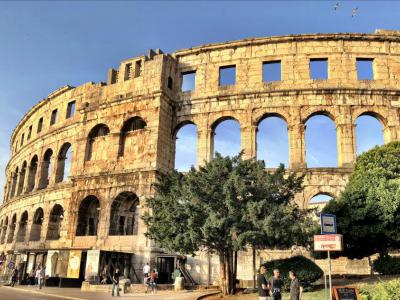
There are six large Roman amphitheaters in the world. The Pula Arena apparently is the best preserved and still in use. It is big. It is the only remaining amphitheater that still has its side towers, four of them, in good condition. It was constructed somewhere between 27 and 68 BC and it is the country's best preserved ancient monument.
The exterior walls are of limestone. The arena was built at the base of a hill, on sloping ground. For this reason, the seaward-facing side has three stories. The opposite side has only two. The maximum height is 96 feet. The lower two floors have 72 arches. The topmost floor has 64 rectangular, window-like openings.
The arena could hold up to 23,000 spectators seated. The arena itself had 15 gates. Underground corridors ran underneath the arena. Animals, ludi (games), scenery and gladiators could be conducted through the tunnels. The seating was raked. There was room underneath for shops and stores. The arena was on the Gladiator circuit.
Each of the four towers held fresh water. The water was perfumed and fed into fountains to refresh the crowd. Large sail-like cloths called valaria shaded spectators from the sun or rain. A system of channels and canals below the arena carried off rainwater or effluent.
The colosseum was outside the city walls, on the Via Flavia. Emperors Augustus, Claudius, Vespasian and Titus each had a hand in enlarging and improving the Amphitheater. It was finally finished in 81 AD under the reign of Titus. The amphitheater was in popular use until the 5th century, when the Emperor Honorius forbade gladiatorial combats.
The arena today is a venue for concerts, operas, ballets, sports and the Pula Film Festival.
The exterior walls are of limestone. The arena was built at the base of a hill, on sloping ground. For this reason, the seaward-facing side has three stories. The opposite side has only two. The maximum height is 96 feet. The lower two floors have 72 arches. The topmost floor has 64 rectangular, window-like openings.
The arena could hold up to 23,000 spectators seated. The arena itself had 15 gates. Underground corridors ran underneath the arena. Animals, ludi (games), scenery and gladiators could be conducted through the tunnels. The seating was raked. There was room underneath for shops and stores. The arena was on the Gladiator circuit.
Each of the four towers held fresh water. The water was perfumed and fed into fountains to refresh the crowd. Large sail-like cloths called valaria shaded spectators from the sun or rain. A system of channels and canals below the arena carried off rainwater or effluent.
The colosseum was outside the city walls, on the Via Flavia. Emperors Augustus, Claudius, Vespasian and Titus each had a hand in enlarging and improving the Amphitheater. It was finally finished in 81 AD under the reign of Titus. The amphitheater was in popular use until the 5th century, when the Emperor Honorius forbade gladiatorial combats.
The arena today is a venue for concerts, operas, ballets, sports and the Pula Film Festival.
2) Triumphal Arch of the Sergii (must see)
One of the greatest naval engagements in ancient history was the Battle of Actium. Octavian faced the forces of Cleopatra and Antony in their bid for the power of Rome. Octavian's ships destroyed his enemies' formations. One of the winners that day was Lucius Sergius Lepidus, a tribune of the 29th Legion. In 27 BC an arch in Pula was erected in his honor.
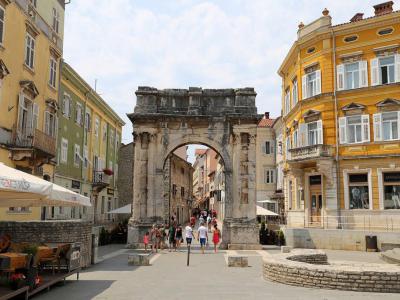
The arch honors the family Sergii as well as Lucius. The Sergii were a powerful family of the Roman colony in Pula. The triumphal arch was built on the facade of a gate in the city walls called Golden Gate (Porta Aurea). An Inscription declares the arch was financed by Salvia Postuma Sergia, the wife of Lucius.
The names of the father and uncle of Lucius are also inscribed on the arch. Initially, statues of the two older men flanked the statue of Lucius on the top of the monument. A frieze depicts ornamental cupids, garlands and bucrania, the heads of sacrificial bulls. The arch has two corinthian columns and winged victories in the spandrels.
Seen from the town side, a hellenistic style relief shows a scene of a war chariot and horses. The arch was well known in the Renaissance. It influenced many artists, including Michelangelo and Piranesi.
The arch honors the family Sergii as well as Lucius. The Sergii were a powerful family of the Roman colony in Pula. The triumphal arch was built on the facade of a gate in the city walls called Golden Gate (Porta Aurea). An Inscription declares the arch was financed by Salvia Postuma Sergia, the wife of Lucius.
The names of the father and uncle of Lucius are also inscribed on the arch. Initially, statues of the two older men flanked the statue of Lucius on the top of the monument. A frieze depicts ornamental cupids, garlands and bucrania, the heads of sacrificial bulls. The arch has two corinthian columns and winged victories in the spandrels.
Seen from the town side, a hellenistic style relief shows a scene of a war chariot and horses. The arch was well known in the Renaissance. It influenced many artists, including Michelangelo and Piranesi.
3) Franciscan Church and Monastery (must see)
In 1209, Pope Innocent III, a firm believer that the papacy was the political Sun and everything else was not, gave his consent for the newly formed Franciscan order to set up shop in the town of Pula. The Franciscans eventually established a church and monastery on the western slope of Pula hill, below the fortress and above the Forum.
Several dates are given for the construction of the church, ranging from 1291 to 1314. It was completed by Jacobus de Pola, a Franciscan Brother and architect. He is believed to have also had a hand in the design of the Communal Palace of Pula.
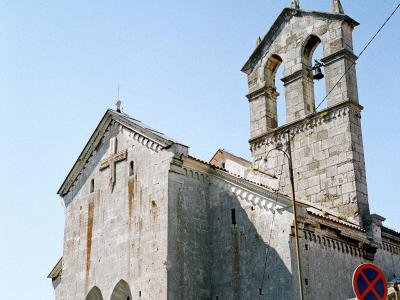
The style of the church is Romanesque with Gothic accents. The design follows the architectural Narbonne rules of 1260. The floor plan is rectangular. The sanctuary is square. There is a single-walled bell tower looming over the roof. There is a connecting cloister, a hall, a refectory and sacristy joining the monastery and choir.
In keeping with the views of a mendicant order, the buildings were simple, nothing fancy and skillfully made. On the main altar is a gilded 15th century polyptych. The center panel holds a high relief of the Virgin Mary and Christ. Twelve disciples are depicted surrounding the center. Gothic phials are at the ends of the piece.
The monastery cloister has Renaissance pillars. In the front of the church is a lapidarium with a collection of wall paintings and medieval monuments. Buried in the Church are the remains of Blessed Otto. He arrived in Pula around 1235. He is credited with many miraculous healings. He died in 1241. He is venerated in Pula to this day.
Several dates are given for the construction of the church, ranging from 1291 to 1314. It was completed by Jacobus de Pola, a Franciscan Brother and architect. He is believed to have also had a hand in the design of the Communal Palace of Pula.
The style of the church is Romanesque with Gothic accents. The design follows the architectural Narbonne rules of 1260. The floor plan is rectangular. The sanctuary is square. There is a single-walled bell tower looming over the roof. There is a connecting cloister, a hall, a refectory and sacristy joining the monastery and choir.
In keeping with the views of a mendicant order, the buildings were simple, nothing fancy and skillfully made. On the main altar is a gilded 15th century polyptych. The center panel holds a high relief of the Virgin Mary and Christ. Twelve disciples are depicted surrounding the center. Gothic phials are at the ends of the piece.
The monastery cloister has Renaissance pillars. In the front of the church is a lapidarium with a collection of wall paintings and medieval monuments. Buried in the Church are the remains of Blessed Otto. He arrived in Pula around 1235. He is credited with many miraculous healings. He died in 1241. He is venerated in Pula to this day.
4) Temple of Augustus (must see)
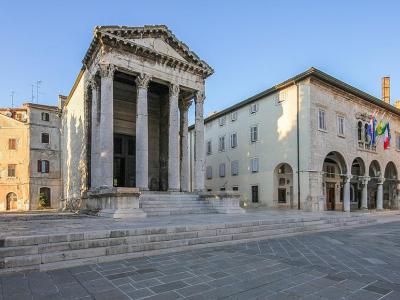
Sitting next to the Communal Palace in the Forum Square of Pula, is the Temple of Augustus. "To Rome and Augustus Caesar, son of the deity, father of the fatherland", the sign once hammered into the temple walls said. Augustus had been a god. Only the nail holes of the bronze sign remain.
Augustus had to wait until after his death in AD 15 to be diefied. The temple was actually built in 2 AD. The building is lavishly decorated. It is built on a podium with a tetrastyle prostyle porch having Corinthian columns with friezes. The overall dimensions are 26 feet by 57 feet in area and 46 feet in height.
The temple originally was one of three. It was located on the left side of the main central temple. The Temple of Diana stood on the opposite side. The main temple has not survived intact, while the back wall of the Temple of Diana was incorporated into the Communal Palace, built in 1296.
The temple of Augustus was closed after the persecution of pagans began in the 4th century. When Pula came under Byzantine rule in the 8th century, the temple was converted into a church dedicated to Mary. In the 17th century, under Venetian rule, the temple was incorporated into a complex of neighboring buildings on the square.
The interior of the temple is a small museum of tombstones and Roman sculptures. These were discovered during excavations of the colony Pietas Lulia, by Napoleonic General Auguste de Marmont, governor of the Illyrian Provinces. Traces of frescoes can be seen on the interior walls.
The Temple today is a lapidarium. For a good look at Pula's Roman beginnings, this is a main destination.
Augustus had to wait until after his death in AD 15 to be diefied. The temple was actually built in 2 AD. The building is lavishly decorated. It is built on a podium with a tetrastyle prostyle porch having Corinthian columns with friezes. The overall dimensions are 26 feet by 57 feet in area and 46 feet in height.
The temple originally was one of three. It was located on the left side of the main central temple. The Temple of Diana stood on the opposite side. The main temple has not survived intact, while the back wall of the Temple of Diana was incorporated into the Communal Palace, built in 1296.
The temple of Augustus was closed after the persecution of pagans began in the 4th century. When Pula came under Byzantine rule in the 8th century, the temple was converted into a church dedicated to Mary. In the 17th century, under Venetian rule, the temple was incorporated into a complex of neighboring buildings on the square.
The interior of the temple is a small museum of tombstones and Roman sculptures. These were discovered during excavations of the colony Pietas Lulia, by Napoleonic General Auguste de Marmont, governor of the Illyrian Provinces. Traces of frescoes can be seen on the interior walls.
The Temple today is a lapidarium. For a good look at Pula's Roman beginnings, this is a main destination.
5) Forum Square and Communal Palace (must see)
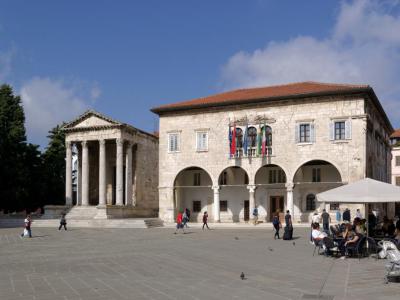
The history of Pula is in its main square, the Forum Square. Pula was officially founded in 44 BC by one Cassius Longinus, brother to the infamous Cassius, assassin of Julius Caesar and by Lucius Calpurnius Piso, Julius Caesar's father-in-law.
The forum of Pula was a venue for public events, politics, religion, and commerce. The square originally measured 128 feet (39 meters) by 269 feet (82 meters). In the north side of the forum were temples dedicated to the Roman gods Jupiter, Juno and Minerva.
Only the temple of Augustus from about 14 AD has been perfectly preserved. Parts of the other temples may be found in the back wall of the Communal Palace, built in the 13th century. The Pula Forum continued to be the town's main square throughout the middle ages.
In the Venetian era, the Communal Palace replaced the temples of the gods. It would be used as the governmental center. The Temple of Diana had served as a town hall since the 9th century. The core date of the Communal Palace is 1296, the time when Pula became a free municipality. The Palace remains the seat of government today.
The structure of the Palace shows a mixture of styles. The east walls show combined Romanesque and Gothic elements. The sculptures of Telemon and Siren in corners flanked by Renaissance columns and Baroque windows mark the latest changes to the Communal Palace. Having been neglected for centuries, the Palace is now restored and it is today a popular tourist attraction.
The forum of Pula was a venue for public events, politics, religion, and commerce. The square originally measured 128 feet (39 meters) by 269 feet (82 meters). In the north side of the forum were temples dedicated to the Roman gods Jupiter, Juno and Minerva.
Only the temple of Augustus from about 14 AD has been perfectly preserved. Parts of the other temples may be found in the back wall of the Communal Palace, built in the 13th century. The Pula Forum continued to be the town's main square throughout the middle ages.
In the Venetian era, the Communal Palace replaced the temples of the gods. It would be used as the governmental center. The Temple of Diana had served as a town hall since the 9th century. The core date of the Communal Palace is 1296, the time when Pula became a free municipality. The Palace remains the seat of government today.
The structure of the Palace shows a mixture of styles. The east walls show combined Romanesque and Gothic elements. The sculptures of Telemon and Siren in corners flanked by Renaissance columns and Baroque windows mark the latest changes to the Communal Palace. Having been neglected for centuries, the Palace is now restored and it is today a popular tourist attraction.
6) Pula Castle (Kastel) (must see)
In its history, Pula has been attacked many times. Before the Roman era, the indigenous Istrian people had defensive fortifications. The Venetians established their fortifications in the same place where the ancient Istrians had theirs; on the hill in the center of Pula. The perfect place for the defense of the city and the bay.
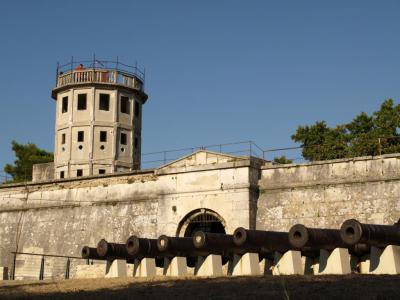
Pula Castle ("Kastel") was built in the period 1630-1633. The designs were by French military architect and engineer, Antonio De Villa. Stones from the old Roman amphitheater were used in its construction in addition to stones from local quarries.
Seen from above, the fort has a blossom shape. The center is rectangular with four pentagonal towers for more effective defensive fire power. The castle was part of Pula's extensive fortification system. During the Austro-Hungarian era the castle was called Hafen Kastell. It became an armory, a prison, and barracks.
The historical and Maritime Museum of Istria is housed in the Baroque 16th century fortress. The museum has more than 100,000 exhibits. The collections include numismatics, photographs and equipment, graphics, maps, postcards, and documents, all involved with the sea and shipbuilding.
There are thousands of 19th century postcards including 1,500 with maritime and naval scenes and sailors' lives and work. In the Maritime History Department, shipbuilding exhibits and items salvaged from wrecks by divers are shown. A reconstruction of the 19th century Royal Hospital and exhibits of pharmaceutical history can be seen.
The Castle offers a rich sampling of history and spectacular views of the city below.
Pula Castle ("Kastel") was built in the period 1630-1633. The designs were by French military architect and engineer, Antonio De Villa. Stones from the old Roman amphitheater were used in its construction in addition to stones from local quarries.
Seen from above, the fort has a blossom shape. The center is rectangular with four pentagonal towers for more effective defensive fire power. The castle was part of Pula's extensive fortification system. During the Austro-Hungarian era the castle was called Hafen Kastell. It became an armory, a prison, and barracks.
The historical and Maritime Museum of Istria is housed in the Baroque 16th century fortress. The museum has more than 100,000 exhibits. The collections include numismatics, photographs and equipment, graphics, maps, postcards, and documents, all involved with the sea and shipbuilding.
There are thousands of 19th century postcards including 1,500 with maritime and naval scenes and sailors' lives and work. In the Maritime History Department, shipbuilding exhibits and items salvaged from wrecks by divers are shown. A reconstruction of the 19th century Royal Hospital and exhibits of pharmaceutical history can be seen.
The Castle offers a rich sampling of history and spectacular views of the city below.
