Custom Walk in Thessaloniki, Greece by nancy_cook21_b8c2ef created on 2026-07-09
Guide Location: Greece » Thessaloniki
Guide Type: Custom Walk
# of Sights: 6
Tour Duration: 1 Hour(s)
Travel Distance: 2.3 Km or 1.4 Miles
Share Key: 886Z5
Guide Type: Custom Walk
# of Sights: 6
Tour Duration: 1 Hour(s)
Travel Distance: 2.3 Km or 1.4 Miles
Share Key: 886Z5
How It Works
Please retrieve this walk in the GPSmyCity app. Once done, the app will guide you from one tour stop to the next as if you had a personal tour guide. If you created the walk on this website or come to the page via a link, please follow the instructions below to retrieve the walk in the app.
Retrieve This Walk in App
Step 1. Download the app "GPSmyCity: Walks in 1K+ Cities" on Apple App Store or Google Play Store.



Step 2. In the GPSmyCity app, download(or launch) the guide "Thessaloniki Map and Walking Tours".
Step 3. Tap the menu button located at upper right corner of the "Walks" screen and select "Retrieve custom walk". Enter the share key: 886Z5
1) Statue of Alexander the Great
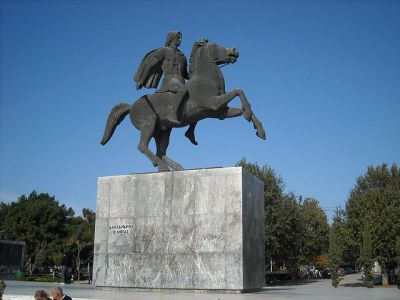
The statue of Alexander the Great shows Alexander the Great riding his horse Bucephalus. The monument is six meters (20 feet) tall. Its height, including the pedestal, is 11 meters (36 feet) tall. The bronze statue was crafted in 1973 by sculptor Evangelos Moustakas.
Alexander the Great was one of the world's most influential politicians and historical figures. Alexander the Great was one of Aristotle's students and became a Macedonian Emperor at 20. He conquered large swaths of land, including Egypt, Palestine, Syria, Pakistan, Iran, and Turkey.
Alexander the Great was undefeated in battle. But, unusually, he didn't seek to change the beliefs or customs of the territories he conquered.
The statue shows Alexander looking east while his faithful horse Bucephalus seems ready to fight. Behind the statue, a low wall depicts the Battle of Issus, which happened in 333 BC. During the battle, Alexander the Great defeated the Persian king Darius III. Other features show shields depicting Alexander's army, a snake, a lion, an ox, a falcon, and Gorgon Medusa.
Alexander the Great was incredibly influential in Macedonia and the ancient world. Thessaloniki was named after Alexander the Great's half-sister, Thessalonike.
The statue overlooks Thessaloniki's waterfront and is part of the Nea Paralia seaside park.
Alexander the Great was one of the world's most influential politicians and historical figures. Alexander the Great was one of Aristotle's students and became a Macedonian Emperor at 20. He conquered large swaths of land, including Egypt, Palestine, Syria, Pakistan, Iran, and Turkey.
Alexander the Great was undefeated in battle. But, unusually, he didn't seek to change the beliefs or customs of the territories he conquered.
The statue shows Alexander looking east while his faithful horse Bucephalus seems ready to fight. Behind the statue, a low wall depicts the Battle of Issus, which happened in 333 BC. During the battle, Alexander the Great defeated the Persian king Darius III. Other features show shields depicting Alexander's army, a snake, a lion, an ox, a falcon, and Gorgon Medusa.
Alexander the Great was incredibly influential in Macedonia and the ancient world. Thessaloniki was named after Alexander the Great's half-sister, Thessalonike.
The statue overlooks Thessaloniki's waterfront and is part of the Nea Paralia seaside park.
2) White Tower of Thessaloniki (must see)
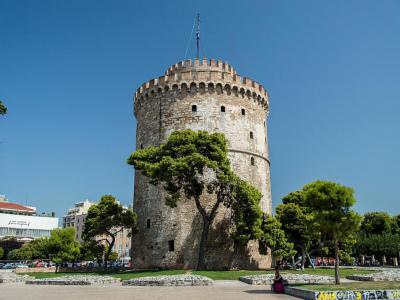
Rising to a height of approximately 112 feet, the White Tower was constructed by the Ottomans in the 15th century, shortly after their capture of the city in 1430. It formed part of the coastal fortifications and was originally integrated into a broader defensive system that included walls and artillery platforms protecting the harbor.
From the outset, the tower served a military purpose and was incorporated into the city’s defensive perimeter. Over time, it became closely associated with imprisonment and punishment. By the 17th century, it functioned as a garrison and later as a prison. During the Ottoman period, it acquired the grim name Tower of Blood or Red Tower, reflecting its role as a site of executions. In 1826, during the suppression of the Janissaries ordered by the Ottoman sultan Mahmud II, imprisoned Janissaries in Thessaloniki were executed, further cementing the tower’s fearsome reputation.
In 1890, the tower was painted white and officially renamed the White Tower. Many historians interpret this act as a symbolic attempt by the Ottoman authorities to erase-or at least soften-the memory of the tower’s violent past, though no definitive explanation survives. Regardless of intent, the new name endured and became firmly established.
The area around the tower has also witnessed pivotal moments in modern Greek history. In 1913, King George I of Greece was assassinated near the tower, marking another dramatic episode linked to the site. During World War I, the tower was used by Allied forces as a communications center, and the surrounding defensive walls were dismantled. At the same time, the tower served as a secure repository for important antiquities.
Throughout the 20th century, the White Tower continued to serve practical functions. Thessaloniki’s air defense operated from the tower between 1912 and 1983, and it also housed a meteorological laboratory. Today, the tower is home to a museum dedicated to the city’s history, presenting exhibitions that trace Thessaloniki’s development from its founding in 316 BC to the present day. Visitors who climb to the upper level are rewarded with views across the city and the Thermaic Gulf.
From the outset, the tower served a military purpose and was incorporated into the city’s defensive perimeter. Over time, it became closely associated with imprisonment and punishment. By the 17th century, it functioned as a garrison and later as a prison. During the Ottoman period, it acquired the grim name Tower of Blood or Red Tower, reflecting its role as a site of executions. In 1826, during the suppression of the Janissaries ordered by the Ottoman sultan Mahmud II, imprisoned Janissaries in Thessaloniki were executed, further cementing the tower’s fearsome reputation.
In 1890, the tower was painted white and officially renamed the White Tower. Many historians interpret this act as a symbolic attempt by the Ottoman authorities to erase-or at least soften-the memory of the tower’s violent past, though no definitive explanation survives. Regardless of intent, the new name endured and became firmly established.
The area around the tower has also witnessed pivotal moments in modern Greek history. In 1913, King George I of Greece was assassinated near the tower, marking another dramatic episode linked to the site. During World War I, the tower was used by Allied forces as a communications center, and the surrounding defensive walls were dismantled. At the same time, the tower served as a secure repository for important antiquities.
Throughout the 20th century, the White Tower continued to serve practical functions. Thessaloniki’s air defense operated from the tower between 1912 and 1983, and it also housed a meteorological laboratory. Today, the tower is home to a museum dedicated to the city’s history, presenting exhibitions that trace Thessaloniki’s development from its founding in 316 BC to the present day. Visitors who climb to the upper level are rewarded with views across the city and the Thermaic Gulf.
3) Palace of Galerius
The Palace of Galerius, situated in the heart of Thessaloniki, stands as an impressive example of Roman architecture and history. Built around AD 300 during the reign of the tetrarch Galerius, it was part of a larger urban development showcasing the wealth and power of the Roman Empire.
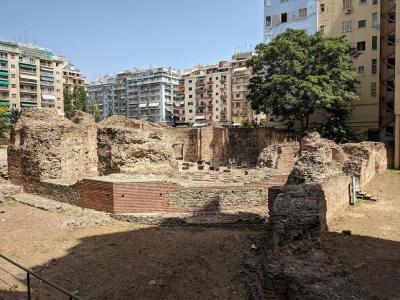
Today, the ruins of the Palace of Galerius offer visitors a chance to step back in time in Thessaloniki's bustling center. Despite its partial state of decay, the remnants of the palace provide glimpses of its former grandeur. Particularly striking is the Octagon, believed to have been Galerius's throne room, adorned with lavish decorations.
The Palace of Galerius wasn't just a single building but a vast complex covering over 150,000 square meters. It included structures like the Rotonda, Navarino Plaza, and the temple of Agia Sofia, all essential parts of daily life in Roman Thessaloniki. These were connected by the Via Egnatia, highlighting the complex's importance in the Roman trade network.
The palace and its surroundings, including a Basilica and a Nymphaeum, showcased Roman architectural prowess and served various purposes, both religious and monumental. The northern part of the complex, near Kamara, is directly linked to the Via Egnatia. The atrium, with its grand colonnade, mosaics, and statues, exuded power and prosperity.
The Octagon, adjacent to the Basilica, was particularly impressive, likely serving as the tetrarch's throne room due to its ornate decorations and prominent location.
The Galerius Complex played a crucial role in Thessaloniki's social, political, and economic life during Roman times, its scale dwarfing typical Greek constructions.
Archaeological excavations have uncovered remarkable artifacts, many now displayed in the Archaeological Museum of Thessaloniki, offering insights into the era's artistry.
Restoration work has been ongoing, allowing the public to visit most parts of the site. Visitors can admire the preserved atrium, arcades, and Basilica, appreciating the restored marble floors and vibrant mosaics. This outdoor museum offers a unique opportunity to connect with Thessaloniki's Roman heritage, making the Palace of Galerius a must-see for history enthusiasts.
Today, the ruins of the Palace of Galerius offer visitors a chance to step back in time in Thessaloniki's bustling center. Despite its partial state of decay, the remnants of the palace provide glimpses of its former grandeur. Particularly striking is the Octagon, believed to have been Galerius's throne room, adorned with lavish decorations.
The Palace of Galerius wasn't just a single building but a vast complex covering over 150,000 square meters. It included structures like the Rotonda, Navarino Plaza, and the temple of Agia Sofia, all essential parts of daily life in Roman Thessaloniki. These were connected by the Via Egnatia, highlighting the complex's importance in the Roman trade network.
The palace and its surroundings, including a Basilica and a Nymphaeum, showcased Roman architectural prowess and served various purposes, both religious and monumental. The northern part of the complex, near Kamara, is directly linked to the Via Egnatia. The atrium, with its grand colonnade, mosaics, and statues, exuded power and prosperity.
The Octagon, adjacent to the Basilica, was particularly impressive, likely serving as the tetrarch's throne room due to its ornate decorations and prominent location.
The Galerius Complex played a crucial role in Thessaloniki's social, political, and economic life during Roman times, its scale dwarfing typical Greek constructions.
Archaeological excavations have uncovered remarkable artifacts, many now displayed in the Archaeological Museum of Thessaloniki, offering insights into the era's artistry.
Restoration work has been ongoing, allowing the public to visit most parts of the site. Visitors can admire the preserved atrium, arcades, and Basilica, appreciating the restored marble floors and vibrant mosaics. This outdoor museum offers a unique opportunity to connect with Thessaloniki's Roman heritage, making the Palace of Galerius a must-see for history enthusiasts.
4) Arch of Galerius (must see)
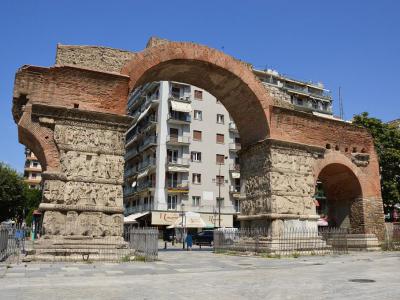
The Arch of Galerius was erected in AD 303 to commemorate the victory of the Roman co-emperor Galerius over the Persian Empire, following his successful campaign against the Sassanids. The monument originally formed part of a grand ceremonial complex and consisted of an eight-pillared structure supporting a triple arch. A processional road linked the Arch with the Rotunda of Galerius and Galerius’ palace complex, reinforcing its role as an imperial statement of power.
Today, only three of the original eight pillars remain standing. Even so, the arch remains one of Thessaloniki’s most recognizable landmarks. Locally known as Kamara, it continues to serve as a popular meeting point and reference marker in the city’s urban life.
The surviving central piers are decorated with sculpted marble relief panels that vividly depict scenes from Galerius’ Persian campaign, including battle sequences and the submission of defeated enemies. Another relief shows the imperial family participating in a ceremonial act of thanksgiving sacrifice. The faces on many figures have been deliberately chiseled away, a form of damnatio memoriae, likely carried out during later political or religious transitions rather than as a commemoration of the dead.
Additional panels emphasize the ideology of the Tetrarchy, a system of government introduced by the Roman emperor Diocletian, portraying Galerius in military attire alongside other rulers, symbolizing unity and shared authority within the late Roman imperial system. The Arch of Galerius forms part of the UNESCO World Heritage List as one of the Paleochristian and Byzantine Monuments of Thessaloniki, inscribed in 1988.
Today, only three of the original eight pillars remain standing. Even so, the arch remains one of Thessaloniki’s most recognizable landmarks. Locally known as Kamara, it continues to serve as a popular meeting point and reference marker in the city’s urban life.
The surviving central piers are decorated with sculpted marble relief panels that vividly depict scenes from Galerius’ Persian campaign, including battle sequences and the submission of defeated enemies. Another relief shows the imperial family participating in a ceremonial act of thanksgiving sacrifice. The faces on many figures have been deliberately chiseled away, a form of damnatio memoriae, likely carried out during later political or religious transitions rather than as a commemoration of the dead.
Additional panels emphasize the ideology of the Tetrarchy, a system of government introduced by the Roman emperor Diocletian, portraying Galerius in military attire alongside other rulers, symbolizing unity and shared authority within the late Roman imperial system. The Arch of Galerius forms part of the UNESCO World Heritage List as one of the Paleochristian and Byzantine Monuments of Thessaloniki, inscribed in 1988.
5) Church of Panagia Acheiropoietos
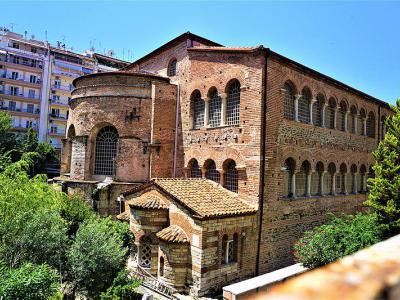
The Church of Panagia Acheiropoietos, located in the center of Thessaloniki, is a remarkable example of early Byzantine architecture. Dating back to the 5th century, it sits prominently on Agias Sofias Street across from Makedonomachon Square, adding to the city's rich historical heritage. Recognized for its architectural and cultural importance, it was listed as a UNESCO World Heritage Site in 1988.
Built between 450 and 470 AD, the Acheiropoietos is one of the oldest surviving churches in Thessaloniki. It has undergone renovations over the centuries. Originally named Panagia Theotokos during the Byzantine era, it was dedicated to Mary. Its current name, Acheiropoietos, was adopted around 1320, likely due to a miraculous icon of Panagia Hodegetria believed to have been created without human hands. Additionally, the church played a role in the veneration of Saint Demetrius, the city's patron saint.
Architecturally, the Acheiropoietos is a basilica with three aisles, measuring 28 meters wide and 36.5 meters long, featuring a distinctive wooden roof. Its structure includes a semicircular vault at the eastern end, a narthex with towers on the western side, and remnants of an exonarthex. The aisles are separated by columns, with galleries above the side aisles. Adjacent to the northern aisle is a chapel dedicated to Saint Irene from the Middle Byzantine period, accessible via a stairway in the northwestern corner. The main entrance is through a triple-arched tribelon, and it likely had a grand southern entrance connecting it to the main street of the Byzantine era.
Inside, the church boasts exquisite decorations dating back to its origins, including 5th-century Ionian capitals, green Thessalian marble columns, Proconnesian marble flooring, and remnants of decorative mosaics. Notably, the southern side features frescoes from the early 13th century depicting the Forty Martyrs of Sebaste, while Roman-era bathhouse mosaics have been found beneath the north aisle.
Following the Ottoman conquest in 1430, the Acheiropoietos was converted into a mosque, known as the Old Mosque, by Sultan Murad II. Today, the Church of Panagia Acheiropoietos stands as a significant religious site and a cherished symbol of Thessaloniki's rich history and architectural heritage.
Built between 450 and 470 AD, the Acheiropoietos is one of the oldest surviving churches in Thessaloniki. It has undergone renovations over the centuries. Originally named Panagia Theotokos during the Byzantine era, it was dedicated to Mary. Its current name, Acheiropoietos, was adopted around 1320, likely due to a miraculous icon of Panagia Hodegetria believed to have been created without human hands. Additionally, the church played a role in the veneration of Saint Demetrius, the city's patron saint.
Architecturally, the Acheiropoietos is a basilica with three aisles, measuring 28 meters wide and 36.5 meters long, featuring a distinctive wooden roof. Its structure includes a semicircular vault at the eastern end, a narthex with towers on the western side, and remnants of an exonarthex. The aisles are separated by columns, with galleries above the side aisles. Adjacent to the northern aisle is a chapel dedicated to Saint Irene from the Middle Byzantine period, accessible via a stairway in the northwestern corner. The main entrance is through a triple-arched tribelon, and it likely had a grand southern entrance connecting it to the main street of the Byzantine era.
Inside, the church boasts exquisite decorations dating back to its origins, including 5th-century Ionian capitals, green Thessalian marble columns, Proconnesian marble flooring, and remnants of decorative mosaics. Notably, the southern side features frescoes from the early 13th century depicting the Forty Martyrs of Sebaste, while Roman-era bathhouse mosaics have been found beneath the north aisle.
Following the Ottoman conquest in 1430, the Acheiropoietos was converted into a mosque, known as the Old Mosque, by Sultan Murad II. Today, the Church of Panagia Acheiropoietos stands as a significant religious site and a cherished symbol of Thessaloniki's rich history and architectural heritage.
6) Kalfayan Galleries
Since its inception in 1995, Kalfayan Galleries in Thessaloniki has been at the forefront of advancing contemporary art in the country. The gallery has focused on promoting art within Greece, the Balkans, and the MENAM (Middle East, North Africa, and Mediterranean) region, serving as a bridge between Eastern and Western visual cultures and contributing to the global art dialogue with diverse perspectives.
Kalfayan Galleries' dedication to nurturing dialogue with emerging and established artists is evident in its varied exhibition program, which embraces different media to showcase the dynamism of contemporary artistic expression. This inclusivity reflects the gallery's mission to support and foster artistic development.
A significant aspect of Kalfayan Galleries' work is its exploration of post-war Greek art through carefully curated exhibitions. By representing the Estates of influential Greek artists from this period, the gallery ensures their legacy endures in the contemporary art scene.
The gallery's philosophy revolves around blending contemporary and post-war art, distinguishing itself within the art community and contributing significantly to artistic research and discourse. Beyond exhibitions, Kalfayan Galleries aims to create a platform for inspiration, facilitating collective exchanges and collaborative projects.
Through diverse projects, participation in international art fairs, and collaborations with galleries, museums, institutions, curators, and artists worldwide, Kalfayan Galleries has built a robust international profile. It stands as a symbol of artistic innovation and cultural exchange, rooted in its commitment to bridging cultural gaps and enriching the global art conversation.
Kalfayan Galleries' dedication to nurturing dialogue with emerging and established artists is evident in its varied exhibition program, which embraces different media to showcase the dynamism of contemporary artistic expression. This inclusivity reflects the gallery's mission to support and foster artistic development.
A significant aspect of Kalfayan Galleries' work is its exploration of post-war Greek art through carefully curated exhibitions. By representing the Estates of influential Greek artists from this period, the gallery ensures their legacy endures in the contemporary art scene.
The gallery's philosophy revolves around blending contemporary and post-war art, distinguishing itself within the art community and contributing significantly to artistic research and discourse. Beyond exhibitions, Kalfayan Galleries aims to create a platform for inspiration, facilitating collective exchanges and collaborative projects.
Through diverse projects, participation in international art fairs, and collaborations with galleries, museums, institutions, curators, and artists worldwide, Kalfayan Galleries has built a robust international profile. It stands as a symbol of artistic innovation and cultural exchange, rooted in its commitment to bridging cultural gaps and enriching the global art conversation.
