

Colossus of Rhodes, Rhodes
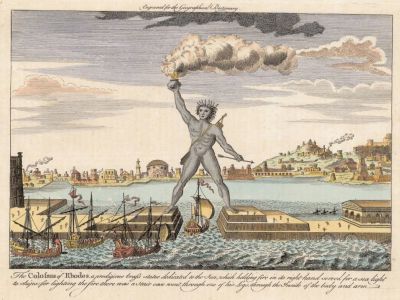
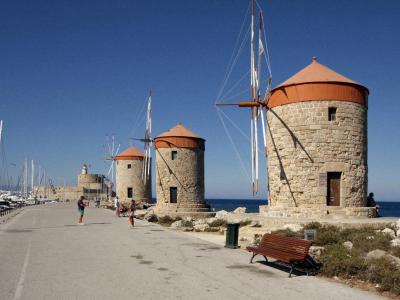
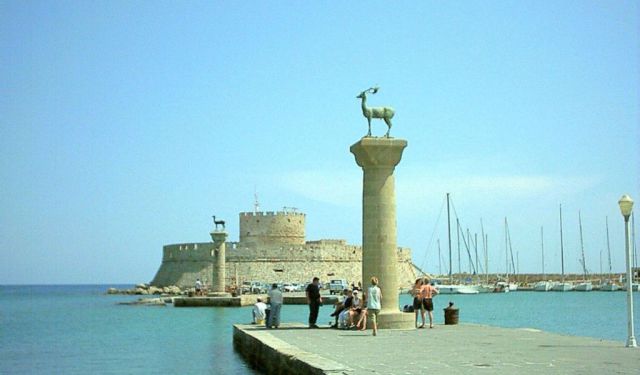
According to legend, the Colossus of Rhodes stood astride the entrance to Mandraki Harbor, with one foot on each side of the harbor mouth, allowing ships to sail between its legs as they entered the port.
However, it’s worth noting that this dramatic image comes from later medieval accounts. Most modern historians and archaeologists agree that the Colossus of Rhodes did not stand astride the entrance to Mandráki Harbor, as such a pose would have been impractical and unsupported by ancient sources. No contemporary account places the statue spanning the harbor, and the idea is generally regarded as a later invention. The true location of the Colossus remains uncertain, though many scholars favor an inland setting, possibly near a sanctuary of Helios or on elevated ground overlooking the harbor.
The colossal bronze statue was erected in the early 3rd century BC to commemorate Rhodes’ successful defense against Demetrius Poliorcetes, who besieged the city for nearly a year. Ancient writers credit the sculptor Khares of Lindos, a pupil of Lysippos, with the project, which reportedly took twelve years to complete. The Colossus stood approximately 33-35 meters high, making it one of the tallest statues of the ancient world. Later sources relate that each of its fingers was as large as a man, though such details belong more to literary tradition than measurable fact. Stories claiming that Khares took his own life over a design flaw are also legendary and cannot be securely verified.
In 226 BC, an earthquake struck Rhodes, causing the statue to collapse at the knees. Ancient authors note that the fallen remains were considered awe-inspiring, and an oracle, traditionally identified as the Delphic Oracle, advised the Rhodians not to rebuild the monument. The fragments were therefore left where they lay for several centuries.
According to later historical accounts, the remains of the Colossus were finally removed in AD 653, when Arab forces captured Rhodes and sold the bronze as scrap. Medieval writers claim that the metal was transported by hundreds of camels.
However, it’s worth noting that this dramatic image comes from later medieval accounts. Most modern historians and archaeologists agree that the Colossus of Rhodes did not stand astride the entrance to Mandráki Harbor, as such a pose would have been impractical and unsupported by ancient sources. No contemporary account places the statue spanning the harbor, and the idea is generally regarded as a later invention. The true location of the Colossus remains uncertain, though many scholars favor an inland setting, possibly near a sanctuary of Helios or on elevated ground overlooking the harbor.
The colossal bronze statue was erected in the early 3rd century BC to commemorate Rhodes’ successful defense against Demetrius Poliorcetes, who besieged the city for nearly a year. Ancient writers credit the sculptor Khares of Lindos, a pupil of Lysippos, with the project, which reportedly took twelve years to complete. The Colossus stood approximately 33-35 meters high, making it one of the tallest statues of the ancient world. Later sources relate that each of its fingers was as large as a man, though such details belong more to literary tradition than measurable fact. Stories claiming that Khares took his own life over a design flaw are also legendary and cannot be securely verified.
In 226 BC, an earthquake struck Rhodes, causing the statue to collapse at the knees. Ancient authors note that the fallen remains were considered awe-inspiring, and an oracle, traditionally identified as the Delphic Oracle, advised the Rhodians not to rebuild the monument. The fragments were therefore left where they lay for several centuries.
According to later historical accounts, the remains of the Colossus were finally removed in AD 653, when Arab forces captured Rhodes and sold the bronze as scrap. Medieval writers claim that the metal was transported by hundreds of camels.
Want to visit this sight? Check out these Self-Guided Walking Tours in Rhodes. Alternatively, you can download the mobile app "GPSmyCity: Walks in 1K+ Cities" from Apple App Store or Google Play Store. The app turns your mobile device to a personal tour guide and it works offline, so no data plan is needed when traveling abroad.
Download The GPSmyCity App



Colossus of Rhodes on Map
Sight Name: Colossus of Rhodes
Sight Location: Rhodes, Greece (See walking tours in Rhodes)
Sight Type: Attraction/Landmark
Guide(s) Containing This Sight:
Sight Location: Rhodes, Greece (See walking tours in Rhodes)
Sight Type: Attraction/Landmark
Guide(s) Containing This Sight:
Nearby Sights
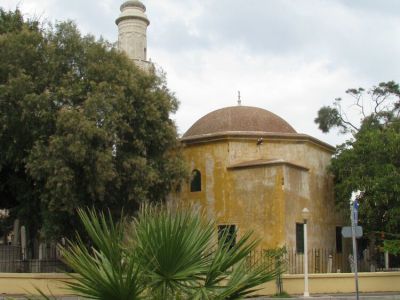
Walking Tours in Rhodes, Greece

Create Your Own Walk in Rhodes
Creating your own self-guided walk in Rhodes is easy and fun. Choose the city attractions that you want to see and a walk route map will be created just for you. You can even set your hotel as the start point of the walk.
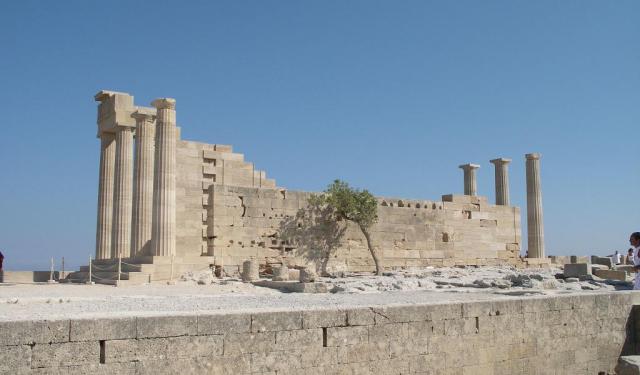
Acropolis of Rhodes
The Acropolis of Rhodes, located on Mount Smith Hill, is an ancient archaeological site. Excavations and restoration work here began under the Italian administration of the island and continue to this day. This historic location is home to several significant structures dating back to the Hellenistic period, offering a glimpse into the history and culture of the ancient Greek world.
One of the... view more
Tour Duration: 1 Hour
Travel Distance: 1.8 Km or 1.1 Miles
One of the... view more
Tour Duration: 1 Hour
Travel Distance: 1.8 Km or 1.1 Miles
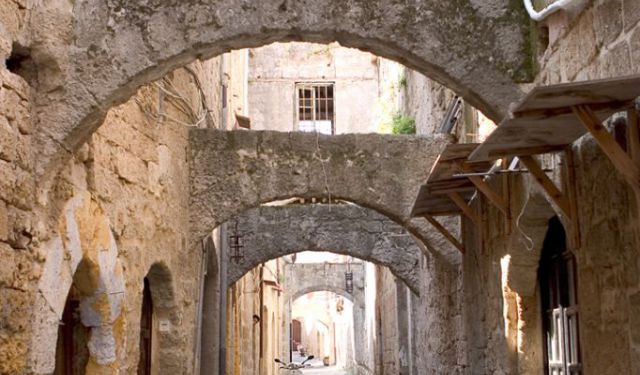
Rhodes Medieval Old Town Walking Tour
Roman writer Pliny the Elder once claimed that Rhodes was home to more than three thousand statues. The most famous of them was, without doubt, the Colossus of Rhodes, a monumental bronze statue of the sun god Helios, erected in the early 3rd century BC and later counted among the Seven Wonders of the Ancient World.
Rhodes is one of the most historically layered islands in the eastern... view more
Tour Duration: 2 Hours
Travel Distance: 2.1 Km or 1.3 Miles
Rhodes is one of the most historically layered islands in the eastern... view more
Tour Duration: 2 Hours
Travel Distance: 2.1 Km or 1.3 Miles
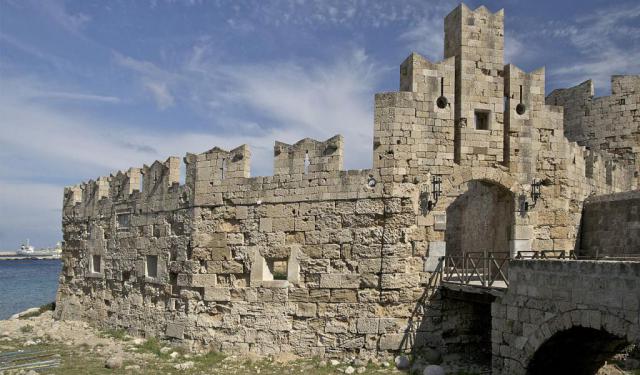
Gates and Walls Tour
Owing to its geographical location, as a gateway to the Aegean Sea, Rhodes has always had a vantage position on trade routes between the West and the East - well protected against both foreign invaders and corsairs sailing the Mediterranean waters. The early defense system of Rhodes dates back as far as the 4th century BC.
Starting the Middle Ages - the year 1309, when the Knights Hospitaller... view more
Tour Duration: 1 Hour
Travel Distance: 1.4 Km or 0.9 Miles
Starting the Middle Ages - the year 1309, when the Knights Hospitaller... view more
Tour Duration: 1 Hour
Travel Distance: 1.4 Km or 0.9 Miles
Mandraki Harbor Tour
Mandraki, one of the three harbors of Rhodes, is by far the most famous of them. For centuries, this “front door” of the island has welcomed visitors to Rhodes from far and away. In large part (and quite literally so), the reason for its popularity was the enormous statue of Colossus, one of the Seven Wonders of the Ancient World, that used to crown the harbor's entrance, adding a sense... view more
Tour Duration: 1 Hour
Travel Distance: 1 Km or 0.6 Miles
Tour Duration: 1 Hour
Travel Distance: 1 Km or 0.6 Miles