

Medieval Town Walking Tour (Self Guided), Rhodes
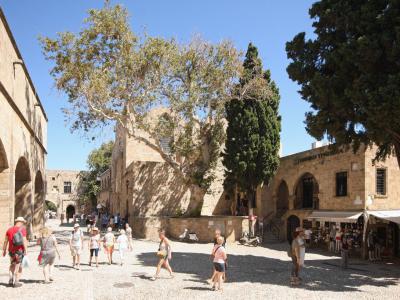
The medieval town of Rhodes, where every street, square, or building evokes a story about ancient times, is a living museum in its own right. Being one of the best-preserved medieval walled towns in Europe, this enchanting area boasts several remarkable locations and is quite deservedly declared a UNESCO World Heritage Site.
Welcoming you at its entrance is the Liberty (or Eleftherias) Gate. Right beside it lies one of the town's notable sites, the Temple of Aphrodite, a sanctuary dedicated to the goddess of love and beauty.
Wandering along the cobblestone streets further, you'll find yourself on the Street of The Knights lined with imposing medieval buildings that tell the stories of the valiant knights who once defended this town. The Palace of the Grand Master of the Knights of Rhodes stands as a grand testament to their influence and power.
Religious diversity is evident in the Mustafa Mosque and the Rejep Pasha Mosque, showcasing the multicultural history of the town. Ippokratous Square offers a charming respite, while the Square of Jewish Martyrs leads to the Kahal Shalom Synagogue and the Jewish Museum of Rhodes, highlighting the Jewish community's enduring presence.
The Church of the Virgin of the Burgh, with the remnants of its awe-inspiring architecture, symbolizes the Christian heritage of the town.
As you explore these landmarks, you can't help feeling awestruck by the layers of history preserved in their stones. The medieval town of Rhodes invites you to immerse yourself in its captivating past while appreciating the cultural tapestry woven by different civilizations throughout centuries. So, do come to explore it and let the echoes of the past transport you to a world of wonder and discovery!
Welcoming you at its entrance is the Liberty (or Eleftherias) Gate. Right beside it lies one of the town's notable sites, the Temple of Aphrodite, a sanctuary dedicated to the goddess of love and beauty.
Wandering along the cobblestone streets further, you'll find yourself on the Street of The Knights lined with imposing medieval buildings that tell the stories of the valiant knights who once defended this town. The Palace of the Grand Master of the Knights of Rhodes stands as a grand testament to their influence and power.
Religious diversity is evident in the Mustafa Mosque and the Rejep Pasha Mosque, showcasing the multicultural history of the town. Ippokratous Square offers a charming respite, while the Square of Jewish Martyrs leads to the Kahal Shalom Synagogue and the Jewish Museum of Rhodes, highlighting the Jewish community's enduring presence.
The Church of the Virgin of the Burgh, with the remnants of its awe-inspiring architecture, symbolizes the Christian heritage of the town.
As you explore these landmarks, you can't help feeling awestruck by the layers of history preserved in their stones. The medieval town of Rhodes invites you to immerse yourself in its captivating past while appreciating the cultural tapestry woven by different civilizations throughout centuries. So, do come to explore it and let the echoes of the past transport you to a world of wonder and discovery!
How it works: Download the app "GPSmyCity: Walks in 1K+ Cities" from Apple App Store or Google Play Store to your mobile phone or tablet. The app turns your mobile device into a personal tour guide and its built-in GPS navigation functions guide you from one tour stop to next. The app works offline, so no data plan is needed when traveling abroad.
Medieval Town Walking Tour Map
Guide Name: Medieval Town Walking Tour
Guide Location: Greece » Rhodes (See other walking tours in Rhodes)
Guide Type: Self-guided Walking Tour (Sightseeing)
# of Attractions: 11
Tour Duration: 2 Hour(s)
Travel Distance: 1.9 Km or 1.2 Miles
Author: rose
Sight(s) Featured in This Guide:
Guide Location: Greece » Rhodes (See other walking tours in Rhodes)
Guide Type: Self-guided Walking Tour (Sightseeing)
# of Attractions: 11
Tour Duration: 2 Hour(s)
Travel Distance: 1.9 Km or 1.2 Miles
Author: rose
Sight(s) Featured in This Guide:
- Eleftherias (Liberty) Gate
- Temple of Aphrodite
- Street of the Knights
- Palace of the Grand Master of the Knights of Rhodes
- Sultan Mustafa Mosque
- Recep Pasha Mosque
- Hippocrates Square
- Square of Jewish Martyrs
- Kahal Shalom Synagogue
- Jewish Museum of Rhodes
- Church of the Virgin of the Burgh
1) Eleftherias (Liberty) Gate
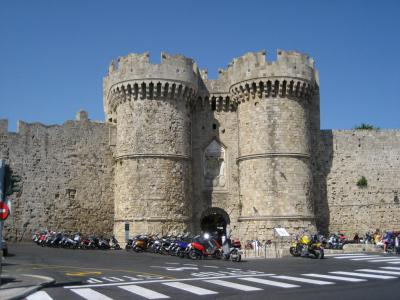
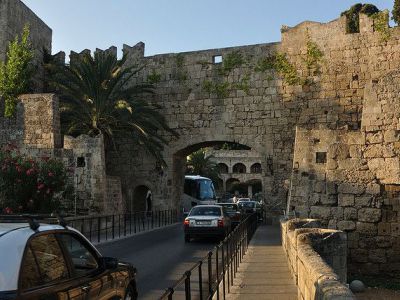
Sitting right in front of Symi Square, otherwise known as Place de l’Arsenal, is one of the main entrances into the medieval city of Rhodes – the Liberty Gate. The original gate on this site dates back to the time of Grand Master Heredia (1377-1396) and used to link the northern flank of the seaside wall to the Mandraki Harbour. Back then it was also colloquially referred to as the Shipyard Gate or Shipyard Vaults, being a short distance from the local arsenal and the knightly shipyards that formed part of the domain of the Langue (Tongue) of France.
Two square towers that once flanked the gate on both sides were razed by the Ottomans in 1910. Historic records indicate that one of them appears on the coat of arms of Grand Master d'Aubusson (1476-1503). The structure shows a pronounced influence of Byzantine architecture, and its dimensions (9.9 meters wide, 5.2 meters high) support the projected use of the passage – letting through voluminous vessels or appurtenances thereof en route to the shipyard. Under Ottoman rule, this gate may have also operated as a bridge over the water to a basin designated in Turkish as "Eğri Liman" ("Concealed Harbour").
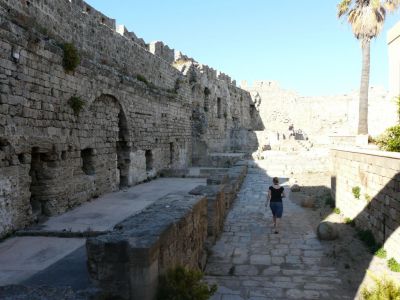
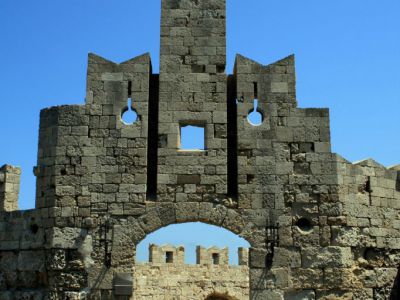
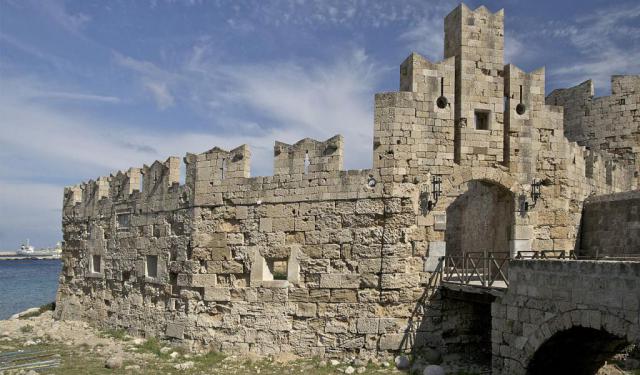
The ramparts currently seen on top of the wall were erected during Italian rule (1912-1943). The Italians, who deserve much credit for historical reconstruction in Rhodes, created this gate in 1924 after they had taken possession of the island during WWI. Portraying themselves as liberators from the Ottoman rule, they called it Liberty Gate. Although modern as such, it was built in a strict accordance with medieval architectural practice.
Two square towers that once flanked the gate on both sides were razed by the Ottomans in 1910. Historic records indicate that one of them appears on the coat of arms of Grand Master d'Aubusson (1476-1503). The structure shows a pronounced influence of Byzantine architecture, and its dimensions (9.9 meters wide, 5.2 meters high) support the projected use of the passage – letting through voluminous vessels or appurtenances thereof en route to the shipyard. Under Ottoman rule, this gate may have also operated as a bridge over the water to a basin designated in Turkish as "Eğri Liman" ("Concealed Harbour").
The ramparts currently seen on top of the wall were erected during Italian rule (1912-1943). The Italians, who deserve much credit for historical reconstruction in Rhodes, created this gate in 1924 after they had taken possession of the island during WWI. Portraying themselves as liberators from the Ottoman rule, they called it Liberty Gate. Although modern as such, it was built in a strict accordance with medieval architectural practice.
2) Temple of Aphrodite
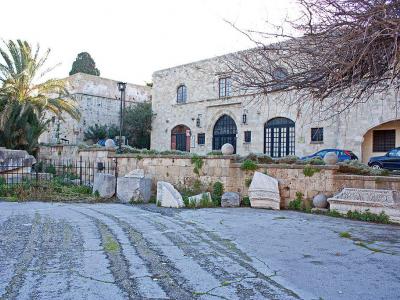
The Temple of Aphrodite, or rather the remains thereof, located on Symi Square, outside the Eleftherias (Liberty) Gate in the Old Town of Rhodes, serves as a reminder of the splendor of ancient Greece that it once was. The sanctuary dates from the 3rd century BC and was built in honor of Aphrodite, the mythological Greek goddess of love and beauty. Venerated by ancient worshipers, her statue, currently in the Archaeological Museum of Rhodes, is believed to have once stood here.
Today the ruins of the formerly majestic temple are surrounded with a small fence. While the site is closed to the public, an information board outside the fence offers a detailed overview of the complex. The descriptions here are written in both Greek and English.
Those determined to have a glimpse of the place's former glory may get close enough to see the old building blocks and fallen columns. Some may even be able to make out some inscriptions on a couple of the flagstones.
Today the ruins of the formerly majestic temple are surrounded with a small fence. While the site is closed to the public, an information board outside the fence offers a detailed overview of the complex. The descriptions here are written in both Greek and English.
Those determined to have a glimpse of the place's former glory may get close enough to see the old building blocks and fallen columns. Some may even be able to make out some inscriptions on a couple of the flagstones.
3) Street of the Knights (must see)
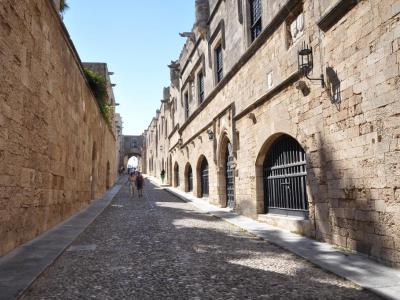
The Street of the Knights is lined with the former inns of the Knights Hospitaller, each once housing members of a specific langue of the Order. The street is widely regarded as one of the best-preserved medieval streets in Europe, notable for the coherence of its architecture and its limited later alteration. The buildings on both sides are constructed primarily of local limestone, carefully dressed to present a unified and imposing facade that remains consistent from start to finish.
At the upper end of the street, immediately after leaving the Palace of the Grand Master, the route is visually anchored by a stone archway spanning the roadway, marking the transition from the palace complex into the residential quarter of the Knights. As you proceed downhill along the center of the street, the facades are punctuated by small square windows set high in the walls and arched doorways at ground level, proportioned to admit mounted riders or carts. Along the way, carved coats of arms, inscriptions, and commemorative plaques appear on both sides, identifying individual patrons and phases of construction as you continue toward the lower town.
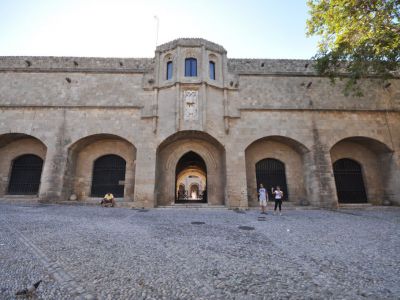
Roughly halfway down the street, the Inn of France comes into view on your left-hand side. Continuing toward the lower end of the street, look across to your left to see a small enclosed garden with an Ottoman fountain. This garden forms part of the courtyard of the 15th-century Villaragut Mansion, restored in 2002. The courtyard is generally closed to the public and accessible only on special occasions or through institutional arrangements. Near the lower end of the street, on the north side, the route opens toward the Archaeological Museum of Rhodes, housed in the former Knights’ Hospital.
During the day, as you walk this stretch, the street is heavily trafficked by visitors and tour groups, which can obscure its original function as a ceremonial and administrative route linking the Knights’ residences to the Palace of the Grand Master. In the evening, with fewer people moving along the route, the architectural sequence, from palace to inns to lower town, becomes easier to read, clearly revealing the street’s original role within the medieval city.
At the upper end of the street, immediately after leaving the Palace of the Grand Master, the route is visually anchored by a stone archway spanning the roadway, marking the transition from the palace complex into the residential quarter of the Knights. As you proceed downhill along the center of the street, the facades are punctuated by small square windows set high in the walls and arched doorways at ground level, proportioned to admit mounted riders or carts. Along the way, carved coats of arms, inscriptions, and commemorative plaques appear on both sides, identifying individual patrons and phases of construction as you continue toward the lower town.
Roughly halfway down the street, the Inn of France comes into view on your left-hand side. Continuing toward the lower end of the street, look across to your left to see a small enclosed garden with an Ottoman fountain. This garden forms part of the courtyard of the 15th-century Villaragut Mansion, restored in 2002. The courtyard is generally closed to the public and accessible only on special occasions or through institutional arrangements. Near the lower end of the street, on the north side, the route opens toward the Archaeological Museum of Rhodes, housed in the former Knights’ Hospital.
During the day, as you walk this stretch, the street is heavily trafficked by visitors and tour groups, which can obscure its original function as a ceremonial and administrative route linking the Knights’ residences to the Palace of the Grand Master. In the evening, with fewer people moving along the route, the architectural sequence, from palace to inns to lower town, becomes easier to read, clearly revealing the street’s original role within the medieval city.
4) Palace of the Grand Master of the Knights of Rhodes (must see)
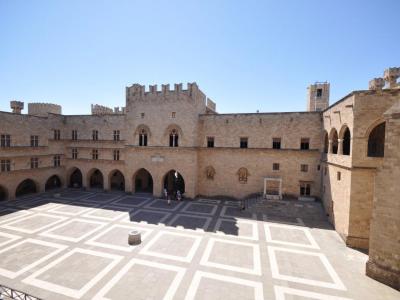
The Palace of the Grand Master was once the administrative seat of the Knights Hospitaller and the symbolic heart of the Knights’ Quarter. During the Ottoman period, the building fell into neglect and was later used as a prison. In 1856, a gunpowder explosion caused severe damage, leaving much of the structure in ruins. The palace was extensively reconstructed during the Italian administration in the 1930s. The rebuilding did not follow the original medieval layout and introduced new interior elements, including sculptures and mosaics transferred from other Dodecanese islands.
Despite these issues, the palace remains visually commanding, dominating one of the highest points of the Old Town. The interior incorporates architectural fragments such as columns and capitals reused from ancient sites. The reconstructed rooms feature coffered wooden ceilings and windows fitted with translucent stone panels that soften the interior light. Many of the grand halls are decorated with large-scale Hellenistic and Roman mosaics, primarily brought from Kos.
Visitors enter between two imposing semicircular towers and ascend a broad marble staircase to the upper level, where spacious ceremonial rooms are intentionally sparsely furnished to emphasize architectural form and mosaic decoration. Among the most notable scenes are representations of the Nine Muses, a sea nymph riding a hippocamp, and the head of Medusa, along with marine motifs featuring fish and dolphins.
The ground floor, once used for storage and logistical purposes during sieges, encloses a large courtyard populated with classical-style statues. Today, this level hosts permanent and temporary exhibitions that outline the history of Rhodes from antiquity through the medieval period and up to the Ottoman conquest, offering broader historical context alongside the palace’s own story.
Despite these issues, the palace remains visually commanding, dominating one of the highest points of the Old Town. The interior incorporates architectural fragments such as columns and capitals reused from ancient sites. The reconstructed rooms feature coffered wooden ceilings and windows fitted with translucent stone panels that soften the interior light. Many of the grand halls are decorated with large-scale Hellenistic and Roman mosaics, primarily brought from Kos.
Visitors enter between two imposing semicircular towers and ascend a broad marble staircase to the upper level, where spacious ceremonial rooms are intentionally sparsely furnished to emphasize architectural form and mosaic decoration. Among the most notable scenes are representations of the Nine Muses, a sea nymph riding a hippocamp, and the head of Medusa, along with marine motifs featuring fish and dolphins.
The ground floor, once used for storage and logistical purposes during sieges, encloses a large courtyard populated with classical-style statues. Today, this level hosts permanent and temporary exhibitions that outline the history of Rhodes from antiquity through the medieval period and up to the Ottoman conquest, offering broader historical context alongside the palace’s own story.
5) Sultan Mustafa Mosque
Completed in 1765, this imposing mosque, facing the Great Hammam (Turkish baths) of the Old Town, stands as a testament to Rhodes' Ottoman heritage. Sultan Mustafa III is credited as its founder, as indicated by a marble inscription on the door frame.
Reflecting Ottoman architectural style, the structure comprises three square spaces, with one larger and taller than the others, covered with domes and two consecutive balconies on the north side. While the minaret was dismantled in 1973 and remains in ruins, the renovations carried out in the mid-2010s restored its bright yellow facade and roof.
Nowadays, the mosque occasionally hosts events for the Muslim community, especially weddings. Notably, its minbar, or pulpit, ranks among the largest surviving marble minbars on the island. Crafted from pieces of gray marble and adorned with intricate Arabic ornaments, it features a prominent inscription of the Shahada, the Islamic declaration of faith.
Reflecting Ottoman architectural style, the structure comprises three square spaces, with one larger and taller than the others, covered with domes and two consecutive balconies on the north side. While the minaret was dismantled in 1973 and remains in ruins, the renovations carried out in the mid-2010s restored its bright yellow facade and roof.
Nowadays, the mosque occasionally hosts events for the Muslim community, especially weddings. Notably, its minbar, or pulpit, ranks among the largest surviving marble minbars on the island. Crafted from pieces of gray marble and adorned with intricate Arabic ornaments, it features a prominent inscription of the Shahada, the Islamic declaration of faith.
6) Recep Pasha Mosque
Epitomizing the grandeur of the Ottoman golden age, this mosque, nestled within Rhodes' ancient walled city, was originally erected in 1588 from the remnants of earlier Christian churches, and was complemented by additional structures: a mausoleum honoring Reçep Pasha, the Ottoman Empire's Grand Vizier, located within the mosque's courtyard and housing his sarcophagus, and an ablution fountain.
Sadly, years of neglect have left the mosque in a state of near ruin, exacerbated by a partial collapse of its portico in 2011. With repair costs estimated at three million euros, the restoration efforts were halted due to financial constraints. Consequently, as of 2022, the mosque remains closed to both worshippers and visitors due to its precarious condition.
Despite its current dilapidation, the Reçep Pasha is hailed as the most exquisite and architecturally striking among Rhodes' mosques, with some advocating for its restoration to house a museum of Islamic art in the future.
Sadly, years of neglect have left the mosque in a state of near ruin, exacerbated by a partial collapse of its portico in 2011. With repair costs estimated at three million euros, the restoration efforts were halted due to financial constraints. Consequently, as of 2022, the mosque remains closed to both worshippers and visitors due to its precarious condition.
Despite its current dilapidation, the Reçep Pasha is hailed as the most exquisite and architecturally striking among Rhodes' mosques, with some advocating for its restoration to house a museum of Islamic art in the future.
7) Hippocrates Square
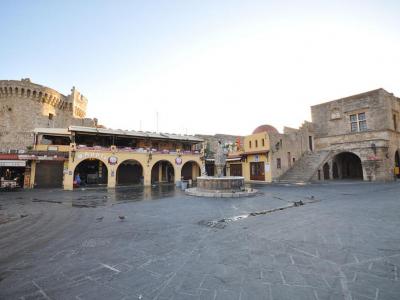
Upon entering the Old Town through the Marine Gate and its imposing towers, visitors arrive at Hippocrates Square, a natural starting point for exploring this UNESCO World Heritage Site. The square functions as one of the Old Town’s main gathering places and is centered on the Syndriváni, a fountain introduced during the Italian period, easily recognized by its decorative upper element and the pigeons that congregate around it.
Standing at the southeastern corner, the long, arcaded facade belongs to the Kastellanía, originally the commercial tribunal and courthouse of the Knights Hospitaller. Completed in 1507 and restored during the Italian administration between 1925 and 1935, the building now houses the municipal library and historical archives. On the northern side stands the small Syndriváni Mosque, a modest Ottoman-era structure dating to the late 18th century.
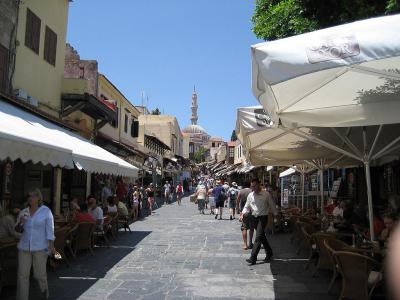
Turning your attention to the western side of the square, Socrates Street begins here, drawing visitors deeper into the Old Town. The surrounding buildings are a mix of medieval structures and later Ottoman- and Italian-period adaptations, many featuring arcades at street level and upper floors converted into cafes, shops, and terraces. Several of these buildings incorporate reused medieval stonework, visible in door frames and wall sections.
Standing at the southeastern corner, the long, arcaded facade belongs to the Kastellanía, originally the commercial tribunal and courthouse of the Knights Hospitaller. Completed in 1507 and restored during the Italian administration between 1925 and 1935, the building now houses the municipal library and historical archives. On the northern side stands the small Syndriváni Mosque, a modest Ottoman-era structure dating to the late 18th century.
Turning your attention to the western side of the square, Socrates Street begins here, drawing visitors deeper into the Old Town. The surrounding buildings are a mix of medieval structures and later Ottoman- and Italian-period adaptations, many featuring arcades at street level and upper floors converted into cafes, shops, and terraces. Several of these buildings incorporate reused medieval stonework, visible in door frames and wall sections.
8) Square of Jewish Martyrs
Tucked away in the southeast corner of the Old Town, the Jewish Quarter is a maze of narrow streets, anchored by the Square of Jewish Martyrs, also known as Sea Horse Square for its charming sea horse fountain. Here, amidst quaint eateries and shops, lies a solemn reminder of the quarter's poignant history.
Once bustling with life, the quarter was home to 5500 residents a century ago; however, the tumultuous events of the 1930s saw half of its inhabitants flee, while the tragic deportation of 1673 Jews to Auschwitz in 1944 left only 151 survivors. Today, a black marble Memorial, inscribed with the words "Never Forget" in various languages (including English, French, Greek, and Hebrew), stands solemnly in the square, shaded by towering Ficus trees and surrounded by street artists.
For a deeper understanding of this history, visitors can explore the Jewish Museum of Rhodes, accessed via the Kahal Shalom Synagogue.
Once bustling with life, the quarter was home to 5500 residents a century ago; however, the tumultuous events of the 1930s saw half of its inhabitants flee, while the tragic deportation of 1673 Jews to Auschwitz in 1944 left only 151 survivors. Today, a black marble Memorial, inscribed with the words "Never Forget" in various languages (including English, French, Greek, and Hebrew), stands solemnly in the square, shaded by towering Ficus trees and surrounded by street artists.
For a deeper understanding of this history, visitors can explore the Jewish Museum of Rhodes, accessed via the Kahal Shalom Synagogue.
9) Kahal Shalom Synagogue (must see)
Completed in 1577, Kahal Shalom stands as Greece's oldest surviving synagogue still in active use. Its worshipers prospered under Ottoman rule into the 20th century; however, the Kingdom of Italy took over the Dodecanese Islands in 1912, and large numbers of the Jews of Rhodes had begun to emigrate during the 1930s, as they felt menaced by the Fascist Italian regime.
The architectural layout of the structure reflects typical Sephardic synagogue design, featuring a central 'biham' from which the Sefer Torah is read. Inside, the sanctuary has a striking mosaic floor crafted from local black and white stones, while two unique Torah arks can be spotted on either side of the door leading into the interior courtyard. In the courtyard, there is also a fountain used for handwashing.
A commemorative plaque within the synagogue pays tribute to the countless local Jews who tragically lost their lives under Nazi rule. Today, Kahal Shalom remains a site of worship and pilgrimage, with its former women's gallery now transformed into the Jewish Museum of Rhodes, preserving and sharing the rich heritage of the island's Jewish community.
The architectural layout of the structure reflects typical Sephardic synagogue design, featuring a central 'biham' from which the Sefer Torah is read. Inside, the sanctuary has a striking mosaic floor crafted from local black and white stones, while two unique Torah arks can be spotted on either side of the door leading into the interior courtyard. In the courtyard, there is also a fountain used for handwashing.
A commemorative plaque within the synagogue pays tribute to the countless local Jews who tragically lost their lives under Nazi rule. Today, Kahal Shalom remains a site of worship and pilgrimage, with its former women's gallery now transformed into the Jewish Museum of Rhodes, preserving and sharing the rich heritage of the island's Jewish community.
10) Jewish Museum of Rhodes
The Jewish presence on Rhodes traces back to the 2nd century BC, with a significant influx of Jewish refugees from Spain in the 13th century – this resulted in the development of a unique local dialect known as 'Ladino', blending Spanish and Hebrew elements. By the 12th century, records indicate that 400 to 500 Jews resided on the island, as noted by Rabbi Benjamin of Tudela.
This well-kept museum, accessible through the Kahal Shalom Synagogue, offers a captivating journey through the community's history via photographs, documents, and personal artifacts. It also commemorates the community's tragic fate, marked by the mass deportations to Auschwitz in 1944. With informative signage and a collection featuring a 16th-century Torah scroll, traditional attire, and textiles, the museum provides valuable insights into the rich heritage and enduring legacy of Rhodes' Jewish community.
11) Church of the Virgin of the Burgh
At the eastern edge of the Medieval City, near the Gate of the Virgin, lie the ruins of this Gothic Roman Catholic Church, dating back to the 14th century. Likely one of the earliest constructions by the Knights Hospitaller, the structure was later converted into a mosque during the Turkish occupation. Despite suffering damage from World War II bombings, its grand original Gothic style remains impressive.
Today, only the three apses and parts of a small chapel stand, yet the site remains significant as one of the few remaining Roman Catholic churches from that era in the islands. With no formal opening times or admission fees, visitors are free to wander among the ruins.
As for a bit of trivia, the name "Burgh" originates from the bourgeois inhabitants of this part of the town.
Today, only the three apses and parts of a small chapel stand, yet the site remains significant as one of the few remaining Roman Catholic churches from that era in the islands. With no formal opening times or admission fees, visitors are free to wander among the ruins.
As for a bit of trivia, the name "Burgh" originates from the bourgeois inhabitants of this part of the town.
Walking Tours in Rhodes, Greece

Create Your Own Walk in Rhodes
Creating your own self-guided walk in Rhodes is easy and fun. Choose the city attractions that you want to see and a walk route map will be created just for you. You can even set your hotel as the start point of the walk.
Mandraki Harbor Tour
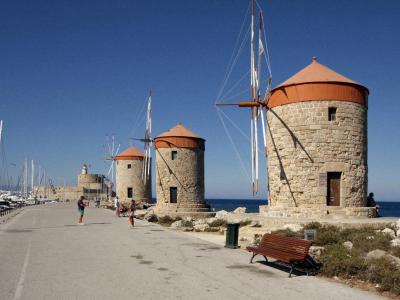
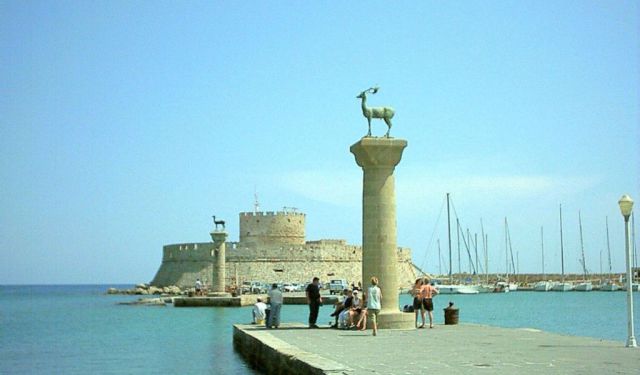
Mandraki, one of the three harbors of Rhodes, is by far the most famous of them. For centuries, this “front door” of the island has welcomed visitors to Rhodes from far and away. In large part (and quite literally so), the reason for its popularity was the enormous statue of Colossus, one of the Seven Wonders of the Ancient World, that used to crown the harbor's entrance, adding a sense... view more
Tour Duration: 1 Hour(s)
Travel Distance: 1.0 Km or 0.6 Miles
Tour Duration: 1 Hour(s)
Travel Distance: 1.0 Km or 0.6 Miles
Rhodes Introduction Walking Tour
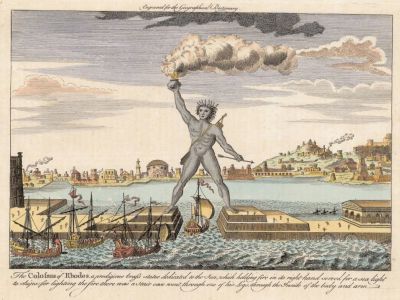
Roman writer Pliny the Elder once claimed that Rhodes was home to more than three thousand statues. The most famous of them was, without doubt, the Colossus of Rhodes, a monumental bronze statue of the sun god Helios, erected in the early 3rd century BC and later counted among the Seven Wonders of the Ancient World.
Rhodes is one of the most historically layered islands in the eastern... view more
Tour Duration: 2 Hour(s)
Travel Distance: 2.2 Km or 1.4 Miles
Rhodes is one of the most historically layered islands in the eastern... view more
Tour Duration: 2 Hour(s)
Travel Distance: 2.2 Km or 1.4 Miles
Acropolis of Rhodes
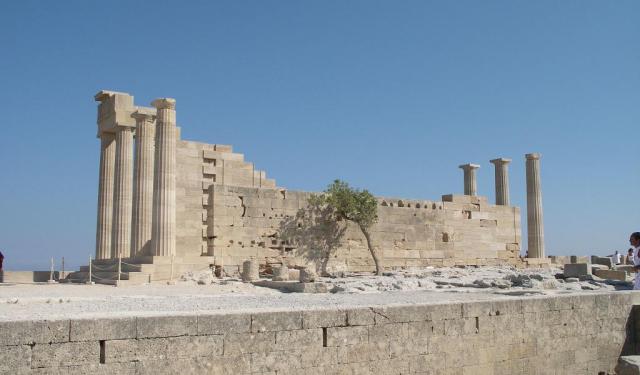
The Acropolis of Rhodes on Monte Smith is an ancient archaeological site. The excavations and restoration works here began under the Italian administration of the island (from 1912 to 1945) and continue to this day. This historic location is home to several significant structures dating back to the Hellenistic period (3rd to 2nd century BC) offering a glimpse into the history and culture of the... view more
Tour Duration: 1 Hour(s)
Travel Distance: 1.5 Km or 0.9 Miles
Tour Duration: 1 Hour(s)
Travel Distance: 1.5 Km or 0.9 Miles
Gates and Walls Tour
Owing to its geographical location, as a gateway to the Aegean Sea, Rhodes has always had a vantage position on trade routes between the West and the East – well protected against both foreign invaders and corsairs sailing the Mediterranean waters. The early defense system of Rhodes dates back as far as the 4th century BC.
Starting the Middle Ages – the year 1309, when the Knights... view more
Tour Duration: 1 Hour(s)
Travel Distance: 1.4 Km or 0.9 Miles
Starting the Middle Ages – the year 1309, when the Knights... view more
Tour Duration: 1 Hour(s)
Travel Distance: 1.4 Km or 0.9 Miles
The Most Popular Cities
/ view all