

Jesuitenkirche (Jesuit Church), Heidelberg
The Jesuits first made their way to Heidelberg in 1622 during the tumult of the Thirty Years' War, following victories over the Protestant Union and the subsequent occupation of Heidelberg by Bavarian troops. After a brief period in the 1680s, they played a crucial role in the Elector's efforts to re-Catholicize the previously Protestant Electorate of the Palatinate. Starting in 1703, Jesuit buildings began to rise around a spacious courtyard designed like a monastery cloister.
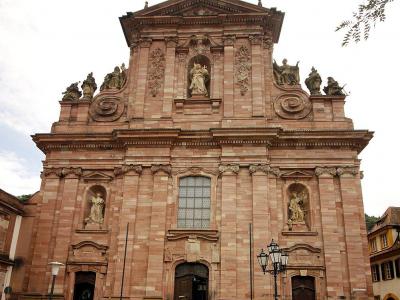
Church construction preparations began in 1711, with plans sent to Rome for approval, emphasizing a design that mirrored the Roman facade style, rare in Germany but reminiscent of Il Gesù in Rome, the Jesuit mother church. The magnificent main facade on the north side is divided into three vertical axes with a strikingly high central projection capped with a triangular gable. At the top, the figure of the Redeemer Jesus Christ stands in the middle niche, flanked by sculptures of Ignatius of Loyola and Francis Xavier above the side portals. The central section is adorned with allegories of the Christian cardinal virtues of Love and Hope, and at the gable's peak, the Cardinal Virtue of Faith stands triumphantly with the sign of the cross.
After the Jesuit Order was suppressed in 1773, the church was first taken over by the Lazarists and then used for secular purposes, including as a storage room. From 1793 to 1797, during the First Coalition War, it served as a military hospital and continued to function as such through the first half of the Napoleonic Wars until 1808. In 1809, Grand Duke Karl Friedrich of Baden granted the church to the Catholic Holy Spirit Community as their parish church, as the choir of the Holy Spirit Church had become insufficient for the growing Catholic congregation. The baroque furnishings from the Holy Spirit choir were moved here, and nothing from the original furnishing was preserved.
The church interior saw major changes during the 1872 to 1874 renovations, including exposing the sandstone columns, darkening the ceiling, and removing the baroque decor. Only the wooden door of the tabernacle, with its depiction of the Pentecost miracle, remains from the baroque high altar. Another significant renovation occurred in 1953/54, which opted for a lighter interior aesthetic. The most recent renovations from 2001 to 2004 included a redesign of the altar area, addition of new pews, and new window glazing, refreshing the church’s historical and spiritual character.
Church construction preparations began in 1711, with plans sent to Rome for approval, emphasizing a design that mirrored the Roman facade style, rare in Germany but reminiscent of Il Gesù in Rome, the Jesuit mother church. The magnificent main facade on the north side is divided into three vertical axes with a strikingly high central projection capped with a triangular gable. At the top, the figure of the Redeemer Jesus Christ stands in the middle niche, flanked by sculptures of Ignatius of Loyola and Francis Xavier above the side portals. The central section is adorned with allegories of the Christian cardinal virtues of Love and Hope, and at the gable's peak, the Cardinal Virtue of Faith stands triumphantly with the sign of the cross.
After the Jesuit Order was suppressed in 1773, the church was first taken over by the Lazarists and then used for secular purposes, including as a storage room. From 1793 to 1797, during the First Coalition War, it served as a military hospital and continued to function as such through the first half of the Napoleonic Wars until 1808. In 1809, Grand Duke Karl Friedrich of Baden granted the church to the Catholic Holy Spirit Community as their parish church, as the choir of the Holy Spirit Church had become insufficient for the growing Catholic congregation. The baroque furnishings from the Holy Spirit choir were moved here, and nothing from the original furnishing was preserved.
The church interior saw major changes during the 1872 to 1874 renovations, including exposing the sandstone columns, darkening the ceiling, and removing the baroque decor. Only the wooden door of the tabernacle, with its depiction of the Pentecost miracle, remains from the baroque high altar. Another significant renovation occurred in 1953/54, which opted for a lighter interior aesthetic. The most recent renovations from 2001 to 2004 included a redesign of the altar area, addition of new pews, and new window glazing, refreshing the church’s historical and spiritual character.
Want to visit this sight? Check out these Self-Guided Walking Tours in Heidelberg. Alternatively, you can download the mobile app "GPSmyCity: Walks in 1K+ Cities" from Apple App Store or Google Play Store. The app turns your mobile device to a personal tour guide and it works offline, so no data plan is needed when traveling abroad.
Download The GPSmyCity App



Jesuitenkirche (Jesuit Church) on Map
Sight Name: Jesuitenkirche (Jesuit Church)
Sight Location: Heidelberg, Germany (See walking tours in Heidelberg)
Sight Type: Religious
Sight Location: Heidelberg, Germany (See walking tours in Heidelberg)
Sight Type: Religious
Nearby Sights

Walking Tours in Heidelberg, Germany

Create Your Own Walk in Heidelberg
Creating your own self-guided walk in Heidelberg is easy and fun. Choose the city attractions that you want to see and a walk route map will be created just for you. You can even set your hotel as the start point of the walk.
Philosophers’ Path
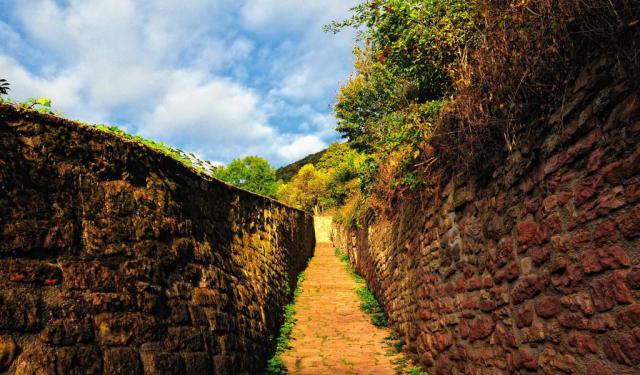
For generations, Heidelberg’s poets, professors, and philosophers came to this hillside to walk, talk, think, and admire the city below. Their footsteps eventually gave one of Heidelberg’s most scenic routes its name: the Philosophers’ Path.
Heidelberg may be best known for its Castle, Old Town, and historic University, but one of the city’s most rewarding experiences lies across the... view more
Tour Duration: 1 Hour(s)
Travel Distance: 1.6 Km or 1 Miles
Heidelberg may be best known for its Castle, Old Town, and historic University, but one of the city’s most rewarding experiences lies across the... view more
Tour Duration: 1 Hour(s)
Travel Distance: 1.6 Km or 1 Miles
A Walk Through Heidelberg's Charming Old Town
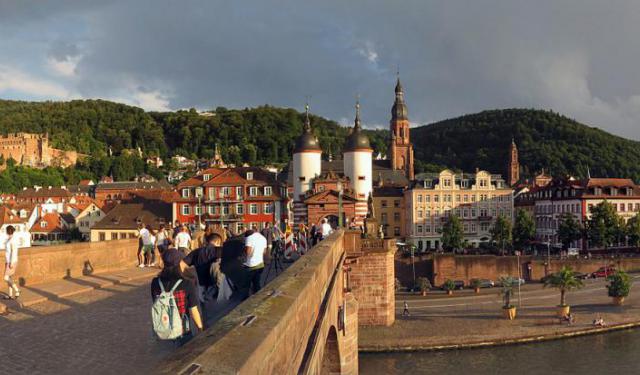
During his European travels, American writer Mark Twain compared Heidelberg after dark to a Milky Way that had fallen to earth.
Heidelberg occupies a narrow site on the Neckar River, where the wooded Odenwald hills meet the Rhine Plain. Now Baden-Württemberg’s fifth-largest city, it has approximately 160,000 residents, around one-quarter of whom are students.
Human settlement in the... view more
Tour Duration: 2 Hour(s)
Travel Distance: 2.0 Km or 1.2 Miles
Heidelberg occupies a narrow site on the Neckar River, where the wooded Odenwald hills meet the Rhine Plain. Now Baden-Württemberg’s fifth-largest city, it has approximately 160,000 residents, around one-quarter of whom are students.
Human settlement in the... view more
Tour Duration: 2 Hour(s)
Travel Distance: 2.0 Km or 1.2 Miles