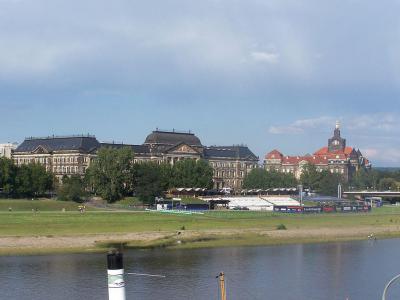


Neustadt Elbufer (Neustadt Bank of the Elbe), Dresden
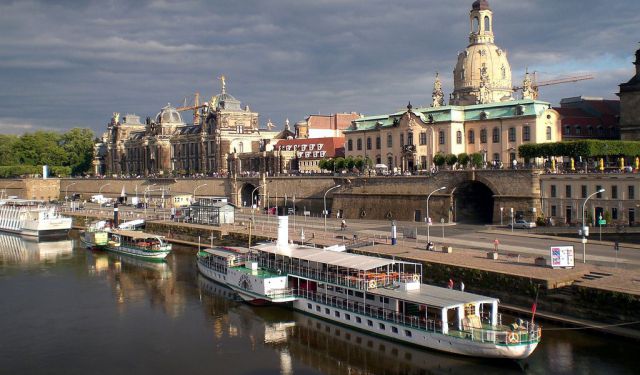
The Neustadt Bank of the Elbe (Neustadt Elbufer) in Dresden, is a meticulously designed embankment stretch between Rosengarten and Marienbrücke, prominently featuring the Königsbank (Königsufer). This area spans the riverside stretch between significant buildings like the State Chancellery and the Ministry of Finance, and the term often represents the entirety of the Neustadt bank of the Elbe.
Historically, the Neustadt Bank of the Elbe has undergone extensive transformations, particularly after the severe damage it sustained during the air raids of February 1945. Key buildings such as the Ministry of Finance and the Japanese Palace were rebuilt, while others, like the Municipal Collections housed within the Körner Museum, were demolished to make way for new constructions including the Hotel Bellevue.
Noteworthy features along the embankment include various architectural and sculptural elements that reflect the area’s rich historical tapestry. Among these are the Carillon Pavilion, reconstructed after WWII, and significant sculptural works like Ernst Moritz Geyger's "Archer," Christine Heitmann's "Standing Boy," and numerous reliefs and sculptures that depict scenes and figures from local history.
The Neustadt Bank of the Elbe also features gardens adorned with artistic works, like the cherubs in the rose garden representing the four seasons, and the sandstone sculpture "Große Kniende" by Otto Rost at the garden's termination point. Modern additions include Steffen Bachmann's "animal" sculpture, enhancing the cultural landscape.
Moreover, the area is dotted with plaques and memorials that commemorate influential figures and historical events, enriching the cultural experience for visitors and underscoring the historical significance of the location. Sculptures and reliefs along the hotel walls, including those by Gerd Jaeger and Wolf-Eike Kuntsche, further emphasize the artistic and historical narrative of the embankment.
Historically, the Neustadt Bank of the Elbe has undergone extensive transformations, particularly after the severe damage it sustained during the air raids of February 1945. Key buildings such as the Ministry of Finance and the Japanese Palace were rebuilt, while others, like the Municipal Collections housed within the Körner Museum, were demolished to make way for new constructions including the Hotel Bellevue.
Noteworthy features along the embankment include various architectural and sculptural elements that reflect the area’s rich historical tapestry. Among these are the Carillon Pavilion, reconstructed after WWII, and significant sculptural works like Ernst Moritz Geyger's "Archer," Christine Heitmann's "Standing Boy," and numerous reliefs and sculptures that depict scenes and figures from local history.
The Neustadt Bank of the Elbe also features gardens adorned with artistic works, like the cherubs in the rose garden representing the four seasons, and the sandstone sculpture "Große Kniende" by Otto Rost at the garden's termination point. Modern additions include Steffen Bachmann's "animal" sculpture, enhancing the cultural landscape.
Moreover, the area is dotted with plaques and memorials that commemorate influential figures and historical events, enriching the cultural experience for visitors and underscoring the historical significance of the location. Sculptures and reliefs along the hotel walls, including those by Gerd Jaeger and Wolf-Eike Kuntsche, further emphasize the artistic and historical narrative of the embankment.
Want to visit this sight? Check out these Self-Guided Walking Tours in Dresden. Alternatively, you can download the mobile app "GPSmyCity: Walks in 1K+ Cities" from Apple App Store or Google Play Store. The app turns your mobile device to a personal tour guide and it works offline, so no data plan is needed when traveling abroad.
Download The GPSmyCity App



Neustadt Elbufer (Neustadt Bank of the Elbe) on Map
Sight Name: Neustadt Elbufer (Neustadt Bank of the Elbe)
Sight Location: Dresden, Germany (See walking tours in Dresden)
Sight Type: Attraction/Landmark
Sight Location: Dresden, Germany (See walking tours in Dresden)
Sight Type: Attraction/Landmark
Nearby Sights
Walking Tours in Dresden, Germany

Create Your Own Walk in Dresden
Creating your own self-guided walk in Dresden is easy and fun. Choose the city attractions that you want to see and a walk route map will be created just for you. You can even set your hotel as the start point of the walk.
A Walk Through Dresden's Historic Old Town
Dresden’s reputation as a city of art and architecture has earned it the nickname “Florence on the Elbe.”
Dresden, the capital of Saxony, lies on the banks of the River Elbe in eastern Germany. The area may have been settled by Neolithic communities as early as 7500 BC, but Dresden’s documented history begins much later. The city developed within the Margraviate of Meissen, a territory... view more
Tour Duration: 2 Hours
Travel Distance: 2.5 Km or 1.6 Miles
Dresden, the capital of Saxony, lies on the banks of the River Elbe in eastern Germany. The area may have been settled by Neolithic communities as early as 7500 BC, but Dresden’s documented history begins much later. The city developed within the Margraviate of Meissen, a territory... view more
Tour Duration: 2 Hours
Travel Distance: 2.5 Km or 1.6 Miles
Exploring Dresden New Town on Foot
Dresden’s New Town occupies the northern bank of the Elbe, directly opposite the historic Old Town. Despite its name, it is far from new. The area was settled in the Middle Ages and was historically known as Old Dresden. It was incorporated into Dresden in 1549 under Elector Moritz but remained a relatively modest settlement for centuries compared with the more prestigious city on the opposite... view more
Tour Duration: 1 Hour
Travel Distance: 2.2 Km or 1.4 Miles
Tour Duration: 1 Hour
Travel Distance: 2.2 Km or 1.4 Miles
Dresden's Architectural Jewels
If there is one thing Dresden is particularly famous for, it is the magnificent architecture. Although known primarily for its Baroque buildings, the city has several other architectural styles present too, such as Renaissance, Historicism, Modernism and Post-modernism.
Much of downtown Dresden was destroyed in February 1945 by Allied bombing, which in turn prompted the rebuilding of the... view more
Tour Duration: 1 Hour
Travel Distance: 1.9 Km or 1.2 Miles
Much of downtown Dresden was destroyed in February 1945 by Allied bombing, which in turn prompted the rebuilding of the... view more
Tour Duration: 1 Hour
Travel Distance: 1.9 Km or 1.2 Miles