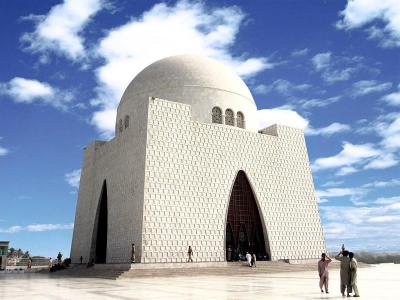


Quaid-e-Azam Mausoleum, Karachi (must see)
Quaid-e-Azam Mausoleum, commonly known as Mazar-e-Quaid, is the final resting place of Muhammad Ali Jinnah, the founder of Pakistan. The wider complex also contains the graves of his sister Fatima Jinnah, Pakistan’s first Prime Minister Liaquat Ali Khan, Ra’ana Liaquat Ali Khan, Sardar Abdur Rab Nishtar, and former Prime Minister Nurul Amin. Construction began in 1960 according to a design by architect Yahya C. Merchant. The building was completed on 2 June 1970 and formally opened to the public on 15 January 1971.
The mausoleum combines traditional Muslim architectural forms with modern design. Its square, elevated structure is clad in white marble and crowned by a large reinforced-concrete dome. Curved entrances, copper and silver screens, geometric forms, and green onyx details decorate the main chamber. Jinnah’s actual grave is located in the basement, while a marble replica stands in the chamber above it. A large chandelier hangs beneath the dome; the present chandelier was provided by China in 2016 as a replacement for the earlier Chinese gift installed around the time the mausoleum opened. The monument is surrounded by Bagh-e-Quaid-i-Azam, a landscaped garden with terraces, fountains, water channels, lawns, walkways, and thousands of trees. The garden was formally opened in December 2000.
The mausoleum serves as a national memorial and a setting for official ceremonies, particularly on Independence Day, Pakistan Day, Jinnah’s birthday, and the anniversary of his death. Ceremonial guard-changing events are held on important national occasions. An exhibition hall within the complex displays Jinnah’s personal possessions, including clothing, furniture, documents, books, crockery, sporting equipment, gifts, and two cars, while an audiovisual hall presents material about his life and the Pakistan Movement.
The mausoleum combines traditional Muslim architectural forms with modern design. Its square, elevated structure is clad in white marble and crowned by a large reinforced-concrete dome. Curved entrances, copper and silver screens, geometric forms, and green onyx details decorate the main chamber. Jinnah’s actual grave is located in the basement, while a marble replica stands in the chamber above it. A large chandelier hangs beneath the dome; the present chandelier was provided by China in 2016 as a replacement for the earlier Chinese gift installed around the time the mausoleum opened. The monument is surrounded by Bagh-e-Quaid-i-Azam, a landscaped garden with terraces, fountains, water channels, lawns, walkways, and thousands of trees. The garden was formally opened in December 2000.
The mausoleum serves as a national memorial and a setting for official ceremonies, particularly on Independence Day, Pakistan Day, Jinnah’s birthday, and the anniversary of his death. Ceremonial guard-changing events are held on important national occasions. An exhibition hall within the complex displays Jinnah’s personal possessions, including clothing, furniture, documents, books, crockery, sporting equipment, gifts, and two cars, while an audiovisual hall presents material about his life and the Pakistan Movement.
Want to visit this sight? Check out these Self-Guided Walking Tours in Karachi. Alternatively, you can download the mobile app "GPSmyCity: Walks in 1K+ Cities" from Apple App Store or Google Play Store. The app turns your mobile device to a personal tour guide and it works offline, so no data plan is needed when traveling abroad.
Download The GPSmyCity App



Quaid-e-Azam Mausoleum on Map
Sight Name: Quaid-e-Azam Mausoleum
Sight Location: Karachi, Pakistan (See walking tours in Karachi)
Sight Type: Attraction/Landmark
Sight Location: Karachi, Pakistan (See walking tours in Karachi)
Sight Type: Attraction/Landmark
Nearby Sights




Walking Tours in Karachi, Pakistan

Create Your Own Walk in Karachi
Creating your own self-guided walk in Karachi is easy and fun. Choose the city attractions that you want to see and a walk route map will be created just for you. You can even set your hotel as the start point of the walk.
Karachi Downtown Walking Tour
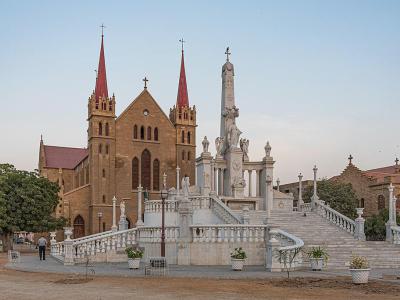
Karachi is a huge, vibrant metropolis, one of Pakistan's most secular and socially liberal. The city boasts abundant and diverse architecture, comprising both contemporary and traditional Pakistani-style buildings, such as the Merewether Clock Tower and the National Museum of Pakistan. To explore these and other prominent sites of Karachi, follow this orientation walk.
Tour Duration: 3 Hour(s)
Travel Distance: 6.0 Km or 3.7 Miles
Tour Duration: 3 Hour(s)
Travel Distance: 6.0 Km or 3.7 Miles

Karachi's Architectural Jewels
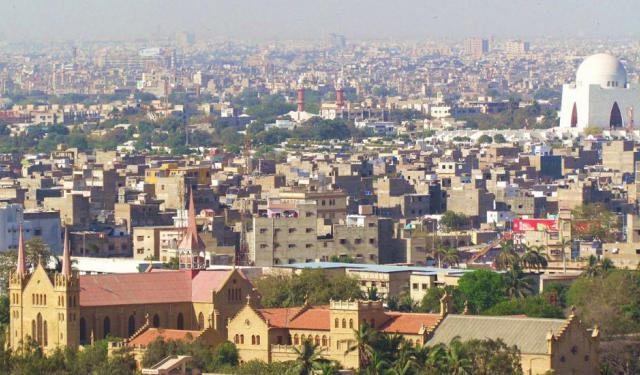
Despite the vague buildings throughout the city, Karachi is actually a region with a special cultural life. Karachi contains several sites which deserve the attention of tourists and local culture-loving habitants.
Tour Duration: 2 Hour(s)
Travel Distance: 3.6 Km or 2.2 Miles
Tour Duration: 2 Hour(s)
Travel Distance: 3.6 Km or 2.2 Miles
Shopping in Saddar
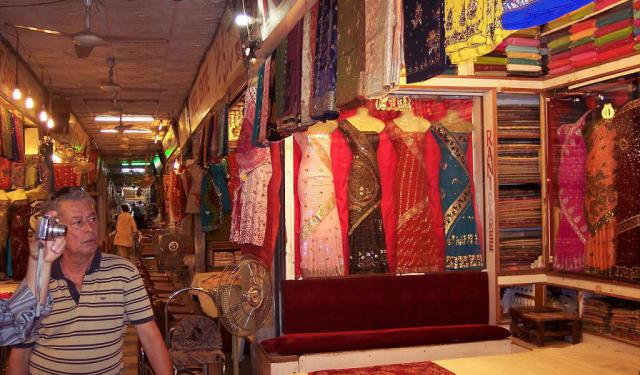
Karachi is city with a variety of shopping locations, yet its true charm lies in the bazaars (marketplaces). Karachi's most populated shopping area is Saddar. Saddar contains a large number of diverse markets and shops where people can find anything.
Tour Duration: 1 Hour(s)
Travel Distance: 1.7 Km or 1.1 Miles
Tour Duration: 1 Hour(s)
Travel Distance: 1.7 Km or 1.1 Miles